From Pingyao to the Ancient Capital of Thirteen Dynasties
I'm not sure when it started, but even my mom knows that every long trip I take signals the end of a job. I used to travel only after quitting, not knowing what else to do, but now I plan trips even before resigning. 2020 brought the special 'product' COVID-19, which thwarted my plan from last year to see cherry blossoms in eastern China this year. I was sad at the time, but what could I do? Plans can't keep up with changes. After the bloom passed, I felt less disappointed, but it also delayed my resignation by half a year. During those months, I actually considered going to Beijing or Hulunbuir, but then the Xinfadi outbreak in Beijing made me too scared to go.
I never thought about visiting Shanxi or Shaanxi; I always imagined them as dry, barren places with scant greenery and severe sandstorms. A couple of years ago, a classmate tried to drag me there, but I stubbornly talked them into going to Lushan instead. That was something!
This time, maybe because I saw a social media post saying Shanxi's 4A scenic spots were free this year, and then autumn arrived along with last year's memories of a post about the red leaves of Liping. When these factors came together, I checked flight tickets—they were cheap—so I persuaded a friend to join me in experiencing the northern scenery. Round-trip flights were less than 1,000 yuan per person. Anyway, enough rambling. Let's get to the point!
This was my first time in northern China and my first trip out of the province since the new year (I had hiked outside the city the week before). Everything—the high-speed train, subway, flights—felt strange. I wore a mask the whole time, had my temperature checked, and scanned QR codes everywhere (for most places, I could just show my local health code, but in Xi'an I had to scan the local travel and health codes).
I arrived at Taiyuan airport late at night and, as per international habit, found a nearby hotel with shuttle service. Stepping out of the airport, I went straight from 30°C to 4°C—unspeakably cold for a kid from Guangdong. October 20, 2020.
I had planned to sleep until the end of time, but at 8 or 9 a.m. I was woken up by people outside rushing to catch their schedules. Too annoyed to sleep, I just couldn't fall back asleep. I dawdled until noon before heading to Taiyuan South Railway Station for the high-speed train to Pingyao. I spent only 12 hours in Taiyuan altogether. Given my love for Jiangnan-style scenery, I probably won't get another chance to visit Taiyuan.
The hotel displayed a sign from the neighboring province; when I posted the photo on social media, everyone thought I was in Chang'an. My friend is the restless type; at any transit, waiting for a bus or plane, she'll wander the streets. In that freezing weather, she actually bought an ice pop—isn't that crazy?
High-speed trains are so convenient. The Taiyuan-Pingyao trip was fast. Along the way, I saw the dry, scrubby vegetation typical of the north, exactly as I'd imagined—quite novel for a first-timer. I booked a guesthouse in Pingyao Ancient City in advance and called the owner, who said they'd pick us up and drop us off for free in the off-season. Am I the luckiest person alive or what?
I noticed the owner's car had these things that looked like Tibetan prayer items, and the trees outside were just turning yellow—beautiful.
The owner was a local resident, but even his car couldn't enter the ancient city. We entered through the North Gate, showing the reservation QR code from the Pingyao Ancient City WeChat account and our health codes. It happened that the northeast corner of the city was under renovation, so dust swirled through the already dry streets. Our guesthouse was in that area too, and the sewage smell from the drains was awful.
Is this the guesthouse sign? So cute, you can pet it all you want. I originally wanted to try a traditional northern kang bed, but the rooms with kang beds here were decorated with bright red flower quilts that felt oppressive. I chose this place because it's close to the North Gate, so we didn't have to drag luggage far, and the room decor was very artsy.
Since it's inside the ancient city, the courtyards have a heavy historical feel. The owner gave each room a map and briefly explained how to explore the city. We listened, but we just ended up wandering wherever.
We didn't go to North Street because it was under renovation. We walked to the central area and started along East Street. The farther we went toward the city wall, the more desolate it became.
On a street in the southeast corner, there was a Catholic church, seemingly abandoned and locked. The area had a strong local life vibe.
Eventually we made our way back near the South Gate, walking along the wall until we reached the gate. Sadly, it was past 6:30 p.m., and we could no longer climb the wall. Then we walked along South Street (also called Ming-Qing Ancient Street, full of restaurants) back to the center and also explored West Street. The county yamen is on West Street, which had plenty of local snacks. We ate as we walked and ended up full.
We stumbled upon the Pingyao snack street near the West Gate, but we were already full. We planned to come back the next day if we could.
October 21, 2020
After a quick breakfast of dry rations at the guesthouse, we headed straight to the South Gate to climb the wall.
To reach the South Gate, you have to pass the Market Tower on South Street. Nearby, there are many courtyard museums to visit, most quite similar. We picked a few representative ones like Rishengchang, Weishengchang, and the county yamen.
To climb the wall, you couldn't use the WeChat reservation code; you had to scan a code on site. It was quite crowded.
View of South Street from the wall.
From the South Gate, I saw the gate-within-a-gate. Flocks of birds were flying overhead, but I didn't catch them on camera.
You couldn't walk the entire wall; it was sealed off not far in either direction. I had hoped to walk from the South Gate to the West Gate, but they made everyone exit via Yunlu Old Street from the South Gate. Yunlu Old Street has bars and souvenir shops. At the end, you find the China Imperial Examination Museum; the day before, we'd seen many students coming out from there, though we didn't know why.
After descending, we strolled toward the county yamen.
My favorite part is peeking at the back gardens.
The stage: the sunlight was perfect when I took the photo.
These wall-climbing plants are pretty.
The prison also has kang beds; I learned something new.
Every household had a horse cart.
After visiting a few courtyard houses, we finally had a proper brunch at Jifu Lane. The day before, I had tried knife-cut noodles, which weren't my thing. This time I found a place with southern-style mixed-grain rice noodles. Once I ate it, I knew: I really have a Cantonese stomach.
It was time to leave. The owner drove us to the high-speed train station again.
Pingyao Station is a regular train station near the ancient city, while Pingyao Ancient City Station is the high-speed rail station, a bit further away.
Before every trip, I dare not cut my nails; they'll definitely break. If I leave them a bit long, I can file them if they break.
As they say, first time strange, second time familiar. Compared to yesterday when I only saw northern crops, today I got a vivid view of the soil erosion landscape typical of the Loess Plateau.
Linfen was our stopover and transfer point for getting to Hukou Waterfall the next day. We ended up staying right next to the Public Security Bureau—talk about feeling extra safe!
In the evening, we still went out to find food. We went to Wei's Liangpi but ended up ordering rice and rice noodles—go figure. Night view of the Drum Tower. Since Pingyao's high-speed rail station, I'd heard the sound of someone cracking a whip, and here in Linfen at the Drum Tower it was even louder.
Tonight was a bit rough. My friend complained about a smell in the room, so we opened the window for fresh air and got chilled. Now she's shivering with a runny nose. I'm worried it'll get worse tomorrow. What should I do?
October 22, 2020
Linfen West Station seemed to have a direct bus to Hukou Waterfall, but departures were infrequent. To also explore downtown Linfen a bit, we signed up for a one-day group tour for 88 yuan round trip. The timing worked perfectly: we'd get back to the station in time for the last high-speed train to Hanzhong.
Along the way, there were many persimmon trees, just like the landscaping mango trees we see back home. P.S. Today my cold still hadn't gone away.
The Drum Tower isn't as pretty during the day as at night. We waited for the bus in the chilly morning wind, heading toward Hukou.
Along the way, we saw the colorful autumn scenery. The sun was strong today. Sitting on the sunny side of the bus, I got so hot near the end I started sweating and quickly changed into a lighter jacket. Surprisingly, the sun even cured my cold.
Even the driver relied on navigation, but he missed the highway exit and ended up dropping us off on the Shaanxi side. Luckily, it wasn't the Shaanxi Hukou Waterfall scenic area. (There's a Shaanxi viewing spot in Yichuan, where you look up at the Yellow River from below to feel 'water rushing down from heaven,' while on the Shanxi side in Jixian, you look down from above to see 'a thousand miles of Yellow River collected in a pot.') The bus couldn't cross the bridge, so we walked across the Yellow River back to the Shanxi side.
This is the Shaanxi boundary sign taken from the bridge:
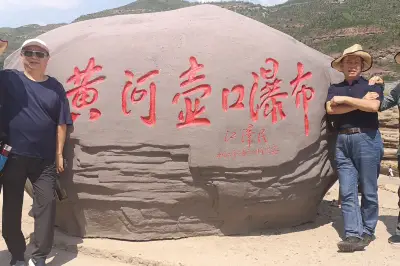
From the bridge, you could see the little island in the river where ancient people viewed Hukou Waterfall. It's said the waterfall has been receding upstream; now it's 3 kilometers from the original viewing spot. After crossing the bridge and walking a short distance, we had to pay 20 yuan for a shuttle bus to the scenic area. Finally, we reached the ticket check. This year, you could scan a QR code at the gate for a free reservation to enter. Once inside, you couldn't sense where the waterfall was at all, until the guide pointed out: where all the people are, that's the waterfall.
Later, I noticed this photo captured the words 'Yellow River Cantata' on the opposite bank.
A few days before, the official account had announced the scenic area was closed because heavy rain had flooded the bridge leading to the waterfall.
Many people lingered by the bridge to photograph the rushing water. Across the bridge, there were many donkey handlers charging tourists for photos. The donkeys were decked out with props, including the big red flower I dislike. They wanted you to wear it for photos, which isn't my style. I just looked at the donkeys.
A tip: when visiting the waterfall, wear a waterproof jacket or buy a raincoat. Otherwise, you'll be soaked from head to toe in water mixed with fine sand.
This is the view from the upper part of the waterfall; I feel the photo can't capture the live impact.
There wasn't much splash on the upper side, but downstream the spray was so heavy it felt like rain. Maybe because it was morning, I managed to capture a rainbow downstream. But chasing that rainbow got my clothes wet; luckily, my jacket was waterproof. My friend asked if I was wearing a raincoat. I touched the water—it was gritty with fine silt.
I'd read in others' travelogues that Dragon Cave was accessible, but today it seemed closed.
The scenic area basically ends after you see the waterfall. With plenty of time before departure, I went back for another look at the seething waterfall—just to feel that even on a workday it's packed.
Following last year's motion sickness on Mount Huangshan, I now add Hukou Waterfall to my list. To distract myself, I tried posing for some photos, but the background wasn't great beyond the waterfall. Luckily, a helicopter that kept circling overhead happened to fly into the frame.
Once my clothes dried, it was time to leave. But you can't just walk out; you have to go through the classic scenic-area trick: a local specialty market. Lots of apples—supposedly they've won gold awards. But I'm not a big apple fan, so I hurried through and left.
After a two-hour drive back to Linfen West Station, we took the high-speed train straight through the Qinling Mountains back south. Around 5 p.m., the sun was about to set.
By the time we arrived in Hanzhong, it was pitch dark.
I booked a hotel next to the high-speed rail station, again with that fresh, cute style. The key advantage was that the long-distance bus station was right there, making it convenient to get anywhere.
October 23, 2020
Staying two days in Hanzhong. Even though I didn't have to pack up today, the bus to Liping left very early. I got up early, grabbed a quick bite near the hotel, and rushed to the main bus station. I made it just in time, jumping on as the bus pulled out.
A note: now we're in Shaanxi, no free tickets here. Luckily, Liping was having a half-price promotion—77 yuan including the scenic shuttle. Round-trip bus fare from Hanzhong to Liping was 68 yuan. We bought a combo on Ctrip: admission + shuttle + round-trip transport for 145 yuan. The price was the same, but it saved us the hassle of buying separately.
The small farmhouses along the road, plus the early morning mist, were like a fairyland.
There's no highway from Hanzhong to Liping; it was two hours of winding mountain roads. Even though I usually don't get carsick, I felt really nauseous—on par with that trip to Lushan.
As the saying goes, the road to success is paved with difficulties. Just before reaching Liping, we smelled something like burning metal; the axle was overheating and steamed when water was poured on it. The driver dealt with the problem while we got off for some fresh air. The scenery was great, but we were afraid of being stranded. Fortunately, the bus started moving again.
At that time, only four scenic spots were open in Liping, and they were far apart. The shuttle bus was essential. The staff said: hop on whenever a bus comes, get off when it stops, and explore. The first spot was called Jade Belt River, I think—a typical forest park scene with mountains, trees, and water.
The second spot was Maple Forest Waterfall, the autumn highlight. I came to Liping just for this view. But to cross a glass bridge, you had to pay an extra 10 yuan on the spot. My friend refused, so we got back on the shuttle to the third spot, China Dragon Mountain. The staff said the bus wouldn't return. At that time, I didn't realize the waterfall view I wanted was there; if I had known, I would have dragged her there no matter what.
I didn't really see the dragon shape, but hiking up the mountain was the thing to do. I took some photos copying what I'd seen online.
Across from China Dragon Mountain was Submarine Stone City, but it wasn't open then.
The fourth spot was Red Dust Gorge, which seemed connected to Heavenly Book Cliff. Here I finally saw a few scattered red leaves.
The main purpose of this trip, the autumn leaf journey, was a bust. The few leaves here were the best I got.
I had researched the best viewing periods online before the trip, but since I didn't make it to the maple forest area, I can't say for sure. Still, the leaves weren't red enough; some were just turning yellow. I felt a little disappointed. Maybe a trip always needs a bit of regret to be perfect!
I had seen Liping's official account mention hot air balloon rides on weekends. Well, today was Friday, and there was not a trace.
On our way back, we discovered there were plenty of food places near the high-speed rail station, so we roamed the streets.
October 24, 2020
Another early start today. The earliest bus to Liuba was at 7:20, costing 26.5 yuan. Fortunately, there's a highway, so it's only an hour. The second bus to the Liuhou scenic area was at 9:20, giving us an hour. We explored Old Street behind the station, feeling like country bumpkins fascinated by everything.
Every household had these things hanging up that looked like kettles; I had no idea what they were for.
I also saw chimneys like this.
The old street had so much character; if time allowed, I would have stayed overnight.
Ginkgo leaves were everywhere, something hard to see in Guangdong. What I saw, I loved.
The old street wasn't long; half an hour was enough. Back at the station, the staff said the next bus was about to leave—a seamless connection. Perfect.
To get to Zhang Liang Temple, you take the Liuba No.1 bus from inside the station. No ticket needed; you pay 5 yuan when boarding (I heard from a passenger it used to be 3 yuan).
Those buildings would be fine as residences, but as a bus station they had a retro 90s vibe.
This was the bus to Zhang Liang Temple.
The scenery along the way was refreshing. As a kid from Guangdong, I yearned to see red and yellow leaves—here they were practically falling everywhere.
The ride was about an hour. It felt like a village service; there were no stop signs. You just told the driver where you wanted to get off.
For Zhang Liang Temple, we simply rode to the last stop. I had read that the second-to-last stop was for Liuhou Ancient Town, but we skipped it due to time.
Zhang Liang Temple cost 50 yuan, a bit pricey. I decided to come here because of a famous ginkgo tree, but after searching for a long time, I realized it wasn't inside the temple. So disappointing!
I started wandering aimlessly. While lingering, I overheard many tour guides explaining things.
When I'd heard enough, I picked a path up the mountain. Halfway, there was a thatched pavilion; further up, a 'Book-Granting Pavilion.' Looking down from there was like a 360-degree oil painting—unbelievable!
Coming down, I took a different path that led straight into a courtyard with a pond. In the pond stood a 'Grain-Abstinence Pavilion,' and the view from the second floor was a feast for the eyes.
Zhang Liang Temple satisfied all my autumn cravings, wiping away yesterday's regret at Liping.
There was also a 'bent bamboo grove'—the stalks really were bent. Too bad some people with poor manners had carved 'Sun Wukong was here' style graffiti on them. I finally found one undamaged stalk.
After we'd had our fill, we strolled nearby and saw people going up to a archway in the middle of the road. We went up for a distant view. The green canopy was the Zhang Liang Temple sign, under renovation. The pavilion in the distance was the one I'd been to. Then I spotted the ginkgo tree I'd been longing for—it was next door at Zhang Liang Villa.
Zhang Liang Villa had turned into a paid parking lot, but we walked in as if no one was there. We took photos of the huge ginkgo tree from every angle, with Zhang Liang Temple visible just beyond the wall.
I discovered that fallen ginkgo nuts smell awful. The villa had quilts airing out, but it looked run-down. Does anyone live there?
Just before 1 p.m., we waited by the road for the bus back. The fare from Liuba to Hanzhong was 25 yuan, I don't know why it was 1.5 yuan cheaper than the outbound trip.
After two days in the south, it was nonstop back north. Ancient capital of thirteen dynasties, here I come.
I contacted a friend in Xi'an to meet tomorrow. She suggested visiting Guanyin Temple to see the ginkgo tree planted by Emperor Taizong Li Shimin. Too bad it required a reservation, and we couldn't get one. I'd actually looked it up before, but I gave up because it was far and inconvenient to reach. Later, my friend got busy and we never actually met.
Arriving at Chang'an city, it was dark again. Thought I'd drop off luggage and find food near Big Wild Goose Pagoda. But my sense of direction failed me; I got lost in the Bell Tower underpass, mistaking an exit for the subway entrance. Ended up eating at McDonald's in Times Square.
I stumbled upon a live concert; the stairs were almost packed with people sitting.
After squeezing onto the subway to Big Wild Goose Pagoda, I caught the last musical fountain show of the night.
But there was a sea of people; no good spots left. After the fountain show, I walked around the pagoda to the south square's Grand Tang Dynasty Ever-Bright City.
The south square had cinemas, bookstores, theaters, and more. Unfortunately, I walked the whole length without seeing the 'tumbler lady.' I could only marvel at how prosperous Chang'an was, with so many visitors.
Big Wild Goose Pagoda was built to house the Buddha statues, relics, and scriptures that Xuanzang brought back from India, so the square had various statues of him.
But a word of caution for those with poor stamina: don't wander from the north square to the south square if you can help it. It's really tiring!
Sweet dreams tonight!
October 25, 2020
Today we went to the Muslim Quarter near the Drum Tower to try street food. I had mirror cake, rose-flavored—not bad. Here you see lots of Hui people.
Very impressive dried corn.
Bread bigger than a pot.
Pastry shaped like a calligraphy brush—I didn't try it.
After a quick walk, we went up the city wall.
Wall admission was 54 yuan, bike rental 45 yuan for 3 hours with a 100 yuan deposit. We entered at Yongning Gate (South Gate).
Impressive sense of grandeur.
Once on the wall, I completely lost my sense of direction. We planned to walk to the East Gate and visit Yongqing Fang, but we kept looping around Yongning Gate. Finally, we decided to rent bikes and ride there.
I never expected riding on the wall to be so exhausting. Later I realized: why didn't we just take the tram to the East Gate? One stop was only 20 yuan. Am I dumb or what?
No choice; the path I chose, I had to ride it through tears. Zhongshan Gate below leads to Yongqing Fang, but there was no bike return there; we had to go to Changle Gate (East Gate). We rode for two hours—exhausted.
Finally, we saw Yongqing Fang—it was already dark.
A photo at the Changle Gate exit. The exit sign said if you want to re-enter the wall later, just scan your ID when leaving.
Yongqing Fang, with all those lanterns, had a vibe like 'The Longest Day in Chang'an.'
I saw an internet celebrity livestreaming on the street.
The viral 'smash-the-bowl wine'.
Our Qin-Jin journey is coming to an end. Tomorrow it's back to Guangdong. Farewell, Chang'an.
Roughly calculated the trip costs:
Guangzhou–Taiyuan flight: 390
Xi'an–Guangzhou flight: 525
Taiyuan West Bank Hotel 1 day: 99 / 2 people
Pingyao Sheraton Inn 1 day: 141 / 2 people
Linfen accommodation 1 day: 138 / 2 people
Hanzhong Home Inn 2 days: 189.2 / 2 people
Xi'an accommodation 1 day: 137 / 2 people
Xi'an airport guesthouse: 128 / 2 people
Home–Guangzhou airport: 35 × 2 = 70
Taiyuan South–Pingyao high-speed train: 28.5
Pingyao Station–Linfen West high-speed train: 43
Linfen–Hukou Waterfall round trip: 88
Hukou Waterfall shuttle bus: 20
Linfen West–Hanzhong high-speed train: 204
Liping admission + shuttle + round-trip transport: 145
Hanzhong–Liuba bus station round trip: 26.5 + 25 = 51.5
Liuba–Zhang Liang Temple (Liuba No.1 bus) round trip: 10
Hanzhong–Xi'an North high-speed train: 97
Xi'an city wall admission: 54 + bike rental (100 deposit) 45 / 3 hours
Meals and other expenses: 330.2
Total approximately: 2600, nearly 1000 less than my budget! Hehehe!
For this trip, flights, accommodations, the Liping combo, and the Hanzhong-Liuba round-trip bus tickets were all bought on Ctrip. High-speed train tickets were on 12306. The Hukou Waterfall day tour was booked locally. Other tickets that I couldn't find online were bought on site.
I'm writing this down as a keepsake and for future travelers' reference. Hehe!