A Thousand-Mile Rendezvous: Overnight from Beijing to Xi’an, a Trip on a Whim
Every inch of Xi’an, whether grand avenues or narrow lanes, is imbued with its profound heritage—the scholarly legacy of the Tang Dynasty’s golden age and the lingering romantic charm of old Chang’an.
No matter how many times you visit Xi’an, it’s never enough. Touch the 600-year-old city wall, watch it in the daytime as if armored warriors surge forward, and at night, it seems draped in the flowing sleeves of celestial dancers.
This trip, three days and two nights, I came to see today’s Xi’an and feel yesterday’s Chang’an.
This Xi’an trip was a weekend plus one day off work. We chose a weekend because, besides that Xi’an is reachable from Beijing by overnight train, leaving two full days for fun, there’s another very, very important reason: Xi’an is way too crowded during holidays! On this ordinary weekend in November, we already encountered massive crowds at the Terracotta Warriors and Shaanxi History Museum; I can’t imagine the spectacular chaos of a public holiday.
Emperor Qinshihuang’s Mausoleum Museum (Terracotta Warriors)
Before, I saw that viral online post ‘Xi’an is a really fun city, the sights and the scammers are both fun,’ and only then did I learn that some people even dig their own pits to fake the Terracotta Warriors! Shocked, I reminded myself to stay sharp on this Xi’an trip.
Xi’an Bell Tower Sende Hotel
Mr. Duo and I sifted through many hotels and finally chose this one, probably the best overall value. The location is excellent: it’s right in the very center of Xi’an, because the Bell Tower is the center, and the hotel lies just east of it. The subway exit is at the hotel doorstep, making it convenient to go anywhere. The surroundings are all commercial streets, and it’s only a five-minute walk to the Muslim Quarter—couldn’t be more convenient.
At check-in, the receptionists were very warm—all young ladies dressed in traditional Hanfu, very pretty. They brought us lemonade and coffee, and we chatted with them about our itinerary. Since we already had a plan, we used the chance to enrich it. The hotel staff were extremely thoughtful: they took our heavy luggage, and after the room was ready, delivered it to us—so considerate & many thanks~
The hotel felt upscale, and the room had smart controls. I absolutely loved the ‘Sende’ assistant—‘Hi Sende, play music,’ ‘Hi Sende, turn on the light,’ ‘Hi Sende, turn off the light,’ ‘Hi Sende…’ We had so much fun!
We stayed in a Bell Tower view room. It was very comfortable and the service was great. The room’s facilities were clean and tidy, the soundproofing was good, and the curtains provided excellent privacy. The blanket smelled of sunshine—surely freshly sun-dried.
The hotel itself is a protected cultural relic—so much historical depth!
After settling in, it was still early, so we headed to the Muslim Quarter to recharge~
Since the Bell Tower is very close to the Muslim Quarter, just a few minutes’ walk, it was fine to set out a bit later.
On the steps, many locals and tourists were resting and relaxing, very leisurely.
Not far away was the Muslim Quarter, and it was su!per! crowded! Although everyone says the food there is just to cheat tourists and tastes mediocre, since it was our first time in Xi’an, we still wanted to experience it.
Long queues formed at the internet-famous shops, but not being one for crowds, we just randomly picked one. Mr. Duo ordered yangrou paomo (crumbled flatbread in mutton stew), and I had liangpi with roujiamo (cold noodles and meat sandwich).
The roujiamo was beef, just okay; the yangrou paomo was quite tasty.
After eating, we started on pomegranate juice.
There were so many more snacks I wanted to try, but the things we ate earlier were too filling—there was no room left in my stomach, so disappointing.
We wanted to take a taxi to the ancient city wall, but the entrance to the Muslim Quarter was full of unlicensed cabs, and the taxis wouldn’t use the meter. Luckily, it wasn’t far, so we opted for the bus instead.
The Xi’an ancient city wall is the most complete surviving city wall in China. During the day, we drove through the tall gate towers several times, and each time it felt like passing through a time tunnel—so wondrous.
Standing on the wall, I couldn’t help but think of Liang Sicheng’s remark that Beijing’s old city wall could have served as a people’s park for playing cards and chess—showing how vast it was. Ma Weidu also said that Beijing’s wall could have carried several lanes of two-way traffic. Unfortunately, our generation never got to see it.
In the distance, the Bell Tower stood not far away. Xi’an is a magical city where tall buildings and ancient structures blend seamlessly. Though the old buildings are adorned with neon lights, it doesn’t feel out of place at all.
Looking up, I saw the full moon hanging right above the pavilion, and only then realized it was the sixteenth day of the lunar month. Uncultured as I am, I could only say ‘How nice.’ If it were an ancient poet, they would surely have recited…
Once again I cursed my lens for not being long enough. But though I lacked a telephoto lens, I had plenty of photo-editing apps on my phone! If it’s too small to shoot, just make it bigger with editing! No guts, no glory! The bigger the ambition, the bigger the moon! Tell me: is that awesome or what? Surprised? Amazed? You better believe it!
Back at the hotel at night, the Bell Tower was brilliantly lit up—absolutely beautiful.
The rooftop terrace of Sende Hotel is a great spot for night views, though my nighttime photos came out a bit blurry.
Slept soundly that night.
Breakfast was simple but not shabby at all—meat, eggs, veggies, and fruit, a well-balanced meal.
Off to the Terracotta Warriors Museum!
From the entrance to the museum, there was a path lined with yellow autumn leaves—quite pretty, so the walk wasn’t boring, much better than Chaka Salt Lake (yeah, I’ll diss Chaka anytime, come at me).
We first visited Pit 1, the largest and most impressive.
Even on an ordinary weekend, visitors were packed in layers. I expected crowds at one of the Eight Wonders, but still didn’t anticipate this many. The guide said statutory holidays are even crazier—on October 3rd last year, they received nearly 120,000 visitors in a single day, with long queues on the square unable to enter the exhibition hall.
The guide said on weekdays, you might see staff restoring the warriors on site.
Except for important foreign dignitaries, ordinary people are not allowed down into the pits, so all those photos of people in the pits are… fake. In Pits 2 and 3, there are warrior replicas for photo ops at 10 yuan per person. I shooed Mr. Duo over to take two pictures—yes, literally ‘shooed’ him over.
Some famous warriors can be seen up close (if you can squeeze through the crowd). The guide explained the fine details of each figure, for example, this one: the tread pattern on the soles varies from front to back and the middle.
I loved the bronze chariot-shaped windows in the museum.
Lintong is known for pomegranates, and vendors selling juice were everywhere. I had a cup before the tour, and couldn’t resist another after.
The kitty in the mausoleum—I waited ages but it wouldn’t give me a front-facing shot.
It was already noon, and there were lots of eateries by the entrance. We grabbed a quick bite; the owner called it biangbiang noodles, but from what I’d seen, other biangbiang noodles didn’t have soup, so I’m not sure if it counts.
Even with the map, we couldn’t find the bus stop for line You 5. We saw a large bus—blue-ish green—and hopped on. Though the fare wasn’t much more expensive, it didn’t take the expressway and many people didn’t have seats, which was a bit annoying.
Honestly, I didn’t have high expectations for the Terracotta Warriors beforehand, but seeing them was truly awe-inspiring. To think that ancients over 2,000 years ago possessed such skill—national pride surged. Though I couldn’t help but sigh at Emperor Qin Shihuang’s ability to exhaust people and money.
In the afternoon, we returned to the hotel.
Yongning Gate is very close to the Drum Tower, so we headed out for another stroll.
Exiting this culturally infused area, you see the ancient wall; we only realized at night that this was the very South Gate (Yongning Gate).
Back at the hotel fairly late, we went to bed early.
Shaanxi History Museum
Morning! The white-haired granny suits the old houses around ‘home’ so well.
We asked the front desk where to find good hulatang (spicy soup) nearby, and finally got the bowl I’d been craving.
After eating, we rushed by taxi to the Shaanxi History Museum. Locals don’t call it the provincial museum or Shaanxi Museum, but ‘Li Bo’ (History Museum). Discovering this ‘secret’ made me feel so local.
It was only the day before that I remembered we hadn’t made a reservation, and by then it was fully booked. I’d thought we could queue for a while and get in, but when we arrived at the gate, I was shocked. The crowd—lines of three or four people side by side stretched over a hundred meters. When did everyone become such museum lovers?
Luckily, the hotel front desk had told us that buying a ticket for the special exhibition hall might allow direct entry without queuing. We asked, and indeed—great!
The museum is vast, built in imitation ancient style; we took a photo at the main hall.
Inside the lobby, we managed to snag the last available guide—couldn’t be luckier.
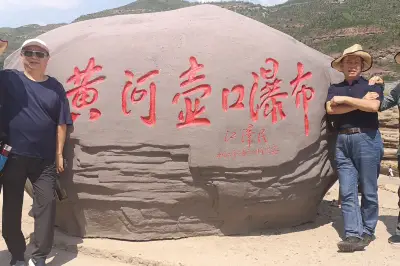
The preface in the lobby isn’t text but a relief of Hukou Waterfall. The stone lion in the center comes from the tomb of Wu Zetian’s mother at Shunling. The lion isn’t sitting or lying down, but walking; even more peculiar, the guide said the stone lion at Shunling isn’t part of a pair—there’s only this one.
We bought the Tang Dynasty Treasures exhibition ticket just for quick entry, but it completely exceeded expectations—superb. Especially because the upper three floors were extremely crowded, this underground exhibition had fewer people and a much better viewing experience.
In 1970, during construction, three not-so-large jars were accidentally unearthed. What stunned everyone was that these three containers held over a thousand gold, silver, agate, glass, and other vessels—how exactly they were all packed in remains unknown. The ‘Tang Dynasty Treasures’ hall exhibits just over 300 of them, each exquisitely crafted. Other mysteries: who left these treasures, and under what circumstances were they buried? Going through with these questions made it much more interesting than just casually viewing the artifacts.
Gold-rimmed Agate Cup with Beast Head – a national treasure, the museum’s crown jewel, one of the first batch of cultural relics forbidden for overseas exhibition – in short, it’s super impressive.
The form and color are exquisitely done. The shape uses the two horns as the cup handle, with finely carved eyes, ears, and mouth. The color skillfully employs the natural variegation of the jade; it’s said to be the only Tang-dynasty piece of jade carving that uses this technique known so far.
Gold Bowl with Mandarin Duck and Lotus Petal Pattern – national treasure, the museum’s crown jewel.
My photo makes it look ugly, but it’s actually super delicate. Both the inside and outside are carved with intricate, orderly, opulent patterns. It’s said Jiang Qing once liked it a lot and borrowed it to play with for a while. Inside the bowl are three small characters in Tang-era handwriting: ‘nine liang three.’ Many artifacts found in the three jars have weight markings. I cannot imagine who the owners of these treasures were, or why they were buried underground…
Plain gold basin. The ancients didn’t deceive us—there really is a gold basin for ‘washing your hands of something’!
Oops! I made that up; this basin was actually used to bathe newborn royal infants.
Silver incense pouch with grape, flower, and bird patterns. The outer wall is an openwork sphere of two hemispheres that can secure together; inside there are two concentric rings with two axes, connected respectively to the outer wall and the innermost hemispherical gold incense cup. This way, no matter how the outer sphere turns, the incense cup stays balanced… So ingenious that even after studying the explanatory diagram for ages, I still didn’t fully understand it but had to marvel.
In short, the over 300 exhibits in the ‘Tang Dynasty Treasures’ hall are all amazing, highly recommended!
Upstairs in the main galleries, the visiting experience wasn’t as good. Many exhibits had layers of people in front, making it hard to get close. I’ve forgotten the names of each hall, so I’ll just introduce a few favorites.
The ‘it’ dish, used in ancient times for holding water. At first glance it seemed unremarkable, but after the guide’s explanation, it left a deep impression.
The key lies in the four little figures supporting the tray; they depict slaves who had undergone the punishment of cutting off feet. After such punishment, they couldn’t do heavy labor and could only do jobs like kneeling to carry trays as shown.
Even now, thinking about it makes me shudder—so cruel.
Inside the museum, there are also some genuine terracotta warriors that you can view very closely. The photo wall behind them shows facial close-ups of some warriors, and you can see that each one truly has a different face!
Painted pottery figurines of a ceremonial procession—had a strong zombie vibe.
【Big Wild Goose Pagoda】vs【Small Wild Goose Pagoda】
Leaving the museum, we went to Daci’en Temple. It was the most famous and grandest Buddhist temple in Chang’an. After his pilgrimage to the Western Regions, Xuanzang became its first abbot, so its status in Buddhism is self-evident.
The sky was gray, but perhaps this grayness is just the temperament of Chang’an.
It has both confidence and depth; the pavilions and towers are stately but not ostentatious.
The temple’s fame extends overseas. Seeing foreigners burning incense was kind of cute. I wonder if foreign visitors at famous cathedrals look at us the same way.
The tall pagoda in Daci’en Temple is the Big Wild Goose Pagoda, said to have been personally supervised by Xuanzang to house the scriptures, statues, and relics he brought back from India.
There were quite a few monks in the temple; despite the many tourists, they didn’t overpower the atmosphere too much.
For 30 yuan, you can climb the pagoda. I love climbing high and looking far, but considering the surrounding modern buildings, there didn’t seem much to see, so I decided to climb the Small Wild Goose Pagoda in the afternoon instead. …As it turned out, it was closed for renovation—so bummed.
Exiting Daci’en Temple, nearby was a famous Xi’an restaurant, ‘Number One Noodles Under Heaven.’ A trending spot with no queue—how touching!
We ordered the signature ‘Number One Noodles Under Heaven’—a bowl of noodles that is just one long, unbroken piece. It comes with two sauces: seafood broth and saozi (meat sauce) broth. The saozi broth was decent; the seafood broth had no seafood and didn’t taste good…
Another dish we ordered was biangbiang noodles, strongly flavored but quite tasty.
Small Wild Goose Pagoda (Jianfu Temple)
After a simple lunch, we took a taxi to the Small Wild Goose Pagoda.
The entrance to the complex is the Xi’an Museum. After viewing the exhibits, we passed through a small gate and were transported to this quiet, ancient-feeling place. There were some noisy stalls selling bell-ringing prayers and red wishing ribbons, but looking back, the place just felt inexplicably pleasant. When I come to Xi’an again, the place I most want to revisit is the Small Wild Goose Pagoda park.
Strolling further, we saw a courtyard with a group of young men in bright red Hanfu, shooting arrows and taking photos. Wondering what event this was, we entered the room and found it was a Hanfu rental. Given the setting, I really wanted to rent an outfit too, but Mr. Duo frowned upon the idea, and plus they only had red ones, so I gave up.
Besides renting Hanfu, there were other cultural activities like calligraphy writing and archery—pretty good for kids.
When we got to the foot of the Small Wild Goose Pagoda, we found it under renovation and could not climb it—so unhappy. Guess I’ll have to do it next time.
Back at the hotel, we lazed on the comfy sofa for our last hour or so, then it was time to say goodbye, Xi’an!
These are memories to cherish. How could just one visit to a place like Xi’an ever be enough?