Morning Bells and Evening Drums: Memories of Chang’an – Experience the Charm of the Ancient Capital~
Xi’an is a historic ancient city, home to a wealth of historical and cultural sites. The Terracotta Warriors of Qin Shi Huang are immense and remarkably lifelike. The Shaanxi History Museum houses a rich collection that will reward a thorough visit with deep insights. Climb the Big Wild Goose Pagoda for panoramic views of the old city’s charm. Cycle a full loop on the ancient city wall and listen to the whispers of history’s rise and fall. At night, the Bell Tower and Drum Tower blaze with golden splendor, a truly magnificent sight. Catch a performance at Tang Paradise and feel as if you’ve traveled through time, dreaming back to the ancient capital.
The air here is thick with the scent of bygone legends and stories from the long river of history. Imagine the camel bells at the start of the Silk Road, envoys from all corners of the world paying homage, Xuanzang translating scriptures under a solitary lamp, and the imperial consort dancing in gorgeous attire in the Pear Garden... Strolling through the streets and passing beneath the towering city walls, visitors unexpectedly find themselves intersecting with the profound, ancient past.
Having delved into the history, art, and culture of this place,
from this moment on, embark on a journey through Xi’an.
Date: July 13–17, 2016
DAY 1: Shaanxi History Museum
DAY 2: Big Wild Goose Pagoda – Xi’an Museum – Tang Paradise
DAY 3: Terracotta Warriors – Huaqing Pool
DAY 4: Xi’an Forest of Stone Steles Museum – Gao Family Courtyard
Xi’an Bell Tower Sende Hotel
The Bell Tower sits at the very heart of Xi’an. With the Bell Tower and Drum Tower as the origin, the city extends along four main streets: East Street, West Street, South Street, and North Street, exuding a strong traditional Chinese flavor. Hence, the fame of Xi’an’s Bell Tower and Drum Tower is well deserved—they’re practically obligatory stops for tourists from home and abroad, and social-media-worthy landmarks.
During my days in Xi’an, I stayed at the Xi’an Bell Tower Sende Hotel, located just east of the Bell Tower, separated only by a road. In fact, the entire block is a provincial-level key cultural relics protection site. At night, the hotel offers views of the Bell Tower’s nocturnal spectacle and the bustling central streets.
The transport is incredibly convenient; reaching any attraction is hassle-free. There are two subway stations nearby, you know~ And it’s just a few minutes’ walk to the Muslim Street, Yongning Gate, and the Forest of Stone Steles Museum. Slightly farther spots like the Big Wild Goose Pagoda and Shaanxi History Museum are only a 15-minute walk away—so convenient! And the surrounding pedestrian shopping streets go without saying. Apart from suburban sites like the Terracotta Warriors and Huaqing Pool, almost everything else is within walking distance. My friend and I compared hotels online for ages before picking this one—it offers the best value.
It’s pretty impressive for a hotel in this location to have so many rooms.
The décor is simple yet luxurious.
The rooftop terrace is perfect for taking in the night views—absolutely thrilling!
The hotel’s buffet is also noteworthy, with exquisite preparation, a wide variety, and delicious flavors.
This photo was taken right outside the subway exit—the hotel entrance is just steps away.
Due to flight timing, we arrived at the hotel very late. A simple gesture, and a bellboy came to help with our luggage. Even in the early hours, the hotel staff were remarkably warm and friendly—kudos to them!
The hotel is smart and high-tech, done in an American style. Corridor lights and bathroom are sensor-operated, and the in-room smart assistant can even sing or tell jokes—what a clever little thing!
What I love most are the bed linens and bathrobes, which truly rival those of five-star luxury hotels. They feel incredibly soft and comfortable, without the slightest roughness!
Waking up refreshed in the morning, I came downstairs for breakfast to find the Bell Tower street outside already bustling with traffic.
Shaanxi History Museum
After a hearty meal, we headed to the Shaanxi History Museum.
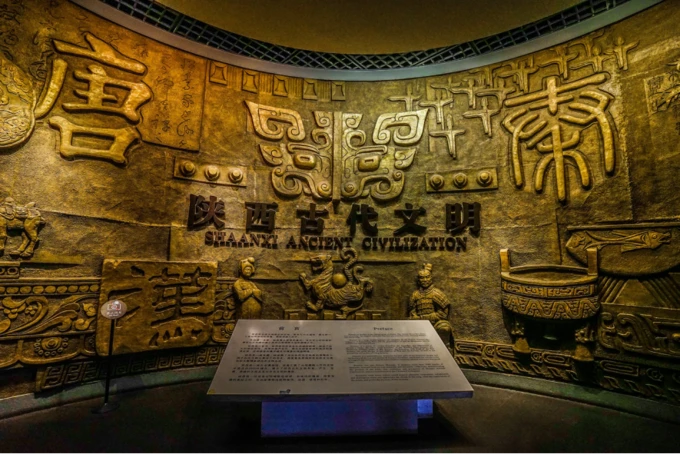
It houses a concentrated collection of precious artifacts unearthed in Shaanxi, mostly from the Han and Tang dynasties—a real treat for those accustomed to Ming and Qing relics. The museum’s main exhibition, “Ancient Civilizations of Shaanxi,” follows the historical timeline, displaying representative objects from each era to reveal the development of ancient society in the region.
Typical exhibits include: [Bronze Ware] spanning from the Shang and Zhou to the Qin and Han dynasties, including ritual vessels, musical instruments, weapons, chariot fittings, daily utensils, and production tools.
[Pottery Figurines] from the Qin, Han, Northern Dynasties, Sui, Tang, Song, Yuan, Ming, and Qing, made from pottery, painted pottery, glazed pottery, and tricolor ware.
After the enlightening museum, we joined a local friend from Xi’an to explore Muslim Street and sample the street food.
Xi’an is a famous city of cuisine and snacks, where you can feast on the diverse foods of Shaanxi. With a strong northwestern flair, local snacks are too numerous to count. Roujiamo (Chinese hamburger), yangrou paomo (crumbled flatbread in mutton stew), cold noodles, Qishan noodles, and dumpling banquets are just a few beloved Shaanxi dishes. Almost every main street in Xi’an has several restaurants specializing in yangrou paomo. Besides night markets at Nanshaomen and Dongxin Street, you can also head to Muslim Street, lined with antique-style buildings and offering every famous Xi’an snack imaginable.
And this is the legendary way to write “biangbiang noodles.”
There are plenty of skewer spots along this street. Prices in Xi’an are very budget-friendly—you can eat your fill for just 70–80 yuan per person.
I snapped this photo of the Bell Tower at night, just outside the hotel entrance—a blaze of lights. Gorgeous, isn’t it~
Back at the hotel after ten, the sight of the bed was enough to make me collapse.
The Big Wild Goose Pagoda, also known as the Great Cien Temple Pagoda, stands within the Great Cien Temple in the southern suburbs of Xi’an, Shaanxi Province. Inside the pagoda, wooden stairs lead up, and each storey has arched doorways on all four sides, offering views from the balconies. From the top, you can gaze down over the ancient city of Xi’an. As the locals say: “You haven’t been to Xi’an if you haven’t visited the Big Wild Goose Pagoda.” Built in imitation of the Indian stupa, with a brick surface and earth core, it was originally inaccessible, and each level housed Buddhist relics. The Big Wild Goose Pagoda is a landmark structure and a famous monument, a symbol of ancient Xi’an. So much so that the pagoda graces the center of the Xi’an city emblem.
A gentle drizzle fell as we wandered here—quite pleasant.
This ancient city is steeped in classical charm everywhere.
Many monks also come here to worship.
The Small Wild Goose Pagoda (Jianfu Temple)
The Small Wild Goose Pagoda, with its design and structure, is a representative example of early Chinese multi-eaved pagodas, influencing the construction of many later multi-eaved brick and stone pagodas across China.
Though not as tall or grand as the Big Wild Goose Pagoda, the building itself conveys a profound sense of historical vicissitudes.
Xi’an Museum
Next to the Small Wild Goose Pagoda is the Xi’an Museum, which displays a multitude of artifacts from various eras in the Xi’an region, some unearthed from major Chinese dynasties like Zhou, Qin, Han, and Tang.
Highlights include: a Tang Dynasty “tricolor galloping horse,” sculpted without saddle or reins, embodying the free-spirited ethos of the era; a Tang “tricolor lotus-petal vessel stand,” with its lotus-petal base and pagoda-shaped lid, bearing clear Buddhist symbolism; and a Western Han “garlic-head vase,” a representative artifact of Qin culture that originated in the Guanzhong region and spread with Qin’s unification wars, before vanishing by the mid-Western Han period.
C’estLaVie (Xiaozhai SEG Store)
For lunch, we ate at C’estLaVie in the Xiaozhai SEG building.
Tang Paradise, situated beside the Big Wild Goose Pagoda in the ancient capital, is China’s first large-scale imperial garden-style cultural theme park showcasing the full splendor of the Tang Dynasty. Historically, Lotus Garden was a renowned imperial retreat, and the park uses the motto “Step into history, feel the culture, experience life” to display the brilliant civilization of the great Tang era. Throughout the day, the park’s various spots put on exciting performances: heavenly drum dances, palace “Jiaofang” music and dance, “Dazzling Attire” fashion shows, Shaolin martial arts, lion dances, stilt walking, acrobatics, and more. In the evening, the world’s largest water-screen film combines music fountains, lasers, flames, water mines, and mist for a stunning 3D experience. The park boasts China’s largest complex of Tang-style replica buildings. Here, you can admire the majestic architecture, enjoy the scenery under dazzling lights, and watch the spectacular Tang-style song-and-dance show “Dream Back to the Tang Dynasty.”
The park is divided into twelve cultural theme zones, covering emperors, poetry, folk life, food, women, tea culture, religion, science and technology, diplomacy, imperial examinations, singing and dancing, and gate features—a comprehensive re-creation of Tang civilization.
Phoenix Singing to the Heavens Theater
“Dream Back to the Tang Dynasty” is a grand CCTV song-and-dance production. The magnificent theater, equipped with modern facilities, embodies Tang-style elegance and serves as the park’s core performance venue for Tang cultural shows.
The night scenery in the park is also brilliantly colorful. As dusk falls and lanterns light up, strolling through the radiant Tang Cultural Corridor, Fanglin Garden, Ziyun Tower, and other spots, everything glitters. Against the moonlight and illuminated lights, Tang Paradise reveals an even more refined beauty.
At night, in Ziyun Tower Square north of the theater, we watched the water-screen film.
Emperor Qin Shi Huang’s Mausoleum Site Museum (Terracotta Warriors)
A trip to Xi’an is incomplete without seeing the Terracotta Warriors and witnessing the might of Qin Shi Huang.
This is a burial pit of the Qin mausoleum, where over a thousand life-sized pottery warriors have been unearthed, each with unique expressions and postures. Historical records say that Qin Shi Huang (Ying Zheng) began constructing his tomb complex at age 13. The sheer scale and grandeur of the project set a precedent for the extravagant burials of later feudal rulers. Based on attire, demeanor, and hairstyle, the warriors are categorized as generals, infantry, charioteers, and so on. Every figure differs in face, build, stance, and expression. Originally painted in bright colors, the figures and horses have largely faded and peeled due to fire and water damage over the centuries. The vast scale, majestic presence, and advanced scientific and artistic achievements of the Qin Terracotta Warriors never fail to amaze visitors. The museum has become an icon of Xi’an.
Pit No. 1, the earliest discovered and largest pit, has corridors at the east and west ends and side corridors along the north and south, with nine east-west passageways separated by rammed-earth walls in between. This pit features chariot soldiers as the main force, forming rectangular combined formations of chariots and infantry. The army faces east, with a line of warriors facing outward along the southern, northern, and western corridors as flank and rear guards; three rows of warriors at the east end serve as vanguard. Inside the nine passages, a massive main formation of chariots and infantry stretches out, with four rows of warriors in each passage—some in battle tunics, some in armor—interspersed with chariots, each with a driver and two soldiers.
Pit No. 2 consists of an L-shaped formation of charioteers, infantry, and cavalry.
Pit No. 3 yielded one chariot, four horse figurines, and 68 warrior figures. The pottery warriors stand in a corridor-like formation, suggesting this pit was the command center of the Qin army.
Huaqing Pool blends cultural history and natural scenery; emperors from Zhou, Qin, Han, Sui, and Tang dynasties built detached palaces here.
Huaqing Pool is a royal garden situated on the site of the Tang Huaqing Palace, 30 km east of Xi’an, leaning against Mount Li to the south and facing the Wei River to the north. Its perennial hot spring resources, the love story of Emperor Xuanzong and Lady Yang, its role as the site of the Xi’an Incident, and its rich cultural and historical heritage have made it a nationally renowned cultural tourism destination and key national heritage site.
The park’s Tang-style architecture is grand and imposing, with distinctive garden landscapes.
This is the legendary sacred spring.
Big Wild Goose Pagoda North Square Music Fountain
At the invitation of a Xi’an friend, we came together to watch the fountain show.
On our final day in Xi’an, we took things more leisurely, strolling along the city wall under the scorching sun.
The ancient city wall is the iconic sight of old Xi’an, built atop the Tang Dynasty imperial city and including a moat, watchtowers, and other features.
Currently, there are eight access points to climb the wall: East Gate (Changle Gate), South Gate (Yongning Gate), West Gate (Anding Gate), North Gate (Anyuan Gate), Hanguang Gate, Wenchang Gate, Heping Gate, and Shangde Gate. Visitors can choose the nearest one.
These are original remnants of the ancient city wall.
Looking down from the wall, it’s wonderful to see the old city below, with many street vendors calling out—a vivid snapshot of daily life.
Not far from the wall lies the Forest of Stone Steles Museum, where you can admire steles and epitaphs spanning over 2,000 years.
We returned to Muslim Street, where the Gao Family Courtyard is located.
Gao Yuesong’s former residence, commonly known as the Gao Family Courtyard, sits on Beiyuanmen Muslim Snack Street, a bustling commercial street in Xi’an. This courtyard is a three-section, four-courtyard brick-and-wood structure, built mainly during the Chongzhen reign of the Ming Dynasty, with a history of over 400 years.
This meal was at Chang’an Da Pai Dang, one of the most popular snack restaurants in Xi’an.
Sifting through memories of this ancient city, wandering its charming streets and lanes, images of splendid relics from past to present fill my mind. Truly, I am in awe of the incredible craftsmanship of our ancestors.