Dreaming in Chang'an, the Ancient Capital: Five Days to Witness Two Millennia of Splendor
As the saying goes, thirty years of history are in Shenzhen, three hundred years in Beijing, and three thousand years in Xi'an!
The primary purpose of this trip to Xi'an is to indulge in its culinary delights, and secondly, to explore the splendid cultural heritage of the ancient capital. There is a classic travel saying: 'Above ground, look to Quanzhou; underground, look to Xi'an.' In Xi'an, what you absolutely cannot miss are those time-honored, exquisitely crafted unearthed artifacts, so museums became the main attractions of our Xi'an journey.
As one of the world's four great ancient civilizations, China has given rise to numerous ancient cities, but none can compare to Xi'an, with its history as the capital of 13 dynasties, a city-building history of over four thousand years, and countless historical buildings and cultural relics preserved within this ancient city, attracting visitors from home and abroad to trace the marks of history.
Xi'an has four distinct seasons, each with its own unique beauty. In spring, flower belts adorn the city parks; in summer, the waterscapes of Qujiang; in autumn, the ginkgo trees at Hanyangling; in winter, the heavy snow upon Chang'an.
Since many attractions and hotels could not be selected in the location choices above, here is a more detailed introduction to our itinerary for this trip:
D0: Fly from Chongqing to Xi'an — Sende Hotel by the Bell Tower
D1: Muslim Quarter — Huajue Lane — Old Sun's Paomo on Xiyangshi Street — night view of the Drum Tower — night view of the Bell Tower
D2: Chaosho Mian (wonton noodles) — South Gate City Wall — Xiangzi Temple — Shuyuanmen Ancient Culture Street — Stele Forest Museum — Xiamaling — ancient alleys
D3: Hulatang (spicy soup) — Qujiang Heritage Park — Qujiang Book City — Drama Culture Square — South Square of the Giant Wild Goose Pagoda — night view of North Square of the Giant Wild Goose Pagoda
D4: Lehua Happy World — night view of the City Wall
D5: Small Wild Goose Pagoda — Xi'an Museum — Shaanxi History Museum — Tang Paradise
D6: Dingjia Xiaosurou (crispy fried meat) — Daming Palace Heritage Park — Depart from Xi'an
Beginning this journey
I actually arrived in Xi'an one day earlier, but it was too late to do anything worth mentioning, so I'll skip straight to the second day. However, evening flights from Chongqing to Xi'an are very attractively priced – you can fly for as low as 168 yuan. And one advantage of traveling at night is getting to enjoy the night view of the ancient city. I must say, viewing a plain city from above at night feels completely different from seeing the mountainous city of Chongqing, which is quite fascinating.
After arriving at Xianyang Airport, you can take a shuttle bus directly to downtown Xi'an for 25 yuan, with a travel time of about 50 minutes. One important note: taxis at Xianyang Airport don't use meters! The fare can range from over a hundred to over two hundred, depending on your negotiation. But personally, I think taking the bus at night is safer. That said, our hotel, Sende Hotel by the Bell Tower, offered airport pickup service. It took just over an hour to reach the center of Xi'an – the Bell Tower. Our hotel was right there, separated from the Bell Tower by only one road.
Sende Hotel near Bell Tower
We chose this hotel after thoroughly researching many guides. It is within walking distance (a few minutes to a dozen minutes) of over 80% of Xi'an's must-visit spots. The hotel entrance also has a subway station with two metro lines – the convenience is just luxurious. When planning, we filtered through numerous hotels and finally settled on this one, which offered the best overall value for money.
Sende Hotel near Bell Tower
From the outside, the hotel's decor is quite Western, with a bit of an American inn feel. Stepping inside, there are some differences, but the color schemes and lighting create a very cozy atmosphere.
The rooms come with smart voice assistants that can control all the appliances.
The in-room facilities are complete. In the bathroom, toiletries are neatly arranged on the counter – toothbrushes, shower caps, cotton swabs, combs, toilet paper, shower gel, shampoo, slippers, towels, and bath towels.
After a long day, a hot shower and a comfortable night's sleep were just what I needed.
At the entrance to the Muslim Quarter stands the Drum Tower. You're probably familiar with the proverb 'morning bell, evening drum' – this is where drums were beaten in ancient times to signal the townsfolk to rest. However, it doesn't look that impressive during the day, so I'll save the spotlight for when we return at night.
Huajue Lane, a visit to the souvenir street
Huajue Lane's entrance is right here at the Drum Tower end of the Muslim Quarter. What Huajue Lane is most famous for is probably the Great Mosque inside. To be honest, the entire Muslim Quarter has several grand mosques, and this one in Huajue Lane isn't the most renowned. Plus, the Huajue Lane Mosque charges an entrance fee, which doesn’t feel quite right. If you're interested in this aspect, you can visit the Great Mosque on Daxuexi Lane, which is free and has a stronger historical feel.
Lamb Paomo – simply delicious!
Just as Chongqing immediately brings hot pot to mind, lamb paomo, as an iconic dish of Xi'an, is something you must try. Whether you end up liking it or not, at least you can experience the local food culture. On a Xi'an friend's recommendation, we chose Old Sun's Paomo main restaurant at No. 40 Xiyangshi Street in the Muslim Quarter. As it turned out, the local tip was very reliable – the taste was genuinely great, and even I, who am not usually fond of wheat-based foods, ate a big bowl.
The decor of the restaurant is also among the best on Muslim Street. On the wall by the entrance are two rows of old Xi'an photos, spanning from the 1930s-40s to the early 2000s, providing out-of-town visitors a vivid glimpse into Xi'an’s historical progression. Further inside is the back hall, which is relatively quieter.
The prices at this Old Sun's are very reasonable. A little secret: this restaurant always has group-buy deals – one serving of beef paomo for only 9.8 yuan, and a serving of stir-fried paomo for 10.8 yuan. Aren't these prices fantastic for the Muslim Quarter?
Breaking the bread for paomo is a very meticulous handiwork that requires patience. Skilled people break the bread into evenly sized small pieces, so when cooked, the bowl looks neat without oddly shaped chunks. But me? Compared to theirs, my bread looked like randomly torn bits – embarrassing.
Dear friends, can you break paomo bread? Let's chat about it!
Some of the most beautiful night scenes: the Drum Tower
The Drum Tower is a place whose brilliance has been overshadowed. When people mention Xi'an, the first thing they think of is the Bell Tower. Ask about places to visit in Xi'an, and you'll hear Bell Tower, Muslim Quarter, City Wall, Terracotta Warriors, Huashan, and so on. Very few mention the Drum Tower, just a street away from the Bell Tower. So today, I want to defend the Drum Tower's fame!
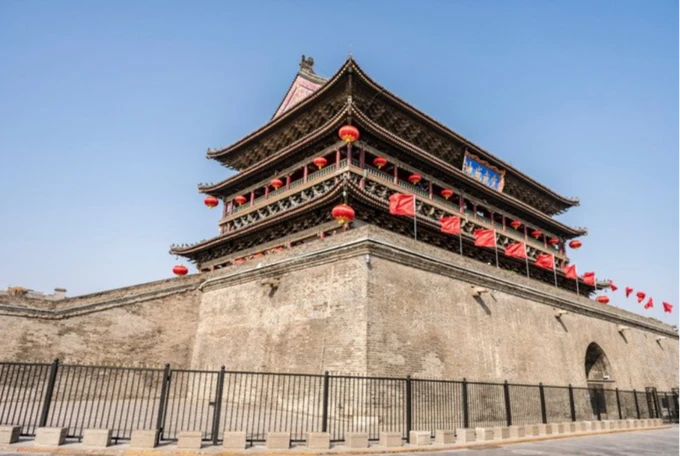
The Drum Tower is located on West Street, at the intersection of Xi'an's four central avenues (East, West, South, North), which is northwest of the Bell Tower. With a history of over 600 years, it is one of the largest and best-preserved ancient drum towers remaining in China.
The most beautiful time for the Drum Tower is, of course, at night. The lights on the row of houses next to it complement the tower's own beauty, making it vastly more stunning than during the day. Although taking photos with a phone at night can be tricky, with the Zhiyun Smooth-Q stabilizer, you can easily capture great shots even at night, and it's even more powerful for shooting videos or live streaming.
The Drum Tower is at the entrance to the Muslim Quarter, so visitors should be mindful of their words and also pay attention to the safety of their belongings – after all, the Muslim Quarter is extremely crowded.
In fact, the Drum Tower at night is truly much more beautiful than during the day, isn't it? It has a solemn and majestic feeling, right? Also, unlike the Bell Tower, it's not fenced off. You can stand right beside the Drum Tower to experience it up close, take selfies at will – a more intimate Drum Tower.
With the auto-adjustment function of the Zhiyun stabilizer, your phone can also capture night scenes.
The darling of this city – the Bell Tower!
Next to the Drum Tower is, of course, the Bell Tower. As the emblem of Xi'an, the Bell Tower is cherished above all. Whether it's the icon on metro cards or the top ranking in tourist attractions, the Bell Tower constantly asserts its status as the symbol of Xi'an. That's why I say, compared to its contemporary, the Drum Tower has been suffering injustice for many years.
Like its counterpart, the Bell Tower looks far more enchanting at night than during the day. So even though you cannot climb it at night, I would still personally recommend visiting after dark. There isn't much to see even if you do climb up during the day, anyway. Of course, if time permits, you could go up during the day and then return at night too.
The half-hour to one-hour period just after dark is called the 'blue hour'. With a phone or camera, you can easily capture the transparent blue sky. Paired with the traffic circling the Bell Tower, if you have a tripod and a DSLR, you can capture light trails from cars, making the ancient architecture even more enchanting.
After photographing the Bell Tower, I felt a bit tired and headed back to the hotel.
The carpets in the hotel corridors are completely silent underfoot, no wonder you can't hear anything in the rooms.
The next morning, I went down to the hotel's buffet restaurant for breakfast. The restaurant is very spacious, with the menu leaning a bit towards Western style.
The breakfast buffet was noteworthy – delicately prepared, with a wide variety, and tasted great.
A witness to ancient Xi'an – the City Wall
The Xi'an City Wall has four gates and several climbing points. The one I visited this time, the Yongning Gate, is just one of them, commonly known as the South Gate. However, the plaque on the wall is engraved with 'Yongning Gate'. According to the stone tablet below the wall, Yongning Gate is the oldest city gate in China, which is also evident from the plaque's ancient feel. The original Xi'an City Wall was destroyed over history and was rebuilt only in the Qing Dynasty, so the wall we see today is mostly from the Ming and Qing periods. But Yongning Gate is genuinely a preserved ancient wall, making it very significant. The admission to climb the wall at Yongning Gate is 54 yuan, with a half-price student ticket at 27 yuan. All climbing points on the Xi'an City Wall have this uniform price.
The sun was a bit strong that day, so some elderly people were strolling along the riverbank. Truly, having a secure old age is the greatest happiness. I wish that all elderly people in China could take leisurely walks like this, free from worries about food and clothing.
Looking across from the other side, the city wall as a whole was quite impressive.
One of the Eight Immortals, known as the most efficacious Taoist temple in Xi'an – Xiangzi Temple!
An ancient capital for three dynasties and a city of three millennia, inherited as today's Xi'an! As an old saying goes: 'Xi'an is full of historical sites!' Although this statement is somewhat exaggerated, it holds some truth. Xi'an boasts numerous places of interest, not just the Bell and Drum Towers, the City Wall, and the Terracotta Warriors. For instance, the Xiangzi Temple hidden in this alley is a wonderful spot!
If Xiangzi Temple is your first stop, you take the same transport as to the South Gate City Wall: take Metro Line 2 to 'Yongningmen Station', enter Xiangzimiao Street, and walk straight for about a hundred meters to reach it. There's a large archway here, visible from afar.
The Stele Forest Museum in Xi'an is China's largest museum of calligraphic steles. It houses the greatest number of steles and epitaphs in the country, with an incredibly rich collection spanning over 2,000 years. The entire museum consists of three parts: the Confucian Temple, the Stele Forest, and the Exhibition of Ancient Chinese Stone Sculpture Art.
The Stele Forest Museum is situated below the Xi'an City Wall. There is no direct bus, but transportation is still very convenient.
D3: Follow me as we set off!
Drama Culture Square is a hidden gem among attractions, located beside the South Square of the Giant Wild Goose Pagoda, just across a street. However, because it's so small and niche, it's rarely mentioned online. I discovered it by chance this time. The ground features many written introductions to drama culture, and the columns have painted opera masks for viewing, though the style of the masks was a bit frightful.
South Square of the Giant Wild Goose Pagoda
The Giant Wild Goose Pagoda area is divided into the south and north squares, but many visitors just watch the musical fountain at the north square and then leave, missing the sights of the south square – which is a pity. The passage between the south and north squares has many shops selling snacks, souvenirs, and kites, with relatively reasonable prices. If you're interested, you can buy a sugar figure to nibble on. Coming from Qujiang, I could only take a bus, but if you're coming from downtown, it's very convenient now: take Metro Line 3 directly to 'Dayanta' (Giant Wild Goose Pagoda) station, exit from C, and pass through Daci'en Temple to arrive.
The main attractions on the south square are Daci'en Temple and the statue of Xuanzang. Between the two squares, there are also many sculptures of literati, all worth taking your time to appreciate.
(Note: the following paragraph repeats similarly, but I'll keep it as in the original text for fluency without adding new facts)
South Square of the Giant Wild Goose Pagoda
The Giant Wild Goose Pagoda area is divided into the south and north squares, but many visitors just watch the musical fountain at the north square and then leave, missing the sights of the south square – which is a pity. The passage between the south and north squares has many shops selling snacks, souvenirs, and kites, with relatively reasonable prices. If you're interested, you can buy a sugar figure to nibble on. Coming from Qujiang, I could only take a bus, but if you're coming from downtown, it's very convenient now: take Metro Line 3 directly to 'Dayanta' station, exit from C, and pass through Daci'en Temple to arrive.
The main attractions on the south square are Daci'en Temple and the statue of Xuanzang. Between the two squares, there are also many sculptures of literati, all worth taking your time to appreciate.
D4: Today we're going for an extremely thrilling itinerary
City Sports Park
Since I'm in Xi'an, besides its historical relics, I also want to experience its modern side and excitement.
Lehua Happy World is Asia's largest roller coaster theme park and the number one, most comprehensive amusement park in the five provinces of Northwest China. Located in the Jinghe New City, Xianyang New District of Xi'an, it's quite far from downtown, but Lehua Happy World offers free shuttle buses, so transportation is still very convenient. In the city, take Metro Line 2 to 'City Sports Park' station, exit from D, walk about a hundred meters north to reach the Lehua World shuttle bus pick-up point. Buses start running at 8:00 am, every half hour.
It's worth noting: definitely keep the small map handed out at the visitor center, because the park is so vast that you'll easily get lost without it. The main gate is built grandly and beautifully, with clowns and mascots dancing to welcome you at the entrance. Once inside, you'll see many amusement facilities, of course mostly roller coasters – after all, it's Asia's largest roller coaster theme park. The entire park is divided into sections like the play area, commercial area, and performance theaters. Walking five hundred meters straight down the pathway brings you officially into the play zone, where you'll find a drop tower, an eight-loop roller coaster, a giant frisbee, the Lightning roller coaster, a suspended coaster, a carousel, a log flume, a haunted house, and more. The most thrilling among them are the 'Drop Tower', which stands over thirty meters high and plunges instantly from its peak, almost stopping your heart, and the 'Lightning Roller Coaster'.
Lehua's commercial area is also well-developed, mainly featuring souvenir shops and restaurants, but prices are much higher than outside, so it's advisable to bring your own drinking water and a small amount of food. The performance theater houses China's largest 4D giant screen cinema, with shows every half hour, though each showing is short, just over ten minutes. Lehua also has a circus, but it wasn't open when I visited; I'm not sure if it's available now for next time.
Xi'an's attractions generally look better at night than during the day. The City Wall is no exception. By day, it feels weighty with history, but at night, it exudes charm.
Walking along the moat outside the South Gate City Wall, you can see ancient walls, watchtowers, arrow towers, old bridges, and other structures. I was fortunate to spot a small canopy boat gliding beneath the bridge, which was particularly evocative.
D5: Xi'an is more than just the Giant Wild Goose Pagoda
One of the 'Eight Scenic Spots of Guanzhong', the 'Morning Bell and Evening Drum', lies right within this Small Wild Goose Pagoda.
The Small Wild Goose Pagoda is located within the Jianfu Temple in the Beilin District of Xi'an. Although not as large or famous as the Giant Wild Goose Pagoda, its tranquil environment is something the Giant Wild Goose Pagoda cannot match – after all, the latter is always bustling with crowds. The Small Wild Goose Pagoda, with its thirteen stories, unique architectural techniques, and beautiful scenery, possesses a distinct charm within this ancient city. Visiting the base of the pagoda is free; you can get a free ticket with your ID card, similar to a museum. However, climbing the tower costs 30 yuan, and personally, I don't think it's necessary – apart from some informational documents, there isn't much to see inside. The Small Wild Goose Pagoda closes at 5:00 PM, so plan your time accordingly. Right next to the scenic area is the Xi'an Museum, which is also free and can be conveniently visited along the way.
A must-visit spot in Xi'an – the Shaanxi History Museum!
The Shaanxi History Museum is the largest historical museum in Northwest China. I highly recommend everyone visiting Xi'an to see it. It houses the most detailed histories of the Zhou, Qin, Han, and Tang dynasties. Those with a background in history will find it exceptionally rich in culture, while those unfamiliar can hire a guide – though you don't necessarily need to; you can just follow behind someone else's guide and still hear detailed explanations. Take Bus No. 5 to Cuihua Road Station, walk a short distance, and you'll arrive; or take Metro Line 2 to Xiaozhai Station and walk just over a hundred meters. Buses and metro in Xi'an can be incredibly crowded, so be wary of pickpockets. As mentioned, you can hire a guide at the Shaanxi History Museum for 100 yuan each – very detailed, and worth it if your budget allows. There are also audio guides available for rent at 30 yuan per unit, with a 200 yuan deposit. Admission here is free, but you should try to arrive early because only 4,000 free tickets are issued daily – 2,500 in the morning and 1,500 in the afternoon, distributed on a first-come, first-served basis with ID card. If you arrive late, while it's generally unlikely that tickets run out, you'll still face very long queues.
The museum is divided into three parts: the central main building and the two side wings. The main building has two floors, each with three exhibition halls, displaying several terracotta warriors, various porcelains, bronze items, and more, with a dazzling multitude of historical treasures.
Although transportation around the history museum is convenient, dining options are not – you'll have to walk quite far to find food. But it's not too far from the Giant Wild Goose Pagoda, about a fifteen-minute walk, or just the minimum cab fare away, so you can visit the pagoda on the way. I hope everyone travels civilly, doesn't litter, and avoids using flash photography when capturing cultural relics.
The most anticipated spot of this trip – Tang Paradise
Since the Giant Wild Goose Pagoda scenic area, Tang Paradise, and Qujiang Park are all adjacent, I suggest visiting Qujiang Park in the afternoon, then heading to Tang Paradise in the evening to see its famous 'Water Screen Movie' and lantern show. Afterwards, you can also watch the musical fountain at the Giant Wild Goose Pagoda Square. This route will undoubtedly leave you thoroughly satisfied.
The long-awaited trip has finally come to an end, with the millennium-old capital etched deep into my heart. I will definitely return.