Where It Began, Back to Civilization: Return Leg of the Northwest Grand Loop – Concluding Our Westward Slow Travels
Driving east from Xining back to Beijing, the G6 Jingcang Expressway would undoubtedly be the best choice, but we didn't want to retrace our steps, so we carved a different path – through Tianshui in Gansu, then Xi'an, Taiyuan, and finally back to Beijing.
First stop: Tianshui
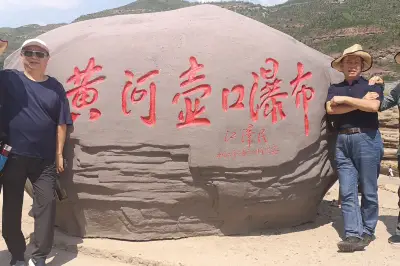
Tianshui was the first highlight on our return journey. Heading east from Xining into Gansu, the landscape shifted dramatically – rugged and majestic, as if shaped by axe and blade. We threaded through mountains, gorges, and tunnels that seemed to collect every tunnel in Gansu. One tunnel cluster after another, an endless succession of dark passages with only fleeting flashes of light, like hurtling toward the end of time. The Yellow River wound sinuously through the gorges here; often, emerging from a tunnel, we'd glimpse the river far below the bridge. It happened so often we had the uncanny sensation of spinning in place, never moving forward. This terrain persisted until we reached the Xigu district of Lanzhou. The entire Xigu town was perched on the Loess Plateau, buildings packed into the plateau's ravines, high and low, like a city in the sky viewed from afar. The landscape here resembled the Yardang landforms; apart from urban greenery, the valleys were almost barren. Just passing through already gave us an immense sense of isolation. Qi's dad especially admired the residents; we were only fleeting visitors, but they live here day after day. How hard that must be!
Satellite images confirm: not a patch of flat ground along this route – endless high plateau mountains.
I had imagined Tianshui would continue this desolation, but the moment we entered its borders, the scenery transformed. Green peaks layered upon each other, a sea of lush foliage. The city nestled along a river, water and sky merging in one hue – it felt like the Yangtze River Delta! After all that stark wilderness in the northwest, this vibrant vitality caught us completely off guard. Qi's dad even felt he was walking through his southern hometown – no wonder it's named Tianshui ("Heavenly Water"). Suddenly a hit song popped into his head: "Take a cup of water from the heavens, reflecting the bright moon as the mortal world sways; love and hate are but a moment, drifting in the red dust…" We ordinary beings yearn for paradise but can't leave the human world; ideals and reality forever intertwine.
Historically known as Qinzhou, Tianshui sits in southeastern Gansu, in the western Qinling Mountains and along the middle reaches of the Wei River. It's a crucial birthplace of Chinese civilization, the legendary home of Fuxi, the first of the Three Sovereigns. Its "five great cultures" – represented by the Fuxi culture, Dadiwan culture, early Qin culture, Maijishan Grottoes culture, and the culture of the Three Kingdoms battlefields – form a rich historical tapestry.
We came to Tianshui solely for the Maijishan Grottoes, and the next day's only itinerary was exactly that.
Tianshui Maijishan Grottoes
One of China's four great Buddhist grottoes, the Maijishan Grottoes are a dazzling artistic gem along the ancient Silk Road. Maijishan – "Wheatstack Mountain" – is a solitary peak in Xiaolongshan, Maiji District, standing 142 meters high, named for its resemblance to a stack of harvested wheat. With construction begun in 384-417 AD, the grottoes house numerous caves and clay sculptures, earning it the title of "Oriental Sculpture Art Museum."
Up ahead, a solitary peak rose – that was Maijishan. The grottoes were carved into the sheer cliff faces from bottom to top. The mountain stood imposing, Buddha statues perched on the cliffs, forcing you to lift your gaze in reverence to this Buddhist realm.
The mountain looked like a colossal earthen wall, almost vertically straight. I truly marvel at the vision and perseverance of the ancients. The grottoes were born of Maijishan, and Maijishan gained fame because of them.
To visit the grottoes, you must ascend a walkway. Now it's reinforced concrete, but in antiquity it was a wooden plank path, later destroyed during turbulent times. Legend has it that the burning of the plank path actually saved the cliffside Buddha statues during wartime.
Qi's mom is afraid of heights, so the climb was a series of startled gasps and unsteady steps. Yet she never forgot to strike a pose for a photo, hugging the cliff wall but still radiating elegance. You can panic inside, but your poise must never waver! For the sake of a good photo, anything can be abandoned.
Qi's little one, like a fearless newborn calf, was brimming with energy, scampering up and down. Qi's dad spent the whole time on tenterhooks, having to encourage the height-fearing mom while also keeping hold of the carefree child – clearly stretched thin.
Buddhas gazed into the distance from these sheer cliffs. Standing so close to a World Heritage Site, you felt the compassion of the Buddha; from any angle, it seemed the Buddha's eyes followed you. Even here on the cliff, you were under that watchful gaze. The sculptures were well-proportioned, uniquely shaped, and exquisitely detailed; the artistry rivals the best among the four great grottoes.
With the Buddha's care, Qi's mom visibly grew bolder, as if she'd adjusted to the chill of great heights, walking confidently ahead, holding Qi's little one's hand.
This Heavenly King truly lived up to his title – that physique! Those muscles! He'd be an absolute fitness icon today! Clearly, the understanding of strength hasn't changed much across millennia.
The Heavenly King trampling an ox outside Cave 005 is a work begun in the Sui dynasty and completed in the early Tang. The king's appearance still clearly shows Western Regions features.
Mother and child were now in perfect sync, operating on the same wavelength. Qi's dad finally emerged from his schizophrenic mental split, achieving a state of harmony. Now, a proper group photo! Haha.
Below Cave 191, a figure of a personified strongman with a human head and bird's body – powerful and robust, almost adorably fierce – dates from the Western Wei dynasty, again with obvious Western Regions traits.
Many cave sculptures here have weathered exteriors that still retain traces of their original colors. You can imagine how radiant they must have been in their heyday.
For conservation reasons, many caves are sealed with tight wire mesh and outer iron bars. It's hard to see inside, let alone photograph. In my opinion, if they're open to the public, they should keep up with the times. Even a glass cover would be better than these rusty wire nets! At least you could see inside. Heritage conservation should include innovation in visitor experience, especially after charging a hefty ticket. Maijishan's shabby "windows" need an upgrade – they really spoil the view.
The walkway is one-way, with an entrance and separate exit. We reached the highest "corridor" and descended from the other end.
Looking up from below, the mountain pierced the clouds. The cliff where the grottoes sit is indeed a vertical wall.
Qi's little one was bursting with pride at his own bravery. At the viewing platform below, he and his mom made a heart gesture together. Our Maijishan visit ended contentedly beneath the lush green mountain.
These Buddhas gaze silently ahead, watching clouds drift and people come and go. Statues that have seen a thousand years, observing a world that seems to change yet stays the same. We, too, are just drifting in this sea of people, arriving with the tide and departing with it. Qi's dad believes that every encounter in this life is serendipity – the mountain, the Buddhas, the people – whether by chance or destiny, everything is beautiful!
Connections have beginnings and endings, things have causes and effects. Hold awe in all things; the way of heaven circulates, and the path of righteousness is etched through time.
Though the Maijishan visit came with a chill of great heights, the cliffs and lush vegetation kept us refreshingly cool! The whole walk felt like the most relaxed and pleasant day of our trip. Back near the hotel, we had a pickled fish hotpot, a welcome comfort for palates tired of lamb after nearly two weeks. Descending from the plateau, starting in Tianshui, from physical sensation to taste buds, we finally returned to the long-missed human world.
The road from Tianshui to Xi'an wound through valleys of verdant greenery, often shrouded in mist, as if we'd entered a tropical rainforest. Geographically, this must be where the Qinling Mountains meet the plateau. The Qinling's ecological richness deserves its reputation: the climate here is moist, the air full of moisture, and all the dry, rugged harshness of the northwest is gone.
Xi'an – The Spiritual Ancient Capital of China
At the toll station, a name shimmered: "Epang Palace." I admire the boldness of Xi'an's administrators – with those three characters, the city's glorious history is instantly on display.
Xi'an served as capital for thirteen dynasties, the earliest, longest (over 1200 years), and most numerous capital in Chinese history. It condenses the essence of China's past: from the slavery-era Western Zhou, to the first unified Qin Empire, the first great Han dynasty, and the pinnacle of feudal society, Tang. Xi'an scripted China's most magnificent chapters. Officially and historiographically recognized as the capital of 13 dynasties, it is indisputably the king of Chinese imperial cities, the spiritual ancient capital of the nation.
After dinner, at Qi's little one's insistence, Qi's dad and mom rallied their spirits and decided to visit the ancient city wall. The streets flanking Yongning Gate glowed with lights, the 13-dynasty capital still radiating vibrant life.
The bright moon hung overhead, lanterns just lit; people strolled on the old city wall. Once a site of tense military standoffs, the ancient battlements have become a leisure spot for residents and tourists. The moon on the city wall, the thriving streets inside and out – my mind quietly filled with those famous verses: "The moon of Qin shines, the passes of Han stand; ten thousand miles they marched, yet no one has returned."; "Looking back at Chang'an, embroidered in splendor, mountain gates open layer upon layer."; "After trampling fallen blossoms, where to roam? Laughing, one enters the tavern with the Western beauty." The first poem isn't about Chang'an, but it reflects the city's desolation during war; Du Mu's poem over Huaqing Palace depicts the extravagance of royal life; Li Bai's youth poem captures Chang'an's glory. Three Tang poems, three faces of Chang'an. In a place so laden with history and culture, every step is upon a classic.
Qi's little one, a tiny figure on the broad wall, his height made the crenellations block his view. What was bustling life to us adults was just walls to him.
The bored little guy needed edible comfort: juice from a cultural creative shop on the wall, a reward for this young traveler's efforts.
The warrior figurine on the wall was even cuter than Qi's little one! In cartoon creation, enlarging the head is an effective way to achieve cuteness, like Doraemon. "Big head, big head, no worry when it rains; others have umbrellas, I have a big head" – Qi's dad's mental circuits are always this quirky.
Xi'an masterfully blends ancient and modern, and walking here never feels jarring.
Lanterns and moon mirrored each other's glow, ancient charm and modernity complementing each other perfectly. In Xi'an, I kept having the illusion of being in Beijing; perhaps both being ancient capitals, China's imperial culture carries on a tradition, like Beijing's Chang'an Avenue being named Chang'an.
The Terracotta Warriors of Emperor Qin Shi Huang
The must-see terracotta warriors museum is a required stop. Right off the highway, the sign confirms Xi'an's directness in naming toll stations.
In the largest exhibition hall, Pit 3, Emperor Qin's army stands ready, awaiting the command to march – a command they've been waiting for over two millennia.
Qi's little one had never seen anything like this; he was full of curiosity, especially about the headless warriors! A child's mind is simple and direct.
They stood ramrod straight, expressions solemn, discipline ironclad – once the most powerful army on this land, the force that shattered mountains and rivers to unify China for the Qin dynasty, giving this planet the concept of "China."
Under the blue sky, a statue of Qin Shi Huang gazes over this land, the place where he and his empire set out, and where they ultimately found their end.
I heard that besides the terracotta warriors, Datang Everbright City is another must-see in Xi'an. After dinner, we took Qi's little one there.
Datang Everbright City is a massive pedestrian street Xi'an invested heavily in. It lies at the foot of the Giant Wild Goose Pagoda in Yanta District, stretching from the pagoda's south square down to Tang City Wall ruins, bordered by Ci'en East and West Roads. Rooted in Tang Dynasty culture, it's a showcase of Tang aesthetics and experiences.
The sea of people made walking difficult. Our family, not fond of huge crowds, quickly left. That day, like Meng Jiao's poem: "In spring's pride, the horse's hooves go fast; in one day, I've seen all of Chang'an's flowers." We weren't on a triumphant spring ride, yet we did see all of Chang'an's flowers in a day. Chang'an is too big; as brief visitors, we could only take a quick glance.
Echoes of the Tang's splendor are everywhere on these streets.
The next day, we had no plans. The family slept in, rolled out for breakfast just before the hotel's cut-off, then returned to the room for more sleep. That day of deep rest noticeably lightened our travel fatigue, recharging us for the journey home.
In the evening came the grand finale of our Northwest Grand Loop: the large-scale outdoor performance "Tang Dynasty Dream" at Tang Paradise.
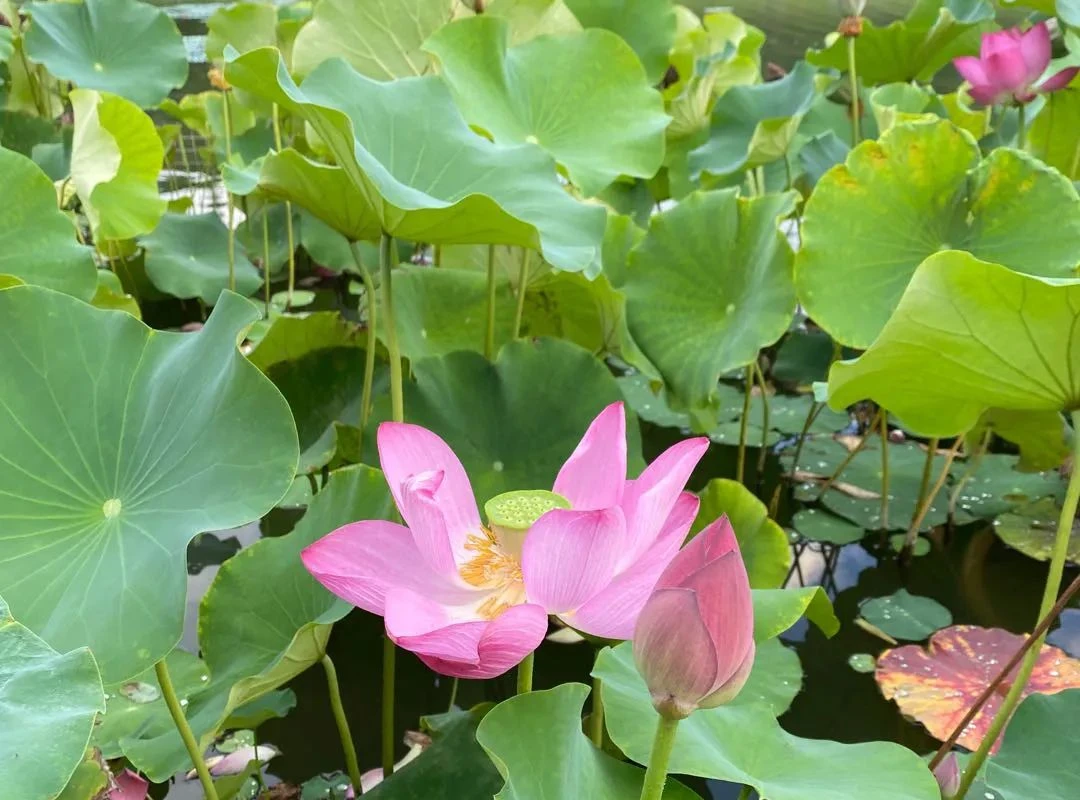
In Tang Paradise, lotus flowers blanketed the lake, the setting rich with imperial grandeur.
Qi's mom, who hadn't gone out all day, perked up the moment she saw the lotus blooms.
This is the Ziyun Tower in Tang Paradise.
The performance is watched from ferry boats on the lake, with Ziyun Tower across the water as the backdrop.
At night, Ziyun Tower became the perfect canvas for a naked-eye 3D spectacular.
The show began, from the golden age of Tang...
to the maritime Silk Road.
Stage play and water-screen film merged seamlessly, as if transporting us through time. A full moon hung on the horizon – the night's only witness to the Tang's splendor, because this very moon once shone upon Li Bai, upon Du Fu, upon Wang Wei, upon the entire glorious Tang era.
Back then, Ziyun Tower echoed with music and dance; tonight, it dazzles with light, the Tang Dreamshow reviving the dynasty's charm. But we had to move on, for history never stops.
In front of Ziyun Tower, like the full moon above, we had rounded off our Northwest Grand Loop itinerary perfectly. Tomorrow, we'd head toward Taiyuan and return to Beijing after 25 days away.
On this Northwest Grand Loop, we journeyed through 7 provinces, municipalities, and autonomous regions, covering over 8,000 kilometers. From grasslands to deserts, lakes to snow mountains, grottoes to ancient cities, mountains to river valleys, and wilderness to metropolises, we traversed nearly every landscape, passed through all four seasons, and drank in beauty everywhere.
The Northwest Grand Loop is a quintessence of natural scenery and a treasure house of Chinese history and culture. Right now, Qi's dad wants to sum it up with just one line: "Abundant rewards, not a single step wasted!"
Beneath this breathtaking nightscape, the "Westward Slow Travels" travelogue series draws to a perfect close along with the Northwest Grand Loop. Thank you all for your constant attention! May you chase your dreams and harvest beauty!