Spring Outing in Louguan: Intangible Heritage, Flower Seas, Cuisine, and the Qinling Four Treasures – A Personal Travel Guide
“The most beautiful April day on earth” is a beloved poem by Lin Huiyin, a literary talent of the Republic era. With emotional directness, she infused April with beautiful hopes. In her poem, laughter can light up the winds from all sides; the light, spirited spring changes like dance steps in the brilliance. In April, the wind is soft, flying in the dusk; the flowers are fragrant, beautiful in the drizzle. Spring is the tender yellow after snow, the green of newly sprouting leaves, blossoms on every tree, and swallows murmuring under the eaves—it is love, warmth, and hope.
It was this poem that made me fall in love with April. So, during the Qingming holiday, my friend and I went to Louguan, beginning our leisurely spring outing to enjoy flower seas, watch intangible heritage, and play with the Four Treasures.
Before Qingming, I had researched Louguan's spring season. I knew that from the start of the Qingming holiday until mid-May, eight scenic spots—Qinling National Botanical Garden, Qinling Four Treasures Science Park, Louguantai National Forest Park, Shuojing Platform, Zhaogongming Cultural Scenic Area (including the Caishen Folk Culture Museum), Zhongnanshan Ancient Louguan Historical and Cultural Scenic Area, Yanshengguan Scenic Area, and Huanvquan Scenic Area—would offer a special "Qinling Louguan One Ticket Pass" discount. Here, not only could you see the tulip flower sea and the beautiful spring blooms of a hundred flowers at the Qinling National Botanical Garden, but you could also enjoy Zhouzhi's local intangible heritage performances amidst cherry blossoms at the Zhaogongming Cultural Scenic Area. You could get up close and personal with the Qinling Four Treasures at the Qinling Four Treasures Science Park, and ascend Xianling Mountain, Huanvquan, and Yanshengguan to gaze afar at the elegance of Qinling in spring.
On April 3rd, the first day of the Qingming holiday, fearing traffic jams, we set out early. As it turned out, the roads were clear all the way. When we arrived at the Zhaogongming Cultural Scenic Area, it was not yet opening time, so we went into the Tianyuhe Scenic Area to the west and greedily breathed in the fresh morning air of spring. We released all the frustration of having to wear masks in the city day after day, right here. The fresh air along the Tianyu River, mixed with the fragrance of bauhinia and lilac, was invigorating and set a rare, wonderful mood for a beautiful day.
At 9 a.m., we entered the scenic area as the first guests. Puppet show, Ox vs. Tiger dance, Zhouzhi paper-cutting, and dynamic kites of master Zhang Tianwei were all being prepared. So we walked into the garden depths to see the cherry trees adorning spring.
“Because of You, Cherry Blossoms” – a romantic encounter.
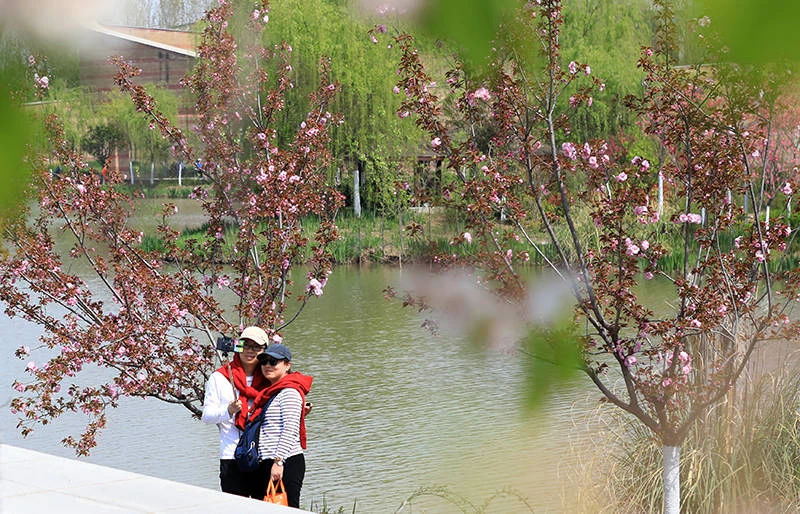
Since opening, Zhaogongming Cultural Scenic Area has a history of nearly 10 years. In spring, trees laden with flowers contrast with the red walls, grey tiles, carved beams, and painted rafters of the faux-ancient architecture, making one feel as if they've stepped into an imperial garden—captivating and intoxicating. While lost in this enchantment, we suddenly heard musical instruments, followed by the sounds of Daqin opera floating on the breeze. We moved to the front courtyard, where the Zhouzhi Dayu puppet show, a Shaanxi provincial intangible heritage, had begun with the striking of gongs.
"Zhouzhi Dayu Puppets" originated in the Xuantong reign of the Qing Dynasty. They are rod puppets, distributed in Zhouzhi County and western Guanzhong. They were brought to Dayu Village by puppeteer Tang Laoba. Today, there are more than 30 performers and carvers. The material selection, carving, and performance are all done by puppet artists in Dayu Village. Locals call it "twisting the rods."
The accompanying instruments mainly include four-sided drum (report drum), yu drum, war drum, hall drum, large gong, small gong, large cymbals (jiaozi), small cymbals (xuanzi), banhu fiddle, erhu, yangqin dulcimer, douweng, cello, dizi flute, suona horn, and trumpet, etc. The vocal style is primarily Qinqiang opera. Main repertoires include "Spring and Autumn Annals," "Down to Hedong," "Beheading Li Guang," "Golden Sand Beach," and nearly 30 other plays. In 2009, it was listed in the second batch of Shaanxi Provincial Intangible Cultural Heritage. It remains active among the people, a gem of folk intangible culture.
I don't understand opera, but I love this puppet show with its vibrant colors, lifelike characters, and high-pitched singing. After one piece, I was left wanting more. Just as the puppet show ended, the traditional dance drama "Ox vs. Tiger" made its dazzling entrance.
I have photographed "Ox vs. Tiger" many times, but this performance felt the best. All the actors, the ox, and the tiger had new costumes; the bright new colors collided passionately with the most beautiful April day on earth—a truly gorgeous artistic feast.
"Ox vs. Tiger" originates from Bajiagang village in Louguan, at the foot of the Daoist sacred site of Louguantai. It is a Han Chinese folk dance from Shaanxi. It is said that a wooden plaque in the well temple at the East Crossroads of Bajiagang bears the inscription "Bajiagang performs Ox vs. Tiger during the Qianlong reign (1736-1795)." Thus, the history of "Ox vs. Tiger" goes back over 800 years.
The whole performance, with its rolling, fighting, and leaping, features the ox, tiger, and a young herder. The figures are simple yet exaggerated, full of charm. The tiger's movements alone comprise four major postures, eight minor postures, and 24 Pingyang stances, including standing, crouching, sitting, shrinking, rolling, going up and down the mountain, and leaping across a ravine. All 24 stances run through the dance, portraying the tiger's bravery, cleverness, and playfulness. The ox also has its postures: rhinoceros gazing at the moon, stumbling and licking its back, grazing, shrinking its fork, scratching its ear, and more. These vividly depict the ox's steadiness, majesty, and simplicity. Interspersed with the lively antics of the herder and his frolicking with the ox, the whole piece brims with rustic charm. This makes the dance even more vivid and spectacular, drawing bursts of applause at every show. It truly has the tiger's spirit, the ox's strength, and the herder's mirth—wonderfully exciting. In 2007, it was listed as an intangible cultural heritage of Shaanxi Province and Xi'an City.
After the two performances, it was nearly noon. We moved to the Zhouzhi paper-cutting display, where we also met familiar faces. I have photographed the paper-cut works of artists Li Xia and Lu Xiaochun many times, and each time I felt differently, always sensing the artistic charm of folk artisans creating pictures with skillful hands.
Zhouzhi paper-cutting, anciently called "jiancai," is the art of cutting paper into pictures used to decorate window lattices during Spring Festival, weddings, and other occasions. When I was little, my mother made paper-cuts using a smoked staining method, and sometimes I would join in and cut a couple.
Zhouzhi paper-cutting falls into two categories: colored and monochrome. The works are cut, engraved, painted, and dyed, meticulous and fine, with rigorous composition and rich, vivid colors. The subjects are diverse, including historical figures, auspicious beasts and birds, lucky patterns, and more. In 2011, Zhouzhi paper-cutting was listed as a provincial intangible cultural heritage.
In the intangible heritage display at Zhaogongming Cultural Scenic Area, the biggest highlight was the dynamic kites brought from Xi'an to Louguan by master Zhang Tianwei. Brightly colored and lifelike, in various sizes but all exquisite, each kite—fighting cocks, red-crowned cranes, Pig Bajie eating watermelon, crabs, scorpions—came alive in the wind, stretching necks and waving limbs, full of motion, drawing crowds of tourists.
I once read in a book: "Waste time on beautiful things." This whole morning, I witnessed the charm of intangible heritage and the beauty of life. I want to say: even if I were given another day to immerse myself in these beautiful things, I'd think: it's worth it! So I've used a lot of words to record the delights of this morning. I hope you like it too.
During travel, besides appreciating and recording these lovely things, local cuisine also brings spiritual joy. Especially after feasting on beauty and achieving a happy mood, food is the best booster on the journey.
The snack street of the Zhongnanshan Ancient Louguan Historical and Cultural Scenic Area officially opened for trial during the Qingming holiday. It gathers more than 20 kinds of Shaanxi specialty snacks: cold pot skewers, Cuifeng tuotuo, banner-flower noodles, Zhongnan fried dough twists, the "Three Qin set meal," stir-fried jelly, jiaotuan, brown sugar yougao... Each one is a favorite of Shaanxi locals. A sumptuous "spring feast" of gustatory delight unfolds here. After tasting, only three words: "Liao za lie!" (awesome!)
It's said that spring brings drowsiness, but in the blessed land of Louguan, after lunch, we felt refreshed and energized. We then headed to the Qinling Four Treasures Science Park to see the cute and lively Four Treasures.
On a bright spring day, the "national treasures" at the Qinling Four Treasures Science Park were also "smitten with spring."
Agile golden snub-nosed monkeys climbed to the treetops and swung on swings; a soft and adorable giant panda lay munching, perfectly at ease; a proud crested ibis flitted about, searching for a mate; a steady and sturdy takin slowly basked in the sun; and the world's only captive brown giant panda, "Qizai," enjoyed the spring day, becoming a little star photographed by visitors young and old.
Bai Juyi wrote in his poem "Peach Blossoms at Dalin Temple": "In April, all flowers on earth have faded, yet peach blossoms at the mountain temple just begin to bloom." I think that April refers to the lunar month. But the April we experienced at the Qinling National Botanical Garden at the foot of the Qin Mountains was indeed "the most beautiful April day on earth." It was the season of flowering crabapples and tulips. Tens of thousands of colorful tulips, following the undulating terrain, spread out in picturesque layers, contrasting with blue sky, white clouds, green mountains, and clear waters, forming a brilliant flower sea—the most beautiful spring landscape, a hot spot for spring outings and flower viewing. To the west of the tulip sea, the Crabapple Garden was equally resplendent with a blooming tide on every tree, reaching the pinnacle of beauty.
We had originally planned a two-day trip, but due to commitments, we canceled the visits to Zhongnanshan Ancient Louguan, Xianling Mountain, Huanvquan, and Yanshengguan. It was a bit regrettable, but the gains from this trip far exceeded our expectations. Fortunately, the remaining scenic spots were all free. We hope to return to Louguan another time, stay for a couple of days, and take in all the beauty.
To facilitate visitors, during the short holiday, the scenic area launched a "One Cart Passes Through Four Parks" convenience service. Tourists can take the sightseeing car of the Zhongnanshan Ancient Louguan Historical and Cultural Scenic Area to travel through four major scenic spots: Zhongnanshan Ancient Louguan Historical and Cultural Scenic Area, Louguantai National Forest Park, Shuojing Platform, and the Qinling Four Treasures Science Park, for only 30 yuan per person (round trip). You can not only explore history, enjoy spring, and wander through forests and bamboo groves, but also have zero-distance interactions with the "Qinling Four Treasures," and get on or off at any stop along the way, achieving true "travel freedom" in Louguan.
If you purchase the "65-yuan One Ticket Pass for Eight Scenic Spots," you can not only visit all eight scenic areas—Qinling National Botanical Garden, Qinling Four Treasures Science Park, Zhaogongming Cultural Scenic Area, Zhongnanshan Ancient Louguan Historical and Cultural Scenic Area, Yanshengguan, Huanvquan, Zongsheng Temple Site, and Xianling Mountain—but also enjoy a free one-way shuttle ride on the "One Cart Passes Through Four Parks" service.