2022 Summer Trip: From the Yellow River in Ningxia to the Yellow River in Shaanxi
If you've never seen a desert, go see one. Never seen the Yellow River? Go listen to it. Never seen a no-man's land? Go take a look.
On July 23, 2022, our summer trip officially began. We set off from Nanjing Lukou Airport on a rare early morning flight, waking the kids at 4:30 a.m. – getting up early for fun is stress-free. Arriving in Yinchuan, wow, it wasn't hot at all, so comfortable. Our eyes were full of curiosity, excitement, and anticipation. Around 10 a.m., we picked up our car and headed straight to the Shuidonggou scenic area – prehistoric humans, Ming Dynasty hidden troop tunnels, and a 'wild man' show (Little Flower would dance like the wild man after the performance, and Dad calls her 'wild little lady' at home). It wasn't hot, but the sun was scorching, so we kept our sun protection jackets on the whole time.
In Yinchuan, if you see mountains, it's the Helan Mountains. Along the way, both big and little friends corrected my pronunciation of the three characters 'Helan'. We visited the Helan Mountain rock paintings and spotted blue sheep. We learned what the sun god looked like in the rock art, how ancient people used symbols to represent men and women. The carvings were simple yet vivid. The kids listened intently to the guide. The big one even had a rare interaction with the guide auntie, and we saw blue sheep. Our fondness for Ningxia started here: not crowded, the weather not too hot, and we enjoyed the scenic spot at a leisurely pace.
They say these rock paintings are fading away with each look, so cherish the chance to see them now. After the rock art, we went to the Xixia Folk Park, which is more kid-friendly, skipping the Xixia Imperial Tombs. As netizens said, the tombs are better for those deeply versed in Xixia history, to feel the vicissitudes and weight of history. At the folk park, the electric cart driver was a chatty fellow who filled us in on Xixia lore. We saw traditional Chinese folk arts: various acrobatics, oil-drinking and fire-spitting, skipping rope with the head, and contortion. Our hearts raced as we watched, appreciating the hardships of life and the power of perseverance. Later, chatting with Dad, we realized we’d been to a folk park in Xishuangbanna too – these parks seem great for kids.
Today we headed to the trip's highlight: the Desert Star Hotel. We'd been planning to stay there since last summer but couldn't get a booking. This year, we finally made it to the much-anticipated Star Hotel. After a three-hour drive to Zhongwei, we caught sight of the desert as we neared – I loved that feeling of openness, an endless expanse. We also saw the solar panels I'd read about online, vast arrays of them, and took the chance to teach the kids about clean energy. We talked about the wind turbines we saw in Weihai two years ago, how this photovoltaic power uses the sun, and how someday we might visit the Three Gorges Dam to see electricity generated from water level differences. This is why I want to take the kids traveling – learning happens on the road, where thoughts become more divergent. I just want to share everything I know with them, to tell them about human greatness. We arrived at the hotel's 'Gate of Time and Space' – the reception area at the desert's edge. Cars had to be parked there. It felt a bit chaotic, maybe because a tour group arrived at the same time, and they couldn't handle everyone smoothly. First impressions weren't great. But once we got to our accommodation, the kids were over the moon, just soaking in the sand, playing all afternoon. The kids' dad and I washed the previous two days' clothes. Dad had brought a clothesline and hangers – so smart. The sun was fierce, and clothes dried in under three hours, though they faded badly. Our pink hangers turned pale pink.
At Shapotou, we dug in the sand, played desert games, sipped goji berry tea and chrysanthemum tea, ate instant noodles, snacks, and drinks. By day, we rode camels, took dune buggies, warrior vehicles, and sand-surfing trucks, and when thirsty we devoured selenium-rich melons. In the evening, we dragged sand sleds up the dunes to slide down. At night, we admired the brilliant stars, the Milky Way, the North Star, Arcturus, and the Chinese Space Station. It seemed every star and shining object in the sky had its own story. The hotel's stargazing activity sparked the kids' further interest in outer space. Three days passed, leisurely and carefree.
On the sixth day, we returned to Yinchuan from Zhongwei. We skipped Route 66 because of time. On the way back, we stopped at the Qingtongxia Grand Canyon. We learned that in every era, people valued water conservancy, probably because the government can only be stable when the people live in peace. We also realized that the dam could generate hydroelectric power. We saw the 108 Pagodas and rode a sheep-skin raft, which we hadn't done in Zhongwei. To be honest, it was too cramped for our family of four. Dad's legs went numb right after he stepped off the raft.
Back in Yinchuan, Dad hadn't yet visited Zhenbeibao, but the kids unanimously opposed it, for some reason. Were they trying to stop Dad from seeing Fairy Zixia? (Dad said there are many other things in the movie, not just Fairy Zixia. Forgive my limited knowledge – that's the only one I know.) The next day, we had booked a day trip into the heart of the Tengger Desert. At first, Dad disagreed, thinking it was unsafe. When I mentioned there’d be a stretch with no phone signal, he found it even more unreliable and worried about danger. Honestly, I hadn't considered that – men’s safety awareness is quite high. His words made me a bit anxious too. We nervously asked for a detailed itinerary and learned that vehicles travel in convoys in the desert, which eased our minds. In the morning, the local guide took us first to the Sanguankou Great Wall. There, we felt the history: Mongols on their steeds riding over the Xixia, the city put to the sword, the Xixia people exterminated. We saw the earthen Great Wall, different from the one in Beijing. This early stage of the wall, though built from rammed earth, still embodied the heroism of armored horses and warriors dying in battle.
From Sanguankou, we entered Inner Mongolia. At the checkpoint, we first had a COVID test, then switched vehicles to head into the desert. The kids’ excitement kicked off: a real off-road vehicle climbed up and down the dunes just like a roller coaster. Compared to this, the rides at Shapotou were child’s play – this was true adrenaline. I worried I might not be able to handle it, but in the end, it was Dad and the kids who couldn’t take it, while I was fine because there was no sensation of weightlessness. I actually felt good. We crossed the desert to see the Five Lakes, the most impressive being Lake Ulan. It left a deep impression, especially because my older daughter ignored my advice and walked on the crystallized salt lake. She stepped into a spot that gave way, and hot brine got into her shoes. She was so scared she ran off, leaving her shoes behind, then ran barefoot on the sand that had been baking in the sun all day. When she saw Dad, she clung to his calf. Little sister now calls Lake Ulan 'Big Sister’s Foot-Scalding Lake.' On the way back, the little one actually fell asleep in the roller-coaster-like vehicle, reminding me of the time two years ago she fell fast asleep on a speedboat off Changdao in Yantai.
Back in Yinchuan, we went to a shop next to Hongliuzhi BBQ. We loved this outdoor barbecue – drinking beer, eating grilled food. I said I’d never done this in Nanjing, and the big kid chimed in, ‘You could too.’ Dad gave her a look and shot back, ‘You don’t know what you’re talking about.’ Maybe I’m just partial to this carefree beer-and-barbecue vibe. Tomorrow we’ll leave Ningxia with a bit of regret: I never mustered the courage to slide down the highest dune. I’ll carry that regret and look forward to coming back.
We took the high-speed train to Shaanxi. At every station exit, we had to do a COVID test. I understood – Xi’an is consolidating its hard-won zero-COVID status. It’s not easy, so we treasured the freedom. In Xi’an, we went to the Grand Tang Dynasty Ever-Bright City, climbed the city wall (thinking it was the Tang wall, but it was actually the Ming wall), watched a shadow play at Gao’s Grand Courtyard, and enjoyed Qinqiang opera and crosstalk in a teahouse. I told the kids that some things are intangible cultural heritage that need inheriting, but some inheritances are in bad shape and could be lost if this continues. We ate biangbiang noodles, Chinese hamburger (roujiamo), pita bread soaked in lamb soup, zeng cake, and gourd-shaped chicken. Leaving the city center, we went to Lintong to see the Terracotta Warriors. My younger daughter remembered the Kneeling Archer when we got back, and that it’s the only intact warrior unearthed so far without damage. The Terracotta Army site is famous, but the gate area was awful – full of stalls and shops, making it hard to even find the entrance. We had to push through crowds and break through obstacles before spotting a not-so-big gate. So many people tried to sell us things or offer to lead us in, giving the feeling that there were traps everywhere. The overall vibe of Xi’an wasn’t great: crowded and noisy. Every taxi driver we met was a fraud with the same trick. How could a city with such a deep cultural heritage be like this?
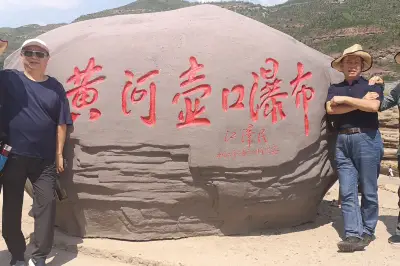
On the way from Xi’an to Yan’an, I started playing 'Defend the Yellow River' for the kids, hoping the song would help them understand our country's beautiful landscapes and that chapter of history, carrying on red education. Arriving at Hukou Waterfall, we met the Yellow River again – the same river we'd parted from in Qingtongxia, Ningxia. It had flowed north into Inner Mongolia and then all the way to Shaanxi. Hello again, Yellow River. I wish we could follow you to the estuary at Yingkou. The Yellow River, 200 meters wide, drops into a 50-meter-wide chasm at Hukou – pure grandeur, mighty and powerful. The splashing mist made it hard to keep our eyes open, and muddy droplets dotted our clothes with faint specks. Above the waterfall, a rainbow bridge seemed to link the east and west banks, fitting the spirit of the 'Yellow River Cantata' perfectly. Watching the live performance of the cantata in the scenic area, with its simple stage and raw, rustic show, my eyes grew moist by the end. The sons and daughters of China rose up, defending the Yellow River, defending North China, defending the whole nation. That evening we stayed at a hotel by Hukou Waterfall, but once the park closed, the access path to the falls was shut. How wonderful it would have been to be near the falls then, to see and listen. The song stayed with us until Yan’an, because there we also watched a performance called 'Return to Yan’an,' which included that same chorus. At night we tried Yellow River carp at the hotel, but it was just okay. Compared to freshwater fish from the Jiangnan region, it paled in quality. The middle and lower Yellow River is full of silt, so the water quality isn't good, and the fish can only taste so-so.
I should mention: we were on the west side of Hukou, which belongs to Hexi (west of the river). Across was Hedong – Shanxi Province. If the COVID outbreak in Xi’an hadn't been brought under control, we had planned to view the falls from the Shanxi side. At Hukou, we also took a helicopter ride to see the falls from above – a first-time experience for us. I remember three or four years ago in Sanya, when I wanted to take the kids on a helicopter, they all said it was too noisy and scary. Now they've grown up and are open to more experiences, and the things they're willing to try are increasing.
On the way from Hukou to Yan’an, what song should we listen to? 'Nanniwan' of course. We played many versions, each of us having a favorite. Following the navigation, we arrived at Nanniwan. I'm not sure if we were at the right spot or if it's just like that – an open attraction with no gate or ticket office, probably just these hills and cornfields. There was a large Party emblem landmark, and I took a photo of the big kid. Dad suggested I could apply to join the Party, but my real aim was for the kids to feel patriotism and respect for the pioneers and martyrs. On the highway to Yan’an, we could sometimes see original cave dwellings on the hillsides, unadorned, previously inhabited but now abandoned. I wanted the kids to see the earliest form of cave dwellings. Arriving in Yan’an, we stayed opposite Hongjie (Red Street). It’s a man-made themed street with red-themed performances, a training ground, revolutionary cultural products, lots of snacks, and a large outdoor playground where the kids played all evening. The performance was immersive – we walked and watched, very novel and quite stunning. It told the story of the Red Army's Long March, crossing snowy mountains and grasslands, and was carefully choreographed. The little one got so scared at the grassland crossing that she insisted on leaving, so Dad had to accompany her out, while I and the big sister watched the whole thing. There are over four hundred revolutionary sites in Yan’an, so an unremarkable corner on the roadside might be a site or a news liaison office. Yan’an is a city of valleys connected by tunnels. Speaking of tunnels, there was a small incident. In the evening, the big kid remembered she’d left her Helan stone zodiac pendant at the dinner restaurant. Dad called and was told it had been found. He took a taxi to get it, but on the way back he couldn’t find a taxi. From the phone call, we learned that if no taxi came, Dad would have to walk back. When I mentioned he’d have to go through a tunnel, the big kid got a bit scared and worried for Dad. All attractions in Yan’an are red-themed, so they’re free. At Wangjiaping, we’d hoped to see an Ansai waist drum performance but missed it; we rushed over at the sound of drums only to find the show had ended. We visited Yangjialing and Wangjiaping, where the great men lived and worked. Dad suggested seeing Zaolin (Date Grove). As we neared, we saw a sign reading 'Zaolin Visit' with a parking lot below. I found it odd – the characters for ‘visit’ looked tacked on, different from ‘Zaolin.’ As soon as we entered the lot, someone approached us to buy dog-head dates. Driving out, we realized that parking lot wasn't the scenic area’s lot at all. Dad decided to head back, move the car, and park at the proper scenic lot. When traveling, safety comes first – avoid scams and pitfalls. After two days in Yan’an, we were ready to head home. Yan’an's airport is built on a mountaintop; Dad said they probably leveled a hill to build it. Seeing that mountaintop airport reminded me of Hong Kong’s seaside airport: one taking off from a peak overlooking lush valleys, the other rising from the sea to soar over blue waters.
Our 15-day wandering journey came to an end. The kids were reluctant, asking for another round. Mom and Dad were a bit worn out and needed to return to work and normal life. We can only look forward to next year's trip.
Here's a picture to show you how to travel along the Yellow River. Would a song make you want to visit a place? Would a book make you want to see somewhere? Would a certain delicious food make you go taste it?