Meet Your Best Self on the Road – A 9-Day Trip to Xi'an, Zhangjiajie, Fenghuang, and Changsha
Lately, it felt like I was stuck in that 'same day,' living yesterday's life on repeat, one worry after another piling up. My husband and I decided to take our son away for a few days, to relax and step out into the world with a childlike heart, to live a few days of something different! Once we made the decision, my mood turned surprisingly bright, and suddenly those troubles didn't seem like such a big deal. We spent every day discussing where to go, learning about the famous sights and local customs, immersed in anticipation of things beautiful and fulfilling. We believed that on this journey, we would surely meet our best selves!
Because our online tickets had a transfer in Xi'an with a one-day stopover, we decided to seize the chance and visit the Terracotta Warriors first, then wander through Huimin Street, see the Bell and Drum Towers, and stroll along the ancient city wall. After that, Zhangjiajie and Fenghuang. Our son wanted to take a side trip to Sichuan to see the Leshan Giant Buddha, but considering the distance, we scrapped that idea and planned to go directly from Fenghuang to Changsha and fly home.
Day 1 (Dandong – Dalian – Xi'an)
We arrived at Dalian High-Speed Rail Station after five in the evening. We hurried through a quick dinner at a nearby seafood restaurant, then rushed out to head to the airport. Just as we were about to get into the car, we heard someone urgently shouting, “Wait, wait!” We turned around to see the young waitress from the restaurant standing breathless behind me, handing me my phone and power bank, panting as she told me I’d left them on the table. My heart was filled with such emotion and warmth that a thousand or ten thousand thanks wouldn’t be enough. If we'd gotten into the car and only then realized, even turning back would have risked our check-in time. If the phone couldn't be found, the trip would have been pretty much ruined, because I’ve grown so dependent on my phone – for everyday shopping, keeping in touch with friends, and for this trip’s flights, accommodation, and attraction tickets, all done on the phone. I felt so lucky to have chosen that restaurant, and it filled our journey with warmth right from the start. I told my son that we must pass on such warmth to others! In the evening, we arrived at Xi'an Xianyang Airport, contacted a nearby hotel, and a hotel car came to pick us up within minutes.
Day 2 (Xi'an – Zhangjiajie)
Going out in the morning, we discovered that the lanes on both sides were lined with persimmon trees. In this season, the trees were already laden with cute little persimmons, looking from afar like strings of tiny lanterns twinkling on the branches.
Thanks to my husband having studied in Xi'an, a local classmate’s car delivered us to the Mausoleum of the First Qin Emperor’s Terracotta Warriors Museum in Lintong in just over an hour. Because we arrived early, there were very few people when we started our visit. I'd done some research online, and everyone said it was essential to hire a guide. After comparing, the official professional guide service inside the museum was quite good, clearly priced at 90 yuan, and dedicated just to our family of three.
The Terracotta Warriors were discovered in 1974 by a farmer surnamed Yang while digging a well. It’s said that Qin Shi Huang began construction after ascending the throne at age 13, spanning 39 years and employing over 700,000 craftsmen. To keep it secret, all the workers were buried with him once it was finished!
Most of the warriors, when unearthed, looked like this. Our archaeologists meticulously identified, sorted, numbered, and pieced together these fragments… One warrior figurine requires several restoration experts over five months to complete. How incredibly painstaking! I suddenly felt deep respect for those who can quietly devote a lifetime to these monotonous earthen shards.
The Terracotta Warriors are known as the Eighth Wonder of the World, so we saw many foreign visitors who also love coming here. Some are simply obsessed with the warriors. Our guide told us a funny story: in 2006, a German tourist named Marlin brought his homemade Qin warrior costume to Pit No. 1 in the early morning, dressed up, and before any other tourists arrived, jumped down into the pit and posed as a clay warrior. He was later spotted by a visitor who found something 'off' and called the police, who had to painstakingly identify and extract him.
The guide told us that each warrior originally had many vivid colors when first unearthed, but due to technical issues, they oxidized rapidly, and within minutes all the colors vanished. What a pity.
Since Pit No. 2 was not damaged, this kneeling archer is the most intact one. Look, the color on the clothing behind him has even been preserved using special methods.
The texture of the hair is as clear as real. It’s said that each craftsman had to leave their name on the sole of the foot; if any part of the warrior was found to be less than perfect, that craftsman’s corresponding body part would be cut off as punishment. It shows how cruel the ruler was.
This is a high-ranking officer figurine. The guide told us the easiest way to distinguish ranks is the shoes: the higher the upturned toe, the higher the rank. Using this method, you can quickly tell the hierarchy of the warriors.
Weapons, war horses, and chariots were all made of bronze and, after over two thousand years, are still remarkably well preserved.
I’d seen the Terracotta Warriors on TV plenty of times and only came because of their fame since we were passing by. But when you stand right beside them, you see them standing in neat formation. Every figurine has a different face, a different expression – truly a thousand faces! Their postures vary too: kneeling, standing, holding horses. Yet all their eyes gaze forward with determination, ready for battle at any moment. These majestic, magnificent warriors are not only a great treasure of the Chinese nation but also a crystallization of the Chinese people’s wisdom and civilization, symbolizing the splendid culture of our ancient country. Looking at them stirred my heart and filled me with a passionate pride of being Chinese! No wonder Jacques Chirac, the former French president who adored Chinese historical relics, made a special trip to Xi'an, praising it as the Eighth Wonder of the World!
At noon, we returned to the city’s very famous Huimin Street to stroll and find lunch. At the entrance, we saw the Xi'an Drum Tower. In ancient times, people used morning bells and evening drums to tell time; not far away stood a Bell Tower.
Xi'an is abundant in pomegranates, so the freshly squeezed pomegranate juice here is genuinely sweet!
The sour plum drink and fermented rice soup were wonderfully tangy and refreshing.
Online reviews raved about Jia San Soup Dumplings, so we gave them a try. I thought the Eight-Treasure Porridge was the best thing I had there!
Walking out the way we came from Huimin Street, we planned to take our son bicycling on the Xi'an Ancient City Wall. Not far along, we saw the Bell Tower standing opposite the Drum Tower.
The Xi'an Ancient City Wall is what once surrounded the old city. We had intended to bring our son up to ride bikes while enjoying the views inside and outside the wall, but once up there, we found the bikes had no child seats, so we had to give up.
In the afternoon, the sky cleared, and the sunlight felt warm and pleasant on our skin. Since we couldn’t bike, we just ambled along the wall. My son, who usually hates photos, was in such a good mood that he kept striking poses for me. We spent the whole afternoon leisurely walking, looking, and taking photos on the ancient wall – what a beautiful memory it is now!
My husband went to university in Xi'an and missed the Big Plate Chicken he used to eat outside the campus. That evening, we spent an hour tracking down a restaurant that made it, and the taste was still great. I only remembered to take a photo halfway through eating ;)
Day 3 (Zhangjiajie National Forest Park – Yuanjiajie – Yangjiajie – Tianzi Mountain)
We booked a three-day Zhangjiajie tour in advance online with Blueberry Travel Agency. It was 1199 yuan per person, a small group of five, and we were very satisfied with the three days. The food, accommodation, and activities were all quite refined, without the problems of large groups like forced shopping, waiting, or rigid time limits.
The first night we stayed at Left Hand Holding Right Hand Inn outside the Zhangjiajie scenic area, a distinctive and very clean inn.
After dropping our bags, we followed our guide, Lü, for five or six minutes to the entrance of Zhangjiajie National Forest Park.
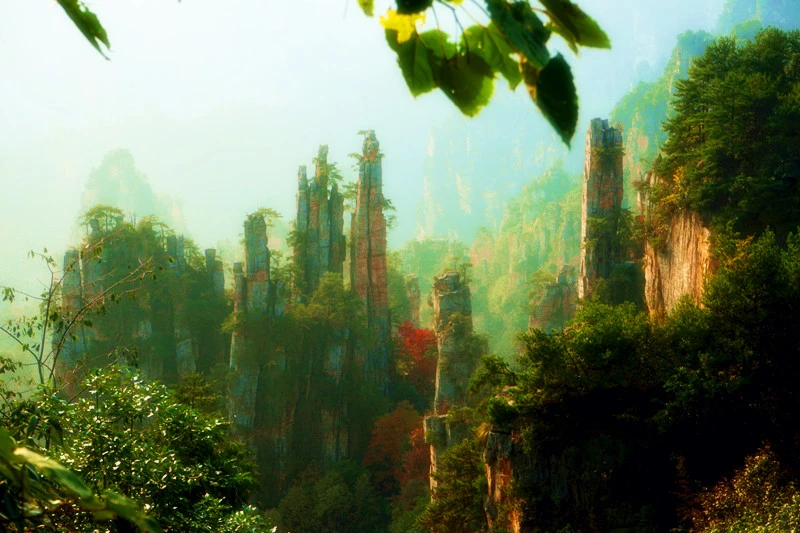
The Bailong Elevator – the tallest outdoor elevator in the world. As it ascended through the mountain tunnel and climbed higher and higher, the view opened up: tower-like karst peaks rose abruptly before our eyes, like giant stalagmites.
Walking on, we noticed many people gathered taking photos. Guide Lü asked us to guess what the peak in front resembled. Looking closely, haha, we instantly understood why everyone loved taking photos here. See, those peaks on the right – don’t they look like the four great figures on the old 100-yuan note?
Avatar filming location.
While walking, Lü kept reminding us: “Tomorrow, when you come back to the park, don’t carry food in plastic bags; keep it in your backpack. And when taking food out, check around for monkeys – there are lot of monkeys here.” We all laughed it off, “Haha, a monkey couldn’t just rob us, could they?!” But right at that moment, the southern girl in our group screamed “Ah!” as a dark shadow zipped past her. By the time we looked, a monkey had already snatched her plastic bag onto a slope beyond the guardrail and was casually munching a biscuit as if no one was watching! Poor girl, she couldn’t decide whether to laugh or cry – her big bag of snacks became an offering to the monkey.
Further along, we heard more screams ahead. We ran over and saw a monkey sitting on a female tourist’s backpack, rummaging for food! We all quickly checked if our own bags were zipped. When we met monkeys again, we were all very cautious. Just look at their eyes: they were fixed on every tourist’s hands and backpacks, as if they were security scanners!
Though these “little bandits” were brazen and aggressive, people never grew tired of them and still offered them treats. Turns out their bad behavior is all spoilt by visitors.
In the afternoon, we arrived at Zhangjiajie’s Yangjiajie scenic area. Looking out, a giant ink-wash landscape painting unfolded before us; the rocks in the foreground formed sections of a natural Great Wall.
Leaving Yangjiajie, we headed to Tianzi Mountain. After seeing its peaks, you’ll understand why Zhangjiajie is called “an enlarged bonsai, a miniature fairyland.”
In the evening, Lü took us to try local specialties, and everyone praised the “Three Pot” dish!
After dinner, we watched the grand “Charming Western Hunan” evening performance – a truly stunning feast for both the eyes and ears.
When the moon rose, Miao boys would gather in groups beneath the houses of the girls they adored, expressing their love through songs, dances, and by climbing ladders. This kind of primal love, clear as a spring and strong as wine, provided us with a feast of pure emotion.
“Driving Corpses” is a unique folk custom of western Hunan. This dance tells the true story of General Luo Rongguang, who at age 67 led his troops against the Eight-Nation Alliance, staining the Dagu Fort with his blood. Blended with the “Driving Corpses” legend, it shows the people of western Hunan’s loyalty, heroism, and deep attachment to home and soil.
Joy and sorrow intermingled – the most complex human emotion. Miao and Tujia brides began crying before their weddings, some for nearly a month, weeping for their parents’ nurturing love. The “Crying Wedding” ritual expressed this most complex emotion in a way that moved heaven and earth.
The mystery of western Hunan is a world-class topic. The famous “Driving Corpses,” “Gu Poison,” “Chenzhou Charms,” along with “Immobilizing Chickens,” “Climbing Sword Mountains” and “Slipping Through Fire Seas,” flying knives, and hard qigong were all demonstrated.
The blades on that knife mountain were indeed very sharp.
This is the fire sea; we felt the heat up close and can confirm it was real.
Day 4 (Zhangjiajie National Forest Park – Ten-Mile Gallery – Golden Whip Stream – Xibu Street – Zhangjiajie city)
Sometimes I’m a very sentimental person, often falling in love with a place just because of its name. That’s how I first grew fond of the “Ten-Mile Gallery” in Zhangjiajie National Forest Park, and it did not disappoint! After breakfast, we re-entered the park, our first stop being the Ten-Mile Gallery. Boarding the eco-friendly park shuttle, a foreigner smiled kindly at us, and my husband naturally sat down and chatted fluently with him in English for over ten minutes. I’d only known he had passed CET-6 and done brief translation work; this was the first time I’d seen him converse so effortlessly in English, and I was instantly filled with admiration!
About twenty minutes later, we arrived at the Ten-Mile Gallery. At the suggestion of the two southern girls in our group, we decided to skip the little train and stroll to enjoy the scenery! Along this over-five-kilometer valley, Nature once again displayed its uncanny craftsmanship, sculpting hundreds of rock formations resembling people, objects, birds, and beasts – some like “Peacock Spreading Its Tail,” “Medicine-Picking Old Man,” others like “Longevity God Welcoming Guests,” “Fierce Tiger Howling at the Sky”… As we admired this massive scroll, walking along, we seemed to melt into the painting ourselves!
Lü told us these are the Three Sisters Peaks, each holding or leading a child, but we thought it looked more like the character Zunzhibao from Stephen Chow's movie A Chinese Odyssey.
Here, you can let your imagination soar and name the peaks whatever you like!
A big camel resting on the ground.
This peak looks even more like a giant camel.
Twilight romance – see, the old grandpa gazing tenderly at the old grandma.
A distant rock giving us a thumbs-up.
At noon, we hopped back on the eco-friendly shuttle, and minutes later reached the next stop: Golden Whip Stream. Following the sound of gurgling water, a crystal-clear creek appeared, its surface shimmering so brightly in the sunlight you could hardly look at it. The rocks in the stream, big and small, were covered with lush green moss, brimming with life and vitality. We tossed pebbles at the water’s edge, made little boats from leaves, and hopped from stone to stone from one side to the other, having an absolute blast. In that moment, we forgot our ages and roles, simply soaking in nature’s gifts, already quite drunk on the moment! I think it’s only during travel that one can so easily and comfortably meet one’s best self!
Passing a small square, a troop of monkeys scurried toward us, and my son jumped with excitement. We’d bought peanuts, biscuits, and fruit at a supermarket that morning to feed them, but until the Ten-Mile Gallery we’d only spotted one. Lü said we might not see any more today, and my son was so disappointed. I think for a child, getting up close to little animals might be the happiest part of traveling. Because of yesterday’s experience, my husband kept glancing around, and when the monkeys weren’t looking, he’d turn his back, quickly slip a hand into his clothes, and whip out a few peanuts, terrified they’d spot him and raid his pockets directly. Haha, he looked just like a thief!
After a while, we found that the monkeys at Golden Whip Stream weren’t as wild as those at Yuanjiajie; even when impatient, they’d wait politely for you to toss them the food.
We gave all our snacks to the monkeys and then reluctantly left. Whenever I recall this trip, closing my eyes, the scene of that afternoon often floats into my mind, my heart filled with something warm…
Leaving Zhangjiajie National Forest Park, we took a double-decker bus to “Xibu Street.” The kid, riding a double-decker for the first time, was once again bursting with uncontrollable excitement!
That evening, we returned to Zhangjiajie city. Guide Lü arranged our hotel by the Lishui River, another place with great taste.
I can’t remember the name of this fish dish, only that it was wonderfully spicy, fragrant, and delicious, unlike anything I’d ever tasted!
The Lishui River at night.
Day 5 (Zhangjiajie – Tianmen Mountain – Fenghuang Ancient Town)
I’d always wanted to come here because of a poem I loved: “The Tianmen breaks the Chu River open, the clear water flows east tracing back. On both banks, green mountains stand across, a lonely sail comes from the sun’s edge.” But when we actually arrived, we realized this “Tianmen Mountain” was not that one! However, after a whole day, we were completely conquered by this magical Tianmen Mountain!
Speaking of its magic, the first marvel lies in the cable car up the mountain. Elsewhere, cable cars start from the foot of the hill, but Tianmen Mountain’s cable car begins right in Zhangjiajie’s city center, spanning 7,455 meters. After queuing for nearly two hours, we boarded the all-glass cable car, passing over parks, railway lines, and lakes before finally reaching the mountain base. Then the truly terrifying moment came: the higher the cable car went, the steeper the ropeway became, until it felt almost vertical. Through the glass bottom, we looked down at a bottomless abyss! We all held our breath, not daring to move a muscle, fearing the slightest shift might send us plunging.
The second marvel is the naturally formed Tianmen Cave on the mountain. This cave attracts adventurers from all over the world.
The 2016 Wingsuit Flying World Championship was held right here.
Standing atop the mountain, looking at that wingsuit launch platform, my legs went weak just imagining the courage it takes to jump off. I felt both admiration and worry.
The third marvel: the winding mountain road going down. Don’t underestimate this road; its design is unprecedented and unparalleled. The entire road has ninety-nine bends, each one a hairpin turn. Riding in the car, we twisted and turned along this route, but there was no need to worry – the driver’s skill was top-notch.
In the afternoon, we traveled four hours from Zhangjiajie to Fenghuang, arriving at Fenghuang Ancient Town well past seven in the evening. It was just when the town’s lanterns began to glow, antique and enchanting, and we were simply intoxicated.
Small shrimp freshly scooped from the Tuojiang River, still jumping, were deep-fried right away – fresh and crispy.
Day 6 (Fenghuang Ancient Town – Changsha)
The early morning ancient town was quiet and serene.
In Hunan, whether at a big restaurant or a tiny eatery, before the meal the waitstaff brings a basin and a kettle of boiling water for you to scald your own tableware. It’s reassuring and comfortable; we should really adopt this back home. At noon in the ancient town, we tried a local specialty – Blood Glutinous Rice Duck. Maybe we’re not used to the flavor, but it truly wasn’t as legendary as people say.
We wandered through the town’s market for a bit. The horned melon was super unpalatable, though they say it quenches thirst and cools you down. Red-heart kiwis were pricey but delicious. The cured meat is very famous here.
In four days, we explored the natural landscapes of Zhangjiajie and Fenghuang, and also learned a lot about the folk customs of western Hunan. We grew fonder and fonder of this place.
Day 7 (Changsha – Yuelu Mountain – Orange Isle – Pozi Street)
Standing inside Yuelu Academy, scenes from historical TV dramas of ancient scholars studying flashed through my mind.
“Aiwan Pavilion” (Autumn-Admiring Pavilion) gets its name from Du Mu's poem “Mountain Travel”: “I stop the carriage, charmed by the maple woods at dusk.”
Ancient temple on Yuelu Mountain.
At noon, we grabbed snacks from Duoluo Street at the foot of Yuelu Mountain. Since we were in Changsha, we had to try its famous street food – stinky tofu. We queued over half an hour to get it. Biting in, it was fragrant, crispy, fresh, and spicy – absolutely fantastic. Only then did I realize the stinky tofu I’d tried elsewhere was completely inauthentic.
“Handsome Guy’s Flatbread” – not only was the guy good-looking, his flatbread was even better.
Aside from Yuelu Mountain, Orange Isle is another must-visit spot in Changsha. We came because we love Chairman Mao’s poem “Changsha – to the Tune of Spring in the Garden,” and we wanted to walk and see the places he frequented back then.
After an hour’s walk, we finally stood before the sculpture of young Mao. Looking at his solemn expression and those eyes weighed with concern for the nation, I was deeply moved. In 1925, the youthful Mao, holding ideals of national salvation, revisited this place. Standing at the head of the isle, facing the surging Xiang River, his heart stirred, thoughts flying, pondering the nation’s fate and future, he wrote the impassioned “Changsha – to the Tune of Spring in the Garden.”
In the cold autumn alone, I stand at Orange Isle Head, watching the Xiang River northward flow. I see hills red with maple leaves, layers of forests dyed; the river clear to its depths, a hundred boats race forth. Eagles soar the sky, fish swim the shallows, all creatures fight for freedom beneath the frosty sky. Bitterly lost in this vastness, I ask the boundless earth, who decides the rise and fall?
Here many friends once traveled with me, recalling those crowded months and years of struggle. Just a student then, in the prime of life, with scholarly spirit, we freely criticized and debated, pointing out our land and writing with passion, counting the powerful as dust. Do you remember, how we struck the midstream waters and the waves stayed even the speeding boats?
That little train – my son could never get enough of it. Look at him sitting in the front row of the little train, grinning from ear to ear.
That evening, we took the subway directly from Orange Isle to Pozi Street.
For some reason, the kid took a special interest in Peking opera and sat himself down to listen intently.
For dinner, we tried a century-old restaurant – Wenji Siheyi. We ordered the two-color fish head and spicy crayfish, among others. It lived up to its reputation: the two-color fish head was delicate, rich but not greasy, spicy and delicious; the crayfish, bright red and glossy, tender and delightfully spicy – simply divine!
Day 8 (Tianxin Pavilion – Hunan Science and Technology Museum)
It was here we learned that Changsha’s ancient sites like Yuelu Academy, Pozi Street, and Tianxin Pavilion were reduced to ashes in the “Scorched Earth Resistance” strategy formulated in 1938 when Japanese forces approached Changsha. That fire raged for five days and nights, claiming over 3,000 lives in what became known as the “Wenxi Fire.”
The Science and Technology Museum is a must-visit every time we travel with Xiaomi. He never tires of it!
Day 9 (Changsha – Dalian – Dandong)
By six in the evening, our family of three returned safely to Dandong. Sitting together over dinner, we savored every little moment of this journey. Though there were many little hiccups along the way, we all felt that everything was the best possible arrangement. Yes! It was precisely with this mindset that we could face whatever came our way with calm and composure. I think we’ll carry this wonderful attitude back into our daily lives and work, always striving to be our best selves!
And we hope that as we slowly grow old, we’ll sit in rocking chairs leafing through these photos, recalling those beautiful times together…