A Two-Day Round Trip Train Journey from Xi'an to Hanzhong: Following Grandfather's Footsteps to Hanzhong
Hanzhong is a place I've known and kept vividly in mind since childhood from hearing my grandfather's stories; I once made a rushed visit to Hanzhong too. Now more than fifty years have passed, and during these dual holidays, I especially miss my sincere, kind, wise, tolerant, and generous grandfather. This is the first time I have come to this place—where he studied, lived, and worked for 16 years—to follow in his footsteps. Here, my grandfather grew from a bewildered teenager into a successful businessman. Hanzhong was his second hometown...
Day 1: After breakfast, I headed straight to the high-speed railway station. At the entrance, I bought a ticket for the nearest departure, costing 97 yuan. There was no waiting once inside, and I boarded directly. The scenery along the way was beautiful, passing through the lush Qinling Mountains and then the flat expanse of the Hanzhong Basin. The white-walled houses of Hanzhong, with a hint of Huizhou architectural style, were a distinct contrast to the yellow-walled ones in Guanzhong. As the train moved on, I kept recalling the stories my grandfather used to tell me.
When he was 16, he followed an elder over mountains and ridges to Hanzhong. At first, he worked as an apprentice, doing odd jobs—running errands, cleaning, looking after the boss's children, emptying chamber pots in the morning, and preparing foot-washing water in the evening. Because he was hardworking and dependable and had attended private school, by age 18 he had become the shop’s bookkeeper, and by 20 he was the chief accountant for the entire chain, with branches across several provinces. He frequently traveled between Hanzhong, Chengdu, Lanzhou, Baoji, and Xi'an for inspections and business. At 32, unable to attend to his family because of constant traveling—my grandmother had by then given birth to my father—he resigned and returned to Xi'an to open his own shop and settled his family in the city. Later, he became the owner of six shops, either self-run or as a shareholder, a well-known gentleman for miles around his hometown, and after the founding of the New China, the township government even honored him with the title of “Enlightened Personage.”
Over those 16 years, every year it took my grandfather about half a month of travel on foot or by sliding litter to cross mountains and rivers back to his Xi'an home. On one trip, he and the litter bearers spent the night in a small mountain temple and were robbed by bandits. Using his wits and courage, my grandfather escaped disaster. Hearing the bandits climb the temple wall, he stripped off all his clothes, knelt in the center of the hall, and tucked his hard-earned gold bars between his legs. The bandits saw there was nothing to search on his bare body and only took some travel money from his bundle before leaving, causing no great loss. These bandits wanted only money, not lives, and the mountain folk carrying the litter were honest and simple.
Lost in these memories, the train attendant soon announced we should prepare to alight; the high-speed journey took about an hour and a half. I marveled at today’s advanced technology, economy, and transportation.
After getting off, I easily found the bus to “Caoyantang.” This was the place my grandfather had reminisced about for decades, famous for its tribute-grade rice. In his words, it surpassed Tianjin Xiaozhan rice and Ningxia tribute rice, and of course outperformed Northeast rice and the “Guihuaqiu” rice from our local Wuxing Township. He said the fragrant rice was so good you could eat several bowls without any accompaniment. In fact, Caoyantang is less than an hour from Hanzhong city center. I had imagined it to be a sizable town, but it’s only a village. After getting off, I strolled around the village, then walked out to the field edges. The sky was so blue, the soil and water were so fragrant. I chatted with locals and learned that rice has been cultivated here since ancient times. Every morning, the mist is heavy and dew fresh, the land fertile and sunshine ample—perfect for tribute rice. Since the yield is low, the locals rarely eat it themselves, and now to expand market opportunities, the area is already known throughout Hanzhong as the land of cured meats.
After a little over an hour of casual sightseeing, I took the returning bus back to the city center. Thus, I had roughly experienced several things my grandfather cherished for decades: “Yuexingzhao” pipe tobacco, “Nianzhipo” cured beef and lamb, “Demao Gong” crystal sugar cakes, and the rice of Caoyantang—only the last is not in Xi'an but in Hanzhong.
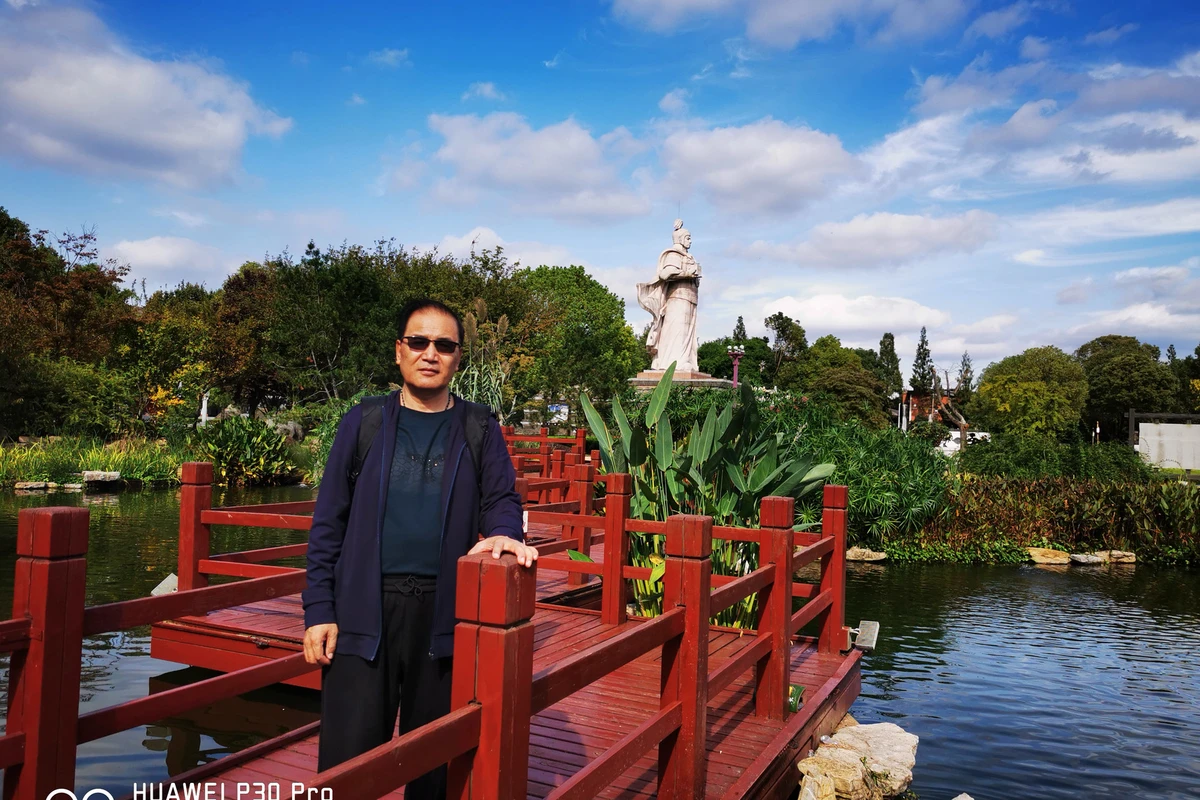
Back in the city, I wandered around Baidu Square and Tianhan Wetland Park along the way. The park is located in the city center, stretching about 6 kilometers along both banks of the Han River, with a total area of about 10 square kilometers. It’s a comprehensive wetland park integrating ecology, leisure, fitness, and entertainment. With natural ecology, Han culture, and Jiangnan-style charm, it forms a distinctive layout of one river, two banks, three sections, nine zones, and over fifty scenic spots. The area was so vast and long that I only explored a small part without venturing far.
I then went to see the surviving old city wall near the intersection of Minzhu Street and Xihuan Road, where only a few remnants remain. The history of Hanzhong’s city walls is very long, dating back to the Warring States period before the Common Era. The restored section now is designated by the government as one of Hanzhong’s “Historic and Cultural City Memorial Sites.”
After that, I hopped on a shared electric scooter for a few minutes and arrived at Baijiangtai (Platform for Appointing Generals) historical site. The entrance fee was 20 yuan. Tradition says this platform was built when Liu Bang appointed Han Xin as his general-in-chief. It is now listed as a key cultural relic protection unit of Shaanxi Province.
When Han Xin was young, he had grand ambitions but was not given an important post by Xiang Yu. After joining Liu Bang, he was still overlooked, so he left. When he reached the Fan River in what is now Liuba County, Prime Minister Xiao He caught up with him under the moonlight—hence the allusion “Xiao He pursued Han Xin by moonlight.” Xiao He persuaded Liu Bang, who chose an auspicious day, set up a ceremonial altar, and appointed Han Xin as his chief general. A memorial structure, the Baijiangtai (also called Baijiang Altar), was built to commemorate the grand investiture. After his appointment, Han Xin led campaigns to conquer Wei, Zhao, subdue Yan, pacify Qi, and destroy Chu, achieving glorious military victories for the Han dynasty. He was named King of Chu and, together with Xiao He and Zhang Liang, became known as one of the Three Heroes of Han’s Rise. Sadly, in the 11th year of the Han King’s reign, someone falsely accused Han Xin of rebellion; Liu Bang believed it, and Han Xin was tricked, captured, and executed by Empress Lü. The great hero died young, but this altar endures. The courtyard is lush with grass and trees, willows and elms shade the ground, the pond water is jade green, and flowers reflect like mirrors—the scenery is exquisite. Several exhibition rooms recount General Han Xin’s grand strategy and exploits, as well as the vicissitudes of Hanzhong through the ages. The Baijiang Altar now draws increasing numbers of visitors with its new look.
After visiting the altar, I checked into a nearby hotel to rest. After dinner, I took a leisurely walk along the Han River to enjoy the nightscape. The Han River is the largest tributary of the Yangtze, originating in Ningqiang County, Shaanxi, on the southern slopes of the Qinling Mountains, flowing through Mianxian to Hanzhong, passing Ankang, and exiting Shaanxi to join the Yangtze at Hankou. It nourishes the people on both banks, and as the saying goes: “I am Han Chinese; I speak the Han language; I write Han characters—because we once had a great dynasty: the Han dynasty.” Since ancient times, Hanzhong has been praised as the “Cradle of the Han” and the “Land of Abundance”; it is the “throat of Qin” and the “gateway to Shu.” Hanzhong got its name from the Han River flowing through it and is a National Historical and Cultural City and an excellent tourism city of China. It is a prefecture-level city in Shaanxi Province, bordering Baoji to the north, Ankang to the east, Sichuan to the south, and Gansu to the west, with an area of nearly 30,000 square kilometers and a population close to 4 million.
The musical fountain on the Han River is famous province-wide, a comprehensive large-scale water spectacle integrating musical fountains, lasers, lighting, and sound. Though it wasn’t operating tonight, which was a bit of a pity, I still saw lovely scenes of citizens strolling and entertaining themselves. Especially impressive was a large group of dozens of women performing a fitness dance—graceful, soft, yet full of momentum.
Day 2: After breakfasting on Hanzhong hot rice skin noodles, I walked a few minutes to Tianhan Wetland Park along the Han River for a stroll. This is a free public park. Breathing in the sweet-scented osmanthus fragrance, feeling the fresh breeze, and taking in the riverside beauty—distant mountains, near reflections, white clouds against blue sky—was immensely refreshing. In the square, women danced, men fished along the bank, elders exercised, and children played: a harmonious, happy scene that made me envy the fortunate people of Hanzhong. Because the riverside park is very long, I alternated between walking and riding; I must especially praise Hanzhong’s shared e-scooters for being so convenient!
After the riverside scenery, I headed into the city’s Han Native Street for a look around. This is a commercial block that integrates distinctive Han-style vernacular architecture, filled with Han cultural atmosphere. It was bustling yet timeless, shaded by green trees, with people leisurely shopping—a slow-paced street life that was enviably pleasant.
I entered through a gate in the middle of the old street, which led to former royal mansion gardens. Now renovated and open to the public for free as Lianhuachi (Lotus Pond) Park, it sits in a prime location in downtown Hanzhong. Though not very large (about 120 mu), it offers an elegant and comfortable environment. Inside, there is a library; the park is a community space mainly for people’s leisure and cultural recreation. Lotus ponds, weeping willows all around, islets in the water, pavilions and terraces, tiny bridges over flowing streams, green shade, and colorful flowers create a natural landscape of mountains and waters, with a unique charm.
After visiting the park and street, I hopped on a handy shared e-scooter for the railway station, casually bought a 97-yuan ticket for the next high-speed train, and returned to Xi'an.
This trip cost about 400 yuan per person and was completely relaxing, enjoyable, and well worth it!