An 18-Day, 10-Flight Leisurely Journey Across Southern and Northern Xinjiang, Starting from Xi'an
Xinjiang, a vast and mysterious land in my heart. I had once skimmed its surface with a tour group, passing through Hami, seeing the karez wells and Grape Valley in Turpan, stopping briefly in Urumqi and Changji, and gazing upon the Heavenly Lake of Tianshan—that was all. Watching friends explore Xinjiang in depth, either by car or with tours, made me green with envy. This time, I persuaded my wife to join me on a free-and-easy trip, venturing into the western regions to scratch beneath the surface and fulfill a long-held wish. Considering the climate—warm in the south and cold in the north—we decided to travel from south to north, gradually leaving the chill behind, which also simplified our wardrobe and preparations for keeping warm. Our plan was to fly from Xi'an to Kashgar, spend a few days in the city, but because of concerns about high-altitude oxygen levels, we would skip the many stunning sights of the Pamir Plateau. Then we would fly to Ili, to experience what many consider the peak of Xinjiang's scenery. Finally, we would fly to Burqin, to feel the boundless charm of this fairy-tale border town on the west frontier; due to time constraints, we would leave the most beautiful Kanas for another trip. After bidding farewell to Xinjiang, we would fly directly from Altay back to Xi'an, completing a triangle-shaped, grand circular independent journey.
Xinjiang Uygur Autonomous Region, known simply as Xinjiang. It is China's westernmost provincial region, an autonomous region for ethnic minorities, and the largest provincial-level region by land area, accounting for one-sixth of the country's total territory; as the saying goes, one cannot truly grasp China's vastness without visiting Xinjiang. Its population is around 23 million, with ethnic minorities forming the majority, roughly 60%. Xinjiang has been an indivisible sacred part of Chinese territory since ancient times, and here one must touch upon its historical origins: after the Opium Wars, the Qing Dynasty grew increasingly weak, and China's territorial sovereignty was trampled by imperialist powers. It was not until the Qing governor-general of Shaanxi and Gansu, Zuo Zongtang, was appointed imperial commissioner in charge of Xinjiang affairs and, overcoming countless hardships, recovered Xinjiang that a new chapter began. In a memorial to the emperor, he wrote that Xinjiang was "old land newly returned," hence the name of the region carries the meaning of "old territory newly returned," a significance that endures to this day. Here we must also express special gratitude and respect to the Xinjiang Production and Construction Corps, which has guarded the borders for decades, with a total population of about 2.57 million military personnel and their families.
This immense and enigmatic land is well worth an in-depth visit.
Day 1. First, we booked Xi'an–Kashgar flight tickets through Ctrip ten days in advance, choosing the most favorable balance of time and price at 985 yuan per person. It was a connecting flight with a four-hour layover in Turpan, where a simple meal cost us 37 yuan each. After flying into Kashgar Airport, we took an 18-yuan taxi to a folk-style hotel in Kashgar Old City, also booked via Ctrip at 99 yuan per night for a twin room. After a short rest, we stepped out and found ourselves right on the dining street of the old town scenic area, where we enjoyed a late dinner of authentic Xinjiang specialties—ice cream, grilled meat, baked buns, and more—averaging 38 yuan per person. Exhausted from a day of flying and driving, at what was already past 10:30 at night in the interior of China (and still bright as day in Kashgar), we hurried to bed, eager for the welcome ceremony performance at the East Gate of the old city the next morning.
Kashgar is the southwesternmost city in China's Xinjiang Uygur Autonomous Region and a key hub on the ancient Silk Road. Its total area is 97 square kilometers. The Uygur population is the largest, accounting for 74.8% of residents. With a long history, it was already the capital of the Shule Kingdom—one of the 36 Western Region kingdoms—when Zhang Qian of the Western Han Dynasty pioneered the route to the Western Regions. Kashgar is short for "Kashgaria," which in Uygur means "a place where jade gathers." Kashgar's economy is mainly agricultural, rich in grain and fruit, supplemented by handicrafts; it is a folk art center, with beautiful pottery, textiles, and dyeing. Transport in Kashgar is exceptionally convenient, with smooth air links and highways radiating in all directions, linking domestic and international destinations, making it the transport hub of southern Xinjiang. We looked forward to seeing its mysterious beauty.
Day 2. According to our host, the free welcome ceremony performance would begin at 10:30 a.m. and last about half an hour. We were up bright and early at 9 a.m.—which felt like 7 a.m. in the interior—when the streets were still quiet, and went for breakfast at a street stall, averaging 9 yuan per person. Afterward, we walked along the winding old streets toward the East Gate, arriving about twenty minutes later. Near the gate, we each bought a set of Uygur ethnic costume and hat for 90 yuan at a clothing shop, donning them to add a sense of solemn festivity.
Kashgar Old City Scenic Area is a national 5A-level open scenic spot and a living Uygur neighborhood located in the center of Kashgar. Here, family life, ethnic customs, traditional handicrafts, and local cuisine are all vividly on display. Covering 3.6 square kilometers, it has weathered over 2,000 years of wind and rain, giving rise to the saying, "You haven't been to Xinjiang if you haven't been to Kashgar, and you haven't been to Kashgar if you haven't visited the old city." It serves as a specimen and cross-section of various historical periods and is praised as a living fossil for studying ancient Western Region cities—also the most valuable, impactful, and representative historical and cultural city for researching the culture of the ancient Silk Road.
When we arrived at the East Gate around 10 a.m., it was already a sea of people, and locals and tourists had already begun spontaneous Xinjiang song-and-dance performances on the venue, full of warmth and excitement. At 10:30 sharp, to lively and cheerful Xinjiang music, the host's resonant voice announced the official start of the welcome ceremony. Handsome young men and women of Kashgar, dressed in gorgeous ethnic costumes, swayed and danced slowly onto the stage. There were also performers playing historical figures and modern celebrities, as well as scenic-area guides, each explaining Kashgar's past and future in their own way, extending a warm welcome to visitors from across China and abroad, and introducing local customs and ethnic features. With the old city gate as a backdrop, the whole scene was steeped in simplicity and elegance, rich in regional, historical, and ethnic flavor—truly a feast for the eyes and ears, leaving us thrilled, grateful, and overjoyed.
Half an hour later, the ceremony ended, and the old city gate resumed its usual calm, with tourists snapping photos and strolling in an endless stream. We took our own pictures, then followed the crowd to the Gaotai Ancient Homes across the street, a free scenic spot. Gaotai is a Uygur residential settlement at the northeastern edge of the old city, built on a loess cliff over 40 meters high and more than 800 meters long. The cliff has existed for over two millennia, and Uygur ancestors began building homes here more than a thousand years ago. The houses are constructed of mud and poplar wood; the branches were stripped but not planed, and the wood is used directly for framing and supporting roofs, lofts, and balconies. The whole neighborhood looks shaky and loose, but it's said that the houses are actually very sturdy, with many standing for hundreds or even a thousand years. Dwellings are built against the cliff; as families grew over generations, new floors were added above the ancestral homes, so house connects to house and floor to floor, layer upon layer. Mostly made of earth, these connected dwellings support one another and resist various disasters. Among these randomly stacked houses and external additions, more than 50 lanes branch out in all directions, winding and crisscrossing, rising and falling. Currently, over 640 households with more than 4,000 people live here, covering 57,000 square meters. Historically, the high cliff's north and south slopes were connected, but later floodwaters severed them. The north cliff is where the old city of Kashgar—the site of the Karakhanid palace—stands, and the south cliff is the Gaotai Ancient Homes, hailed by Chinese and foreign visitors as a "living folk museum of Uygur life."
Afterward, we slowly returned to our accommodation in the city center for a rest and lunch.
Lunch was again Xinjiang-style grilled meats and ice cream, delicious and filling, averaging 29 yuan per person.
In the afternoon, we strolled around casually; just across the street was the mosque quarter, home to many Instagram-worthy spots and beautiful scenery everywhere, perfect for photos. There was also a folk performance of a princess choosing a groom—lively and full of ethnic flavor—a free show every day at 4:30 p.m., well worth watching.
Day 3. After a breakfast averaging 8 yuan, we took a 2-yuan bus to the much-anticipated "Fragrant Concubine Garden" 5 kilometers east of the city center. Entry is free, and the garden covers over 300 mu (20 hectares). The architecture blends ethnic features with modern elements, telling the legendary story of the Fragrant Concubine from three perspectives—her hometown, former residence, and personal life—from birth to death, from Kashgar to Beijing, and from Princess Xiangxiang to a woman adorned with overwhelming imperial love.
"Happy Fragrant Concubine Garden, a place to celebrate love"—here you can deeply understand the love story of the Fragrant Concubine. A woman worthy of respect—well-read, accomplished in music, chess, calligraphy, painting, horseback riding, archery, song, and dance, kind, gentle, tolerant, and possessing a natural body fragrance, a Uygur woman… "Xiangfei." She was Emperor Qianlong's Rong Fei, named Hezhuo Fatima, a Uygur from Kashgar. She had a unique body fragrance, was 167 cm tall, and had blood type O. Her appearance differed from Han women: fair and rosy skin, a high-bridged nose, large deep-set eyes, an oval face, and red lips—a peerless beauty. Among Qianlong's consorts, many were stunning, but Rong Fei not only had fine features but also an exotic charm. She had no interest in power and never interfered in political matters. She had no children, so she posed no influence on the present or future throne. The reasons she could gain Qianlong's favor, apart from the political marriage alliance, lay in her own amiable personality, her skill in dressing up, and her harmonious relationship with Qianlong's mother—all without political ambition. These were key reasons why she stood out among the three thousand palace beauties and became Qianlong's beloved consort, and it was no accident. Every time Qianlong went on an inspection tour, he would take Rong Fei along; he could hardly bear to be apart from her. Rong Fei died of illness at the Old Summer Palace at age 54. After her death, the nearly 80-year-old Qianlong wept bitterly in profound sorrow. He decreed that no new empress or noble consort would be appointed, so at that time, the rank of consort was the highest in Qianlong's harem.
We spent two hours here, not only experiencing the unique regional customs up close but also, by learning about the Fragrant Concubine, seeming to personally feel the kindness, simplicity, wisdom, and versatility of the Uygur people's folk ways. Then we took the 2-yuan bus back to our lodging for a rest.
In the afternoon, we cycled to the city's People's Park for a visit. With towering trees casting deep shade, lawns soft as felt, gurgling streams, and melodies winding around the beams and graceful dancing, it is a delightful spot for citizens' leisure and recreation. Built in 1953 near the municipal committee and residential quarters, it was Kashgar's first park. Covering 24 hectares, it is home to over 50 tree species (more than 260,000 trees), over 40 flower types with 800 varieties, and a greenery coverage of 96%. Winding paths total over 4,000 meters in length. The statue of Chairman Mao, standing solemnly in front of the municipal committee opposite the park, remains radiant and magnificent, with the words "Serve the People"—strikingly clear and heartwarming.
We strolled for over an hour; the park was so large we couldn't cover it all, and we hoped to visit again if opportunity allowed.
Day 4. After breakfast, we took a 2-yuan bus to the Kashgar Museum. The new site of the Kashgar Museum is located on Tianshan West Road, in a still somewhat quiet area. Occupying 50 mu (3.33 hectares), with a floor area of 15,100 square meters, the main building has four floors, including an exhibition space of 6,500 square meters. It houses over 5,300 items (sets) of collections, including 63 (sets) of precious cultural relics. This is a comprehensive history museum, currently presenting four basic exhibitions: "Kunlun River Basin & Ancient Road Treasures—Kashgar Historical Relics Display," "A Special Exhibition on Historical, Ethnic, and Religious Culture in Xinjiang, China," "Exhibition on Economic and Social Development in Kashgar Prefecture," and "Kashgar Prefecture Planning Exhibition." Here, you can not only appreciate Kashgar's long history and rich culture but also feel its rapid, ever-changing development and vigorous growth momentum. We browsed for about two hours before returning the same way to rest.
After lunch, we cycled to East Lake Park. Beside the park is the Gaotai Old City. Inside the park, rippling lake waters, swans in flight, fish swimming leisurely, pavilions and towers, lush green trees, magnificent sculptures—a boat ride on the lake is also a wonderful experience. Bars and restaurants are convenient, making it an ideal spot for tourists and locals to enjoy natural resources and relax. Riding the Ferris wheel offers a panoramic view of the entire city. We delighted and lingered for over two hours before cycling back to our lodging to rest.
In the evening, as night slowly fell, we strolled through the old city to the bar street, experiencing where the young and trendy gather. Every doorstep here dazzled with lights, song, and dance. Passersby and tourists, drawn by the music and movement, couldn't help joining the joyful crowd; one could also sit indoors or under roadside canopies, sipping wine, drinking tea, eating meat, and enjoying the show—utterly delightful. At the end of the street, in the northeast corner of the old city, stands a hundred-step high platform, on which perches a pavilion named "Geng Gong Shrine." Who is Geng Gong? Few people know, and even in history, he is not well known. Although he only had one major encounter with the Xiongnu, his actions were so fierce, like a sudden clap of thunder, making the Xiongnu think a deity had descended. This thunderclap became a historical echo, and that man was Geng Gong.
Geng Gong, courtesy name Bozong, was from present-day Xingping, Shaanxi. In the 17th year of the Yongping era of the Eastern Han Dynasty, as a Major commanding troops, while Ban Chao served as acting Major, they accompanied the General of the Chariots and Cavalry, Dou Gu, leading 14,000 cavalry from Dunhuang to the Western Regions. They defeated the Northern Xiongnu's Huyan Prince regiment at Baishan and subsequently subdued the kingdoms of Nearer and Further Jushi. Geng Gong firmly controlled the strategic throat through which the Xiongnu entered and left the Western Regions, making this place the center of Han army operations in the region. It was precisely because Geng Gong garrisoned here that Ban Chao could freely negotiate in Khotan, Loulan, Shache, and elsewhere, persuading those kingdoms to break with the Xiongnu and submit to the Han. Ban Chao was the mover, Geng Gong the steadfast anchor; they echoed each other from afar. Hence, Geng Gong’s fame never matched Ban Chao’s, but his contributions cannot be overlooked. When Geng Gong led his troops eastward back home, Xiongnu skirmishers continuously harassed and pursued them; the Han army fought as they marched. By the time they reached Yumen Pass, only thirteen soldiers remained, all "in tattered clothes and shoes, gaunt and haggard." Geng Gong’s defense of Shule City, his unwavering commitment in a near-death situation, upheld the dignity of the Great Han. Because of Geng Gong, we have the heroic line in Wang Wei’s poem "A vow to make a flying spring gush from Shule," and Yue Fei’s stirring pledge, "My hungry appetite feasts on the flesh of invaders, in light-hearted talk I thirst for the blood of the Xiongnu." What has been passed down is a loyal integrity and martial spirit that flows through our national bloodline for millennia. Over eighteen hundred years later, Liu Jintang, part of Zuo Zongtang’s western expedition that recovered Kashgar, deeply admired Geng Gong’s bitter defense of Shule City for more than 300 days and prostrated himself before his spirit and moral character. Because the Han Chinese city of Kashgar was also called Shule, he ordered the construction of Geng Gong Shrine—also called Geng Gong Tower—on the highest point of the Muslim city of Kashgar to express his reverence. On either side of the towering Geng Gong platform, a pathway rises; in the center of the steps stands a bronze statue of Geng Gong, imposing and astride a galloping steed, the horse’s front hooves high in the air, its mane flying. The whole statue is lifelike, capturing the heroic bearing of the Great Han's martial soul. Climbing the steps leads one to the awe-inspiring Geng Gong Shrine.
Standing on the steps outside Geng Gong Shrine, overlooking Kashgar Old City, we saw it ablaze with lights and boundless beauty. Below was the Kashgar sub-venue for the CCTV Spring Festival Gala live broadcast; the nightly light show starting at 10 p.m. made the old city even more radiant, displaying the multi-dimensional beauty of Kashgar. Combined with music and dance, it was truly magnificent and extraordinary.
After enjoying the music, dance, and light show, we wandered through the old city streets at night on our way back, feeling an infinite happiness and wonder.
Day 5. After breakfast, we took another turn around the old city, admiring and photographing, reluctant to leave. In the afternoon, we took a 20-yuan taxi to Kashgar Airport and flew to Ili, with a transfer and overnight stay in Aksu. The hotel was near the airport in Wensu County, booked through Ctrip at 100 yuan, and dinner at a nearby restaurant averaged 53 yuan per person; both the hotel and the meal were quite nice.
Day 6. In the morning, the hotel sent a driver to take us to the airport. We flew to Yining Airport on tickets booked via Ctrip, then took a 16-yuan taxi to our pre-booked Ctrip hotel (100 yuan). Ili is a place we had yearned for since childhood; many of the wallpaper images on our computers and phones come from Ili’s grassland scenery. Ili Kazakh Autonomous Prefecture, known simply as Ili Prefecture or Ili, is located in the Ili River Valley in the northern part of the Tianshan Mountains in western Xinjiang, bordering Kazakhstan to the west. The Horgos Port, China's largest land port for trade, lies in the west of the prefecture. Ili is hailed as "the Jiangnan beyond the Great Wall," covering 350,000 square kilometers with a population of over 4.4 million, comprising 47 ethnic groups living together. It is among China’s top 200 charismatic cities. Yining is the capital of Ili Kazakh Autonomous Prefecture, and we decided to begin our spring-outing and beauty-seeking Ili journey from here.
In the afternoon, we took a casual stroll around the nearby Liuxing Street and Kazanqi, getting a first taste of local folk customs.
Liuxing Street: an old neighborhood in Yining, a city known as the Jiangnan beyond the Great Wall in Ili Prefecture, Xinjiang. With a history of nearly a century, it was planned and designed by the German engineer Wassili. The layout is circular, with six main avenues radiating from the center, dividing the neighborhood into six fan-shaped areas. The center hosts public buildings such as a school, shops, and mosques, while the periphery is residential, forming a distinctive living pattern. In this rare "garden city," multiple ethnic groups live together. Liuxing Street bears witness to a unique cultural symbiosis where external and local cultures blend. The neighborhood is the city's memory, longitudinally remembering the city's historical context and heritage, and horizontally displaying its broad and deep experience. Various ethnic courtyards and residences are arranged in an orderly manner along the radial streets in a circular diffusion pattern. There are European-style attics with pointed roofs, semi-arched windows in a strong Islamic style, Russian-style wooden cabins with iron-sheet roofs and porches, and Uygur-style wood carvings, stone relief panels, and varied ironwork on porches. Liuxing Street has become a renowned tourism and leisure block, integrating characteristic street sightseeing, cultural displays, courtyard tourism, special dining and entertainment, and craft production and retail into a beautiful, stable, harmonious, and vibrant large-scale human and cultural tourist area.
A song titled "Apple Fragrance," written and sung by local musician Lang Ge, has drawn many visitors. It is said that "Apple Fragrance" tells the regret of a couple. Two people in love were separated by the strong opposition of the girl's parents. The girl went abroad, while the boy became a taxi driver. Ten years later, by chance, the girl got into the boy's taxi. After a decade, the girl looked as she did back then, but the boy’s face was marked by time. He recognized her but didn't dare greet her, unsure if she recognized him from the back seat. Through the rearview mirror, he saw her dial a number; it seemed to be her good friend. Throughout the ride, the girl talked into the phone about her experiences abroad, while the boy just listened silently. Finally, they reached the destination, and the girl hung up and said, "I've told you all my experiences over these ten years. Won’t you even say hello?"
It turned out the girl had recognized the boy immediately. That phone call had no one on the other end; everything was meant for him. The boy was already choked with emotion and tremblingly uttered "Hello." The girl looked at him deeply and asked, "Can we go back?" The boy replied, "Go back? Of course we can go back, but it’ll cost extra…"
I believe this "it’ll cost extra" was the boy’s teasing way to break the awkwardness; in the end, the lovers were reunited.
Walking along the streets of Liuxing Street, we keenly felt the local people's culture, romance, sentiment, and diverse lifestyles. We thoroughly enjoyed this urban neighborhood nicknamed "Little Bagua City" and lingered long.
From Liuxing Street, we took a 2-yuan bus to Kazanqi Folk Culture Block, where we happened upon a local family hosting their son’s wedding, allowing visitors to personally experience Kazakh wedding customs and their warm, lively welcoming ceremony.
"Kazanqi" in Uygur means "people who cast pots." It is Yining's image window, located in the southern part of the city, covering about 22 square kilometers with around 100,000 residents, nearly 80% of whom are Uygur. With over 200 years of history, some Uygurs here still follow their ancestors' handicrafts as a means of livelihood. Simple, kind, and original, Kazanqi remains part of the locals' way of life—a rare patch of tranquility preserved in the post-industrial era. It has developed into a large, original ecological cultural scenic spot themed on experiencing ethnic customs and traditional culture.
Entering Kazanqi, right by the main gate stands the Great Mosque, called Shaanxi Great Mosque, with a history of nearly 300 years. Its layout mimics the Huajue Lane Mosque in Xi'an, featuring a traditional Chinese palace-style brick-and-wood structure combined with Arabic decorative art. It can accommodate more than 1,000 worshippers and is a famous mosque on the northwestern frontier. The district offers various modes of transport—horse carts, electric cars, rickshaws—each with its own charm. After a preliminary tour, feeling a bit tired, we returned to our hotel by bus to rest.
Day 7. We contacted a travel agency and learned that the meeting point was near the train station on the outskirts, so we booked a hotel near the station to make it easier for the next few days’ tour pickups. Then we signed up for four one-day tours at 1,033 yuan per person, covering famous classic sites like Nalati Grassland, Sayram Lake, Kalajun, Bagua City (Eight Trigrams City), and Qiaxi Grassland.
After breakfast, we checked out of our downtown hotel, left our luggage, and took a 2-yuan bus to the Ili River Scenic Area.
The Ili River is a famous river for irrigating farmlands; ancient people all lived along its basin. Originating from the western section of Tianshan in Xinjiang, its drainage area within China is about 57,000 square kilometers, with the highest water volume among Xinjiang’s rivers, accounting for roughly one-fifth of the region's total runoff. Flowing west, it receives the Horgos River and others before entering Kazakhstan. Within China, it stretches over 400 kilometers, and about three-quarters of its water flows out of the country. Near Yining, the riverbed is over a kilometer wide, with floodplains, branching currents, many sandbars and islets, and beautiful scenery. Riverside parks extend over a thousand mu. People can cook fresh fish, barbecue lamb, drink heartily, then sing and frolic on the grass, savoring the untamed delights beyond the Great Wall. It has become a wonderful scenic spot for tourism, vacation, and leisure. We had lunch at a riverside restaurant, averaging 65 yuan, enjoying fine views and delicious food—utterly satisfying.
Afterward, we returned by bus to our original downtown hotel to collect our luggage, then took a 13-yuan taxi to the train-station-area hotel, where we stayed for seven nights.
Day 8. After breakfast, the guide and tour bus were already waiting downstairs. We packed light and set off for a much-anticipated day trip to Nalati Grassland in Ili. All the way, the guide’s sweet and detailed narration added to the charm of the already mystical and beautiful Nalati.
Nalati Tourism Scenic Area is located in Xinyuan County, Ili Kazakh Autonomous Prefecture, Xinjiang, deep in the Tianshan Mountains at the eastern end of the Ili River Valley. Its total planned area is 1,848 square kilometers. It is the leading scenic spot of Ili Prefecture’s tourism and one of Xinjiang’s famous attractions. Legend has it that when Genghis Khan was on a western campaign, a Mongol army advanced from the depths of Tianshan toward Ili. It was springtime, yet the mountains were filled with windblown snow and dark clouds; the soldiers were cold and hungry. But after crossing a ridge, a surprise appeared—it was as if they had entered another world, an expansive, flower-filled grassland with numerous springs and babbling brooks, bright sun and blue skies. The soldiers couldn’t help shouting "Nalati, Nalati," which means "the sun, the sun," and thus the place name was born.
After having the tour group meal of eight dishes and a soup in Nalati Town, our vehicle gradually entered the Nalati Valley Grassland. The breathtaking beauty made tourists exclaim "too beautiful!" Step by step, it was picturesque; moving forward, even more so. Nalati Grassland is ranked among the world's four great valley grasslands, sloping from southeast to northwest. The wild plains are dotted with springs, threaded with streams like a net, crisscrossed with river channels, and lush with forests, earning it the name "Sky Grassland." The lush, colorful flowers and grass form the finest summer pasture for livestock; herders hold various gatherings here, and one can also experience strong Kazakh folk culture. Valleys, peaks, deep gorges, and forests set one another off; the emerald-green meadows are immensely beautiful. On the boundless grassland, snow-white yurts are scattered like pearls; to the south stand snowcapped peaks that gleam year-round, complementing the green grass—a living painting, typical of alpine meadows. Here, one can truly feel the beautiful highland scene of "cattle and sheep appear where the wind bends the grass." Nalati Grassland also enjoys the reputation of "Deer Park" and is said to be the ceiling of Xinjiang’s scenic spots.
Our tour bus replaced the scenic shuttle, stopping at each viewpoint so we could enjoy the splendid scenery from different angles. Finally, we reached a stop accessible only by the scenic electric vehicle, where we paid 60 yuan each to ride to the summit viewing platform and meadow, where the boundless charm and beauty were fully before our eyes—a trip not in vain. We ate grilled meat, rode horses, danced to joyful music, and admired the scenery, spending a delightful hour or more at just 20 yuan per person—excellent value!
Afterward, we returned by the same route and vehicle to our lodging, ending a happy day of sightseeing, with memories to savor.
Day 9. Tired from the previous day’s Nalati tour, we opted for a rest day. We took a bus downtown and revisited Kazanqi, wandering slowly through the district. For lunch, we found a courtyard-style restaurant and tried local specialties—ice cream, grilled meat, laghman noodles, pilaf—delicious and very reasonably priced at 19 yuan per person. Then we returned by bus to our hotel to rest.
Day 10. After breakfast, the guide and driver with the tour bus came to pick us up at the hotel. We were off on a day trip to Sayram Lake, Horgos Port, and Lavender Manor. The guide, a Ms. Ma, was the most professional and dedicated guide I’ve encountered in all my years of travel. Throughout the journey, she tirelessly explained the scenery, origins, and stories along the way, allowing us strangers to immerse ourselves more deeply and leave a stronger impression.
Driving over the Guozi Valley Bridge was spectacular—an engineering marvel of great difficulty. Located in the Guozi Valley of Xinjiang, it is a main section of the Lianyungang–Horgos National Expressway and a vital livelihood project in Xinjiang. Construction began in 2006; due to severe environmental constraints, the main bridge was joined in 2010 and opened to traffic in 2011. The total road length is 4.4 kilometers, with the bridge itself spanning 700 meters. The deck is a dual four-lane expressway with a design speed of 80 km/h. It is also a landscape bridge of immense aesthetic value.
After crossing the Guozi Valley Bridge and exiting the tunnel, a glance to the left suddenly revealed another stunning and breathtaking sight: Sayram Lake. Sayram Lake Scenic Area is a key national scenic area, characterized mainly by lakes, wetlands, grasslands, forests, and snowcapped mountains’ natural ecological landscapes. Its primary activities include sightseeing, ecological leisure, exploration of the historical culture of the ancient Silk Road’s northern route, and experiences of ethnic minority customs. It is an alpine lake and grassland-type national scenic spot. As Xinjiang’s highest-altitude and largest alpine cold-water lake, it has been nominated as a World Natural Heritage site. Known as the "Pearl of the High Mountains," Sayram Lake covers 458 square kilometers, with a surface elevation of 2,073 meters. The beauty of "clear water blending with blue sky, white clouds dancing with swans, grasslands and snowy peaks mirroring each other" attracts tourists from around the globe. It is a renowned tourist area in Xinjiang—another ceiling-level scenic spot.
Promotional material says, "Seventy million years of waiting, just for my arrival," and "come see the last teardrop of the Atlantic, the breathtakingly beautiful Sayram Lake." There is a shade of blue in the world called Sayram Lake Blue. Only after seeing the real lake does one feel these accolades are not excessive. Tourists who rode electric cruise boats on the lake were especially enthralled, with exclamations of wonder rising one after another. At 120 yuan per person, it sounded expensive but was truly worth it. We toured for about three hours and also spent 48 yuan to taste the lake’s unique "High White Salmon" fish—tender and delicious.
Lunch was the tour group meal of eight dishes and soup, which was quite good. Then we continued by bus to Horgos Port, also the western starting point (Kilometer 0) of the Lianhuo Expressway.
Horgos Port is Xinjiang's largest comprehensive land and rail port, a "six-in-one" transportation hub integrating highway, railway, pipeline, aviation, fiber-optic cable, and postal services—a multi-functional, top-ranked port in Xinjiang. It is located in Horgos City, Ili Kazakh Autonomous Prefecture, directly adjacent to the Republic of Kazakhstan. As early as the Sui and Tang dynasties, it was an important post station on the northern route of the ancient Silk Road. It is the country's longest-running, most comprehensive, eco-friendly, and fully functional Class I national highway port in western China, although it has intermittently closed throughout history for various reasons. Currently, the port has a management committee with well-established inspection and quarantine institutions; buildings meet the needs of various agencies, offices, and enterprises. "Horgos" means "a place where camel dung piles up like a mountain" in Mongolian, evoking the era of long-distance camel caravans—imagine how bustling the trade here must have been, how many caravans passed through, how many people stopped, how many goods changed hands.
Today, it is the zero-kilometer western starting point of the Lianyungang–Horgos Expressway (numbered G30), which starts from Lianyungang in Jiangsu province, passes through Anhui, Henan, Shaanxi, Gansu, and Xinjiang—six provinces—and is an important artery of the Belt and Road Initiative, the longest expressway in China. The completion of this expressway underlines Horgos Port’s immense importance.
We took photos here, visited the port and memorial hall, feeling that this is not only a place for economic exchange but also a guardian of national security and dignity, showcasing China’s international status and influence. We expressed our thanks to the compatriots stationed here and saluted and took pride in our national gateway. After about two hours of touring, we set off to visit Xinjiang’s largest lavender estate.
Built by the Production and Construction Corps, "Princess Jieyou Lavender Manor" is a national AAA-level scenic spot and one of Xinjiang’s top ten favorite attractions, located in Qingshuihe Town, Ili. Its geographical location, climatic conditions, and soil are very similar to Provence, France—the birthplace and largest planting base for lavender in the world—making it the third-largest lavender planting base globally and earning it the nickname "China’s Lavender Hometown." The estate covers over 220 mu (about 14.7 hectares) and consists of the Lavender Museum, Lavender Herb Garden, and Aroma Workshop. The museum is currently China’s only lavender-themed museum, comprising four sections: Theme Hall, Essential Oil Hall, Specimen Hall, and Culture Hall. It also serves as a venue for professional research, academic exchange, and cultural creation related to lavender.
We came a bit early in the season; the lavender hadn’t fully bloomed yet, but from a distance, the fields were still a gorgeous purple. If we had come a few days later, the blooming purple lavender would have been mesmerizing. After touring for over an hour, we returned to the city by bus, our hearts filled with memories and joy.
Day 11. After breakfast, the guide and driver arrived at our hotel with the tour vehicle. We were heading to Tekes, known as "World’s Kalajun, China’s Bagua City," to explore grasslands and a peculiar castle-like layout.
We first had the tour group meal at a farmhouse restaurant outside the scenic area, then continued driving into the site. "Kalajun" is a Kazakh word; "Kala" means dark, dense, and vast, while "jun" describes lushness. Literally, "Kalajun Grassland" translates to the boundless, luxuriant grassland. It is a typical high-mountain five-flower meadow natural grassland, gradually ascending, with elevations between 2,000 and 3,600 meters, stretching 89 kilometers from east to west and 32 kilometers from north to south, covering 2,848 square kilometers. With abundant rainfall, a cool climate, and fertile soil, it supports over a hundred species of high-quality forage grasses. There are majestic snow-capped mountains, grassland vistas, and forested canyons—diverse, layered, and extraordinarily beautiful. We toured by bus, stopping at sites in succession, though we missed many spots because it was cold at high altitude and we’d brought insufficient clothing. We only took some photos against the rolling hills, grasslands, snow mountains, and sky—very beautiful, steep, and profound. The flower season had not yet peaked; what should have been colorful wildflower meadows were only sparsely dotted across the great grassland, but it was still very lovely.
Feeling cold and short on time, we decided against further climbing and opted to return early to the county town to explore Bagua City and wait for the other tourists who continued hiking. We paid 60 yuan for a taxi operating between scenic spots to take us directly to Bagua City. We had the driver circle the central landmark building (which is also a museum), experiencing the wonder of a city where every road leads to the center. Right then, mountain rain suddenly poured down. We got off and found a small eatery for a bite and shelter from the rain, while also feeling the locals' warmth and simplicity. After the rain stopped, we spent 80 yuan each to ascend the best vantage point for a bird’s-eye view of Bagua City—the Ferris wheel outside town.
Bagua City is the current county seat of Tekes in Ili Prefecture, Xinjiang, originally built over 2,200 years ago. It is an ancient city rich in historical and cultural heritage. Its streets are laid out like the Eight Trigrams (Bagua) diagram, radiating in a circular pattern—a fascinating labyrinth where every road and street connects. It boasts strong folk customs, profound history and culture, and beautiful natural scenery. Nowadays, 22 ethnic groups live and develop together in this city, which was also home to Princess Xijun, China’s first princess in a political marriage. Legend has it that the layout was designed by the Daoist Qiu Chuji ("Eternal Spring Master"). It is said to be the only city in China without traffic lights, yet traffic flows in perfect order. It is a tourist destination integrating culture, history, and architecture, recognized by the Shanghai Guinness Headquarters as the "World’s Largest Bagua City Urban Layout."
Because the city has undergone two millennia of changes, building lines and road edges are not sharply defined, and even from the heights of the Ferris wheel, one cannot clearly see the fine details of its distinctive layout—only a rough outline. If viewed from an aerial drone or illuminated by night lights, it would undoubtedly be very striking and beautiful. A single revolution on the Ferris wheel still offered a glimpse of Bagua City’s unique appearance, distinct from any other.
After the bird's-eye view, our tour bus picked us up, and we returned to the city amid laughter and song.
Day 12. After breakfast, the guide and driver with their minibus came to collect us again. We set off directly for a farmhouse restaurant near Qiaxi Grassland, where a fragrant plate of Xinjiang pilaf filled us up for hiking. The guide bought entrance tickets, escorted us into the scenic area, and we took the internal shuttle to the square. From there, everyone was free to enter the primeval forest, grasslands, and rivers, and even go horseback riding. This is also a camping site for self-driving travelers, with RVs and tents dotting the landscape, becoming a scenery in itself. People here enjoy nature’s generous gifts—the air and views are so pleasing to the heart and mind.
After about three hours of play, we returned by bus to the city, concluding the day’s trip and our beautiful Ili journey.
Day 13. After breakfast, we took a taxi to the airport and flew to Burqin on Ctrip-booked tickets, with a transfer in Turpan where we stayed overnight again. The hotel, also booked through Ctrip at 100 yuan, was near the airport and high-speed rail station, with good conditions and great value.
Day 14. After breakfast, the hotel driver took us to the airport in a few minutes. We passed through Koktokay Airport and landed at Burqin Kanas Airport. The airport is roughly equidistant from Burqin town and Kanas Forest Park, but shuttle services mainly head to Kanas. Since we planned to skip Kanas this time, we had to pay 100 yuan per person for a taxi into town, then checked into our Ctrip-booked hotel and rested.
Burqin, for some unknown reason, had always seemed extremely remote in our minds, and this time we came specifically to experience its charm. Burqin County, under the administration of Altay, is the northwesternmost city in Xinjiang. Its northern and northeastern borders touch Kazakhstan, Russia, and Mongolia. It is the only county in China bordering Russia, with a border line of 218 kilometers. Its rivers are numerous, and it is the source of the largest tributary of the Irtysh River—China’s only river system flowing into the Arctic Ocean. The county has a total population of over 70,000, with 21 ethnic groups living together. With rolling high mountains, vast grasslands, and lush pastures, Burqin has been a place where nomadic peoples in western China have lived and multiplied since ancient times. Due to convenient transport links with Russia and other countries, it is deeply influenced by foreign cultures; the town’s architecture and daily customs often have an exotic flavor, earning it the title of a fairy-tale border town.
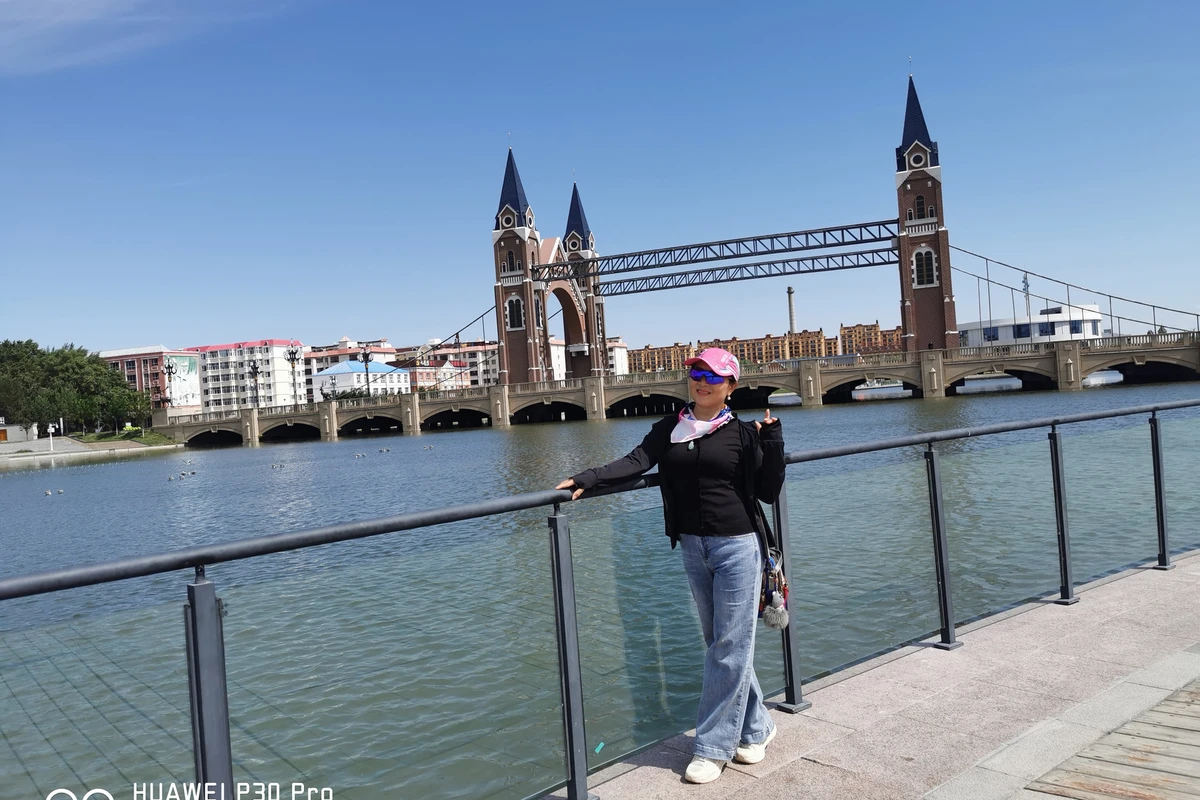
Day 15. After breakfast, we walked to the Kanas Tower Bridge over the Qicai (Rainbow) River. Looking up at the 27-meter-high bridge, it resembles a Gothic fairytale academy straddling the colorful river. Its design is rarely seen in China, and thanks to the internet, it attracts travelers from all directions; viewed from a distance, it is even more enchanting. Who would have thought that thirty years ago this area was a barren desert of yellow sand and gobi? Through the unremitting efforts of Burqin’s people—ecological protection, connecting rivers and city, purifying water and beautifying the town—the former desert has become the 50-hectare Qicai River Leisure and Tourism Resort. The recently built Kanas Tower Bridge has become a brilliant highlight of the resort’s landscape belt, spreading its fame at home and abroad, with a steady stream of visitors coming to snap photos. Strolling along the river park, every step reveals a new scene; the air is fresh and pleasant—a fine place for leisure and recreation.
Lunch at a nearby small restaurant averaged 40 yuan per person, with very decent dishes.
Day 16. After breakfast, we wandered the town’s streets and alleys, feeling the distinct exotic ambiance of this border town. Before we knew it, we arrived at the Old Sino-Russian Wharf Style Street, with its Russian-style buildings, Russian cuisine, cozy wooden cabins, and Russian sculptures that seem to tell interesting stories. Built along the river, it is even more charming; strolling and admiring was utterly relaxing.
Lunch was local noodle dishes averaging 20 yuan, also quite good.
At the entrance of the old wharf stands the Sino-Russian Navigation Memorial Hall; we registered and entered free of charge. The moment we stepped through the gate, for people of our generation, the buildings, objects, and photos were all very familiar. The looped Soviet-era song "Red Berry Flowers Bloom" gently took us back to that passionate era of construction.
At nightfall, we returned to Kanas Bridge and the Old Sino-Russian Wharf Style Street to admire and photograph the night scenes; with lights twinkling, it was even more beautiful.
Day 17. After breakfast, we bade farewell to Burqin and took a scheduled bus at 50 yuan per person to Altay, preparing to fly back to Xi'an from Altay Xuedu Airport that evening. We arrived in the city in the morning, setting foot in a place whose name was familiar but whose geography was strange.
Altay was historically a nomadic area for ethnic groups in ancient China. It covers over 10,000 square kilometers with a population of about 600,000, over 60% of whom are ethnic minorities. It lies on the northern edge of Xinjiang, bordering Mongolia. "Altay" means "gold mountain" in Mongolian, named for the gold deposits in the mountains; there’s a saying: "Seventy-two valleys of the Altai Mountains, every valley has gold." The Irtysh River, which flows through Altay City, is China’s only river that flows west into the Arctic Ocean.
We had lunch near the passenger station, averaging 60 yuan per person, and left our luggage there. Then we took a 13-yuan taxi to Birch Forest Park. This is a favorite recreational spot for Altay residents, located in the northwest corner of the city on a floodplain of the upper reaches of the Kelan River. The terrain is relatively flat and open, with the river dividing it into six small islands, creating a beautiful intermingling of woods and water. At about 910 meters above sea level, it covers 1.5 square kilometers. The park mainly features natural birch trees as its primary landscape, followed by poplars, with over ten types of shrubs such as wild roses, spirea, and wild roses growing among the woods, totaling 52.5 hectares. Unlike typical man-made parks, Birch Forest Park integrates natural trees, river water, and flowers seamlessly, set against the mountains. Beneath the trees and in open spaces grow cinquefoil, wild mint, wild strawberry, white clover, red clover, sweet clover, yellow lucerne, yellow artemisia, and white artemisia, among other herbaceous plants; in low, damp areas, there are calamus, reeds, sedges, mosses, etc. The temperature inside the park is 2–4°C lower than outside. Under the graceful white birches, the grass is lush, streams gurgle, birds chirp among the woods, and fish swim in the shallows. Many tourists enjoy the charming scenery; there are uniquely styled structures and activities, such as sightseeing cars, a "Language of Flowers Lovers’ Corridor," lovers’ steps, swings, as well as bars, coffee shops, and cold drink stands, all set against the blue sky—a delightful touch that makes one linger.
After over two hours of strolling, we took a 13-yuan taxi back to collect our luggage, then another 24-yuan taxi to Altay Xuedu Airport.
Day 18. That evening, we boarded our Ctrip-booked flight back to Xi’an, arriving in the early hours of the next morning. A 118-yuan taxi ride brought us home, concluding our 18-day independent journey through Xinjiang.
Over the entire 18 days (May 21 to June 7), we made our own plans, booked our own tickets and hotels, took seven flights and played through a loop, spending just over 5,000 yuan per person. It was extremely worthwhile! There were a few regrets—places we especially wanted to visit but didn’t—we’ll find another chance to go.