2019 New York and Boston Trip
The summer 2019 trip to New York and Boston was the last overseas trip before the pandemic. After that, I didn't go out again until long after the lockdown was lifted. During that time, I was too lazy to write a travel journal. My wife said I should write it down so we can look back and reminisce in the future.
Visa: ten-year visa. Flights: China Eastern Airlines nonstop from Shanghai to New York. Google Maps, mobile WiFi (or a US SIM card), multi-currency credit card, driver's license with international driving permit. With these, you can travel freely around the US.
The trip covered over 13,000 kilometers. The flight took fourteen hours—exhausting. The return flight took fifteen hours, which was really unbearable.
Even while traveling, homework couldn't be neglected.
My wife and son went to business class, while I sat in economy.
Halfway through the flight, I swapped seats with my wife; she went to economy, and our son was sleeping soundly.
We arrived at John F. Kennedy International Airport in the evening. After clearing customs, we took a taxi to the BEST WESTERN hotel in Flushing, which we had booked. On the first night in the US, no one sleeps well; I couldn't sleep after four hours. Groggily, we started our first day.
Breakfast at the American budget chain hotel was bread, milk, cookies, and fruit—enough to fill our stomachs.
We bought water at a supermarket near the hotel.
New York's subway, though old and with no air conditioning on the platforms, making them hot as steam baths, was efficient and fast.
The New York public transit system is very developed. We stayed in Flushing, Queens, a Chinese enclave, and took the 7 train to Manhattan Island. We bought a seven-day unlimited pass, which allowed us to ride the subway and buses freely.
Our son, still jet-lagged, fell asleep on the subway.
The Metropolitan Museum of Art is one of the world's four great museums. It used to be pay-what-you-wish, but changed to a fixed admission fee in 2018. We bought tickets on Ctrip, which were cheaper than the official website.
The museum was packed with crowds.
Ancient Egyptian temples and mummies had been moved here.
What was once a church fence.
The collection includes an extremely rich array of medieval armor.
African art exhibition area.
If you want a quick look, set aside a full day. If you follow the audio guide, set aside three days. If you examine every exhibit carefully, set aside a lifetime. When visiting, carry your backpack in front to avoid damaging exhibits.
Indian art exhibition area—indescribable.
"The Buddha of Medicine" mural, from the Lower Guangsheng Temple in Hongtong County, Shanxi Province, is a masterpiece of Yuan Dynasty mural art, over seven hundred years old, with invaluable historical and cultural value. It was sold by temple monks for 1,600 silver dollars, cut into pieces, and shipped to the US.
Our son was still jet-lagged.
After touring for half the day, it was noon, so we had lunch at the museum's restaurant.
We continued exploring. They had even moved a Chinese garden here.
The Metropolitan Museum of Art has a rich collection of Chinese porcelain and bronze ware, but due to time, we could only glance at it.
In the painting gallery, we headed straight for works by Monet and Van Gogh. Our son has been learning to paint since he was young and is a big fan of Van Gogh.
On the first day, we weren't fully over jet lag. The huge museum was exhausting, so we went back early to rest.
There was a small church next to our hotel.
Near Rockefeller Center, there were several tall churches. We went in and sat down, listened to a sermon for a while, but when they started handing out flyers, we escaped.
Someone asked whether to go to the Empire State Building or Rockefeller Center for views. Answer: Rockefeller Center, because from up there you can see the Empire State Building.
When buying tickets, the young man kindly said the weather wasn't great today and visibility was low. Were we sure we wanted to go up? Of course we did!
What seemed to be a luxury apartment building under construction—it's certainly occupied now, with record-setting unit prices.
Visibility was actually pretty good. We could see the World Trade Center in the distance.
After coming down, we bought a few servings of fried rice from a street vendor and ate sitting on a flower bed.
The World Trade Center subway station looked like a giant bird with outstretched wings.
The memorial is underground, and the air conditioning made it very cold.
The steel structure of the main building was twisted and deformed.
The antenna that once stood on the roof.
After the attack, there were fears that the protective dam near the river might collapse, but it held up.
Fire trucks that participated in the rescue.
Shares the same name as my son.
Both my son and I are fans of aircraft carriers and battleships. Whenever we visit a place with ships, we go see them. We couldn't miss the USS Intrepid in New York.
Directly across from the carrier is the Chinese Consulate General in New York.
At the nearby pier, a cruise ship was docking, passengers disembarking as their trip ended.
Next to the Intrepid was the USS Growler, a missile submarine. It is the only American diesel-powered submarine open to the public and the first Grayback-class cruise missile submarine.
The captain's quarters were nothing special.
We boarded the Intrepid to start our tour.
The British-invented landing aid.
The flight deck also displayed various aircraft.
The classic A-12 (predecessor to the Blackbird SR-71; see my Seattle travel journal).
At the rear of the deck was a separate hangar housing a space shuttle—the Enterprise. In February 2019, we visited the Endeavour space shuttle in Los Angeles (see my LA travel journal).
After seeing this repair hangar, we returned to where my wife was resting. She said the elevator had just demonstrated a lift, and many tourists experienced it. What a pity we missed it!
After the tour, we spotted a Sichuan restaurant on the street. The food was very authentic, and they offered half portions—superb!
New York's Grand Central Terminal, which we've seen in many movies and TV shows.
The ceiling of the main hall features the zodiac constellations.
We saw a couple taking wedding photos with a pile of poop—truly an eye-opener.
New York Public Library.
Outside, we bought two ice creams.
We continued walking to Times Square. The M&M's store was very interesting.
We couldn't wait for the lights to come on and went back. We were too tired to walk anymore.
We booked a tour of the United Nations Headquarters online, choosing a Chinese-language guided tour. A young lady led us through the main venues.
We checked in and picked up tickets across the street.
Saw Nobel Prize medals for the first time.
The large conference hall often seen in the news.
At the UN post office, we bought many stamps and wrote postcards to send to teachers. We had lunch at the UN cafeteria. I took the yogurt container home and used it to store pickled mustard greens.
Next stop: the Statue of Liberty. Booked online and visited at the designated time.
After landing on the island, we first toured the museum, which explains how the statue was built.
To go up to the torch, you need to book well in advance. I'm not sure if it's still open now.
Great view from the top!
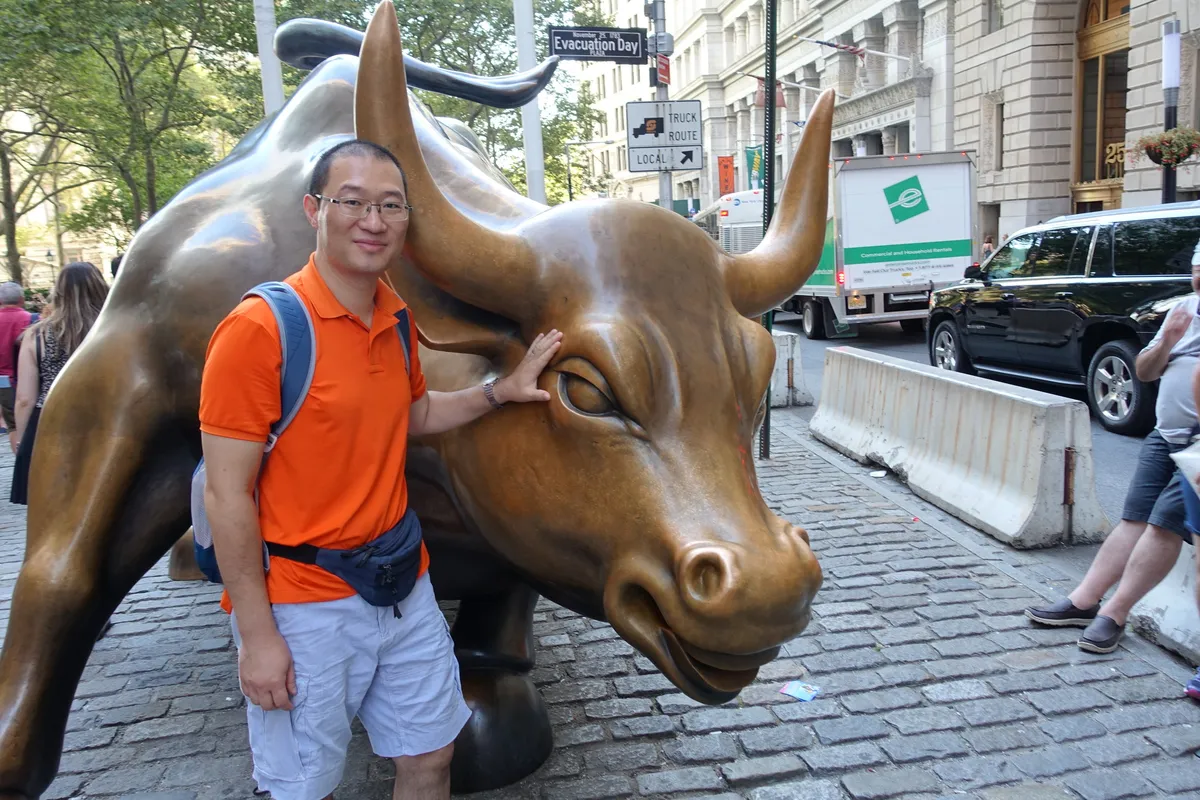
Back in Manhattan, we had to see the Charging Bull. Not long after we returned, the news said a crazy person had damaged the bull.
That day was extremely tiring. Near the hotel, we bought a genuine Italian pizza. We overestimated our capacity and got a medium one—couldn't finish it even though we ate until we were stuffed.
Early next morning, we packed up, checked out, and went to the car rental office. We rented a Grand Caravan and drove to Boston.
On the way to Boston, we visited the world's first nuclear-powered submarine—the USS Nautilus. The submarine was named after Jules Verne's Nautilus in "Twenty Thousand Leagues Under the Sea." It was built by General Dynamics Electric Boat, launched on January 21, 1954, commissioned on September 30, 1954, decommissioned on March 3, 1980, and later converted into a museum ship at the Submarine Force Museum in Groton, Connecticut.
Size comparison between an early US submarine and an Ohio-class nuclear submarine.
After the visit, we continued northeast. Near Boston, we visited the battleship USS Massachusetts. We arrived after 2 PM, and the staff said there were only two hours left for visiting, suggesting we come back tomorrow. Two hours was enough—we also toured a destroyer and a submarine nearby.
We had previously visited the USS Iowa and USS Missouri, but only the USS Massachusetts opens its main gun turrets and ammunition magazines, which was extremely impressive.
We crawled through a small door at the back of the main turret.
Huge 16-inch shells were fired using six such powder bags.
This is the ammunition magazine inside the hull. Shells were transported to the turret via a conveyor system.
Mind-blowing 16-inch conning tower armor.
To my surprise, there was a simple latrine on the deck—photo op.
We also toured the destroyer and submarine.
An old high school classmate, who was on a company assignment near Boston, treated us to Boston lobster for dinner. After 23 years since graduation, we met in a foreign land.
In Boston, we also stayed at a BEST WESTERN hotel. This one was the best of the trip—new facilities, spacious rooms, good breakfast, and reasonably priced.
First stop: the USS Constitution.
The USS Constitution (IX-21) is a three-masted, wooden-hulled heavy frigate of the US Navy. Launched on October 21, 1797, in Boston, with a displacement of 1,576 tons. She was named by President George Washington after the US Constitution, which took effect in 1789.
Second stop: Bunker Hill Monument, built to commemorate the famous Battle of Bunker Hill. The monument is an obelisk-like structure, 67 meters tall, made of granite.
Climbing the stifling tower was mechanical work. Luckily, we had a handheld fan, or we would have gotten heatstroke.
After a tough climb to the top, the view was nice.
Coming down, we drove to the city center. We planned to park and walk, but parking was extremely expensive—$9 for 20 minutes. We backed out when we saw the price at the entrance. So we just drove around the city, missing many historic buildings like Quincy Market and the Old State House. For a walking tour, you can follow the Freedom Trail.
Finally, we found a parking spot at a meter. After parking, we visited Harvard.
We touched Mr. Harvard's foot for good luck.
A stone tablet donated by Harvard alumni.
We bought a book at the Harvard Book Store as a souvenir.
Next, we went to MIT.
The campus is open; many classrooms were open for anyone to enter.
Early next morning, we checked out and drove back to New York. First stop: the John F. Kennedy Library.
In 1964, to commemorate the late President John F. Kennedy, it was decided to build a permanent structure—the John F. Kennedy Library—on Boston Harbor. Designed by architect I.M. Pei, the library is located on Columbia Point in Dorchester, near Boston. Construction took 15 years and was completed in 1979. Due to its innovative design, bold shape, and high technical skill, it caused a sensation in American architecture and is considered one of the best works in American architectural history. The American architectural community declared 1979 the Year of I.M. Pei and awarded him the AIA Gold Medal that year.
The library focuses on Kennedy's growth, his campaign, and events during his presidency. The world-shocking event was not mentioned at all.
Springfield Armory was established in 1794 and closed in 1964. It was once the US government's main center for the production and research of small arms. The former factory buildings are now a museum and university campus.
There, we finally learned the firing principles of matchlock and flintlock guns.
A gun struck by lightning.
Various production equipment.
We ordered a small burger at a Subway on the street and still got stuffed.
While planning the route, I discovered that the Naismith Memorial Basketball Hall of Fame is near Springfield. I had always thought the Hall of Fame was just a symbolic honor, not a physical venue.
Among the circle of famous people's photos, we found Yao Ming.
Took a photo with idol Michael Jordan.
Checked the prices of basketballs and jerseys.
Driving west, we stayed at a hotel near Woodbury Common Premium Outlets, the largest outlet mall north of New York.
Before entering the campus, there was a waiting hall with school introductions.
Domestic West Point summer camps are all false advertising. A real visit to West Point requires advance reservation. After two security checks, we entered the campus. A guide led us through the history, the stories behind various buildings, and anecdotes about famous figures.
Famous alumni have nameplates set into the first row of pews in the chapel, including five-star general Douglas MacArthur.
West Point is located along the Hudson River. During the Revolutionary War, heavy iron chains were used to block the river to prevent British invasion.
A flagpole above is made from the mast of the USS Arizona from Pearl Harbor.
We saw a couple taking wedding photos.
The Army and Navy are rivals on the field; everywhere there are signs saying "Beat Navy!"
In addition to the campus, there is a museum to visit.
Outlet shopping. There were a lot of cars on the road to the outlets.
On our last day, we checked out and drove to Ferncliff. Ferncliff is in northwestern New York. It is the final resting place of many famous people well-known in China. Those interested can visit.
Holiday over, back to China to continue working.
Travel log index:
1. Day 1: Metropolitan Museum of Art
2. Day 2: Rockefeller Center, 9/11 Memorial
3. Day 3: USS Intrepid, Grand Central Terminal, Public Library, Times Square
4. Day 4: Central Park, United Nations Headquarters, Statue of Liberty
5. Day 5: USS Nautilus, USS Massachusetts
6. Day 6: Bunker Hill Monument, Boston City, Harvard University, MIT
7. Day 7: John F. Kennedy Library, Springfield Armory, Naismith Memorial Basketball Hall of Fame
8. Day 8: West Point, Outlet Shopping
9. Day 9: Ferncliff, Return Trip
Travel Information
Hotel Index
Travel Guide Index
Flight Index
Website Navigation
Travel Index
Cruise Index
Corporate Travel Index
Franchise Cooperation
Distribution Alliance
Friendship Links
Corporate Gift Card Purchasing
Insurance Agency
Agent Cooperation
Hotel Franchise
Destination and Attraction Cooperation
More Franchise Cooperation
About Ctrip
About Ctrip
Ctrip Hot Topics
Contact Us
Careers
User Agreement
Privacy Policy
Business License
Security Center
Ctrip Content Center
Intellectual Property
Trip.com Group Algorithm Disclosure