First Impressions of America - 2025 Winter Vacation Travelogue
The plan to travel to the US was made long ago. After visiting Canada in 2017, I wondered when I would go to the US. It was originally planned for 2020, but for well-known reasons it was postponed until 2024, and two elderly friends joined the group, turning it into a group of five spanning young, middle-aged, and elderly. The itinerary had to be revised again and again, and places I was personally interested in were almost zero; even if there were any, I could only skim the surface. In April 2024, the itinerary was finalized, tickets were booked, hotels were reserved, and a car was rented, but then one of the elderly members fell ill. Cancel or postpone? That became the most pressing issue. But to avoid disappointing the two seniors, everyone decided to postpone the trip to the 2025 winter vacation, meaning we would spend the New Year in the US. So the new dates were January 19 to February 12, 2025, a total of 25 days.
As mentioned earlier, "a quick tour and a check-in" was the main purpose of this trip, making the direction simple: in the western US, we visited three cities—San Francisco, Los Angeles, and San Diego; in the eastern US, we chose four cities—New York, Boston, Philadelphia, and Washington DC. We spent eight days in the West: three days in San Francisco, three days in Los Angeles, and two days in San Diego. In the East, we stayed in New York for eight days in total and three days each in the other three cities. As also mentioned, the summer trip turned into a winter trip, with the main change being that the original plan of "East first, then West" became "West first, then East" because we needed to celebrate the New Year with relatives and friends in New York. Additionally, the planned self-drive trip along Highway 1 was canceled, as it was indeed not suitable in winter (I later heard that Highway 1 hadn't been fully repaired and required detours).
Finally, regarding the detailed itinerary, we followed the preferences of the group, focusing on four aspects: visiting relatives and friends, outlet shopping, landmark check-ins, and university tours. Thus the schedule was set. The following are attractions we personally tested and recommend. Additionally, you can refer to other travelogues and a treasure trove website called Meilvtong.
The cable car in the city center is a must-ride experience; it can take you directly to Fisherman's Wharf. If you're a hardcore walker, you can also buy a day pass and use the cable car to visit all the attractions along the route. Fisherman's Wharf in winter is very comfortable, especially for watching sea lions. You can also choose a restaurant, sit by the window, and enjoy seasonal seafood while taking in the bay view. Afterward, we took a bus directly to the southern end of the Golden Gate Bridge. Although you can't overlook it from a high vantage point like at the northern end, viewing the bridge at eye level or looking up is also quite nice. If you have the energy, you can walk across the Golden Gate Bridge round trip. As for Chinatown, forget it—most shops were closed during the New Year. We also visited the Golden State Warriors' home arena and bought some satisfying items at their official store. On the way to Los Angeles, we stopped by Stanford University, the first university we visited on our trip.
Overall impression: Public transportation is very developed—subways, buses, and trains are all good, with diverse and convenient transfer options. We stayed near Union Square, so safety was fine. However, winter weather was dry with strong UV rays, so sun protection and moisturizing are essential. San Francisco is probably the most technologically advanced city in the US.
The Getty Center was temporarily closed due to wildfires, so we had to switch to Huntington Gardens. The best part was its library, which houses some of the most famous Western books from ancient to modern times, such as incunabula, Shakespeare's First Folio, the Declaration of Independence, and first editions by famous authors—too many to list. Griffith Observatory is worth visiting if you want to overlook the entire city of Los Angeles from a high point, and you can also check off the Hollywood sign. In the city center, there's Hollywood Boulevard and the Wax Museum—worth a look if you've never been. UCLA, which claims to be the top public university in the US, had us watching students train and compete—it was exciting and very professional. Unfortunately, we didn't go to Universal Studios; maybe next time. But we did go outlet shopping for an entire day—couldn't drag us away.
Overall impression: Driving is the only practical way to get around; otherwise, it's too exhausting. We stayed in a neighborhood not far from UCLA, which was decent overall and convenient for eating out at night. To be honest, visiting Los Angeles once is enough; for living and working, it's not as good as San Francisco.
We visited the USS Midway aircraft carrier just for the check-in—it was spectacular. The interior was like a maze; without the guide markings, we wouldn't have known how to get out of the compartments. Retired elderly couples were everywhere, making it a true vacation destination. We also went to an outlet on the US-Mexico border, which made us feel more and more like a shopping group.
The first day we arrived in Boston, it snowed heavily. The white Boston had a unique charm. Harvard and MIT are must-visits. The winter campus was quiet and solemn; if it weren't for the weekend, we could have had the place almost to ourselves. In Harvard's Art Museum, there are artifacts looted from the Mogao Caves in Dunhuang. At the time, I didn't feel much, but after visiting the Mogao Caves myself in June and seeing the incomplete murals, it stung my heart like a needle. Quincy Market is basically an indoor street food market, with shockingly high prices—a lobster roll cost over $40, so we just looked. Boston Common is worth a stroll, especially the skating rink. In summer, it's a rippling lake; in winter, it becomes everyone's ice stage. Unfortunately, we missed the Museum of Fine Arts, Boston—maybe next time.
Overall impression: Boston is, in my opinion, the most suitable city for both tourism and living in the eastern US. It has four distinct seasons and well-developed public facilities. Perhaps because of the Chinese-American mayor, it felt the most friendly toward Chinese people. We stayed in the city center, so walking everywhere was convenient, and the subway station was right under our hotel.
The main purpose was to visit the University of Pennsylvania. UPenn is huge, like a small city. We checked off several Instagram-worthy spots and saw two of the Six Steeds of Zhao Mausoleum. Then we visited City Hall and Independence Hall. To be honest, if you're not familiar with American history, it's hard to feel much—similar to Boston's Freedom Trail.
Overall impression: From a capital city to a slum, it doesn't take long—a cautionary tale for countries still undergoing urbanization like ours.
Washington DC:
As the capital, it's grand and high-end. Individual buildings are majestic and solemn, with a well-planned grid layout. There are too many museums and landmarks; three days were definitely not enough. We mainly visited the Natural History Museum, the Air and Space Museum, the National Museum, the White House, the Capitol, the Washington Monument, and the Lincoln Memorial, and took a distant look at the Pentagon. One thing worth mentioning: the US introduces its history with war as the main thread—haha, you figure it out. China, on the other hand, looks at maps and territorial size.
Princeton University in New Jersey:
We passed by it. The museum was under renovation, so we couldn't go inside, only walked around the campus. I personally recommend it—it's a quiet and leisurely small town, after all, a cradle of many social science scholars.
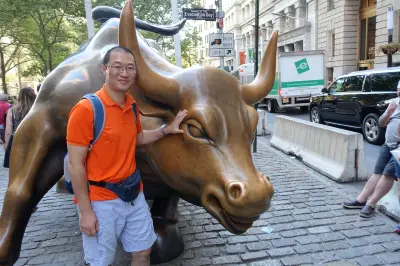
We spent a full week in New York, with two days on my own visiting bookstores and MoMA. On the other two or three days, we went out with friends and relatives in New York, mainly checking off Instagram-worthy spots. The Metropolitan Museum of Art and Central Park can be visited together. We took a free ferry to see the Statue of Liberty from a distance—not because we didn't want to pay to go to the island, but to experience the feelings of those new immigrants in movies when they first saw the Statue of Liberty.
Overall impression: How to put it? As a Shanghainese, I probably didn't have much sense of novelty. We stayed near the New York Public Library in Manhattan, with numerous subway lines making it easy to get anywhere. The smell inside subway stations was unbearable, but it got much better once on the train. My impression of New York had been formed from movies and books, but being there in person still gave me an inexplicable thrill.
After posting the photos, I suddenly remembered we also visited the 9/11 Memorial. No photos were taken, but I'll note it—a moment of silence for the victims.
Our family of three spent about 120,000 RMB in total. The biggest expense was airfare. Actually, the airfare could have been lower, but we bought tickets for the summer and then changed the dates; otherwise, we could have saved nearly 20,000 RMB. Another expense was accommodation—we chose hotels, basically costing about $300 per room per night. These costs were unavoidable, given the obvious inflation in the US. What's harder for Chinese to accept is the consumption tax and tipping. In China, prices are generally tax-inclusive, while in the US, they are tax-exclusive, and tax is added only at checkout. The lowest tip rate option is 15%, with 18% and 20% also available. For example, if you order a bowl of noodles in downtown New York for $25, with an 11% consumption tax, it becomes $27.75. The tip, calculated on the $25, is at least $3.75, making the total $31.50. That $6.50 is the sound effect you hear when you sit down—a line between the rich and poor. All fast-food restaurants include tax in the price and have no tipping.
Alright, I've rambled on with a lot of nonsense. Just look at the photos in the article—I think they're decent enough. Thank you all, dear readers! Salute!
Travelogue Contents:
1. Good Things Come to Those Who Wait
2. Brief Itinerary
3. City by City Notes
4. Overall Costs
Travel Information:
Hotel Index | Strategy Index | Flight Index | Website Navigation | Travel Index | Cruise Index | Corporate Travel Index | Franchise Cooperation | Distribution Alliance | Friendship Links | Corporate Gift Card Procurement | Insurance Agency | Agency Cooperation | Hotel Franchise | Destination and Attraction Cooperation | More Franchise Cooperation
About Ctrip:
About Ctrip | Ctrip Hot Topics | Contact Us | Careers | User Agreement | Privacy Policy | Business License | Security Center | Ctrip Content Center | Intellectual Property | Trip.com Group Algorithm Explanation