48 Hours in Baotou: Echoes of the Yellow River and Yin Mountains Through the Millennia
“Chile River, beneath the Yin Mountains, the sky like a felt dome, covering the vast wilds…” Fifteen hundred years ago, the Music Bureau compiled a popular folk song from north of the Yellow River during the Southern and Northern Dynasties: “The Chile Song.” With its concise words, it celebrates the northern grasslands and the Chile people’s heroic spirit: at the foot of the towering Yin Mountains, the grassland backdrop is magnificent, the sky like a yurt covering all directions, heaven and earth merging in boundless grandeur. It also opens a door to understanding Baotou through literary works.
Bordering the Yellow River to the south and traversed by the Yin Mountains, Baotou has long been a vital crossroads linking the nomadic culture of the northern grasslands with the agricultural civilization of the Central Plains. Today it is Inner Mongolia’s largest industrial city. From the Han Dynasty’s Wang Zhaojun departing for the frontier, to the widely known “Prairie Heroic Sisters” of the 1960s, from ancient times to the present, this beloved land of Baotou has been the stage for one moving story after another.
Stepping into Baotou feels like a journey through history, and the trip continuously echoes with the tremors of the Yellow River and the land of Baotou.
Day 1 Meidaizhao Monastery – Jiuqu Huajie – Nanhai Wetland – Wudangzhao Monastery
Day 2 Baogang Industrial Tour – Saihantala – Yellow River Ballad – Northern Weapons Square
The first stop in Baotou is Meidaizhao Monastery.
“Meadai” in Mongolian means Maitreya; its original name was Lingjue Temple, later changed to Shouling Temple. Meidaizhao Monastery is built alongside hills and waters, modeled on Han-style architecture of the Central Plains yet blending Mongolian and Tibetan styles. It is a temple where “city and monastery merge, and people and Buddhas dwell together.”
Towering peaks, lush forests, and gurgling streams — the eternal song of Chile echoes, a yurt song born of nature. Elegantly ancient, Meidaizhao Monastery stands at the foot of the Yin Mountains, renowned worldwide for its profound cultural and historical heritage, distinctive architecture, and exquisite murals.
Meidaizhao Monastery is encircled by tall, thick walls of rammed earth faced with stone. The main gate is a city gate, and at each corner stand two-eaved watchtowers. The solid, sturdy walls could withstand artillery fire and cavalry assaults. Embedded above the gate is an inscription from the Ming dynasty expansion: “The imperial domain is consolidated; the emperor’s rule brings universal peace; all people live in contentment; the world is clear and tranquil.” Inside, several ancient murals vividly recount the story of Sanniangzi — wise, brave, talented, and beautiful — who upheld stability across the region for over forty years.
The moment you step through the Taihe Gate, over 470 years of history envelop you. Mahavira Hall, Glazed Tile Hall, God of Wealth Temple, Buddha’s Mansion, Octagonal Temple, Temple of Sanniangzi, Baofeng Pagoda... these soulful structures, sheltered by the Yin Mountains, exude solemn dignity and add layers of inspiration to the mountains’ majesty.
Baotou’s favorable location has blessed it with multiple faiths. Beyond Meidaizhao, there is an even more delightful surprise: Wudangzhao Monastery.
Driving toward Wudangzhao, your curiosity climbs with the altitude, until a vivid and lavish Tibetan-style spectacle unfolds at the summit.
With reverence, stepping on each flagstone, ascending every stair, the timeworn buildings seem to whisper tales of the past, emerging slowly from historical scrolls to stir the soul.
“Wudang” means “willow tree” in Mongolian; the original Tibetan name, Badagar Zhaow, means “white lotus.” It was first built during the Qing Kangxi reign and granted the Chinese name Guangjue Temple. The first living Buddha, Lobsang Gyaltsen, modeled it after Tibet’s Tashilhunpo Monastery. Through successive expansions under Kangxi, Qianlong, Jiaqing, Daoguang, and Guangxu, it grew to its present scale.
Its multiple temples rise harmoniously with the mountain contours, arranged in orderly tiers. Vast and imposing, the seemingly natural layout resembles a mandala shining uniquely in the Buddhist realm. Since ancient times it has been praised as the “Potala of the Grasslands,” standing among China’s four great Tibetan Buddhist monasteries alongside the Potala Palace in Tibet, Ta’er Monastery in Qinghai, and Labrang Monastery in Gansu. It is the largest Tibetan Buddhist monastery in Inner Mongolia.
Gazing from a high peak, you can’t help but marvel at Wudangzhao’s architectural ensemble. It fuses aesthetics, architecture, religion, the city-monastery concept, and politics, recreating ancient architectural thought and artistic beauty, and showcasing the profound richness of Chinese culture.
Baogang is one of the earliest steel industry bases established after the founding of New China.
In 1927, a young man surnamed Ding discovered iron ore in Bayan Obo. Later, He Zuolin’s meticulous research revealed that the ore was also associated with rare earth minerals.
In 1954, 80,000 builders from across the nation gathered by the Yellow River, south of the Yin Mountains, to begin constructing Baogang. Since then, Baotou, the “Steel City of the Grasslands,” has become a pearl beyond the Great Wall, and Baogang — alongside Anshan Iron & Steel and Wuhan Iron & Steel — ranks as one of China’s three major steel industry bases.
In October 1959, Premier Zhou Enlai cut the ribbon for Baogang’s No.1 blast furnace, completed a year ahead of schedule, ending Inner Mongolia’s history of not producing iron.
You can’t truly appreciate Baogang’s awe-inspiring scale without visiting.
From the moment you enter the plant, you are overwhelmed by enormous industrial facilities, some familiar, some nameless.
The most direct introduction is the Baogang Exhibition Center, which also serves as the company museum. Through a massive diorama and multimedia displays with sound, light, and electronics, it presents Baogang’s six-decade history of profound transformation. Here you can feel the Baogang spirit — the perseverance and pursuit of excellence that define its people.
As visitors, we may never fully grasp how steel is made — the journey from ore to finished product requires boundless imagination. Yet, seeing the vintage steam locomotives still in use, we can catch a glimpse of Baogang’s glorious past.
These locomotives have been part of Baogang’s story since the days when it was still called the “Wusi Iron and Steel Plant.” These veteran workhorses are the best footnotes to Baotou as an industrial city and a living record of Baogang’s development over more than sixty years.
When people joke about Baotou’s local specialties, they sometimes say: tanks and artillery.
Indeed, on October 1, 1959, 32 Type 59 tanks manufactured in Baotou participated in the grand military parade celebrating the 10th anniversary of New China, drawing worldwide attention. Since then, Baotou has been linked to the nation by a very special bond.
Enter the Northern Weapons City, a large artillery theme park run by China North Industries Group. Here you’ll find the People’s Republic’s first anti-aircraft gun, the first Hongqi-2 missile, the first independently designed tank gun, the first jet fighter... It’s like stepping into a museum of Chinese weaponry.
The times have imbued this city with a deep military-industrial character. Time may pass, but the glory of the “Military City” remains fresh. The “military industry” gene is deeply embedded in Baotou’s urban bloodstream, growing ever stronger. Behind every major national parade, every enhancement of strength, you can spot “Made in Baotou” weaponry and equipment.
I see the “First Gun of the Republic” that was reviewed on the 10th anniversary; I see the cutting-edge Hongqi-2 missile of the 1960s; I see the twin 57mm naval guns that distinguished themselves in the Xisha Islands; I see the nemesis of modern tanks paraded at the 50th National Day celebration...
I see aircraft, tanks, artillery... every piece solemn and silent, as if whispering stories of their encounters with land, sea, and sky in their respective eras. Baotou’s industrial culture, like the soaring eagle sculpture, catches the world’s eye.
In 33 BC, the Han dynasty ruler, seeking national unity, agreed to a political marriage requested by Chanyu Huhanye. A Han consort, Wang Zhaojun, thus left the frontier that year to marry into the Xiongnu. Legend says she departed Chang’an, first traveling east by water, then north by land, passing through what is now the Nanhai Lake ferry in Donghe.
After disembarking, she admired the scenery on the grassy lakeshore when a flock of wild geese flew overhead. Seeing her matchless beauty, the geese were so overwhelmed that they tumbled from the sky. Thus, Zhaojun’s beauty came to be described as “mesmerizing enough to make geese fall,” and this grassy bank became known as Luoyan Beach (Geese-Falling Beach). The sea-like waters where they fell is today’s Nanhai Wetland.
The Nanhai Wetland Scenic Area lies in the southeast of Baotou. It was once a former course of the winding Yellow River; when the river shifted southward, it left behind open water and marshes.
To the north, blue hills glimmer in the distance; to the south, the Yellow River ribbons around like a jade belt. The lake ripples with emerald waves, its shores lush with water plants, and gulls wheel in the sky — a uniquely beautiful scene.
Nanhai is also the very root of Baotou. Old Baotou was known as a “water and land wharf.” According to historical records, during the Kangxi period, about five kilometers southeast of today’s Donghe District, there was a lake spanning four to five hundred mu, vast and reed-filled, teeming with fish and turtles, covered in purple willows. Proximity to town and the flat, spacious terrain made it easy to load and unload boats and rafts, gradually forming a bustling port.
People from various regions who came to trade, transport goods, or operate ferries gradually settled, and the flux of people around Nanhai Wetland coalesced into what became Baotou. Nanhai Lake, vast and picturesque, leans against the hills to the north and touches the Yellow River to the south.
In the heart of Baotou, the Saihantala urban grassland covers more than 10,000 mu, like a crystal-clear emerald embedded in the city center, radiating eternal light — poetic, picturesque, dreamlike.
From over 2,000 mu of boundless natural reed wetland to nearly a thousand mu of tamarisk woods; from the majestic Mongolian camp to the graceful sika deer in the Sacred Deer Garden; from the Wanquan Oboo where people pray for favorable weather, to the sea of verbena, purple sage, and cleome at the Oboo Square... Baotou’s city center has become a grassland paradise thanks to Saihantala.
From the grassland observation deck, Saihantala vividly displays both grassland and Yellow River culture through breathtaking scenery. The meandering river floats like a blue khata across the grassland, and the call of deer echoes, evoking Baotou’s name as the “Deer City.”
By the Yellow River, a group of Baotou people pay tribute to the river’s unending twists and turns through architecture, and interpret life’s resilience through their shops.
If you’re looking for a place in Baotou that appeals to all, with both earthy market life and literary charm, it has to be Jiuqu Huajie. The Yellow River’s ninety-nine bends nourish the Chinese people on both banks and give rise to a deep Yellow River culture. Jiuqu Huajie, in Baotou’s Beiliang area, authentically recreates Baotou’s past and present through unique expressions.
Perhaps it’s an old piece of leather: no matter the noise outside, the artisan stays focused, turning it into something both practical and unique.
Perhaps a piece of cliff cypress — from nature into infinite possibilities, a lifelike form emerges.
Perhaps a rough jade, undergoing pounding sand, grinding slurry, splitting, sawing, shaping, polishing, hollowing, carving, drilling, piercing, piercing eyes, and final polishing with wooden and leather tools — lovingly transformed into an irresistible piece.
Perhaps it’s a newspaper, a water cup, a winnowing basket — telling Baotou’s stories, portraying its people’s lives, enveloping the sundry affairs of the world and the inner philosophy of all trades.
Jiuqu Huajie brims with the atmosphere of “Zouxi Kou” life. Amid old objects and antiques, you can explore the cultural collisions brought by the migration wave, feel the historical sedimentation of a century-old Beiliang, and vividly sculpt “Baotou memories.”
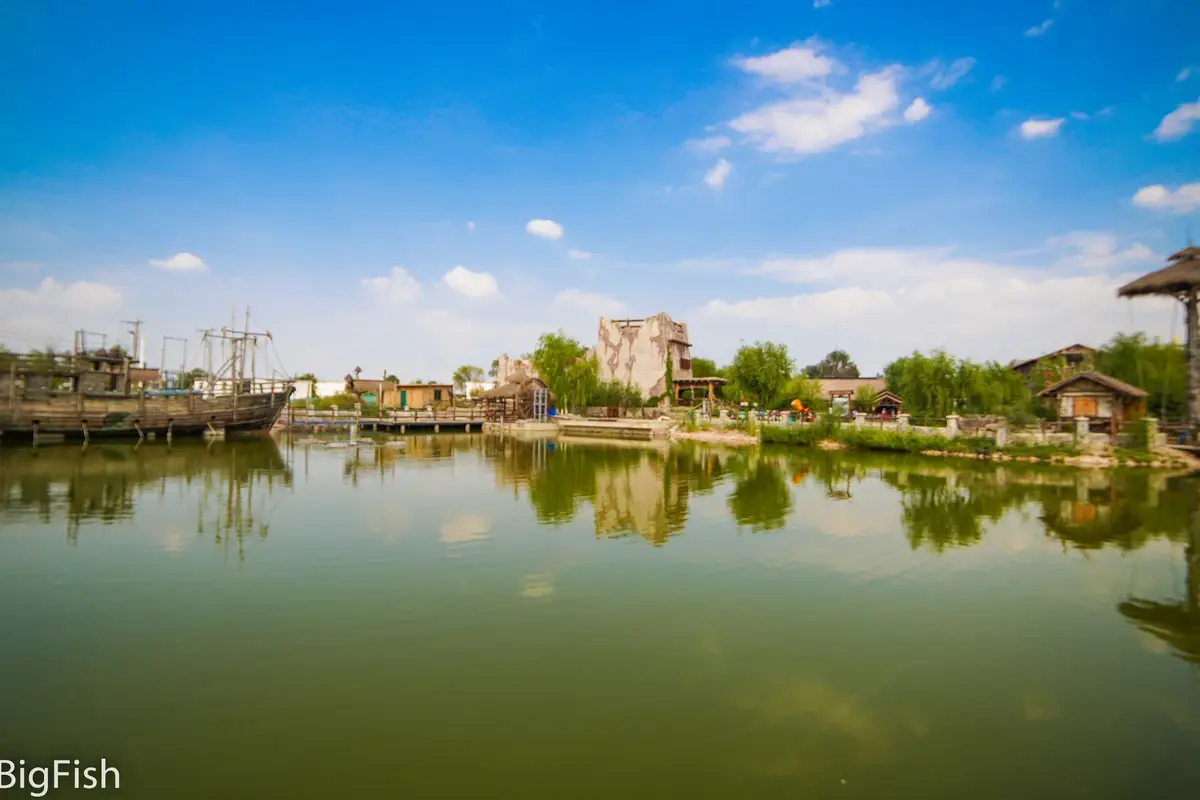
Driving along the Yellow River, you come to a rustic estate where devoted individuals use profound craftsmanship to unearth the simple, pure life stories of working people. Here, rugged stone walls display the weight of history, and an old waterwheel spins the spring of life.
Yellow River Ballad is not just a peaceful retreat from urban hubbub, but a cultural landscape where you can seek inner calm.
Here stands the only large thematic museum in China that reflects the culture of the Yellow River, its folk history, and the spirit of craftsmanship. Driven by his passion for Yellow River folk culture, Mr. Li Tiandong has collected nearly a thousand items over twenty-plus years, covering production and daily life across agricultural and nomadic cultures.
The waterwheel, its design based on Duan Xu’s method from “Tiangong Kaiwu,” churns the Yellow River waters, its waves singing the Yellow River ballad. The Yellow River Ballad Craftsman Museum houses over ten themed workshops — carpenter, blacksmith, tanner, felter, and more — inviting us to step into history and relive those bygone days.
It’s the ancient laboring people’s ingenious craftsmanship, and even more, the cultural heritage passed down through generations of Baotou people. Baotou, a long-time water-and-land wharf, carries the spirit of craftsmanship that bears history and culture — from the past, through the present, and into the future.
1. Best Time to Visit: Baotou’s summer and autumn, from mid-to-late June to early September, are ideal. The breeze is cool, flowers are fragrant and colorful — a perfect summer escape. Spring is cold and often sees sandstorms, making it less suitable for travel. Winter temperatures are very low, and Baotou turns into a world of ice and snow.
2. Getting There: Baotou is easily accessible by air or train.
Baotou Airport in Donghe District offers flights to/from Beijing, Shanghai, Taiyuan, Shijiazhuang, Shenzhen, Zhengzhou, Chongqing, Shenyang, Guangzhou, Chengdu, and 16 other cities.
The passenger stations Baotou Railway Station and Baotou East Station serve the Beijing-Baotou, Baotou-Lanzhou, Baotou-Baiyun, and Baotou-Shizuishan lines.
Travelogue Contents: 1. Prelude to the Journey 2. Itinerary Overview 3. From Sanniangzi’s Citadel to the Potala on the Grasslands 4. From How Steel is Tempered to Guns and Roses 5. Watching the Sea Inland, Grassland in the City Center 6. Jiuqu Huajie Meanders, Yellow River Ballad Murmurs 7. Travel Tips | Travel Information | Hotel Index | Travel Guide Index | Airfare Index | Website Navigation | Travel Index | Cruise Index | Business Travel Index | Partnership | Distribution Alliance | Friendly Links | Corporate Gift Card | Purchase Insurance | Insurance Agent | Agent Cooperation | Hotel Alliance | Destination & Scenic Spot Cooperation | More Partnership and Cooperation | About Ctrip | About Ctrip | Ctrip Hot Topics | Contact Us | Join Us | User Agreement | Privacy Policy | Business License | Security Center | Ctrip Content Center | Intellectual Property | Trip.com Group Algorithm Announcement


