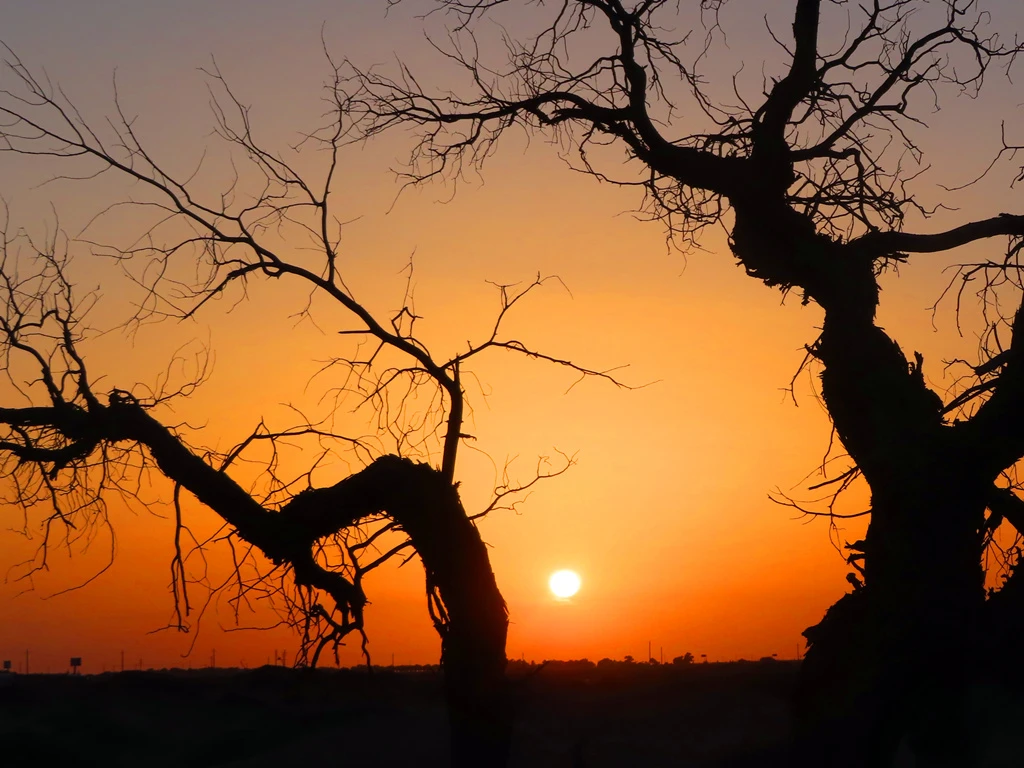
Ejina Poplar Forest Itinerary
Ejina Poplar Forest, Heishui City, Strange Forest, Juyan Lake, Aolunbulag Grand Canyon, Sanggan River Grand Canyon, Yellow River Sanshenggong, Wudangzhao, Wuliangsuhai Lake, Jimingyi 9-Day Bus Tour
Departure Date: October 2nd
[Itinerary]
D1: Beijing - Ulanqab Meals: Lunch, Dinner Accommodation: Ulanqab
Depart from designated location in Beijing to Xuanhua, Hebei. Upon arrival, enter [Sanggan River Grand Canyon]. The Sanggan River gets its name from the fact that the river dries up when mulberries are ripe each year, and is famous for the novel "The Sun Shines Over the Sanggan River" by female writer Ding Ling. The grand canyon has numerous waterfalls, deep gorges, clear blue-green pools of various shapes, with splashing water creating a spectacular view. After the tour, take a bus to Ulanqab.
Sanggan River Grand Canyon
D2: Ulanqab - Baotou Meals: Breakfast, Lunch, Dinner Accommodation: Baotou
After breakfast, take a bus to Baotou. Upon arrival, visit Wudangzhao. Wudangzhao, meaning 'place with willow trees' in Mongolian and 'Badagar' in Tibetan, is one of the four famous Tibetan Buddhist monasteries in China and the largest Gelug sect monastery in Inner Mongolia. Built on a hillside, the main buildings sit on a terrace where two mountain gullies meet. All halls are in typical Tibetan style, with a harmonious and unified layout, reputed as the 'Little Potala Palace'.
D3: Baotou - Aolunbulag Meals: Breakfast, Lunch, Dinner Accommodation: Aolunbulag
After breakfast, take a bus to Dengkou. Upon arrival, visit Feng Yuxiang's Western Granary. When General Feng Yuxiang led 400,000 troops westward to assist Gansu and pacify Shaanxi, he set up a grain station and built granaries here to supply the army. At that time, Sanshenggong was the richest area in Dengkou County. Then visit Sanshenggong Catholic Church, the earliest Catholic church built in the Hetao region, mainly Gothic style but also incorporating Chinese ethnic features. Then tour the Yellow River Sanshenggong Water Conservancy Park. The Yellow River Sanshenggong Water Conservancy Scenic Area is located in the upper-middle reaches of the Yellow River. With good ecology and rich natural and cultural landscape resources, it was rated as a national water conservancy scenic area in October 2005. Then take a bus to Aolunbulag Town, check into hotel upon arrival.
Yellow River Water Conservancy Scenic Area
D4: Aolunbulag - Wuliji Meals: Breakfast, Lunch, Dinner Accommodation: Wuliji
After breakfast, visit [Aolunbulag Grand Canyon Scenic Area]. The grand canyon is 5 km long, composed of deep red sandstone, integrating Yadan and Danxia landforms. It records millions of years of landform changes and geological evolution. The interaction of wind and geology has formed a landscape dominated by desert and Gobi. Under the blue sky and white clouds, it is magnificent, majestic, and desolately beautiful. Inside, the path winds, with changing views at every step, as if entering a dream world. In the afternoon, take a bus to Wuliji Town.
D5: Wuliji - Ejina Meals: Breakfast, Lunch, Dinner Accommodation: Ejina Banner
After breakfast, take a bus to Ejina. After lunch, explore the best-preserved Western Xia ruins on the ancient Silk Road: [Heishui City, Strange Forest]. The ruins tell a story of loneliness, desolation, and unyieldingness. Legend says that after each spring wind, the desert shifts. Walking into the ancient city, you can occasionally pick up various Western Xia tiles and bleached cow bones. It may completely disappear in the long river of history in the near future. At sunset, enjoy the peculiar sight of the sun and moon shining together, and feel the vast golden desert and Gobi under the clear blue sky. In the evening, take a bus back to town and check into hotel.
D6: Ejina Banner Meals: Breakfast, Dinner Accommodation: Ejina Banner
Get up early at 04:00, take a bus to [Juyan Lake, watch/photograph the sunrise] (about 1 hour drive, 50 km, visit time no less than 3 hours). Juyan Lake is a lake near Ejina, with clear water and beautiful scenery. It is long and curved like a crescent moon. The Ejina River flows into the lake, which is its main water supply. Worship at the Bao'er Obo on the shore of Juyan Lake, feeling the vitality of the vast Gobi. Then [Free photography at the Poplar Forest Scenic Area, tour the poplar forest sea] (including scenic area shuttle bus): Poplar is a magical tree species, its growth always closely linked to phoenixes and blood. It is a variable tree species: green in spring and summer, yellow in late autumn, red in winter. It is a tough tree species: alive for three thousand years without dying, standing for three thousand years after death, and not decaying for three thousand years after falling... Throughout history, poplar has become a spirit worshipped by people. Enjoy the beauty of the poplar forest, a soul-liberating journey. Since each person's tour time differs, lunch can be arranged on your own in the scenic area or return to town to eat. The poplar forest ticket is a one-time entry ticket, so those who return to town for lunch cannot return to the poplar forest to continue sightseeing. (The town is small; the scenic area gate is about 10 minutes' walk from the town center.) Meet at the guide's designated location and return to the hotel.
[Ejina Banner Poplar Forest Viewing Guide, Best Photography Spots]
Erdao Bridge: On the east bank of the Heishui River in Ejina Banner. There is water here. The poplars along the bank reflect golden shadows in the water, against the blue sky. The filming location of the movie 'Hero' is great for viewing and photographing the magnificent scene of 'evening glow scattering afterglow, poplars dyeing autumn gold'.
Sidao Bridge: Poplar forest is sparse and dense in order, with many themes. The old tree nest golden poplar forest at Sidao Bridge has Mongolian herders living in the forest, with white sheep and golden poplars, presenting a peaceful pastoral life scene.
Liudao Bridge: Has vast endless poplar leaves. Occasionally, you can see sturdy Mongolians riding tall camels passing through, and sometimes the dust raised by passing sheep leaping in the light.
Qidao Bridge: Poplar trees are tall and uniquely shaped, each with different postures. The deeper poplars become taller and the area more open. The ground here has more dead branches and withered poplar trunks.
Badao Bridge: This is a rich landscape combining the Badain Jaran Desert and poplar forest. The desert, poplars, camel teams, and sunset/sunrise make it a paradise for photographers.
1. On this day, visitors explore on their own without a guide. The scenic area includes two attractions: poplar forest and Badao Bridge Desert.
2. Today's itinerary is prepared for photography. Photos turn out very well. You can wear red, white, or light blue clothes to leave a beautiful silhouette in the golden autumn fairy tale.
3. The scenic area is only about 1 km from the town center. If there are many people, we will park nearby and walk. Before entering the scenic area entrance, the guide will give you a love map we provide, so you can explore on your own and transfer via scenic area buses without the guide's lead.
D7: Ejina Banner - Bayannur Meals: Breakfast, Lunch, Dinner Accommodation: Bayannur
After breakfast, visit [Ejina Museum]. Then take a bus to Bayannur.
D8: Bayannur - Ulanqab Meals: Breakfast, Lunch, Dinner Accommodation: Ulanqab
After breakfast, take a bus to the tourist site at the foot of Yinshan Mountain - Wuliangsuhai Lake. [Wuliangsuhai Lake] means 'Red Willow Lake' in Mongolian. Suddenly appearing on a dry Gobi, a vast water area of about 440,000 mu (about 293 square kilometers) gives a direct visual impact. Among them, 150 square kilometers of reeds and cattails are lush and dotted throughout the lake. Wuliangsuhai Lake is rich in aquatic products, with beautiful scenery and a pleasant environment. It is the largest freshwater lake in the Yellow River basin and a rare bird watching spot in the north. It is a paradise for fish and a haven for birds, known as the 'Pearl beyond the Great Wall'. After lunch, take a bus to Ulanqab.
D9: Ulanqab - Beijing Meals: Breakfast, Lunch
After breakfast, take a bus to Jimingyi. Upon arrival, visit [Jimingyi Ancient City]. Jimingyi is located at the foot of Jiming Mountain in Huailai County, Hebei Province. Jimingyi was built in the 18th year of Yongle (1420). Inside the city, there are the Postmaster's Office, Garrison Command, Guesthouses, Stables, Theater, Shops, as well as eight earth temples and Yongning Temple, Dragon God Temple, White-Robed Guanyin Temple, God of Wealth Temple, Guan Emperor Temple, Pudu Temple, Mount Tai Temporary Palace, and City God Temple. Among them, Yongning Temple is the earliest building in the post city, with a history of over 800 years. It is one of the larger existing ancient post stations in China. Take a bus back to Beijing, ending the pleasant trip.


