Vast Grassland, Beckoning to Emerge (Part 2)
------ Continued from the previous part.
At dusk, we flew from Hulunbuir Dongshan Airport to Hohhot Baita Airport, the capital of Inner Mongolia.
At the airport, we picked up two pre-rented SUVs.
Our first stop was the Green Tomb.
Nestled against the Daqing Mountains and beside the Yellow River, it gained fame from Du Fu's poem 'Alone the green tomb remains in the dusk.' A double-riding statue depicts Wang Zhaojun and Huhanye Chanyu on horseback.
A memorial archway bears the words 'Green Tomb.' In the northern lands, all grass is white, but only the grass on Wang Zhaojun's tomb is green as a carpet, hence the name.
Wang Zhaojun is renowned on the Mongolian grasslands. The herders, grateful for her kindness, each carried soil to the tomb site, building it up into a mound.
Inside a latticed pavilion stands a statue of Wang Zhaojun, with the Green Tomb at the very back. On both sides of the sacred path, stone beasts stand in pairs, imposing and solemn.
The memorial hall displays Wang Zhaojun's deeds.
Dong Biwu's inscription 'Visiting Zhaojun's Tomb' reads: 'Zhaojun's legacy lasts through ages, her marriage for peace between Hu and Han showed great vision. Poets each express their minds, but fussing over words is always in vain.'
Leaving the Green Tomb, we drove to Wudang Zhao.
The four ancient Tibetan Buddhist monasteries in China are the Potala Palace in Tibet, the Kumbum Monastery in Qinghai, the Labrang Monastery in Gansu, and the Wudang Zhao in Inner Mongolia.
Wudang Zhao in Inner Mongolia is known as the Little Potala Palace. 'Wudang' means willow tree, 'Zhao' means monastery, and its Chinese name is Guangjue Monastery. It is the largest Tibetan Buddhist monastery in the Inner Mongolia Autonomous Region.
These are white buildings stacked layer by layer against the mountain, surrounded by hills and shaded by green pines and cypresses, majestic and magnificent. We hired a guide who gave us a detailed introduction. At the highest point behind the monastery is the stupa forest.
Wudang Zhao was a monastery of political and religious unity with privileges, including a prison, court, and armed forces. Its architecture, murals, and sculptures in various halls demonstrate high artistic value.
We walked back along the East Mountain trail, going up and down the hills.
Sculpture of an eagle holding a scripture crown.
All along the way were Buddha statues and prayer flags.
Afterward, we drove to Dalate Banner for accommodation.
Located in the golden triangle of Shaanxi, Shanxi, and Inner Mongolia (the Ujimqin Coal Belt), it lies at the easternmost end of China's famous Kubuqi Desert. The scenic area covers 24 square kilometers, at the center of the 'golden triangle' development zone of Hohhot, Baotou, and Ordos, known as 'the golden button on the Yellow River's golden belt.'
In Mongolian, Xiangshawan is called 'Burhamangha,' meaning 'sand dune with horns.' The sand dunes stretch endlessly, and what is more astonishing is that the sand here can 'sing.' Here we experienced the famous sand sliding: sliding down from the top of high sand dunes, you hear strange sounds from the surrounding sand, soft as frogs croaking, loud as the roar of airplanes or cars, or like thunder piercing the ears, hence the name Xiangshawan (Resounding Sand Bay).
It is a comprehensive desert leisure scenic area integrating sightseeing and relaxation.
It rained lightly today, missing the dry heat of the desert, presenting a different desert scene. We walked along the sand ridge for a different experience.
Since we had already ridden horses in Hulunbuir and could not find a place to ride camels, and the sandy ground was too wet for sand sliding, it was a bit regrettable.
Our second stop was Baotou Ancient City.
Baotou Ancient City Cultural Tourism Scenic Area is a diversified tourist attraction integrating Mongolian-style dining and lodging, large-scale Mongolian song and dance performances, Mongolian equestrian shows, Northern Shaanxi cultural displays, recreations of old Baotou, various amusement projects, ethnic museum, traditional crafts, animal breeding, shallow water fishing, self-service barbecue, physical activities, and more.
Loess slopes, broken walls, and ruins give a strong sense of vicissitude.
A 'Sun Erniang Inn' was built here, referencing the 'Water Margin'!
Viewing the city gate of Baotou Ancient City from a distance.
A set of photos of educated youth life.
From the 1950s to the end of the 1970s, the total number of educated youth sent to the countryside nationwide was estimated between 12 and 18 million. During the Cultural Revolution alone, over 300,000 educated youth went to Inner Mongolia.
The mark of the era is deeply engraved in the hearts of the educated youth. Today, most of them have passed away, and people are even reluctant to mention this experience.
At that time, under the call to 'be determined, fear no sacrifice, surmount every difficulty, and fight for victory,' they went to the borderlands, to the countryside, to the places where the motherland needed them most. Many lives took a major turn.
A winding corridor, with various production and daily tools at the entrance.
Yellow flowers in the north bloom exceptionally fragrant.
Leaving Baotou Ancient City, we drove back to Hohhot.
We first found accommodation and settled in. Then we walked north along Da Nan Street to the east gate of Dazhao Square.
We first arrived at Dazhao Temple, but it was closed due to the pandemic. Here are the Dazhao Shakyamuni Eight Pagodas in front of Dazhao Temple.
Because the main hall houses a silver statue of Shakyamuni Buddha, it is also called the 'Silver Buddha Temple.'
In front of Dazhao Temple is Altan Khan Square, also called Anda Khan Square.
Altan Khan (1507–1582), the 17th-generation descendant of Genghis Khan, advocated Han-Mongolian friendship and greatly developed the Mongolian economy and culture during his reign. During the Ming Dynasty, Hohhot was called Guihua, meaning 'submission and transformation.'
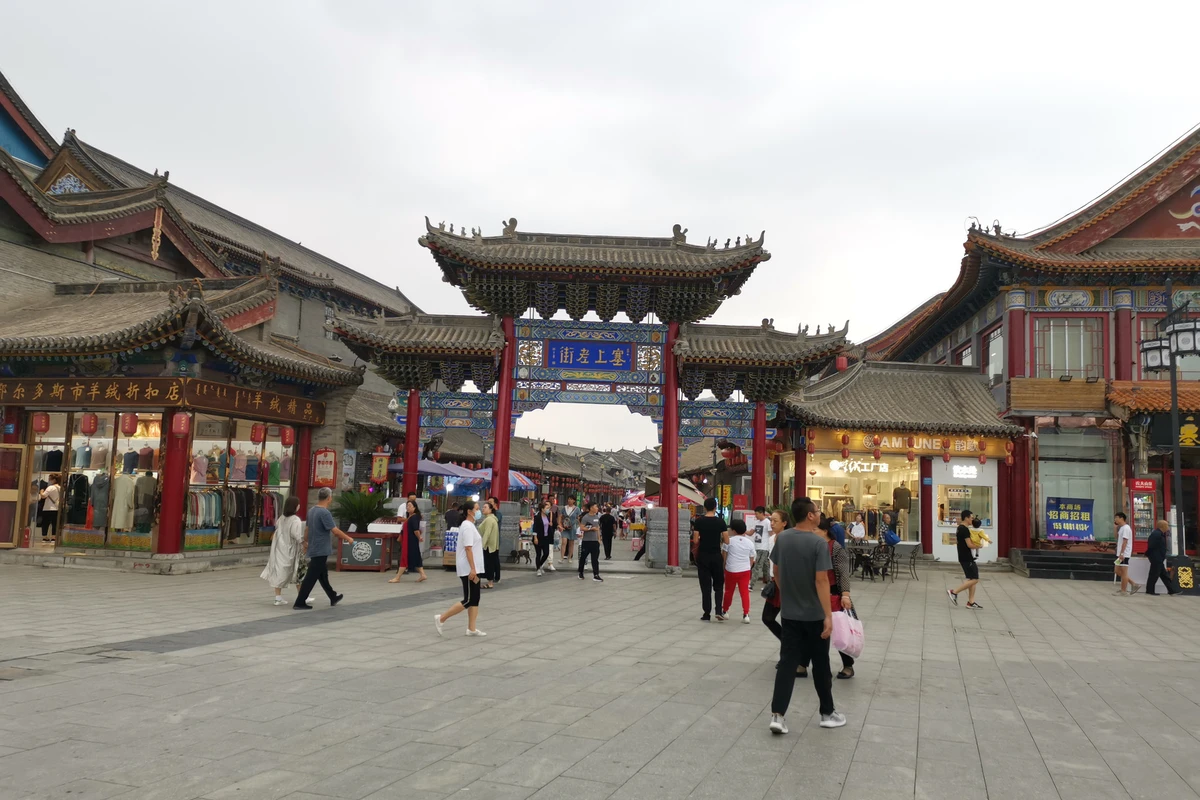
On the west side of the square is the Old Street beyond the Great Wall, a highlight of the historical and cultural city. It is 380 meters long, with architecture fully reflecting the characteristics of the Ming and Qing dynasties, known as the condensed old image of old Hohhot.
This old street, named Tongshun Street, is lined with shops selling jewelry, jade, folk herbs, general merchandise, and local products.
At the westernmost end is the Tongshun Gate Bell and Drum Tower, and further ahead is the Zhadage River.
In the past, people from Shanxi traveled westward from the Shahu Pass to this place and even to Baotou, while traveling eastward they went through Zhangjiakou to beyond the Great Wall. Only the western route was desolate and not as safe as the eastern route.
The food street on the south side of the old street was crowded with people. The tempting food along the street made our mouths water. We ordered various dishes from several stalls at a square table on the food street edge as dinner and ate heartily.
Dazhao Temple and the memorial archway under the night sky.
That day, we visited several representative attractions in Hohhot:
The first spot was the Princess Mansion.
The full name is Gulun Kejing Princess, the sixth daughter of Emperor Kangxi. The Qing Dynasty adopted a conciliatory policy toward Mongolia, marrying Princess Kejing to Tushetu Khan's son Dundob Dordorji of the Khalkha Mongol tribe. She was first granted the title Heshuo Princess, then Kejing Princess, and finally Gulun Kejing Princess.
The princess mansion has five courtyards, including a main gate, a passage hall, a main hall, and an inner courtyard. A large screen wall stands in front of the gate, and the east part of the residence has rockeries and ponds.
It is very spacious and imposing.
It has now been converted into the Hohhot Museum, using the ancient building to house cultural relics and exhibitions.
The second spot was the Suiyuan General's Mansion.
This was the office of the Qing Dynasty's Suiyuan General, who governed Guihua City, southern Mongolian regions, and commanded troops stationed in Datong and Xuanhua. It was built according to the format of a first-rank feudal official's mansion.
The mansion is magnificent. Its construction was a product of the Qing Dynasty's policy to consolidate the northwestern border and implement political and military control over the Mongolian regions north of the desert.
The main hall served as the decision-making center.
Large-scale construction began in the second year of Emperor Qianlong's reign and was completed in the fourth year (1739). The Qing court then gave Hohhot the name 'Suiyuan City.'
On the east side, there is a garden with pavilions and corridors connecting them.
The third spot was Genghis Khan Park.
The park was built on the site of a former sand quarry in Hohhot, below ground level, making it very cool. The ground was covered with greenery, and with light rain falling, it felt even more comfortable.
The Genghis Khan sculpture is typical of the north—very grand and imposing.
Above the sculpture is Genghis Khan East Street, and below it is a tunnel connecting the north and south sides of the park. Crossing the tunnel leads to the northern part of the park, which was near where we parked.
An unknown statue, likely one of Genghis Khan's consorts.
The park features bridges, flowing water, pavilions, and a large rockery, all very realistic and grand. Especially amidst the green trees, it is easy to get lost if not careful.
The fourth spot was the Inner Mongolia Museum.
Originally the Inner Mongolia Museum, built as a key project for the 10th anniversary of the autonomous region's founding in 1957, it was the only comprehensive museum at the autonomous region level and one of the earliest museums established in ethnic minority areas. It was included in the history of world architecture as early as the 1950s. In 2007, the Inner Mongolia Museum was officially inaugurated, with a building area of over 15,000 square meters and an exhibition area of 7,000 square meters, and is a national first-class museum.
On the wall of the main hall is President Xi Jinping's inscription: 'Build a beautiful Inner Mongolia, jointly realize the great Chinese Dream.'
The museum has four floors. The first floor is below, and exhibitions start from the second floor. The second floor features four basic exhibitions: 'Ancient World,' 'Vast Plateau,' 'Treasures Underground,' and 'Divine Spaceship,' introducing the birthplace of grassland culture. The third floor has four basic exhibitions: 'Grassland Heroes,' 'Grassland Lords,' 'Grassland Customs,' and 'Grassland Flames,' presenting the vertical development of grassland culture from ancient to modern times. The fourth floor has six special exhibitions: 'Grassland Sunrise,' 'Knights of the Wind,' 'Grassland Costumes,' 'Melodies of the Sky,' 'Grassland Splendor,' and 'Ancient Road Treasures,' focusing on highlights of grassland culture.
Focusing on Genghis Khan and the Yuan Dynasty, it displays a nearly thousand-year complete lineage from the origin of the Mongols to the Mongol Yuan era and then to the Ming and Qing dynasties.
Grassland Customs: Exhibits the production, daily life, culture, arts, etiquette, religion, and other customs of eight ethnic groups—Mongol, Daur, Ewenki, Oroqen, Manchu, Hui, Korean, and Han—living in Inner Mongolia over the past centuries.
Grassland Flames: Displays the social conditions and revolutionary relics of Inner Mongolia from the May Fourth Movement in 1919 to the founding of the People's Republic of China in 1949.
Ancient World: Displays natural ancient fossils from Inner Mongolia, showing the dramatic changes in the region's ancient ecological environment from 3 billion years ago to 10,000 years ago, especially highlighting Mesozoic dinosaurs and mammalian fossils from the Tertiary and Quaternary periods.
Time was limited; we looked at some parts in detail and glanced over others, but we managed to go through all the exhibitions.
I have always believed that to truly understand a place, one must visit its local history museum.
History is created by the people. Museums reflect the footprints of predecessors and foreshadow the future. Large and small museums are like encyclopedias, showing the motherland's progressive steps through every time and space.
The Inner Mongolia Museum has a building area of 50,000 square meters and an exhibition area of 20,000 square meters, spread over four floors, including eight basic exhibition halls and eight special exhibition halls. The eight basic exhibition halls display Inner Mongolia's ancient ecological environment, geological and mineral resources, history of ancient northern ethnic groups, revolutionary struggle history, and modern ethnic folk customs, vividly and richly displayed, making one marvel at the wisdom of predecessors and the vastness and profundity of China.
Thus, our journey ended happily. We drove to the airport, returned the rental car, and boarded the flight back.


