Journey to the West, Chapter Three: Leaving Homeland, a Beauty of Falling Geese Becomes a Xiongnu; Encountering Saihantala Prairie in Baotou Astonishes the Traveler
All photos in this article were taken by the author "Black and White Touch". All rights reserved. No unauthorized use!
One autumn day in 33 BC, a woman from Jiangnan bid farewell to her homeland and set out northward toward the unfamiliar deserts. Along the way, horses neighed and wild geese cried, filling the air with sadness and desolation, making her heart heavy with sorrow. On her mount, she plucked the strings of her zither, playing a solemn and stirring melody of parting. The southward-flying wild geese, hearing this mournful music and seeing the beautiful woman on horseback, forgot to flap their wings and plummeted down...
This woman was Wang Zhaojun, one of the Four Great Beauties of ancient China, renowned for her "falling geese" countenance.
The story of Zhaojun's departure beyond the frontier is known to all. She was born in Zigui (present-day Xingshan County, Yichang, Hubei) and buried in the Green Tomb.
A somewhat familiar image appears in many ancient poems:
Du Mu wrote "The Green Tomb": "Before the Green Tomb, the Long River flows; on Mount Yanzhi, evening clouds and autumn. Once a moth-browed beauty falls into the spring of poverty, night after night her lonely soul grieves under the moon."
Cao Xueqin, through Xue Baoqin, composed "Meditation on the Green Tomb": "The black waters choke and refuse to flow, the ice strings are plucked to the end of the tune's sorrow. The Han dynasty's system is truly lamentable; the useless elm and catalpa should be eternally ashamed."
The Green Tomb is not just any grave. Wherever it appears, behind it lies a complex interweaving of parting sorrow, great righteousness, and the legendary epic of individual fate colliding with the tides of the times.
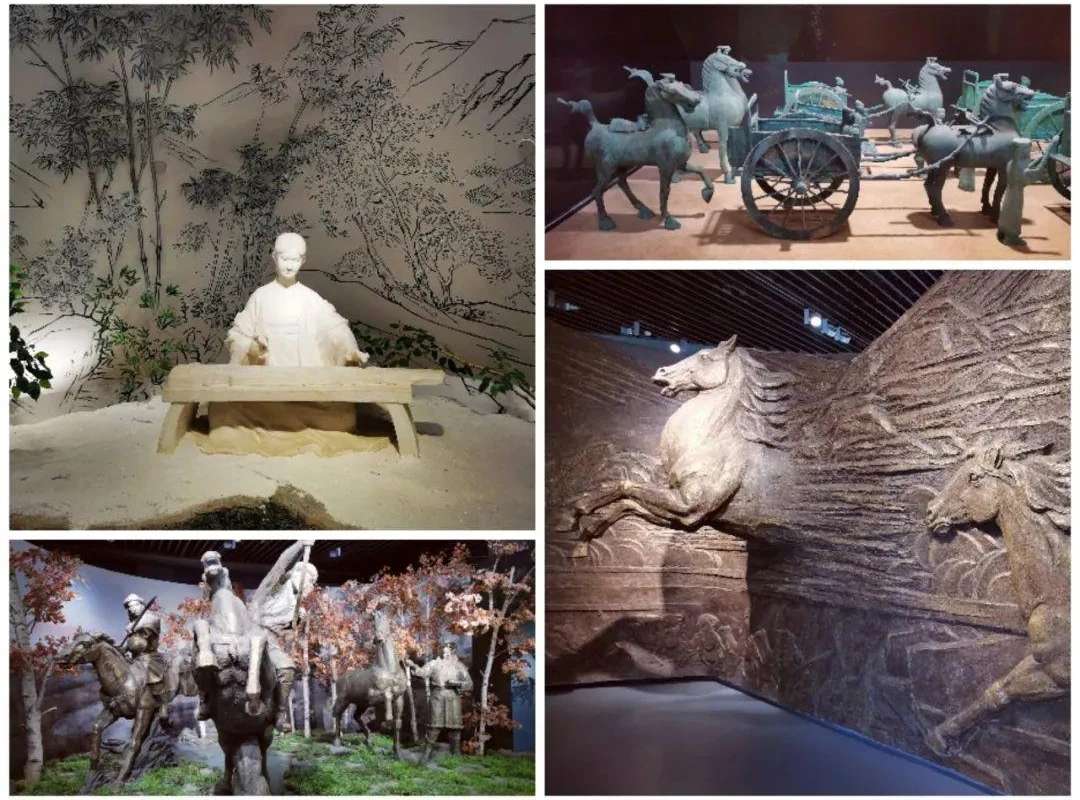
About ten kilometers south of Hohhot, in the suburbs, is the location of the Green Tomb. Today, the Zhaojun Museum has been established here, unfolding the culture of Zhaojun and the history of the Xiongnu...
The Xiongnu people were briefly mentioned in the second chapter when introducing the Mongols, as they once fought with the Mongols' ancestors, the Donghu. Today, let us learn in detail what kind of people the Xiongnu, Zhaojun's "husband's family," were.
The term "Xiongnu" first appeared in the Warring States period texts "Yizhoushu" and "Strategies of the Warring States." According to historical records and archaeological evidence, the Xiongnu were active on the Mongolian Plateau as early as the Xia, Shang, and Zhou dynasties. At their peak, their territory stretched east to the Liao River, west to the Altai Mountains, north to the Baikal region, and south to the Great Wall. The Xiongnu were a nomadic military regime, with the Chanyu as their supreme leader.
Touman Chanyu was the first Xiongnu ruler recorded in history. Under his leadership, the Xiongnu tribal confederation rose rapidly, beginning its initial expansion and development. Its sphere of influence covered the Yin Mountains to the area north of the Hetao region.
(Touman Chanyu)
Modu Chanyu was another outstanding Xiongnu military strategist. In 209 BC, he established the first nomadic regime, reigning until 174 BC. During his rule, he expanded three times, commanding 300,000 mounted archers and leading the Xiongnu to become the most powerful people on the Mongolian Plateau. He invented a type of whistling arrow called "mingdi" and ordered his cavalry: "All must shoot at the target of the whistling arrow; anyone who does not will be executed," demonstrating his strict military discipline.
(Modu Chanyu)
Historical records state: "Warriors who can draw a bow are all armored cavalry. Their custom is to follow the herds when there is peace. They rely on hunting and shooting for a livelihood; in times of crisis, they train for war and invade—this is their nature." This means that Xiongnu social and military organizations were integrated; warfare, hunting, and invasion were inherent to their nature.
The rise and fall of the Xiongnu were closely linked to Chinese civilization. In the 3rd century BC, the two civilizations collided, and over the following centuries, there were repeated brutal conflicts and skirmishes, as well as trade, friendly marriages, and alliances.
During the Warring States period, the Xiongnu gradually unified the Mongolian tribes and then continually harassed the Central Plains states. The neighboring states of Yan, Zhao, and Qin built the Great Wall to defend against them. After Qin unified China, General Meng Tian led an expedition to consolidate the border and built the Great Wall to defend against the Xiongnu. Amidst the wars, there were also cultural exchanges between the Xiongnu and the Central Plains; the King of Zhao's adoption of Hu-style clothing and archery on horseback was a cultural paradigm influenced by the Xiongnu.
In the early Western Han, the state was weak. Modu Chanyu led an invasion of Han territory, besieging Emperor Gaozu of Han on Mount Baideng for seven days and seven nights. The Han army suffered from thirst and hunger. Later, the strategist Chen Ping offered a plan to bribe Modu's consort with large sums of money to persuade Modu to withdraw, allowing the emperor to escape. This event is known as the "Siege of Baideng." During this period, the Han mainly pursued a policy of peace marriages (heqin) with the Xiongnu.
After the reigns of Emperors Wen and Jing (the "Rule of Wen and Jing"), Han power gradually strengthened. Under Emperor Wu of Han, generals such as Wei Qing, Huo Qubing, and Li Guang launched several large-scale campaigns against the Xiongnu. Through the Battle of Henan, the Battle of Hexi, and the Battle of Mobei, they greatly weakened the Xiongnu, driving them out of the Yin Mountains and the Hetao region and its western areas, basically eliminating the Xiongnu threat. Zhang Qian's mission to the Western Regions occurred during this period; Emperor Wu sent Zhang Qian westward not to open the Silk Road, but to ally with the Dayuezhi against the Xiongnu. However, the unintended cultural and trade exchanges had profound and lasting significance.
In the late Western Han, the Xiongnu experienced a "struggle among five Chanyus." Huhanye Chanyu led his tribe to submit to the Han and, with Han help, unified the Xiongnu tribes. The story of Zhaojun's departure beyond the frontier and the peace marriage between Hu and Han took place during this period. Jin Midi, the son of the Xiongnu Xiutu King stationed in Wuwei, was even appointed by Emperor Wu as a regent for his young son. The two peoples maintained friendly relations for over half a century, with "no alarms of war for several generations, and cattle and horses covering the fields."
In the early Eastern Han, internal conflicts among the Xiongnu intensified. In 48 AD, the Xiongnu split into northern and southern halves. While settling the Southern Xiongnu, the Eastern Han sent troops twice into the Western Regions to attack the Northern Xiongnu and dispatched Ban Chao on a diplomatic mission to the Western Regions, where he skillfully contended with the Xiongnu, leading the Western Regions states to submit to the Eastern Han. The Northern Xiongnu suffered heavy losses and were forced to retreat from the Mongolian Plateau, moving westward to Central Asia. The Southern Xiongnu entered the frontier and joined the great ethnic fusion.
During this period, a heroic feat comparable to "Three Hundred Spartans vs. the Persian Army" occurred: "Thirteen Warriors Return to Yumen Pass." In 75 AD, General Geng Gong of the Eastern Han and his 300-plus soldiers successfully repelled an attack by 50,000 Xiongnu troops on Shule City. With the help of reinforcements, they ultimately prevailed, but only thirteen men survived to return to Yumen Pass.
In 91 AD, the Northern Xiongnu fled westward to an unknown location. It was not until the mid-4th century that a people called the "Huns" appeared in the Don River region and began invading Europe. According to research, the Huns were the Xiongnu. In the mid-5th century, under Attila's leadership, the Xiongnu reached their peak influence in Europe, establishing a powerful Xiongnu regime known as the Attila Empire. The Xiongnu invasion contributed to the collapse of classical European slavery and marked the beginning of the great migration of peoples in world history.
To Europeans, Attila was the "Scourge of God" even earlier than Genghis Khan, and his life was full of legend. European sculptures reflect Attila's bravery, ruthlessness, and terror. One sculpture depicts a legend: when Attila swept across Europe, Pope Leo I of Italy received angelic aid to drive away the Huns. In the sculpture, Leo I is persuading Attila to withdraw; Saints Peter and Paul fly in from the sky, and Attila raises his right hand to avoid them.
The Hungarian poet Sándor Petőfi wrote: "Our distant ancestors, from Asia to the Danube, how did you travel the long road and build a new homeland?" The "ancestors" here were likely the Xiongnu.
During the Wei, Jin, Northern and Southern Dynasties, the Xiongnu split into branches such as the Tuge Hu, Lushui Hu, and Tiefu. The Southern Xiongnu united with the Tuge Hu to successively establish the "Han—Former Zhao" regime, the Lushui Hu established the Northern Liang regime, and the Tiefu established the Da Xia regime. The Xiongnu were no longer as unified as during the Warring States and Qin-Han periods. Through exchanges and integration with the Xianbei, Han, and other peoples, the Xiongnu gradually disappeared from the historical stage in the late Northern and Southern Dynasties.
From their debut in the 3rd century BC to their disappearance in the 5th century AD, the Xiongnu endured 700 years of turbulent history, performing many grand and heroic dramas in Chinese ethnic history. They created a unique nomadic folk culture that had a significant impact on Chinese and even world cultural history.
When the Xiongnu first rose in the deserts north and south, they had already entered the Iron Age. Based on hunting, their livestock industry flourished, accompanied by a small amount of agriculture, which promoted the development of handicrafts, commerce, and transportation, making them unique among northern nomadic peoples.
The Xiongnu had no written language; they used customs as the basis for punishment, known as "customary law." The Xiongnu loved music and dance; their folk songs were beautiful and melodious, and they had their own musical instruments, such as the hujia (a reed pipe). They also created distinctive bronze art and rock art. The Xiongnu believed in shamanism and held three large ceremonies each year to worship heaven and earth. They lived in yurts (qionglu zhanzhang) and practiced "levirate marriage" (shouji hun) as their marriage custom.
The Xiongnu also enjoyed wrestling. In autumn when horses were fat, they held grand gatherings to compete in events derived from horseback archery and hunting. This custom later evolved into the "Nadam Fair" among the Mongols.
The Xiongnu's ethnic culture had a profound influence on later Chinese peoples: the titles and organizational structures of supreme rulers among ancient northern peoples—including the Xianbei, Rouran, Turks, Khitans, Jurchens, and Mongols—were all influenced by the Xiongnu Chanyu system. The Xiongnu's horseback archery, Hu-style clothing, music, dwellings, rituals, and athletic competitions were all introduced into and integrated with Central Plains culture.
In 33 BC, Zhaojun went beyond the frontier to marry the Xiongnu, ending more than 170 years of conflict between the Xiongnu and Han, and maintaining peace for over half a century. Huhanye Chanyu and Wang Zhaojun had a harmonious and loving relationship, bringing prosperity to the Xiongnu Empire. What kind of upbringing did this extraordinary woman, who bridged civilizations, have?
Wang Zhaojun was born in Zigui (present-day Xingshan County, Hubei) during the Western Han, which was also the hometown of Qu Yuan. Today, two stone tablets stand side by side in the county town: one reads "Hometown of Qu Yuan, Grand Master of Chu," and the other "Hometown of Wang Qiang (Zhaojun), Lady of Han."
Around 37 BC, Wang Zhaojun was recruited into the Han palace, beginning several years of lonely life as a palace maid. At that time, the only chance for a palace maid to see the emperor was to bribe the court painter—the emperor would first look at portraits and then decide which woman to summon. Zhaojun disdained this and never curried favor with the painter, so even though she was outstanding in appearance and talent, she remained unseen by the emperor for years. In 33 BC, Huhanye Chanyu submitted to the Han and sought a peace marriage. Zhaojun volunteered herself and requested to go beyond the frontier. According to legend, at the farewell ceremony, Emperor Yuan of Han saw Zhaojun for the first time and immediately regretted it. Reluctant to part with such a beauty, but the matter was already settled, he had the painter executed to vent his anger. History records: "The emperor summoned the five women to show them; Zhaojun's rich appearance and splendid attire illuminated the Han palace; she glanced back and forth, stirring everyone around."
After Zhaojun arrived at the Chanyu's court, Huhanye held a grand wedding ceremony and bestowed upon her the title "Ninghu Yanzhi" (Pacifying Hu Consort). They had a son. In 31 BC, Huhanye died, and his former consort's son, Diaotaomogao, succeeded him. According to Xiongnu levirate custom, Zhaojun married Diaotaomogao and gave birth to two daughters. Zhaojun lived beyond the frontier for about thirty years, getting along well with the Xiongnu people, who deeply loved her. She made significant contributions to the economic and cultural exchanges between the Han and Xiongnu.
The Xiongnu levirate marriage custom: when a father dies, the son marries his stepmother; when a brother dies, the other brother marries his widow. This was quite different from Han customs and even violated Han moral norms. After Huhanye Chanyu's death, the Han emperor ordered Zhaojun to follow the Hu customs. Zhaojun underwent great inner struggle but ultimately gave up the idea of returning to the Han, marrying Huhanye's son out of consideration for the interests of both peoples.
After Zhaojun's departure, trade between the Xiongnu and Central Plains peoples along the frontier became more prosperous. There are records that "from the Chanyu down, all Xiongnu were close to the Han, coming and going along the Great Wall," showing Zhaojun's contribution to the peace and friendship between the two peoples.
According to historical records and legends, Zhaojun was buried in the Green Tomb after her death. The tomb was built by manually piling and ramming earth, shaped like an overturned dou, 33 meters high, making it one of the largest Han tombs in China. In present-day Inner Mongolia and northern Shanxi, there are more than a dozen tombs of Zhaojun of varying sizes, expressing the reverence of the frontier peoples for Zhaojun.
(The Green Tomb in the Tang dynasty)
For two thousand years, Wang Zhaojun has maintained enduring charm across all dynasties. Artistic representations of her are diverse and colorful, including literature, calligraphy, painting, drama, and handicrafts. Zhaojun culture is also a characteristic culture of Hohhot, and the Zhaojun Museum displays various artworks related to Zhaojun.
The museum also features an exhibition on "Peace Marriage Culture." In multi-ethnic China, war and peace are the two main forms of ethnic relations. War brings deep suffering to all peoples, while peace is conducive to mutual understanding and development. Peace marriage (heqin) is the most influential and effective way to promote peaceful exchanges among ethnic groups. The exhibition presents the history of peace marriages from the pre-Qin period to the Qing dynasty, telling the stories of Princess Wusun, Princess Wencheng, the Mongol princess, Empress Xiaozhuang, and Feng Liao—China's first female diplomat—showcasing, from another perspective, the female envoys who contributed to ethnic peace, proving that women are as capable as men.
The above exhibitions are located in the two pyramid-shaped tomb gates of the Green Tomb (pictured below) and the buildings in Mongolian and Han styles along the passage behind the gates. These stylistically diverse buildings are another highlight of the Zhaojun Museum.
The interior design of the exhibition halls features graceful curves that are visually striking:
Along the sacred way stands a white marble statue of Zhaojun, graceful and elegant, with a spring breeze on her face, displaying the beauty and confidence of a legendary woman.
On one side of the sacred way is a "Zhaojun Visiting Hometown" landscape. Behind a memorial archway, a replica of Zhaojun's residence and ancestral hall has been built, displaying artifacts such as furniture, farm tools, and miscellaneous items, recreating the folk customs of Zhaojun's hometown, including daily life, diet, and labor.
The sacred way passes through the Green Tomb archway to reveal the majestic bronze peace marriage statue, depicting Wang Zhaojun and Huhanye Chanyu riding two horses—one looks back and whispers, the other cocks its ear to listen—recreating the intimate newlywed affection between Zhaojun and the Chanyu.
Beyond the statue, after a flight of steps and a stele pavilion, the raised mound is the Green Tomb. Ancient records say: "The grass in the north is all white, but only the grass on Zhaojun's tomb is green, hence the name Green Tomb."
On either side in front of the tomb stand tomb markers, small structures indicating the occupant's identity. The pedestals are carved with tigers facing head to tail, serving as tomb guardians protecting the path. The columns feature two intertwined tigers, symbolizing the peace marriage.
On the way back from Zhaojun's tomb to Hohhot, we passed the Mongolian Folk Custom Park, which features a rainbow gate, a Mongolian avenue, and other attractions. This tourist area showcases Mongolian history, military culture, imperial court culture, and folk culture. If time permits, one can enter to see the grasslands and yurts.
That afternoon, we drove 170 kilometers west to Baotou. The next morning, we visited the Saihantala Urban Prairie.
"Falling in love with a wild horse, but my home has no prairie"—this is the regret of young people in inland cities. But for nomads, home is the prairie. Even in the city of Baotou, there is a prairie.
Looking at the pictures, you might think I'm making a fuss. Isn't this just an urban wetland park? Many cities have them.
But have you ever seen a wetland park where horses graze?
Have you ever seen a wetland park dotted with yurts?
Have you ever seen a solemn cairn (obo) in a wetland park?
(Bayinbaolige Obo in Saihantala)
"Saihantala" means "beautiful prairie" in Mongolian. It is the only urban prairie in China and even in Asia, with a complete original prairie ecosystem. It covers nearly 10,000 mu of natural vegetation and is home to over 30 species of wild animals, including pheasants, hares, and wild ducks. Located in the heart of Baotou's main urban area, it is a unique city business card reflecting Baotou's prairie culture.
Another famous scenic spot in Baotou is Wudangzhao, about 60 kilometers northeast of the city center.
"Wudang" means willow in Mongolian; "zhao" is from Tibetan, meaning elder brother or venerable, extended to mean temple. Thus, Wudangzhao means "Temple in the Willow Valley." It is also known as "White Lotus Temple," deriving from the legend of "an eagle carrying a scripture crown, milk turning into white lotuses." Its Chinese name is "Guangjue Temple," bestowed by Emperor Qianlong.
Wudangzhao was first built during the Kangxi period and expanded several times. It is a temple that combines politics and religion, and it also served as a research base for studying esoteric Buddhism, philosophy, medicine, astronomy, geography, and other disciplines. This large-scale temple with its unique structural form is unique among existing Tibetan Buddhist temples in Inner Mongolia. It is as famous as the Potala Palace in Tibet, the Kumbum Monastery in Qinghai, and the Labrang Monastery in Gansu, ranking among the four great temples of Tibetan Buddhism in China.
After entering the scenic area, one must cross a hill to reach the temple. Along the way, one can see many Mani stones and Tibetan Buddhist deity images and mantras. The scenery of red willows, green grass, blue sky, and white clouds along the way is also pleasant.
The temple halls are built along the mountain, arranged in a well-proportioned layout. There are nearly twenty Buddhist halls, including Jinke Hall, Subugai Mausoleum, A'hui Hall, and Queyila Hall, covering sutra halls for exoteric Buddhism, esoteric Buddhism, and bodhi path studies. The halls are grand in scale, with statues, murals, and thangkas inside, each with its own features. They include a ten-meter-tall bronze statue of Shakyamuni, a nine-meter-tall bronze statue of Tsongkhapa (the founder of the Gelug sect), statues of Vajra protectors, and statues of White Tara and Green Tara, among others—too many to take in.
At the foot of the mountain is a prayer flag square with a sculpture titled "Eagle Carries Crown, Milk Turns Lotus." Legend has it that during the first Living Buddha of Wudangzhao's journey to choose the temple site, a golden eagle picked up his scripture hat and placed it on a tree; then a woman's milk bucket tipped over, and the milk turned into white lotuses. The lotus is a symbol of auspiciousness in Buddhism, and the golden eagle is the protector deity of Shakyamuni. Seeing this, the Living Buddha rejoiced and decided to build the temple here, following heaven's will.
Another striking feature in the square is a five-colored stone pagoda called the "Mani Stone Pagoda," built from Mani stones. Mani stones are a traditional Tibetan folk art, usually carved with the six-syllable mantra, Buddha images, wisdom eyes, and other auspicious patterns. This Mani stone pagoda is the largest and most exquisitely crafted in Inner Mongolia. It is carved with twelve Buddha images, including Shakyamuni, the Three Protectors, the Three Long-Life Deities, Amitabha, Yellow Jambhala, and Green Tara. At the top of the pagoda stands a six-meter-high golden victory banner, symbolizing victory over all afflictions and adverse conditions, attaining the perfect ultimate fruit.
After visiting Wudangzhao, it was noon. With good weather, we decided to drive all the way to Ordos. On the way south, we passed the Baotou Ancient City and the Resonant Sand Bay—these convenient attractions along the route were the most delightful encounters on our road trip.
Baotou Ancient City is a replica ancient tourism area similar to Western Film Studios. It features towering and majestic gates, lifelike sculptures, houses of yellow earth and blue bricks, and many old Baotou objects. Walking through the streets, one can experience Baotou's folk customs and the rugged frontier scenery. Watching performances and taking photos with ancient buildings are good experiences, but if you have visited many such places, these ancient cities are much the same—it's fine to skip them.
Resonant Sand Bay (Xiangshawan) is at the eastern end of the Kubuqi Desert, the closest desert to inland China and Beijing. Like the Singing Sand Dunes at Mingshashan in Dunhuang, the sand here also "sings" (the "diabolo" effect caused by sand grains spinning in air currents). Unlike Mingshashan, the dunes here resemble waves upon waves, whereas Mingshashan has clear ridgelines like artificial carvings. Resonant Sand Bay also has several resort islands with complete entertainment facilities, including sand sliding and water play—everything you could want.
(Mingshashan in Dunhuang)
Mingshashan already belongs to Ordos. Continuing south to Dongsheng District and Kangbashi District, the impression was completely different from Hohhot and Baotou. What stunning sights does this city, famous for cashmere, have to offer?


