Backpacking Through Gansu, Ningxia, Inner Mongolia, Shaanxi, and Shanxi
Due to the pandemic, I hadn't left Shanghai for half a year. The planned 'Backpacking Through Gansu, Ningxia, Inner Mongolia, Shaanxi, and Shanxi' was repeatedly postponed. In early July, the ninth edition of the national epidemic prevention measures was released, and the situation in Shanghai stabilized slightly. With a mixed feeling of anxiety, I finally boarded the westward train.
July 17:
K360, after a night's journey, arrived on time at 11:41 at the first stop—Pingliang. Upon exiting the station, strict pandemic controls directed those from Shanghai to a designated area: first register, then get a nucleic acid test. This took about an hour and a half. To save time, I took a taxi directly to the hotel and then to the scenic area.
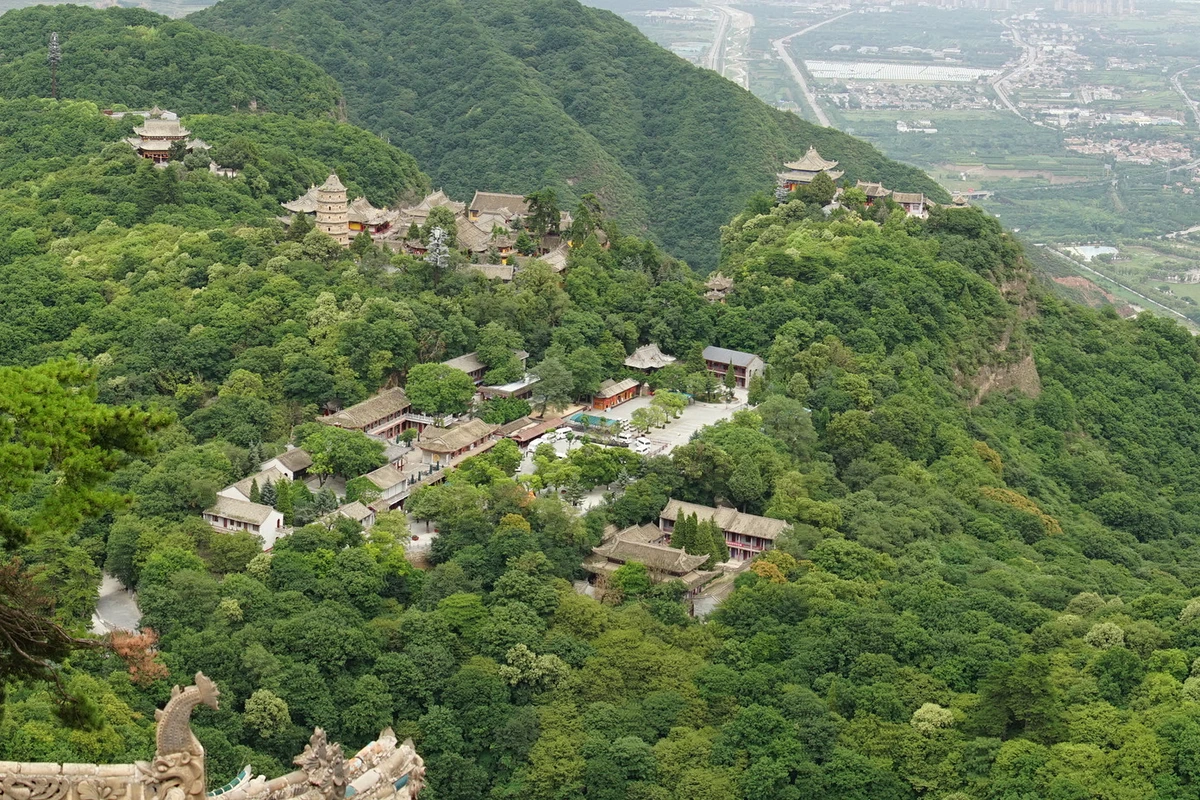
Mount Kongtong, at an altitude of 2123 meters, has a forest coverage rate of over 95%. Its peaks stand majestically, steep cliffs rise abruptly, embodying both the grandeur of northern mountains and the elegance of southern landscapes. It also features eight platforms, nine palaces, twelve courtyards, and forty-two building complexes, combining spectacular natural scenery with exquisite cultural heritage. Since ancient times, it has been known as the 'First Taoist Mountain in China.'
Hunyuan Tower (Geological Museum)
Hunyuan Tower in the distance
'Huangcheng' (Imperial City) is the main building complex, mostly from the Ming Dynasty, expanded and renovated with donations from the vassal Prince Han and his wife, Lady Guo. It has a history of over a thousand years.
Leisheng Peak and surrounding buildings
Zhongtai and Buddhist temple in the distance
Chaotian Gate and Shangtian Ladder
From the Shangtian Ladder, Zhongtai is not far. Zhongtai, as the name suggests, is a platform halfway up the mountain, hosting several Buddhist temples and serving as a tourist hub for food, accommodation, and transportation. From here, I took the scenic shuttle back to the visitor center at the foot of the mountain, then took a one-cent bus back to the hotel.
July 18:
Today's plan was to visit the 'Yunya Temple National Geopark' in Zhuanglang County. The West Bus Station has a bus to Zhuanglang county town, but it took the northern route via Longde in Ningxia, taking a full four hours. Upon arriving in Zhuanglang, although there was a dedicated tourist bus, no one knew when it would depart. To avoid wasting time, I had to take a taxi.
The Zhuanglang terraced fields are also a sight, and taking the northern route this time happened to let me see them.
'Yunya Temple Geopark,' located 30 km from the county town, hidden deep in the Guanshan Forest. The highlight is the Yunya Temple grottoes, carved during the Northern Wei period, known as 'Little Maijishan.'
There are also other grottoes such as Dasi and Xisi, but they are severely damaged. However, the forest is deep and sparsely populated, the air is fresh, and walking there, accompanied by the sound of flowing water, birdsong, and floral fragrance, it is truly a place where Buddhism and scenery blend.
Getting there was easy, but returning was difficult. After leaving the scenic area, the parking lot had only a few self-driving cars, with no other means of transport. After much trouble, I finally returned to Pingliang.
July 19:
Today, I took the same bus again, but I got off at Longde.
Longde belongs to Guyuan, Ningxia, while Pingliang belongs to Gansu. I crossed the provincial border. After a nucleic acid test, I exited smoothly. I left my bag at the station and shared a car to the 'Liupan Mountain Long March Memorial Scenic Area.' The visitor center at the foot of the mountain has a bus directly to the memorial square at the top. When I first arrived, the sky was blue with white clouds, but soon mist spread across the square. Liupan Mountain is said to be 'red in the north and green in the south.' The north is the Long March Memorial, while the south is the Liupan Mountain Forest Park in Jingyuan. Due to time and transportation constraints, I chose the north. At noon, I went down the mountain, hailed a car for 5 yuan to the bus station, had local lamb soup on the street, and then visited the internet-famous 'Old Alley.' According to my research, there were frequent buses from Longde County to its superior city, Guyuan, every 30 minutes until the last bus at 5:30 p.m. However, in reality, there was not a single bus. Eventually, I shared a car with others for 50 yuan per person. It was unheard of for a proper county to have no bus service to its superior city.
Statue in the memorial hall (Qing Ping Le, Liupan Mountain)
Peak on Liupan Mountain
Having visited many ancient towns in Jiangnan, Longde's 'Old Alley' gave me a fresh impression: the yellow tones blended with the green of the trees, the red lanterns, and the strong northwestern accent filling the air. This old alley has been developed into a vibrant place for tourism, commerce, and entrepreneurship.
After visiting the Old Alley, I walked to the nearby bus station and took a taxi to Guyuan.
July 20:
In Guyuan, I stayed at a hotel near the bus station. The first thing was to take a taxi to the hospital for a nucleic acid test that day. I also arranged with the driver to charter a car to Xumishan tomorrow.
Xumishan is about 50 km north of Guyuan. It is also a grotto site from the Northern Wei period, with 150 existing caves, making it one of the ten major grottoes in China. The most famous is the 20.6-meter-high Maitreya statue in the Great Buddha Hall, but unfortunately it is still under renovation.
To visit Xumishan, you must first enter the museum.
Xumishan also features Danxia landforms, and the adjacent gorge is the Shimen Waterway, a strategic point on the Silk Road.
Caves 45 and 46 at Yuanguang Temple are from the Northern Zhou period, with beautifully ornate and voluptuous niches.
Cave 51 at Xiangguo Temple, also from the Northern Zhou, houses seven 7-meter-high Buddha statues of high artistic merit, known as the 'Light of Xumi.'
Selfie in front of Zisun Palace
July 21:
The train from Guyuan to Qingtongxia departs at 1:35 p.m. In the morning, as usual, I went to the hospital for a nucleic acid test, then climbed the Guyuan Goose Park for a view, and later visited the Guyuan Museum.
July 22:
Arriving in Qingtongxia, I checked into Junyue Hotel. I arranged with Manager Huang to drive me to Qingtongxia Ancient Town, visit the 'Qingtongxia Yellow River Grand Canyon Scenic Area,' and then go directly to Wuzhong High-Speed Rail Station. There are many cars here, and it takes only 30 minutes to Yinchuan.
'Qingtongxia Yellow River Grand Canyon' is located in Wuzhong City, Ningxia Hui Autonomous Region. It is a national 4A-level tourist attraction, a national key cultural heritage site, a national science education base, and the essence of the World Heritage Irrigation Structure 'Ningxia Yellow River Ancient Irrigation District.' The famous Qingtongxia Water Conservancy Project, the mysterious unique 108 Pagodas, and the scenic ten-mile-long gorge make it a well-known tourist destination in China.
Yellow River Water Conservancy Museum
Qingtongxia Water Conservancy Project
The 108 Pagodas on the opposite bank, originally built during the Western Xia, have been renovated over the years, becoming even more robust.
I took a speedboat back to the dock; I had chartered the whole boat.
Arriving in Yinchuan early, after settling in accommodation, I took the bus to the city center to visit the Drum Tower, Yuhuang Pavilion, Nanguan Mosque, and Chengtian Temple.
Chengtian Temple Pagoda and Chengtian Temple
Climbing the pagoda to view the city
My hotel was an apartment-style room.
July 23:
There is a tourist distribution center right downstairs. I chose a one-day tour to Shuidonggou with a 100-yuan combo ticket. Departure at 9 a.m., returning at 4 p.m.
The Shuidonggou scenic area is large, consisting of the Site Museum, the Ming Great Wall, the wild grassland surfing camp of Otog Front Banner, Hongshan Lake, the Hidden Soldier Cave, and Hongshan Fort. Multiple modes of transport are required. The so-called combo ticket essentially covers the transportation costs for those with preferment cards.
The minibus crossed the Yellow River.
First, visit the Site Museum (this was a human habitation site 30,000 years ago).
In 1923, French paleontologists worked here.
Prehistoric archaeological site
Hongshan Fort 'Mutual Market' (where the Ming Dynasty traded horses and goods with Mongolia, Tatars, and Oirats)
In the deep, mysterious canyon from Shuidonggou to Hongshan Fort, there is a Ming Dynasty hidden soldier cave over 500 years old. Supported by the majestic Great Wall, steep cliffs, and mysterious ancient fort, it appears even more remarkable.
July 24:
Early in the morning, I took a train from Yinchuan to Bayannur (Linhe) in Inner Mongolia. Tomorrow is Monday, so I visited the 'Inner Mongolia Hetao Culture Museum' this afternoon, planning to go to the 'Hetao Cultural Tourism Area Wetland Park' tomorrow.
In ancient times, the Hetao region was warm, moist, and pleasant, making it one of the important areas for the origin and evolution of ancient Chinese humans. The Hetao Plain has abundant water resources, fertile land, suitable for farming and animal husbandry. From the Qin and Han dynasties to the Ming and Qing, over 2,000 years, successive feudal dynasties established administrative offices, resettled people, reclaimed land, and developed water conservancy. With irrigation from the Yellow River, it became the famous 'Granary beyond the Great Wall.' Due to time and transportation constraints, I could only give it a brief look.
The museum is large and impressive.
The gold crown with eagle top of a Xiongnu king unearthed here.
Since the attractions were relatively close, I decided to adjust my itinerary: tomorrow morning, head to Baotou.
Then I took a taxi to the nearby 'Hetao Cultural Tourism Area Wetland Park.' The Yellow River here is called 'Second Yellow River,' meaning it's not the main stream, but the area is still large.
For 10 yuan, I took a small train round trip.
The 'Second Yellow River' is actually a manually dug main canal.
'General Camp' is a tourism project integrating dining, accommodation, and entertainment.
July 25:
Early morning, I took K1518 to Baotou. The Daqing Mountains and morning glow welcomed the distant traveler. My hotel was 'Speed 9' near the station. Today, I will visit two attractions: 'Baotou Ancient City' and 'Saihan Tara Ecological Park.'
'Baotou Ancient City' is something I saw on media, not originally on my itinerary. It is over 20 km from the city center, backed by the Daqing Mountains. The scenic area features northwestern folk customs, recreating the culture of old Baotou, and is a comprehensive tourism area integrating sightseeing, leisure, and vacation.
A supply and marketing cooperative from the 1970s and 1980s.
Rural flowers and plants.
On the way back, I took a taxi directly to 'Saihan Tara Ecological Park.' This is a large grassland built in the city center, similar to New York's Central Park. It is very large. Besides the scheduled electric shuttle, the only options are two-person or multi-person bicycles. For my situation, a staff member recommended a mother-child bicycle: 60 yuan per hour, with the option to return at a different location. But unfamiliar with the route, I rode for 1.5 hours, costing 90 yuan.
Its advantage is that it is very suitable for travel photography.
The big grassland, the lungs of the city.
On the way back, I wanted to have a good meal at the food street.
Near the station, I had lamb soup from Fu County. Delicious!
July 26:
Morning: took K7929 to Ordos Station. The urban area of Ordos consists of Dongsheng, Kangbashi, and Yijinholo, which are very scattered. Today, I plan to visit Genghis Khan's Mausoleum, which is 27 km south of Ordos Station. My plan was to take a taxi first, then on the return, take the dedicated bus from Dongsheng to the mausoleum back to Dongsheng.
Ordos Station is in Yijinholo, still far from the main urban area.
'Genghis Khan's Mausoleum' is a 5A scenic spot, built in 1954. It is the cenotaph of the Genghis Khan, moved from Kumbum Monastery in Qinghai. The real burial site remains a mystery.
There are many entertainment facilities around the mausoleum area. Due to transportation and weather reasons, I didn't explore them one by one.
Returning to Dongsheng was a constant worry. At the visitor center, I asked the staff, who gave me a piece of paper and told me to contact the number on it. Eventually, I spent five cents to return to Dongsheng (a taxi would have cost at least a hundred yuan). I stayed at Wenlan Hotel, very close to the passenger transport center.
July 27:
Although I was already on the bus to Shenmu, this leg of the journey worried me the most, because I had to cross two provinces, and I didn't know what problems might arise, especially during the current pandemic.
The bus traveled through the abundantly wealthy wilderness for nearly four hours, arriving at noon in Shenmu, a city famous nationwide for coal. However, I wasn't here for mining; I specially came for Erlang Mountain.
Erlang Mountain is southwest of Shenmu. From a high vantage point, Shenmu City lies in a valley between two mountains. The beauty of Erlang Mountain is that it stretches along a long ridge, with pavilions, towers, temples, and Taoist temples built along the steep ridge. According to the introduction, the incense was flourishing here as early as the Yuan Dynasty (Zhengzheng period), continuing intermittently to this day. After many years of renovation in the new century, it finally took its current form in 2020.
Shenmu's sports stadium across the mountain.
July 28:
Today, I took a train to Mizhi, then to Yan'an.
Early in the morning, I had breakfast at the bus station and took Bus No. 1 to Shenmu Railway Station. My initial impression of Shenmu was somewhat messy and poor, but as the bus rounded a hill, the scene became high-class and grand. The roads were clean and wide, with tall buildings on both sides. This was the new city area I wanted to see. Shenmu has the financial resources to rebuild a new Shenmu.
There were mobile testing vehicles at the train station, and I didn't forget to take a nucleic acid test before boarding. Mizhi was also strict: upon arrival, I had to take a test.
'Li Zicheng's Palace' is not far from the station, a 10-yuan taxi ride.
Li Zicheng was born in Mizhi in the 34th year of the Wanli reign of the Ming Dynasty (August 21, 1606 in the lunar calendar). In the 4th year of the Chongzhen reign (1631), he joined the rebel army under Gao Yingxiang. In the 17th year of the Chongzhen reign (1644), he established the Dashun Dynasty in Xi'an with the era name Yongchang, and on March 19 of the same year, he captured Beijing, overthrowing the Ming Dynasty. After being defeated, he retreated to Tongshan, Hubei, where he died. Another theory says that after his defeat, he retired to Xiashan Temple in Shimen, Hunan, and passed away in the 13th year of the Kangxi reign (1674).
'Jiang's Manor'
The manor is located in Liumaoli Village, Mizhi County, built during the Tongzhi and Guangxu reigns of the Qing Dynasty (1871–1886), covering an area of over 26,000 square meters. With its unique cave dwelling architecture and strong northwestern style, it is listed as a national key cultural heritage site.
This internet-famous northwestern manor is known from many film and television works shot here, and at the end of the last century, it was replicated at a 1:1 scale in the Beijing Chinese Ethnic Culture Park.
July 29:
'Ganquan Grand Canyon Scenic Area' is located in Xiasiwan Town, Ganquan County, 60 km north of Yan'an. The scenic area covers 400 square kilometers, mainly consisting of Birch Gully, Peony Gully, Longba Gully, etc. The Ganquan Grand Canyon, after hundreds of millions of years of water erosion, has gradually developed into a typical gully-type Danxia geological wonder.
I also visited this place with a tour group in 2018, but at that time, the scenic area was still under development, and the gully we visited was not very typical. This time, I came to Yan'an specifically for 'China's Antelope Canyon.'
July 30:
Today, I will go to Hancheng, Shaanxi. The itinerary: take C181 from Yan'an at 7:05 to Xi'an, then transfer to C218, arriving at Hancheng at 11:13. Hancheng is a key point of this trip, as it is said that 'the most Shaanxi cultural relics are in Hancheng.'
I visited Shaanxi in 1966, and again in 1982, 1999, 2015, 2018, and 2021. I have been to almost all areas of Shaanxi: Longdong, Weinan, northern Shaanxi, and Hanzhong. But I had never been to Hancheng, the 'most' one.
Yuxiu Bridge, first built in the 41st year of the Kangxi reign of the Qing Dynasty (1702).
I stayed at 'Ancient City Inn.'
Wang Jie was the only zhuangyuan (top scholar) from the northwest region in the Qing Dynasty. He was the teacher of Emperor Jiaqing and served as the chief minister, known as 'the prime minister of two dynasties, the teacher of one emperor.' Wang Jie was an upright official, loyal and honest, full of integrity, and was credited for handling the corruption case of He Shen.
The Zhuangyuan Mansion Museum was carefully crafted by Shaanxi Zhuangyuan Mansion Cultural Development Co., Ltd. over two years.
The three-story building where Wang Jie lived after retirement.
Hancheng has three major ancient architectural complexes: the Confucian Temple, the Dongsheng Temple, and the City God Temple. They are now managed by the Hancheng Museum as the 'Three Temples of Hancheng Ancient City' (4A).
Confucian Temple: The Dacheng Hall is a Yuan Dynasty building. In front of the hall is a five-fingered pine tree that is 1,500 years old.
Zunjing Pavilion, built in the 3rd year of the Hongzhi reign of the Ming Dynasty (1490).
Dongsheng Temple: Now it is the Guandi Temple, with a 'Three Dukes Shrine' dedicated to Liu Bei, Guan Yu, and Zhang Fei.
City God Temple: The largest, with three courtyards, glazed tiles, and Qing Dynasty architecture.
July 31:
Today's itinerary includes Sima Qian's Tomb and Ancestral Temple, Dangjia Village, Longmen, and the Big Ladder Cliff, crossing from Shaanxi into Shanxi.
Early in the morning, I took a special line bus from the South Gate Bus Station to Sima Qian's Tomb and Ancestral Temple, then returned to Hancheng, took a taxi to Dangjia Village and Big Ladder Cliff, and finally to Hejin City. Although the process was complicated, it was uneventful.
Sima Qian was also from Hancheng, the greatest historian in China. The scenic area is located in Zhichuan Town, adjacent to the Yellow River. Here, we bathed in the great aura of the sagely historian, felt the profoundness of the Records of the Grand Historian, and enjoyed the beauty and harmony of nature.
Located northeast of Hancheng, in the Mishui River valley, shaped like a gourd. First built in the 2nd year of the Zhishun reign of the Yuan Dynasty (1331). There are now 123 courtyard houses, 11 ancestral halls, 25 watchtowers, temples, stages, Wenxing Pavilion, Kanjia Tower, Fenyin Room, Miyang Tower, and other ancient buildings. The rise of the Dang family is related to their reverence for farming and reading culture, as well as their joint-stock trading. Here you can see Beijing-style courtyard houses, appreciate the profound family instruction culture, and enjoy the ancient village customs of northern Shaanxi. Admission is 60 yuan.
'Big Ladder Cliff Scenic Area', located next to the Longmen Scenic Area in Hejin, Shanxi, now a 4A scenic spot. The 100-meter-high vertical elevator is not yet completed. It is this year's internet sensation, built on the Yellow River Grand Canyon. On the Shanxi side, there are ladder-shaped stone steps carved during the Northern Wei period, and a 100-meter-long glass walkway built on the precipice, creating a seamless blend of high-risk experience and the Yellow River canyon.


