Baotou Through a Lover’s Eyes
Baotou, many people are probably unfamiliar with this beautiful grassland city. But if we compare the mother river of the Chinese nation, the Yellow River, to a crown, then Baotou is the pearl right at the center of that magnificent crown. This is not only because Baotou sits just above the great bend of the Yellow River’s “几” shape. More importantly, it is the very first place the Yellow River nourishes—the head of the fertile, thousand-li Hetao Plain—and the largest modern city on the endless grasslands where “the sky is blue, the wilds are vast, grass bends low and sheep and cattle appear.” Baotou is also the world’s largest reserve and production base of rare earths, accounting for more than 75% of the global total.
If that were all, we’d at most see Baotou as a powerful industrial and economic city. But when I tell you that Baotou has not only won the UN-Habitat Scroll of Honour Award but was also named one of China’s first ten model civilized cities, alongside Dalian, Beijing, Shanghai, Qingdao, and others, you might find it hard to believe, right? Why on earth? Well, let me explain in detail…
Baotou’s history as a city is long. There’s an old saying in Old Baotou: first came Fushenggong, then came the city of Baotou. Fushenggong was the place where Qiao Zhiyong’s grandfather, from the recent TV drama “Qiao’s Grand Courtyard,” made his fortune. Thanks to commercial prosperity, Baotou grew rapidly as a city during the Qing Dynasty. Over 200 years ago, it was already a bridgehead for Sino-Russian trade. In those days, the “Mercedes-Benz, BMW, and Pierre Cardin” brands in the eyes of Russians were essentially goods from inland China, transshipped through Baotou deep into Russian territory. If you go to Russia today and ask, Jin-brand brick tea is still considered a top-tier luxury tea. All of it was carried by Shanxi merchants through Baotou. But who in Shanxi nowadays remembers this once internationally famous brand? In 2004, the internationally renowned hotel group Shangri-La established itself in Baotou. That was a landmark. Savvy globetrotters know that Shangri-La only opens in central and coastal tourist-developed cities. In western China, currently only Baotou has one. The astute Mr. Cheng Yu-tung long ago had his eye on the beautiful grassland Deer City—Baotou. And you, my friend?
To me, the Russians are quite sentimental. After the October Revolution, having become the elder brother of socialism, they still longed for the once prosperous city of Baotou. In the first Five-Year Plan of the new China, the first urban construction project aided by the Soviet elder brother was to build, near the resource-rich Baotou and close to the Soviet Union, a northern metropolis planned with 16 districts on the scale of today’s Shanghai. Unfortunately, it fell through midway, leaving behind only the framework of an international city. Today’s new urban area of Baotou mainly comprises Kundulun District, built around Baotou Steel; Qingshan District, built around Inner Mongolia First Machinery Group and Inner Mongolia Second Machinery Group; and Donghe District, which grew out of the old Baotou city. Baotou Steel is China’s main production base for bridge steel and rails; the First and Second Machinery Groups are China’s major manufacturing bases for heavy tanks—the main battle tanks seen at the 50th National Day military parade all came from Baotou. The old city area, Donghe, continues the commercial traditions of old Baotou, bustling with business. It still acts as the main goods distribution hub for western Inner Mongolia. The famous Deer King cashmere sweaters and Yuzhu brand sugar cubes are produced in this district. In addition, the earliest Sino-German joint venture with Mercedes-Benz, North Benz, is based in First Machinery Group. Then there are the famous mining areas, Bayan Obo and Shiguai. Plus, there is Jiuyuan District sandwiched between the new city and old Baotou. In total, that’s six districts.
The distance between the new and old urban areas is over 20 kilometers. The roads are broad enough for drag racing, and public buses routinely cruise at 90 km/h—something rarely seen in other cities. Such forward-thinking urban planning has left immense room for Baotou’s subsequent urban development. Green belts between districts drown the city in green woods and gardens. Thanks to Khrushchev’s ruthlessness, we ended up with a model civilized city that’s extremely livable. We have to thank old Khrushchev, even though he’s no longer with us.
Speaking of gratitude, there is another senior figure, now departed like Khrushchev, and that is Niu Yuru, a good cadre of the Party. This name is known to Party members. It was this Mayor Niu who transformed a dilapidated Baotou into today’s garden city. I once met Mayor Niu briefly, ten years ago, when I was helping a friend plan a commercial street. The mayor came in person to view our model. He looked very earnestly and carefully—clearly one of those rare, excellent cadres. Back then, only Dalian and Shenzhen seemed to pay attention to urban landscaping. Now that commercial street and the beautiful Baotou have become reality, but our good mayor is no longer here to see them. I am not a Party member and I dislike sham political propaganda, but my respect for Mayor Niu comes from the heart. I believe anyone who has been to Baotou is attracted and moved by its beauty! Keep in mind that this is not the humid, warm Yangtze River delta, nor a coastal city near the sea, but a near-cold-temperate plateau region where the heating runs for six months of the year and the frost-free period is less than half a year. Let us all salute the miracle-making Mayor Niu and the heroic people of Baotou!
The most beautiful season in Baotou is from June to October. At this time, Baotou is like a young bride lifting her veil—graceful, fresh, and radiant. The meticulous and hardworking people of Baotou pour all the passion for life accumulated over a long winter into beautifying their homeland. Not to mention the carpet-like greening everywhere—earth is covered with grass, roads are lined with trees, greenery is dotted with flowers. Baotou’s residents are so thorough that they’ve planted every possible nook. Across the three main urban districts, there are over 30 garden squares each over 10,000 square meters. The city’s green coverage rate is 34%, essentially the standard green rate for garden-style residential compounds. Truly, they’ve realized the dream of building a city inside a garden. Strolling along Baotou’s streets, with abundant sunshine and a sea of green, you’ll almost think you’re in the beautiful southern Yangtze region. But the Yangtze region doesn’t have such bright sunshine, or such infinitely deep blue skies, or such warm and hospitable grassland people!
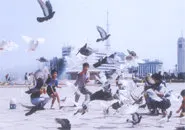
I must especially mention Baotou’s Ardin Square. By area, it is the world’s third-largest city square, after Tiananmen Square in Beijing and Red Square in Moscow. I heard that the Soviet planners who once aided us intended to make it the largest in the world, but political factors caused the plan to be abandoned. Still, that hasn’t stopped it from being one of China’s largest and most beautiful squares. Most importantly, it is China’s most ecologically friendly central urban square. The bridgehead for my ranch endeavor on the grasslands is right beside Ardin Square, within walking distance. Here you can see flocks of peace doves living harmoniously with people. Even rarer is the chance to witness “a place where deer are,” something hard to find even on the vast grassland today. The city government keeps a herd of beautiful sika deer on the square. Their graceful silhouettes and carefree manner are a microcosm of today’s Baotou and a symbol of its history!
What makes Baotou most beautiful and unforgettable is not its pretty urban appearance, but its warm and hospitable people! The grassland nomads have always been a welcoming people, a tradition inseparable from their nomadic life. Scattered alone on the boundless steppe, it was rare for nomadic tribes to encounter visitors or passersby. The warm grassland people would treat visiting guests as a gift from the Eternal Blue Sky, welcoming them with grand ceremonies. It was, in fact, a precious opportunity for socializing and gathering. These fine traditions have been preserved in the lives of Baotou residents. Especially when you sit inside a Mongolian yurt, the red Eight Immortals table laden with hand-grabbed lamb, camel pads, cheese, and kumiss, a group of Mongolian maidens sing and dance as they come to offer toasts. They raise the fragrant mare’s milk wine and white hada high above their heads and gracefully approach you, already halfway to tipsy. With their uniquely resonant voices, they sing heart-stirring Mongolian songs, and even the lightest drinker will be unable to resist taking the bowl and downing it in one go—preferring to dive under the table immediately without a single regret. The hosts never skimp on effort; they drink and toast, and the whole family sings and dances together until everyone, overcome by drink, either collapses on the spot, falls onto the grass on the way to the bathroom, or disappears, and they too drift off into a contented sleep. Don’t you want to join such a gathering, my friend? It’s absolutely thrilling and memorable.
From Baotou Airport, head north for under an hour by car. Once you cross the Daqing Mountain Pass, you’ll arrive at the beautiful Long Mei and Yu Rong grassland. People my age must have studied the elementary school text “The Brave Little Sisters of the Grassland.” The two heroines, Long Mei and Yu Rong, not yet ten years old, fought through a blizzard all night to protect the commune’s flock. In the end, the lambs were safe, but the little sisters suffered frostbite. Now those little sisters have grown old—reportedly Yu Rong serves as the director of the People’s Congress in the old Donghe District. Yet the beautiful grassland remains as young and radiant as ever, exuding a captivating charm. On the boundless steppe, you can speed by car or gallop on horseback, or organize a ball game on the grass, where for hundreds of meters there’s not a single weed. Playing football here is absolutely no less thrilling than at the Rose Bowl, venue of the 1994 World Cup final. Lying on the endless grass and looking up, the sky is an almost frighteningly deep blue. The southern skyline is the majestic Daqing Mountain—which is the Yin Mountain of ancient poetry: “By the Chile River, beneath the Yin Mountains, the sky is like a vault, covering the wilds on all sides. The sky is blue, the wilds are vast, grass bends low and sheep and cattle appear”; “But for the Dragon City flying general, the Tartar horses would not be allowed to cross the Yin Mountains.” That refers to this very Daqing Mountain. Clearly, the Han Dynasty’s Flying General Li Guang had already reached here. Dragon City is today’s Taiyuan in Shanxi; given the conditions then, coming all this way to intimidate the nomads was no small feat. If you look carefully into the folds of Daqing Mountain, you’ll see the faint traces of a Great Wall. That is the famous authentic Qin Great Wall built by Qin Shi Huang. The Great Wall of China we see on the moon or in travel adventures today are mostly Ming and Han dynasty constructions. The only existing Qin-era Great Wall is probably right here.
This is the spot on the grassland that I dream of. I plan to choose my ranch right at the foot of this majestic Daqing Mountain. I hope the heroic spirits of our ancestors never leave the Eternal Blue Sky and help me realize my dream—to find a piece of open, free land where my lonely soul can stretch out at will!
I’m going to spend half of my retirement there, because there I have my ancestors, my family, my grasslands, my ranch, and my dream!
Attachment 1: Baotou, from the Mongolian “Baoketu,” means “place with deer,” hence it is also called Deer City. Baotou lies in the western part of the Inner Mongolia Autonomous Region, bordering Mongolia to the north, the Yellow River to the south, and the vast Tumochuan Plain and Hetao Plain to the east and west, with the Yin Mountains running across its center. Covering nearly 30,000 square kilometers, it administers nine banners, counties, and districts, and is home to 43 ethnic groups including Mongol, Han, Hui, and Manchu. With a population of 2.3 million, it is one of China’s 23 cities with over a million urban residents and one of the first 13 larger cities designated by the State Council in 1984.
Baotou’s history dates back to the Neolithic Age over 6,000 years ago. It was where the steppe civilization of Eurasia and the agricultural civilization of the Yellow River basin intersected. It boasts the “Ashan Site” representing primitive civilization, well-preserved sections of the Zhao Great Wall, Qin Great Wall, the ancient city of Machi, and the ancient Kulun City. There are also the ancient lamasery Wudangzhao, the famous temple Meidaizhao, the Xilamuren Grassland, Jiufeng Mountain Nature Reserve, and other scenic spots.
As a city, Baotou took shape relatively late. Counting from the establishment of Baotou Town in the 14th year of the Jiaqing reign (1809), it has not yet been 200 years. However, due to its unique geographical position, over the long course of transformation it several times became the stage for history’s grand dramas, so its story should not be limited by its town foundation or city walls but can be traced further back. From the Warring States period to the Tang Dynasty, several ancient cities were built within Baotou’s borders. The earliest was the Nine Plains City built by King Wuling of Zhao in 306 BC (20th year of King Wuling). In 221 BC, under the Qin, it became the Jiuyuan Commandery. In AD 433, the Northern Wei Dynasty, founded by the Xianbei people, established Huaishuo Garrison here. Later, as circumstances and times changed, these ancient cities were abandoned one by one. After the Five Dynasties, Baotou came under the rule of the Liao Dynasty, which set up Yunnei Prefecture here, a system that continued through the Jin and Yuan dynasties unchanged. In the early Yuan Dynasty, smelting, textile, and ceramic industries began to flourish, giving rise to a commodity economy and bustling commerce. Later, various Mongol tribes moved into the Hetao, and Baotou became the nomadic lands of the Tumote tribe. After the Qing Dynasty was founded, in the 5th year of the Qianlong reign (1741), a local administrative post was set up in Salaqi, the earliest administrative establishment in the Baotou area. Around 1870 (the 9th year of the Tongzhi reign), city walls were built in Baotou, with five city gates opening to the east, south, west, northeast, and northwest, forming the modern urban scale of Baotou. From the late 19th to the early 20th century, Baotou had developed into a renowned fur trading hub and a land-and-water port in northwestern China. In 1923, the Beijing-Suiyuan Railway reached Baotou. In 1931, the Baotou Electric Flour Mill Company and the Yongmaoyuan Licorice Company were established, marking the beginning of modern industry in Baotou. In 1934, the Eurasian Aviation Mail Transport Company, organized by China and Germany, built an airport in Baotou and launched the Baotou–Ningxia–Lanzhou route, with scheduled flights once a week. The catering and service industries boomed, and the city grew increasingly prosperous.
Historically known as the “Gate to Beyond the Great Wall,” Baotou today has seen tremendous development in transportation. Railways such as the Beijing-Baotou, Baotou-Lanzhou, Baotou-Shenmu, and Baotou-Bayan Obo lines converge here, with direct trains to Beijing, Ningbo, Shanghai, Nanjing, Shijiazhuang, Wuhan, Xi’an, Lanzhou, Yinchuan, and more. Baotou Airport is a 4C-grade airport, now offering flights to Beijing, Shanghai, Wuhan, Guangzhou, Xi’an, Wenzhou, Shijiazhuang, Lanzhou, Taiyuan, and other cities.
Attachment 2: The UN-Habitat Scroll of Honour selection committee recently announced that for 2002, nine cities worldwide won the award, and the municipal government of Baotou, Inner Mongolia, China, was among them. This is the first city in western China to receive this honor. In 2002, China nominated only Baotou for the award. After two rounds of evaluation by UN-Habitat experts, Baotou finally won. The global celebration of World Habitat Day 2002 took place on October 7, 2002, in Brussels, Belgium. The theme that year was “City-to-City Cooperation.” At the ceremony, representatives of the Baotou municipal government received the UN-Habitat Scroll of Honour Award from Prince Philippe of Belgium and the Executive Director of UN-Habitat. Baotou’s successful practice in solving housing problems for low- and middle-income families attracted attention at home and abroad, with urban delegations from over 50 domestic and neighboring countries visiting to learn. Baotou has successively been rated a National Sanitary City, a National Model City for Housing Reform, a Garden City, and a National Advanced City for Implementing the Comfortable Housing Project. In July 2001, Baotou won the first “China Habitat Award” for its low- and middle-income housing project. After receiving the “Good Example” citation in the 2000 Dubai International Awards for Best Practices to Improve the Living Environment, it went on to win the “Best Example” award and was included in the UN Best Practices Database for global promotion. In recent years, Baotou has vigorously implemented urban “hardening, greening, beautifying, purifying, and brightening” projects, especially strengthening urban greening. It has built 30 large-scale green leisure squares each exceeding 10,000 square meters and numerous gardens and scenic spots, with per capita public green space reaching 8 square meters and a citywide green coverage rate of 31.24%. In 2001, it was designated an “Excellent Tourism City of China,” the only prefecture-level city in Inner Mongolia to receive that honor.
Attachment 3: The Central Commission for Guiding Cultural and Ethical Progress publicly announced the list of the first National Civilized Cities: Xiamen, Qingdao, Dalian, Ningbo, Shenzhen, Baotou, Zhongshan, Yantai, Langfang, Zhangjiagang, Tianjin Heping District, Shanghai Pudong New Area, Beijing Xicheng District… On September 5, the office of the commission published in media and online the candidate list for the first batch of national civilized cities, townships, and work units, widely soliciting public opinion and accepting supervision. The list immediately drew widespread attention. The ten national civilized cities and three national civilized urban districts became a focal point. After all, this was the first time in over 20 years of civilized city creation activities that national civilized cities were being selected. Following the commendation of two batches totaling 121 advanced cities (districts) in 1999 and 2002, this was the first time a “small but excellent” number of cities (districts) were granted the title of “National Civilized City (District).” (Subhead) Seven major categories, 119 indicators… qualitative and quantitative, scientific and reasonable, the evaluation system replaced subjective impression-based selection, bringing civilized city assessment onto an institutionalized and standardized track. Cities are the “amplifiers” and “accelerators” of human civilization, focusing and reflecting the trajectory of civilization’s evolution. Starting in 2002, the office of the commission organized experts to develop the “National Civilized City Evaluation System (Trial),” which was listed as a specially commissioned project of the National Social Science Fund. It mobilized the efforts of almost all provincial civilization offices, solicited opinions from over 30 central ministries and commissions, and took two years and eight months. The high standards, enormous workload, broad scope, and large number of participants were unprecedented in China’s cultural and ethical advancement work. Drawing on systems for sanitary cities, garden cities, environmental protection model cities, and other domestic and international indicator frameworks, conducting research in nine cities, holding five thematic seminars, four symposiums, and testing in 13 cities… after repeated revisions, the expert group finalized the draft for review, then submitted it to the commission members for revision. After further refinements, the trial version was approved by the leadership of the commission. A clean and efficient government environment, a fair and just legal environment, a standardized and trustworthy market environment, a healthy and progressive humanistic environment, a peaceful and content living environment, a sustainable ecological environment, and solid, effective creation activities… In September 2004, the evaluation system was officially published for trial. This was the first indicator system for evaluating and assessing the effectiveness of mass cultural and ethical creation activities, comprising 119 indicators in total. In scoring, higher values were given to ideological and moral qualities, scientific and cultural qualities, and good social norms. “The evaluation system won high praise from authoritative experts. Professor Tang Yijie of Peking University said that by quantifying, standardizing, and proceduralizing various phenomena in urban economic and social development, the system represents an important breakthrough in the scientization and socialization of philosophy and social sciences.”
(Peace doves at Ardin Square)
(Unity Square)
(Milky Way Square)
(Night view of Milky Way Square)
(A place with deer)


