A Simple Trip to Bali
Today marks the first day of my Bali journey, and I'm writing this travelogue on the plane heading to Bali. Overall, the first day went very smoothly.
1. Dalian to Incheon
My flight departed at 2:30 PM. Following the good rule of arriving at the airport 2.5 hours early for international flights, I reached Gate 24 of Dalian Zhoushuizi International Airport at 12:00 PM.
According to the airport electronic display: KE870 checks in at counters 15-18, with check-in starting at 12:30 PM.
At 12:30 PM, the airport announced that check-in was open. I carried my luggage and queued at counters 15-18. Since I was flying from Dalian to Incheon and then from Incheon to Denpasar, both on Korean Air, I could check my luggage all the way to Bali and get both boarding passes at once.
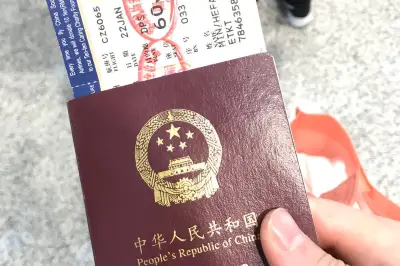
After completing these procedures, I took my passport, boarding passes, and baggage tags, and proceeded to immigration.
Immigration usually asks a trivial question—nothing to worry about, just answer truthfully. I wasn't sure exactly what to show the officer, but I handed him my passport and both boarding passes, and he stamped the Dalian-to-Incheon boarding pass.
After the stamp, I walked a few more steps to another security check. I placed my jacket, phone, carry-on bag, and all other items into a plastic bin, then walked through the security gate, stood on a pair of footprints, and raised my arms sideways. An officer would scan me with a handheld device. Once cleared, I collected my belongings and proceeded to the boarding gate to wait.
I boarded and found my seat. You can choose your seat in advance; when getting your boarding pass, you can ask for a good location—either a window seat or an aisle seat.
On the first leg from Dalian to Incheon, there were no window seats left, so she gave me a front aisle seat, which I was quite satisfied with. The meal served was a sandwich.
2. Incheon to Bali
When I landed at Incheon Airport, I was on the second floor. Exiting the plane's jet bridge, I saw signs for "TRANSFER." I followed them, turned left, and arrived at another security checkpoint—the transfer security. Again, I took off my jacket and placed my bag on the belt, then walked through the electronic gate.
After security, I took the escalator up to the third floor of Incheon Airport, which was the departure hall—all duty-free shops! DUTY FREE!
Of course, the first task was to find my boarding gate, marked with a large yellow sign. If unsure, don't wander; ask at the information desk visible right after the escalator.
Boarding, finding my seat, eating—the flight attendant said a long string of things, but I couldn't understand. I just ate whatever was given. After leaving my country, I realized how important English is. I must study English hard once I return to China.
After the meal, I had to fill out the arrival/departure card and customs declaration form. There are templates online; it's best to download and fill them out beforehand, then just copy them on the plane. If you have questions, ask the flight attendant. Korean Air's flight attendants are quite nice.
The card below is the immigration card, with a dotted line in the middle that can be separated. The left part is the arrival card, the right is the departure card—do not separate them on your own. Upon arrival in Bali, the left arrival card will be collected, and you should keep the right departure card to be handed over when you leave.
Then I slept. The flight from Incheon to Bali was over 6 hours. I had a window seat and thought maybe I'd have a beautiful encounter or a romantic adventure, but even after takeoff, no one sat next to me. Well, I could lie down and sleep, but I still kept my seatbelt fastened.
3. Arriving in Bali
The plane finally landed at Ngurah Rai Airport in Bali, which I had longed for. Before landing, I looked down from the plane and saw a sea of lights—it felt like landing on another planet.
After getting off the plane, I followed the crowd and found the "VISA ON ARRIVAL" sign. I went downstairs and saw many people queuing to buy visas. At this counter, I prepared 25 USD, immigration card, customs declaration, and passport.
After paying, I received a visa receipt. I continued forward to another crowd waiting in line. When it was my turn, I handed my passport and the visa receipt to the officer, who stamped it.
This is the notorious place where tips are reportedly demanded, but I didn't experience that. From my observation, people with improperly filled immigration or customs forms were held back—mostly Chinese, due to poor English. So be well prepared!
After obtaining the visa on arrival, I retrieved my luggage. I saw only one baggage carousel with flight numbers written on one side. I checked if it was my flight and found my bag.
Continuing outward, I saw a wall with "NO DECLARE" on the left and "GOODS TO DECLARE" on the right. Since I had nothing to declare, I went left, put my luggage through an X-ray, and the officer collected my customs declaration form. Then I could proceed further.
Then I encountered a large group of people waiting at arrivals. I looked for my name sign. As I walked out, a beautiful woman wearing traditional Balinese attire placed a flower garland around my neck.
4. Starting the Itinerary
Now it's my first morning in Bali. I arrived at the hotel around 1:00 AM last night. It took about 20 minutes by car from the airport to the hotel. After midnight, there were very few cars in Bali, but many motorcycles speeding by. At first, I thought Bali was so fashionable that people were racing motorcycles at midnight, even with passengers! Later I learned that motorcycles are the main local transportation. They were just driving normally.
Familiarizing myself with the environment and calming down from the initial excitement, it was already 2:30 AM. I quickly went to sleep.
But this morning, around 7:30 AM, I woke up to the sound of birds. For someone who usually wakes up to car horns, this was incredible! I never imagined life could be lived this way.
For the first two nights, I stayed at Swiss-Belhotel Segara. It was affordable and had a nice view, quite suitable for someone like me who enjoys a leisurely vacation.
When it comes to beautiful scenery, even the worst equipment or photography skills don't matter—no need for Photoshop.
I went downstairs for the buffet breakfast. For Chinese people used to millet porridge with steamed buns or soy milk with fried dough sticks, the fried noodles, fried rice, bacon, omelets, salad, fruit, and other American or Indonesian local breakfast options might not suit your taste, but it was quite rich. You can choose what you like or try everything—it would be a pity to stick only to Chinese food while abroad.
After breakfast, I grabbed my camera and explored the hotel. For someone who has long lived in a city, Bali's greenery is amazing—lush green everywhere, interspersed with fragrant flowers, bringing joy. Coconut palms, large coconuts, durians, and more grow all over Bali.
Here, truly open your lungs and breathe deeply—you'll feel purified.
Endless green and fragrant flowers.
As I write this travelogue sitting on the balcony chair, so many swallows fly back and forth under my eaves. I want to tell them how lucky they are to live here forever.
When staying at a hotel in Bali, you must visit the beach. Generally, international five-star hotels have private beaches. My Swiss-Belhotel's beach was farther away, but that didn't matter to me—I didn't plan to swim anyway.
Swiss-Belhotel offers a free shuttle for guests to the beach, as well as a shuttle to the shopping center. There's a schedule here for reference if you plan to stay.
I went to Geger Beach (Geger in Chinese means "Geger Beach," a lovely name). This is the hotel shuttle—I enjoyed a ride. Haha.
After about 8 minutes, I arrived at the beach.
This beach is quite suitable for swimming, with gentle waves and very clean, clear water.
There are lounge chairs for sunbathing.
This is my only appearance in this article—big footprints traveling the world, haha. The sand consists of round grains, very beautiful.
After seeing the beach, at 10:00 AM, my guide and driver picked me up, starting my first day's itinerary.
Tanjung Benoa Water Sports Center is a must-visit for most tourists in Bali. Activities include beach massage, braiding Indonesian-style cornrows, jet skiing, banana boats, parasailing, snorkeling, scuba diving, etc. Additionally, you can take a glass-bottom boat to Turtle Island. Along the way, with the sea breeze blowing, you can leisurely feed colorful tropical fish and admire the beautiful coral reefs beneath the boat. Upon arriving at Turtle Island, you can take photos with large sea turtles, pythons, iguanas, or even engage in a thrilling cockfight to test your luck.
Since this is a water sports center, many people come here, so don't expect pristine white sand—that's for Dreamland Beach.
Uluwatu Temple.
Uluwatu Temple is almost at the southernmost tip of Bali. My guide and driver drove for a long time to get there.
The roads in Bali are narrow, unlike China's. Most roads have no markings—just bare asphalt—and there are many ups and downs. Riding in the car felt like a roller coaster. I have a slight fear of heights; every time we descended a hill, I had to lightly cover my chest to keep my heart from jumping out, which made the guide laugh at my timidity.
To reach Uluwatu Temple, you first pass through an area with many monkeys. These monkeys are good at begging for food. Though they look cute, be careful if one sets its eyes on you—those cunning eyes!
There was a little yellow rubber figure on my backpack. A monkey spotted it and moved so fast I couldn't react. When it looked at me, I sensed trouble and quickly gripped my camera. In an instant, it swooped past me and snatched the yellow figure off my backpack! When I looked back, it had already bitten off the poor rubber figure's head and spat it out on the ground with a disdainful expression.
I felt sorry for my rubber figure, but also a bit apologetic to the little monkey—it was my fault for not buying it a banana, so it mistook my yellow rubber figure for one.
My friend who came with me screamed loudly when the monkey lunged at me, startling even the monkey. People ahead turned to look at us—it was quite funny.
A local Indonesian asked me in Chinese, "Is it glasses?" I said no, I didn't want it. I left the little figure as a gift for the monkey, though he might not have liked it.
The monkeys here are not afraid of people at all; it's people who are afraid of them. This one is said to be the monkey king.
After passing through this fun and thrilling monkey forest, I arrived at Uluwatu Temple.
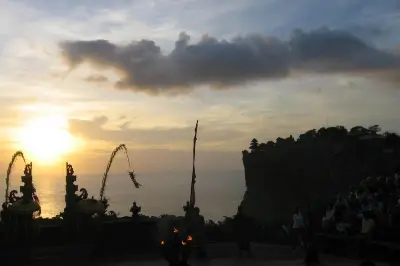
Uluwatu Temple is the most solemn and magnificent temple in Bali, perched on a cliff at the edge of a plateau, with the roaring Indian Ocean below. Built in the 11th century entirely of hard granite.
Legend has it that ancient sailors angered the sea god, who raised huge waves that threw the ship onto the shore, forming a bow-shaped cliff. This is the end of the pilgrimage of the great priest Nirartha, where he finally attained nirvana, freeing himself from physical bonds in the home of the South Sea guardian, Baruna.
For a person from Dalian, the sea is common. I never had a particular yearning to see the sea, but when I came to Bali and saw this ocean, I was amazed—this is truly viewing the sea. Its surging, magnificent power, the pure blue, and the white foam make you forget worries and immerse yourself in the moment.
Uluwatu Cliff is also called Lovers' Cliff, named after a romantic and tragic love story: Long ago, a young couple in love were opposed by their parents, and to pursue freedom of love, they jumped off the cliff together.
It's quite touching. I think they could have eloped anywhere. Why choose death? Perhaps they couldn't bear to leave this paradise on earth and decided to be together in heaven?
Then I went to Yang Yang Cliff (or Pandawa Beach area), a place to enjoy afternoon tea with a sea view.
There I found a pleasant surprise: blooming lotuses. The sun was intense, and the pond wasn't very full, but the lotuses flourished. Though not a strict Buddhist, I admire Buddhism, so I was delighted to see the lotus, one of the four auspicious flowers of Buddhism.
The lotus represents holiness and purity. It is a gentleman among flowers, symbolizing the ideal Chinese personality: "emerging from muddy water unstained, bathed in clear ripples not seductive."
The lotus pond is at the entrance of Yang Yang Cliff. Along a quiet path, you can reach the place for afternoon tea with a sea view.
The view at Yang Yang Cliff is also beautiful, but be warned—there are monkeys here too, so be careful if you're afraid.
Morning itinerary satisfied my senses with beautiful scenery. At noon, it was time for good food. I went to a famous local restaurant, AKAME. The owner is an Indonesian Chinese who is very warm to Chinese visitors.
Please forgive me—I was too hungry or the food too tempting, so I forgot to take photos. By the time I remembered, the plates were empty.
This restaurant is uniquely located on a lake surrounded by mangroves. The midday sun was scorching, but seated in a lakeside pavilion with a gentle breeze, it felt cool and refreshing, boosting my appetite.
Next door is another fishing restaurant, similar to AKAME. I took a photo mainly because of the big yellow duck on the lake.
Hearing that I was from China on an inspection trip, the owner of AKAME enthusiastically told me about a camel breeding area and a helicopter exhibition hall next to the restaurant. Both places also receive tourists, offering camel rides through the mangroves and helicopter tours to see Bali from above.
I was interested in both, and after a satisfying meal, I continued exploring.
First, I went to the camel area. I saw several camels leisurely digesting, staring at us while chewing.
Behind them was the mangrove area. Despite the sun, it was much cooler once inside. Those who want to ride camels can start here and enjoy a camel tour through the mangroves.
Next was the helicopter exhibition hall. This helicopter is said to be the only one approved for tourist sightseeing in Bali. It can carry 6 passengers. Visitors board with a professional pilot for an aerial tour around the island. This is a novel activity—seeing Bali's beauty from above.
Finally, I saw it up close! This was my first time so close to a helicopter!
The helicopter and the security guard next to it made me feel like I was in Vietnam.
The instrument panel in the cockpit.
Today's itinerary was relaxed. After seeing the helicopter and camels, we went to Kuta in the afternoon for some casual shopping. As someone who doesn't enjoy shopping even in China, shopping abroad was just sightseeing.
During shopping, I encountered something interesting: a Balinese local ceremony to worship gods, very solemn with many preparations. Many people participated, each with different roles.
I saw two older women burning incense at the front, while others behind chanted—perhaps a language to communicate with gods.
A Balinese colleague said it was a ceremony for moving house.
Forgive my lack of adventure, but I craved Chinese food. So my colleague took me to Hongxing Chinese Restaurant. The food was delicious, and the ambiance was nice.
Delicious dishes arrived—appetizing!
After dinner, I checked into another hotel: Le Grande in the Uluwatu area.
The hotel was peaceful, quiet, and elegant. Since it was dark when I arrived, the photos may not be great.
Continuing the tradition from the previous hotel, I woke up to birdsong again. This is truly a livable place! The sliding door leads directly into the courtyard. The lush greenery cheered me up.
Walking among the verdant trees, with only birdsong and no noise, sunshine sparkling on the green leaves, I felt vibrant life energy.
The hotel's "daydreaming pavilion" (bale) where beams of sunlight create a serene atmosphere. To borrow a phrase: "Time is peaceful, the world is stable."
The hotel pool, with few swimmers. Lazing around and enjoying the green scenery is wonderful.
Outdoor breakfast area.
Here, there is no haze. The sky is blue except when it rains; even overcast skies with gray clouds are beautiful and natural, as if the sky has expressions. Unlike China's current sky, which seems covered by a glass dome or a cement-colored veil of haze.
Scenery everywhere.
The hotel's children's play area.
Le Grande's beach is stunning, though not very close. The hotel offers a free shuttle that takes about 8 minutes.
Due to time constraints, I only took two photos from a distance. The white sand was enchanting. Bali's Dreamland Beach lives up to its reputation.
Today I head to Ubud to see the famous Ubud Palace. Although netizens say it's small, it's worth a visit to appreciate its architecture and historical atmosphere.
Everywhere, you see offerings. Be respectful and do not step on them.
Ubud Palace was built in the 16th century during the Ubud Kingdom. Though no king lives there, descendants of the royal family are said to reside within. The palace is unlike the grand palaces we imagine—small, but old, stable, with distinctive architecture.
The exterior reflects Balinese characteristics, while the interior is more ornate. The stone carving is particularly striking—delicate yet bold, with carved buildings throughout the small courtyard, mostly depicting Brahmanic themes.
After leaving Ubud Palace, I had lunch. Today's lunch was grilled pork ribs, famous online. I enjoyed it—it suits Chinese tastes.
Outside the restaurant, I found a sculpture I liked, reminiscent of Thai style.
After lunch, I visited the famous Tirta Empul (Holy Spring Temple). It is one of Bali's notable temples, over a thousand years old. The stone shrines are mossy, but the spring still flows as in ancient times.
Entrance to Tirta Empul.
Inside, there is a large koi pond with many fat, happy koi fish.
Local residents often come to bathe in the holy spring for blessings. The day I visited happened to be a Balinese holiday, so there were many people.
Tirta Empul is a must-visit for tourists. It is said that the holy spring water is always clear and has healing properties, with different outlets offering different benefits. It attracts devotees from everywhere to worship and bathe.
Further ahead is the spring's source.
The sight of the spring gushing out is moving. Ancient stone pools with black sand at the bottom; at the spring vents, water bubbles and sand dances, like large black peonies blooming in the blue sky-reflecting water. Legend says the god Indra thrust his sword into the ground to create the immortal water that can cure all ills.
The water color at the source is very different and beautiful.
Nearby, on a small hill, there is a European-style building that serves as the Indonesian president's villa, hosting world leaders. It is said he often stood on the bridge nearby to watch local Balinese girls bathing in the spring.
In Bali, people wrap daily offerings with square cloths to indicate worship. Offerings can be placed on statues, incense burners, large trees, etc. In Balinese belief, everything has a spirit and can be worshipped.
Next stop: Tanah Lot (Sea Temple). Usually, Tirta Empul and Tanah Lot are visited on separate days, but due to time, I went to Tanah Lot in the afternoon. Fortunately, I caught the sunset, which delighted me.
Tanah Lot sits on a large rock offshore. It is one of Bali's most famous temples. At high tide, it is surrounded by water and completely isolated; at low tide, it can be reached.
Built in the 16th century, it is dedicated to the sea god. Below the rock, a small cave is said to contain poisonous sea snakes, believed to be the temple's guardians, protecting it from demons and intruders. Legend says that when the temple was built, a huge wave threatened it, so a monk untied his sash and threw it into the sea, where it turned into two sea snakes that calmed the storm. Since then, sea snakes have been the temple's guardians.
The sunset light turned golden.
From Tanah Lot, you can see the sunset, which is a major attraction. Contemplating the changes of time and nature's beauty.
The sun set.
Tonight, I changed hotels again—to Vasanti Seminyak Resort in Seminyak.
Vasanti is located in Seminyak, near Seminyak Square and Petitenget Beach, and conveniently close to the airport.
Comfortable environment, beautiful scenery, elegantly designed rooms with a touch of traditional Balinese style—wooden furniture and marble floors create a spacious feel.
Lobby decorations and local musicians playing traditional instruments.
This hotel surprised me—I loved the room.
The room and bathroom are separated by transparent glass.
In the evening, the hotel hosts a candlelit dinner by the pool with live music. The singer visits each table to take requests and sings specially for each group.
This hotel also offers a free shuttle to the beach. I arranged a time with the front desk in the morning and waited in the lobby.
The waves at this beach were big, unsuitable for swimming but good for walking and surfing.
After a morning at the beach, I had lunch: Bali's famous charcoal-grilled pork ribs, which I had been craving. They did not disappoint—it was the most satisfying meal in Bali.
The restaurant's decor was unique, with pig-shaped decorations overhead.
As a normal-eating woman, one plate was enough; I think a man would need two. Delicious.
Today I visited the place I most wanted to see in Bali: Garuda Wisnu Kencana (GWK) Cultural Park.
The entrance of GWK.
The park was intended to erect the world's tallest copper statue of Vishnu riding the mythical bird Garuda, but it was never completed due to lack of funds. The smaller statue at the reception shows what the full statue would look like.
A high priest reportedly advised former President Suharto that the statue would bless Indonesia with prosperity and peace, but only Vishnu's head and chest, and Garuda's head were completed. Still, its grandeur impresses visitors.
This cultural park was begun under Suharto, covering 250 hectares and costing billions. The plan was to carve the entire mountain into an arts and culture area. After Suharto fell, the project continued by his son but eventually stopped due to insufficient funds, achieving only 20%. So today, some parts are only half-built. The large square in front of Garuda has become a venue for big events and cultural activities.
Further along, you see story panels on the rock face, with a Chinese version (though the translation is rough). You can get the gist of the story. Several panels form a complete narrative.
Next is a Balinese performance venue where you can watch traditional dances.
Balinese dance emphasizes hand and eye expressions. I found it peaceful and unhurried, as if Balinese people do everything slowly and elegantly. The dancers seem absorbed in their own world, paying no attention to tourists.
After the dance, I continued. Bali's sky is so blue that I never want to leave.
GWK is large, so there are resting areas and eateries. I had a big coconut!
The expansive plaza is my favorite part. Although incomplete, seeing the mountain carved into huge square blocks is awe-inspiring. Even the clouds seemed reluctant to leave.
Finally, the Garuda appears!
And this great god appears! People have different feelings when seeing it, but all admire it. Why are its eyes closed?
See the sky? Pure moisture and mist!
Farewell, great god!
As I was about to leave GWK, I saw a local Indonesian girl with her hair in many tiny braids—very cute! This is also a characteristic of Indonesia.
My last night was at a villa named Lavender in the Kuta area. It has a great location, close to Kuta Beach, duty-free shops, and Carrefour, and is affordable. I recommend it.
A standalone villa: when you enter, you typically see the pool first.
There are lounge chairs and a dining table near the door. You can have breakfast in the dining room or order room service.
On the bed, there were beautiful "swans" made of towels and frangipani flowers.
In the morning, I sat on the rocking chair and looked up at the blue sky—it felt wonderful.
Villa breakfast.
Staying alone in such a place feels like paradise.
Today is my last day in Bali. After a farewell dinner and a short rest, I headed to the airport.
Ngurah Rai Airport is new, but I forgot to take an exterior photo. Its design is quite distinctive. In front of the airport stands a statue of the Balinese hero Ngurah Rai.
At the airport, I first found the check-in line. Unlike in China, where different airlines have separate counters, Bali's airport is small and doesn't have many counters. Almost all counters handle the same flight simultaneously—about 8 counters.
I checked in my luggage. Korean Air allows only one checked bag, so I had my small bag packed together with my suitcase at a packing counter to the left, costing about 10 USD.
The packed luggage must not exceed 20 kg; otherwise, an overweight fee of 100 USD applies.
At the counter, I only needed to check my luggage and show my passport. Again, I checked my luggage through to Dalian and used my poor English to request a window seat—successful.
After getting my boarding pass, I walked to the right and then to the back to the departure tax counter. I paid 1,500,000 Indonesian rupiah (now increased to 2,000,000). I also showed my passport and boarding pass, and the officer stamped them.
Then came the carry-on baggage security check.
After the check, I turned right and followed the "Departure" sign.
I passed a long stretch of duty-free shops: first cosmetics, then food, cigarettes, perfume, watches, bags, etc. Ahead, I saw a building resembling Big Ben in London.
Under that building was a small counter marked "DFS COLLECTION." This is where you pick up items bought at Bali's duty-free shops.
After DFS COLLECTION, more duty-free shops, then the boarding gates 1-10.
This trip to Bali was mainly for work and inspection, so I didn't get to see everything. I'll have to come back next time.