A Paradise Blessed by God: A First-Time Summer Experience in Bali and Komodo!
Here you'll find pristine tropical rainforests,
nature's most distinctive hues,
the world's most affordable seafood,
and warm-hearted, simple people.
......
This is a place blessed by God.
This summer, the pink world filled my girlish heart, yet I left it behind on these islands......
Bali and Komodo are the two most dazzling islands among millions in the South Pacific! Before coming, you wouldn't even care which country they belong to, but after visiting, they stay on your mind forever!
Two months ago, that heavenly summer is still vivid: the grandeur of nature I'd never seen, the unique local customs, the unforgettable pink beach and blue underwater world......
These are the islands I've visited and want to revisit again—no others compare!
With the dream and courage to 'travel the world,'
following my own To-Go list,
I've been to over 180 cities in 23 countries!
Every trip's end marks the start of the next,
whether it's a dish, a melody, a building, or someone I long to see......
On the road of exploration, I encounter the unknown and discover a new self!
I'm Fiorelady, welcome to follow me:
WeChat public account: Fiorelady's Pastoral (ID: MsFiore)
All platforms: Fiorelady (please note from Ctrip)
> Ubud Jungle Adventure
After the exhaustion of the previous day, the hearty breakfast the next morning helped us recover a bit.
I must say the breakfast at these private villas in Bali is exquisitely prepared, with hot dishes that satisfy a Chinese palate and refreshing cold options, from salmon, smoked meat, soft eggs to croissants, yogurt, grains, black tea, fresh milk, coffee, and fresh fruit salad. After this feast, we were motivated to head out again.
Grand Religious Festival and Penjor
While waiting for the driver at the hotel entrance, we noticed the streets lined with numerous Penjor! It turned out that Bali was celebrating its second Galungan festival of the year. In the 210-day Balinese calendar, besides the annual Nyepi Day (Day of Silence), similar to our Spring Festival, the most grand festival is the twice-yearly, ten-day Galungan festival! It's a major Hindu festival in Bali, also known as Earth Day!
During every major festival, each local household places a tall Penjor on the right side of their entrance!
The bamboo pole of the Penjor symbolizes the body of a 'dragon,' decorated with swinging coconut leaf tassels. Altars about one to two meters high hold various offerings! These sacred swaying Penjor are unique to Hindu Bali and are known as 'Balinese aesthetics.'
Besides religious festivals, Penjor are also used in weddings; Wallace Huo and Ruby Lin's wedding featured modified Penjor!
During Galungan, besides the rich offerings like cakes, fruits, and flowers placed in Penjor, locals also place items on the ground to welcome gods and ward off evil—this is a unique Balinese prayer method. They give thanks for food, shelter, and a good life!
During the ten-day celebration, locals wear their finest clothes and jewelry, carrying flowers, fruits, and food to pray at temples.
The last day of Galungan is called 'Kuningan Prayer Day,' the most important day of the ten-day celebration. After this day, the holiday ends!
Balinese people are not wealthy, but they live simple, peaceful lives amidst their traditions, devoutly praying each day. These religious rituals teach them gratitude and devotion!
We were fortunate to experience a Balinese festival and feel the local culture! I recommend visiting Bali during their festivals—the spectacular sight of Penjor lining the streets is a rare treat!
The 2019 festivals have mostly ended; here's a preview for 2020:
February 19: Galungan
February 29: Kuningan
September 16: Galungan
September 26: Kuningan
Back to our first day's itinerary in Bali: after leaving the hotel, our driver Ketut Budiasa picked us up quickly. On the way, I kept asking him about Penjor and Galungan. He seemed pleased to have a customer so curious; every response showed he thought carefully!
What impressed me most about Ketut was his precise recommendations for scenic spots! For example, our first stop was supposed to be Tibuwana Waterfall, but he said the most beautiful waterfall nearby was Tukad Cepung Waterfall. He opened Google Maps' Street View to show us, and indeed, the latter was superior! Although it was a bit farther and might eat into other attractions' time, since we were there, of course we wanted to see the best!
From the entrance to the cave, it takes 10 minutes downhill, meaning we had to climb back up the same way!
At the bottom, we waded barefoot through a small stream.
Through this cave, the waterfall was right before us!
The roar of the waterfall and the rising mist were quite strong. Lifting my skirt, I walked slowly to the front of the waterfall. Sunlight streamed through the opening above, casting light on me, contrasting sharply with the dark cave—perhaps the most beautiful light and shadow among Bali's waterfalls!
There's also this cave's light and shadow beauty here!
It's worth noting that we did all the walking barefoot. For locals, it's an easy hike, but for us who don't exercise often, completing the whole route was really tough.
Besides the main waterfall, Tukad Cepung has a smaller waterfall in the opposite direction—just a distant view!
On the way back, we saw rows of coconut trees. Being in the tropics means Bali has various fruits year-round: mangoes, durians, rambutans, mangosteens, guavas, dragon fruits, sugar apples, papayas, wax apples, etc. With plenty of sunlight, any fruit grows tall and large, with plenty of water and sweetness!
On the way to Tegallalang Rice Terrace, Ketut stopped the car to show us the right side—wow, Mount Agung, Bali's largest volcano! On a clear day, we could clearly see this mysterious mountain—quite lucky!
I hadn't realized that Tegallalang Rice Terrace is the very terrace featured in Jay Chou's song 'Rice Fragrance'!
The interplay of coconut groves and terraced fields north of Ubud creates Bali's unique pastoral scenery.
Some compare it to the terraces in Guangxi and Yunnan, but I think scale isn't everything—walking at each level offers different views. This might be the perfect combination of tropical jungle and pastoral landscape!
There are many heart-shaped nests in the terraces for photos, charging 10,000-20,000 rp/person.
I recommend the nest right at the entrance, with the terraces as background—very impressive!
Shops around the terrace sell local products; these oil paintings and dreamcatchers might be unremarkable in a city, but here in Ubud's terraces, they become rare artworks, thought-provoking!
I don't know when giant swings became one of Bali's hottest activities. Smart Balinese seized this opportunity, installing swings everywhere: waterfalls, terraces, lake views, beaches......
Each swing has its features, but few combine thrilling excitement with beautiful scenery and photogenic results. As mentioned in the 'Route Guide,' the most fun swings are the 'jungle swings,' like the style of the famous 'Bali Swing'!
But don't go to Bali Swing anymore! Since it became a popular attraction, queues are long and prices are high—now you can only pose, not actually swing! Our reliable driver Ketut told us that the best swing near the terraces is Uma Pakel Swing: cheaper, longer swinging time, and staff to take photos and videos—360-degree service!
The sign at the entrance looks like this.
This swing-themed amusement park also has a little surprise: the famous Indonesian civet cat, Luwak. Coffee processed from its feces after eating ripe coffee cherries sells for hundreds of dollars per pound—one of the world's most expensive coffees! In Bali, a cup of civet coffee costs over 300,000 rp, about 150 RMB!
There are many swing styles; walk further inside—the best one is at the end!
Ecco, here it is, the last No. 5 swing! This is Uma Pakel Swing's best view, widest arc, and most thrilling swing!
Let's see some guest photos first.
One person swinging, so many people serving! The staff here are quite dedicated: two performers (without safety belts), one taking photos and videos from the best angle!
Now it's my turn!
360-degree surround shooting, beautiful!
And creative shots like this—similar to the 'Sky Gate' technique!
At this height, you'll definitely wear a safety belt, so it's very safe. Just focus on posing and let your voice out freely!
This is a video taken by the staff—when you play, make sure to shout out loud; it's truly exhilarating!
Ubud's trendy swing - Tencent Video
Tip: When coming to Bali to swing, girls should bring a flowing long dress in a color contrasting with the green jungle—the brighter, the better! If you don't have one, there's a dress rental nearby with vibrant colors, quite pretty!
When choosing accommodation in Bali, I considered several areas: Kuta, Nusa Dua, and northern Lovina...... Finally, I chose central Ubud, the artistic and painting center of Bali, where intellectuals gather. The former Sukawati royal palace is here, and artists from around the world come to Ubud for inspiration!
Arriving in Ubud's city center at dusk, the soft sunset shone on the Penjor at the entrance of the Ubud Palace, swaying beautifully in the wind!
At the end of the first day's itinerary, we arrived at this iconic Ubud landmark, the 16th-century Ubud Palace! Centuries old, it still shines with artistic brilliance. Through the golden gates and intricate carvings, we glimpsed the luxurious royal life of the past!
The palace's overall design was by the famous Lempad, who skillfully integrated living spaces with Brahmanic beliefs and art. Mountain-shaped gates, pavilion-style buildings, and exquisite Brahmanic stone carvings are all artistic treasures worth careful appreciation!
The palace still houses descendants of the royal family. The open area is small; we soon reached the exit. Ubud Palace isn't grandiose, but it's unforgettable!
Every night at 7 p.m., there's a traditional Balinese dance performance—if interested, you can buy tickets!
Across the road from the side of Ubud Palace is Ubud's liveliest market. This street becomes Bali's busiest road in the afternoon!
The market is small but densely packed with shops. Most items are handmade by villagers: xylophones, woven bags, wood carvings, sarongs, Balinese paintings—many styles unseen elsewhere, only available in Bali!
Most stalls sell similar crafts. If you see something you like, don't rush—compare prices at several stalls to find the cheapest. Haggling is part of the fun of visiting Ubud market!
The fatigue from checking in at 3 a.m. finally hit us after the Ubud tour. All we wanted was to lie down and rest!
Ketut returned us to Samkhya Villas before sunset. Riding the hotel's golf cart, we enjoyed the rice field views along the path, recalling the verse 'In the fragrance of rice, talk of a good year; listen to the frogs.' It's amazing how Ubud can shift from waterfalls and swings during the day to peaceful fields at dusk, full of reflection and anticipation......
Before returning to our room, we wandered around the hotel. The common areas were almost empty—guests probably stayed in their private villas, so we had the whole garden to ourselves! This environment deserves a slow, extended stay to savor fully.
We booked the free SPA at 7 p.m. Although free, it was thorough, with just the right pressure. The sound of water beside the wooden house almost put me to sleep~
Since we had to check out early the next morning for the dolphin-watching in Lovina, we arranged a breakfast pack with the front desk and turned in early.
> Northern Bali's Hidden Gem
I used to think Bali was a small island, but when booking dolphin-watching in Lovina, I realized it takes 2.5 hours to drive from Ubud to Lovina—about the same distance as from Nanjing to Shanghai! If you stay in southern Bali, crossing the entire island one way takes over 4 hours!
So if your itinerary includes sunrise dolphin-watching, you need to plan where to stay. Either way, you'll spend the same time traveling from the airport area to far northern Lovina; it's just a matter of when. We chose to depart early in the morning, so we went to bed early the night before. But if you skip sunrise, you could negotiate with the driver to leave later.
Many give up due to the long drive and early wake-up, but I say: the chance to get close to one of the few wild dolphin populations on Earth is once in a lifetime. Compared to flying from the Northern Hemisphere across the equator, these ocean spirits are right here!
The driver dropped us at Lovina Beach around 5:50 a.m.
Walking on the black sand, we saw a pale pink sky and dark blue sea. As the sun peeked over the horizon, the mystery of Lovina's waters was unveiled......
The boatman said hundreds of wild dolphins live in these waters; before sunrise, they gather to feed, forming a spectacular 'dolphin军团'!
Sitting at the bow, I was both excited and anxious. A dozen spider boats had gone far out to sea since sunrise, but still no dolphins in sight.
Just then, the boatman suddenly sped up toward 10 o'clock. Before other spider boats could approach, a group of gray sprites showed their slippery heads on our left side, then submerged in seconds...... That was our first encounter with dolphins!
These ocean elves seemed interested in our visit, taking turns showing off.
We were lucky to have our boatman; in two hours, he spotted half the dolphin jumps and led the way! Sitting by the boat, we could photograph these little cuties up close—a truly value-for-money visual feast!
Before we knew it, the sun was getting high. The boatman asked if we wanted to continue chasing dolphins; we said we'd had a great time and were very satisfied!
On the way back, we slowly admired this most tranquil blue sea in northern Bali! Its blue is different from other parts of Bali—calm and smooth as a giant sapphire embedded in the earth.
July and August are Lovina's busiest season. Besides dolphins, you can see tropical fish and coral reefs. Compared to rougher shallow seas, this is a paradise for divers!
After the spider boat docked, our two families each tipped the boatman; he was very happy! The sincerity of Balinese people made us grateful—we'd happily tip more!
Bedugul is the collapsed caldera of Mount Bratan in northern Bali, filled with rainwater and spring water over millennia, forming three beautiful volcanic lakes: Lake Buyan, Lake Tamblingan, and Lake Beratan. The first two are close together, also known as the 'Twin Lakes'!
Unlike Ubud's jungles and terraces, the lakes and mountains here are more grand and dynamic! Smart Balinese have built various swings and bird nests around the Twin Lakes, becoming Instagram-worthy spots! Ask your driver to circle around and find one with the best backdrop for photos!
The spot our driver brought us to included almost all the popular props: swings, boat tips, full bird nests, half bird nests. The ticket was cheap at 50,000 rp/person, and every shot looked like a professional photo!
Interestingly, the staff not only took photos and videos but also posed us—even more professional than photographers! Check out these standard seller shots—I was their model!
Tip: The Twin Lakes are at a high latitude, average temperature at least 5-7°C lower than the plains, and windy on the mountain. After shooting, put on a jacket to avoid catching a cold!
Before coming to Bali, I saw a video of long queues at the 'Sky Gate': a line of people, a staff member taking photos, tourists posing briefly and leaving...... That rushed experience made me decide to skip it!
The 'Sky Gate' with Mount Agung as backdrop is indeed Bali's largest and most spectacular gate, but without the freedom to enjoy it, even the most beautiful scenery isn't worth it!
So, on the way to the Ulun Danu Beratan Temple, we found this 'Forest Gate'—ticket 30,000 rp/person.
The path beyond the gate stretches into the distance, surrounded by lush greenery that makes this gate under the mountain less lonely!
This gate shaped like a 'mountain,' with intricate carvings and a small beast on each side representing good and evil, is Bali's most distinctive 'Good-Evil Gate.'
Balinese believe spirits inhabit everywhere, and that good and evil gods are equally matched; thus they treat both with equal respect—similar to China's yin-yang theory!
The rest of the itinerary was 'on the road.' Our driver took us from north all the way south to Nusa Dua, passing through Denpasar city briefly, which felt urban, but soon we were back to the southern countryside! During our days in Bali, we'd gotten used to changing scenes several times a day!
Departing from Ubud at 3:30 a.m., leaving Lovina at 8:30 a.m., and heading south, after 10 hours of travel, we finally arrived at Bali's southern beach, Nusa Dua, at 1:30 p.m.!
Nusa Dua is a resort area with luxury hotels, international resorts, and a seaside golf club! We weren't splurging on five-star hotels, but in our booked private villa, we found the same leisure and comfort!
Entering Anjing Villa No. 2, a typical Balinese villa with tropical vibes, the well-trimmed plants in the courtyard made us feel at home; our mood instantly relaxed!
The bedroom, living room, and SPA room were decorated with bright frangipani flowers! Frangipani (kamboja bungajepun) is Bali's island flower, blooming from May to October. Its simple appearance yet hopeful symbolism; just smelling its fresh fragrance makes the holiday dreamy!
Sitting on the second-floor balcony lounge chair facing the sea, the azure Pandawa Beach and colorful paragliders dancing in the sky were a captivating sight for this lazy afternoon! Seeing those dynamic, lovely paragliders made me decide to experience it on Pandawa Beach on our last day back from Komodo!
Gazing at the sea, daydreaming, then enjoying a traditional Balinese essential oil SPA—I could use a whole series of such days!
After the SPA, it was almost sunset—perfect time for a swim without too much sun~
Most Bali villas offer dinner. Looking at the menu, the dishes were home-style (even spring rolls!), fitting our Chinese palate. After finishing this plate, I was still hungry—the day's activities had burned a lot of energy!
> Nusa Penida, Where the Fairies Live
Today's destination is Bali's largest southeastern offshore island: Nusa Penida!
From Anjing Villa to Nusa Harbour is only a 15-minute drive. The road to the harbour is excellent and spacious—the best road we've traveled in days!
Arriving at the harbor, we were drawn by lively gamelan-style pop music! It was the 'Bali Plastic Environmental Festival.' Though we couldn't understand, we felt the enthusiasm of local students participating!
There's also a 'fresh catch' market by the harbor; it's in Bali that I realized seafood in Southeast Asia is really cheap!
This is the boat company we'll take; there are three daily round trips from Nusa Harbour to Nusa Penida. Pay attention to departure times; missing one means a 4-hour wait!
As mentioned earlier, exploring all three routes (east, south, west) in Nusa Penida requires at least 3 days! The west route is the most scenic and most popular.
Nusa Penida is like an uncut jade, still maintaining its primitive beauty. Nature's gifts make everything here seem like a fairyland!
Through layers of dense forest, the view suddenly opens up—the place where sea and sky meet is the most mysterious spot on Nusa Penida: Kelingking Beach! As the name implies, it's where fairies live!
Following the mountain path to find fairies' traces, we first found this one! Nusa Penida's monkeys are much gentler than Bali's; they don't touch visitors' belongings. When I took a photo, it sat still, cute!
Driver Yan took us around the other side of the mountain. Turning around, we found the 'fairy' behind us! Doesn't this angle look like a cute little fairy dragging its tail and swimming into the sea?
God accidentally knocked over paint here! The golden yellow beach and Tiffany blue sea at the foot of the cliff are so unreal!
When I found the path down to the beach and told Yan I wanted to go down, he laughed and said: 'Down and up takes 3 hours. You play here; I'll drive to the next spot!' Wishes are beautiful, but reality always leaves some regrets for next time!
Currently, most Nusa Penida tour itineraries are compact. Adding extra attractions makes a day trip insufficient unless you stay overnight on the island (most people do day trips from Bali).
You could rent a motorbike or car, but as mentioned earlier, road conditions on Nusa Penida are notoriously bad. For safety, it's recommended to hire a local driver who knows the roads better and thus is safer!
Following volcanic rocks toward the sea, we arrived at the second stop: Angel Billabong.
This is a natural volcanic rock pool, with the vast blue sea in front. The erosion by waves over time has created a unique infinity pool! Before becoming an internet sensation, backpackers used to pitch tents and sleep by the pool overnight. Now more people come to swim and take photos—I hope its mysterious beauty remains undisturbed!
If Bali is a graceful lady, then Nusa Penida is a wild girl! Spreading my arms at that moment, I felt the power of nature!
'Nature is the greatest sculptor!'
All the tension of life is carved by nature, the power bursting forth in the changes of life......
Broken Beach, a five-minute walk from Angel Billabong. A huge hole formed beneath the extending cliff, like an arch standing on the sea. For those who've seen diverse landscapes, this wasn't spectacular, but the surrounding rugged cliffs against the blue sky and sea were more captivating!
With luck, you can see manta rays from the cliff!
Manta rays mainly inhabit tropical and subtropical shallow seas, from near the surface to 120 meters deep. Nusa Penida is a manta ray hotspot; they appear year-round. Besides manta rays, there are various coral fish and deep-sea fish. From July to October, you might also see sunfish (Mola Mola).
Special reminder: Angel Billabong and Broken Beach are cliffs edge viewpoints. When waves are strong, never approach the edge—a single wave can sweep you away. Humans are small before nature!
Playtime always flies! Yan took us to a resort for lunch. Food I'd normally not care for became delicious on the trip!
Though only one afternoon attraction remained, Yan drove a long time, saying Crystal Bay is on the other side of the mountain—the farthest spot today! This stretch was the bumpiest on the entire Nusa Penida, feeling like crossing countless hills, but I felt fine—Yan's driving was excellent!
Crystal Bay, on the northwest side of Nusa Penida, has crystal-clear water and abundant coral fish—great for snorkeling! From Crystal Bay, you can take a boat to Manta Bay for a high chance of swimming with manta rays and sunfish!
Before high tide, extensive reefs emerge from the shallow water, becoming a great spot for playing.
The shallow area near the deep sea is perfect for fishing, mostly shirtless foreigners who don't mind getting tanned.
The reef world is also exciting: fish I've never seen, colorful plankton...... If you don't want to snorkel, you can spend half a day here!
Besides blue sea and sky, Crystal Bay has extensive coconut groves! Often overlooked because they line both sides of the road without suitable parking—most people just see them from the car.
But our driver Yan knew a spot; he drove into a forest clearing where we could stroll and marvel at the magical nature of Nusa Penida!
Around 4 p.m., Yan delivered us back to the dock. The speedboat back to Bali hadn't arrived yet, but he didn't leave immediately—he waited with us.
The Balinese people's commitment to service, from start to finish, touched us! In this complex world, meeting a responsible person, whether in life or work, is precious—most people don't actively empathize with others' perspectives!
Back at Sanur Harbour, because the tide was rising, the speedboat stopped about 10 meters from shore, so we had to wade through seawater to land.
Nearby, the square was full of children playing; kites soaring in the sky and carefree kids made the most touching scene at that moment.
Bye-bye, Nusa Penida! Hope to meet again!
> Southern Bali Beach Tour
We returned to Bali at noon on the last day, flying back from Komodo. With our luggage, we directly hired a car to visit the southernmost beaches: Pandawa → Uluwatu → Kuta → Seminyak.
Our driver was Ketut Budiasa, the same driver from our first day in Ubud. Seeing him again felt so familiar! I briefly explained our itinerary; he thought it over and gave some practical advice:
√ For Uluwatu and Edge Hotel, he recommended Uluwatu.
√ For Jimbaran Beach and Kuta Beach, he recommended Kuta.
X No need to go to Garuda Wisnu Kencana—it's a tourist trap for foreigners; locals don't go.
Remember that glimpse from Anjing Villa a few days ago? The dots on the azure sea were paragliding, one of Bali's hottest activities! The innkeeper told me many participants were Chinese and offered to book for me, but his quote shocked me. I ended up booking through Taobao for half his price!
Like Pandawa Beach's alias 'Secret Beach,' the cliff takeoff point for paragliding is also quite hidden. The further south, the fewer people; eventually, ours was almost the only car on the road—I thought we were lost until we saw the sea ahead and returning cars!
The takeoff point is in a great location, surrounded by high-end villa developments under construction; the best cliff hotels in southern Bali are nearby—we'd see them from the air. Also, the launch platform is on a 1,000-meter-high cliff. After strapping in, the instructor ran a few steps, and we were above the sea! The sensation of swaying with the wind was amazing!
Below us was the purest sea in southern Bali: Pandawa Beach. It was once inaccessible by road, so locals called it 'Secret Beach.' Later, the government blasted through the mountain to build a road, yet due to its hidden location behind cliffs and bushes and inconvenient transport, Pandawa Beach remained unpopular for a long time!
With the development of high-end hotels and villas on the cliffs, this southern secret has caught celebrities' attention. More and more famous people hold weddings here; outdoor wedding setups are often seen on the beach.
After about ten minutes in the air, we landed. If that's not enough, you can sit in a bird's nest by the launch point and gaze at the sea a bit longer!
Tip: You're not allowed to bring any camera during the tandem jump, but the staff will provide a GoPro and selfie stick. The recorded video and memory card are given to you for free. Like many sports, after paragliding, you get a certificate to prove you're awesome!
Legend has it that long ago, a young couple in love, facing parental opposition, jumped off this cliff for freedom. So, young couples come here with hopes for free love; it's considered a love sanctuary!
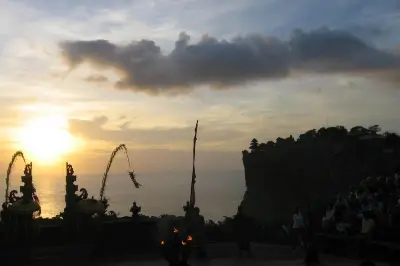
On the cliff stands one of Bali's holiest temples, Uluwatu Temple, built in the 11th century entirely from hard granite. The jagged cliffs on both sides extend into the Indian Ocean, spectacular!
Below the near-vertical cliff, waves crash against the cliff walls, again and again, as if telling a story, making people stop and listen......
At the entrance, Ketut warned us to be careful of the monkeys at Uluwatu, as they're mischievous and often snatch visitors' belongings, especially glasses—be sure to hide them! To protect us, Ketut found a stick for defense. But we were lucky; we didn't encounter any troublemakers—maybe they'd already had their fun during the day!
Tip: Because of the temple, visitors must tie a yellow sash around their waist. Skirts and shorts must be above the knee; if not, you need to wear a sarong to enter, showing respect to the gods.
A trip to Bali without watching a sunset feels incomplete. I asked Ketut whether to go to Jimbaran or Kuta for sunset. Without hesitation, he recommended Kuta! Once there, I found that besides the sunset, Kuta has plenty to do!
Kuta Beach is Bali's most famous beach for water fun. The area from sand to shallow sea is vast, allowing you to run in the sea. Almost every visitor jumps and laughs, full of joy!
Most stunning is that while the back is calm shallow water, the front has 7 kilometers of high waves perfect for surfing. You can see wave after wave—a surfer's paradise!
As sunset approached, everyone found good spots to quietly watch the sun disappear into the sea. Who says Bali has only first-class hotels and second-class beaches? I'd vote for Kuta Beach as the 'Best Sunset in Bali'!
After sunset, we quickly filled our stomachs. At a small shop near Kuta Beach, we had simple fried rice and noodles—taste wasn't much different from back home. I was impressed that the shop owner spoke excellent English!
The daytime fun continued into the night. If you have time, you can stroll around Kuta Square, shop for traditional handicrafts, or join the young people's nightlife......
We had booked a 7 p.m. SPA at a Seminyak hotel, so we left Kuta after eating.
For our last stop in Bali, we arranged a 2-hour traditional essential oil SPA to fully relax before our 1:30 a.m. flight back home!
Bali is a SPA paradise. Every hotel and villa offers SPA services, but quality varies; better ones cost more. After comparing a few on Taobao, we chose Lagoon SPA in Seminyak!
Since the 13th century, Balinese have used natural herbs and plants for massage to promote blood circulation. Modern Balinese SPA still uses local natural plants and flowers as essential oil ingredients, combined with unique Balinese massage techniques. Common types include:
Balinese Massage: traditional essential oil SPA
Hot Stone Massage: hot stone SPA
Lulur: exfoliating SPA
We chose the traditional essential oil SPA. In two hours, our entire body relaxed thoroughly. The best part was unknowingly drifting into sleep during the treatment, which is when the body absorbs best!
That concludes the Bali part! The Komodo part is even more exciting!
Komodo Island: Just for That Pink
Most people come to Komodo to see the world's largest and most venomous Komodo dragon, or to dive in the richest marine biodiversity...... But I came to fulfill a girl's dream: to see the dreamy pink beaches!
This summer, the pink world filled my girlish heart, yet I left it behind on these islands......
During the one-hour flight from Bali to Komodo, I admired the natural wonders over the ocean almost every moment. Unlike Australia's Great Barrier Reef, the unique combination of islands and coral reefs in Indonesia's Lesser Sunda Islands is unforgettable!
Arriving at Labuan Bajo at noon, this gateway town to Komodo National Park has transformed from a small fishing village into a busy hub thanks to tourism! The small airport sees faces from all over the world!
Our inn, Dorme Tree, was just two minutes' drive from the airport. I booked it for convenience but discovered many benefits: close to the town center (10-minute walk), shuttle service, friendly and helpful staff, and affordable meals!
WenQ, the owner of 'Dive Komodo,' specifically recommended their pork noodles, saying it's the best pork around Komodo—they eat there often! On the day we checked in, our guide Warren Yang also ate there and said local pork is usually tough, but Dorme Tree's homemade pork is tender and tasty!
So our first meal in Komodo was this pork feast!
There's a map and 'Things to Do' in Dorme Tree's hallway; we planned to visit the town later.
Before coming, WenQ recommended some nice spots. Combined with tips from the Dorme Tree innkeeper, here are the activities for half a day in Labuan Bajo:
1) Rangko Cave: a bit far; first 40 mins by car, then 10 mins by boat. (From WenQ)
2) Batu Cermin (Mirror Cave): 30 mins drive from the inn. (From WenQ)
The cost for both is about 500,000 rp/car (250 RMB) plus boat fee 100,000 rp/person (50 RMB).
3) Bukit Amelia: a hill in Labuan Bajo with beautiful sunsets, 15 mins drive from the inn.
4) Fish Market: strongly recommended by the Dorme Tree innkeeper, a food street 15 mins walk or 5 mins drive from the inn.
The afternoon sun was still fierce. Considering the UV and our energy, we decided to take a nap at Dorme Tree, then go to Bukit Amelia for sunset, and finally to the Fish Market for seafood!
We booked a shuttle from the inn: 30,000 rp/trip. We got the driver's and innkeeper's WhatsApp (similar to WeChat).
'Bukit' means 'hill' in Indonesian; 'Amelia' is a woman's name—so the scenery must be as beautiful as the name suggests.
From a distance, it looked like a short climb to the top, but after several peaks, we were out of breath!
The scenery changed with elevation; every step was a captivating painting.
We arrived just in time—the sunlight was the softest of the day!
Indonesia, the 'land of a thousand islands,' amazes me: each island we visited had its own style! Bali was the graceful lady, Nusa Penida the wild girl, and Labuan Bajo like an innocent youth—every leaf radiates its unique charm!
Tip: Although Bukit Amelia's hill isn't high, there are no steps for climbing and no railings at the top—watch your safety!
From Bukit Amelia, we drove to Labuan Bajo's liveliest fish market. In daylight, it's a peaceful fishing village; after sunset, it shows unique rosy clouds!
The evening clouds scattered in red; mountains, sea, returning fishing boats, colorful sky...... Moving scenes that enchant!
The fish market operates daily from 5 p.m. to 2 a.m. It's not only a food paradise for tourists worldwide but also a favorite port for locals! Pick a few fresh fish, order a glass of Pilsen dark beer, watch the sunset scenery, chat about life—the beauty of life is this simple......
Seafood here is very cheap: grouper 50-60 RMB/kg, crabs 30-40 RMB each, lobsters 150-200 each...... Probably the cheapest fish market in Asia!
When choosing fish, look for bright eyes and red gills—these are freshly caught!
During our two nights in Labuan Bajo, we ate at the fish market every night. The first night, we chose Napoleon fish (kaka tua), a Komodo specialty. Its color reminded me of the wild Napoleon fish Wally at Australia's Moore Reef—two months later, I found its relative in Komodo!
The seafood is grilled directly over fire. Although not as refined as Chinese cooking, it preserves the natural freshness—perfectly satisfying!
The second night, we went for the mouse grouper strongly recommended by guide Warren Yang; he said the same fish costs several times more in Jakarta!
The market management requires visitors to buy a recharge card with a deposit; after spending, the balance and deposit are refunded. This is to uniformly manage vendors and collect a 20% management fee from each shop.
Considering the seafood is already cheap and vendors pay commission, it's tough for them. The next night, we didn't recharge; we directly approached the first night's vendor and offered to pay him directly for a better price. It worked: they saved the management fee, and we got a discount—win-win!
Finally, the highlight: a full-day chartered boat tour of Komodo National Park! WenQ sent me the sea guidelines the day before, noting a new rule: drones require a permit—500 RMB per drone!
The day's itinerary includes 6 spots: Padar Island's three-color beaches → Komodo Island dragon → Komodo pink beach → Padar Island crescent beach → Kanawa Island snorkeling.
A red sun rises in the east, like a fan of rosy clouds half the sky!
Departing at dawn, we watched the sunrise at sea and entered Komodo National Park waters. Guide Warren Yang said our small speedboat is faster and more stable than large boats; even in rough seas, we needn't worry. His captain has 30 years of experience and knows the terrain well!
Our first stop, Padar Island, is the most physically demanding. This small island was recently named one of the world's most spectacular hiking destinations. Long ago, wild Komodo dragons lived here, but now they're almost extinct; deer are the island's main inhabitants!
As we climbed, we first saw this black sand beach.
Higher up, we saw the pink sand beach behind the black sand hill.
To the right is a white sand beach.
Standing at the summit, a magical sight: pink, black, and white beaches connected in a beautiful bay arc, surrounding calm blue sea. I marveled at nature's craftsmanship! The hill's vegetation changes color with the seasons; the best light is before 10 a.m., illuminating all the beaches!
Besides the scenery, the hike itself was enjoyable. Walking on the open hilltop with gentle sea breeze, turning back every step—each frame is a masterpiece!
Tip: Padar Island's hills have steps, making the climb easy. I recommend coming before 10 a.m. or near sunset to avoid strong sun. Prepare with comfortable shoes, clothes, water, and sunscreen.
Indonesia is the only country in the world where you can see Komodo dragons in the wild! Currently, Komodo dragons mainly live on Komodo and Rinca Islands. Warren Yang chose Komodo Island because, besides designated photo dragons, you can see wild ones; Rinca only has captive dragons. This choice proved excellent, but luck is involved—there's a 50% chance of seeing no wild dragons on a hike!
As the speedboat approached Komodo Island, Warren pointed out the colorful stilt houses on the shore—homes of indigenous people living alongside dragons. Legend has it that dragons understand their language! So, during the dragon-watching hike, an indigenous guide escorts us; they'll handle any incidents.
After entering, the indigenous guide introduced the hiking routes. We chose a moderate loop—a dragon-spotting tour! Our group of six had two escorts, one front and one back—quite safe feeling!
Within minutes, the guide suddenly stopped and pointed ahead: a wild Komodo dragon drinking at a pond! He led with a stick, telling us to follow quietly. My feelings were mixed: thrilling yet worrying about danger!
This carnivore can suddenly pounce on prey, biting the neck or artery. The prey dies from septicemia due to toxic bacteria in the dragon's saliva. A human bitten would have no cure and die within 24 hours! Women on their period are not recommended to visit, as Komodo dragons can smell blood and carrion from 10 kilometers away.
Scary, right? That's why an indigenous guide is necessary—stay behind them and don't wander!
After a while, the dragon turned into the forest, and we relaxed. The guide said, 'You're the first group today to see a wild dragon—very lucky!'
We continued the loop. The guide explained: Komodo dragons can reach 3 meters long and weigh over 70 kg—the world's largest lizard and reptile. They can climb trees and swim; they can eat up to 80% of their body weight in one meal, preying on water buffalo, deer, pigs, even humans.
During April and May, dragons are rarely seen because it's their mating season. But adult dragons eat the young, so hatchlings quickly climb trees to avoid being eaten.
The dragon population has dropped from an estimated 5,000 to about 3,500, listed as endangered!
Now the highlight: photo with a Komodo dragon! The dragons used for photos are generally not aggressive, likely trained. Still, you must stand behind it, with the guide in front directing!
This angle captured perfectly!
The morning itinerary ended perfectly. Warren was waiting at the exit, seeing our 'safe return.' He prepared a special treat: freshly fried purple sweet potatoes and bananas, seafood and rice brought from Labuan Bajo. For an island with scarce supplies, this was satisfying!
Our luck continued: while eating, a small baby Komodo dragon appeared nearby—so cute! But it ran super fast and disappeared into the jungle in no time!
Every girl has a pink dream: pink beaches, pink sands, pink flower fields...... We'll be at every pink place on Earth!
80% of the beaches on Komodo and Padar Islands are naturally pink, making it one of the seven pink sand beaches in the world!
Guide Warren has an excellent eye for beaches. This unnamed natural beach near the three-color beach has even more beautiful gradient water than other pink beaches! He said the newly opened Ayana Hotel's pink beach day trip copied his route but charges several times more!
Beautiful red corals! I'm speechless to describe!
Warren specifically instructed: nothing from the pink beach may be taken away. If anyone takes something onto the boat, he'll throw them back into the sea!