28 Panfilov Heroes Memorial Park. Central Asia 2. Kazakhstan 2.
June 8, 2015. After a lesson on Xilai musical instruments and a wander through the museum, we went out to visit the adjacent Park of 28 Panfilov Guardsmen.
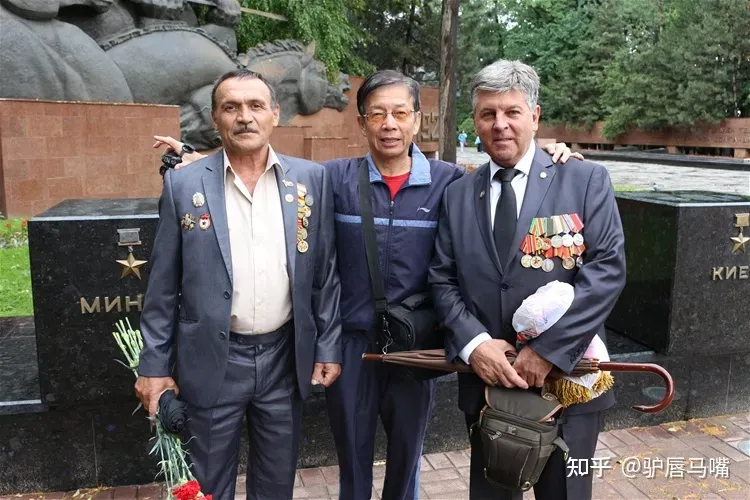
(Lv Zong encountered two veterans who came to lay flowers.)
Climbing a few steps, to the left is a tall colonnaded archway. This is Kazakhstan's Officers' House, adorned with emblems on the building.
Looking down from the grand staircase, a vast square unfolds, with the eternal flame visible straight ahead. Two veterans with chests full of medals descended the steps with me.
The memorial park covers 18 hectares and was built in the 1970s. It was established to honor the 28 brave soldiers of the 1075th Regiment of the 316th Panfilov Guards Rifle Division of the former Soviet Army, who heroically repelled a German fascist tank attack during the Battle of Moscow. Ten of these heroes were from Almaty. After the battle, all 28 were awarded the title Hero of the Soviet Union. The park is a key site for locals to receive patriotic education, remember the martyrs, and enjoy leisure time on holidays.
I first went to see the monument on the left side of the square. Tiered flower beds rise to a stone pedestal. Three soldier sculptures stand atop it — one seated, two standing — their expressions grave, reflecting the torment of war. Below the base are inscribed the martyrs' names, along with bronze depictions of helmets, olive branches, and rifles.
Returning to the main square, I looked at the eternal flame. In the center of the paved walkway is a bronze golden star encircled by ears of grain, with the flame burning brightly at its heart, symbolizing the unceasing spirit of life.
On the walls on either side, golden inscriptions in Russian and Kazakh read: “Heroes who bravely sacrificed for freedom and territorial integrity will forever live in the hearts of the people.”
Behind the flame, a long walkway paved with black marble leads straight to the sculptural ensemble of the 28 heroes, also known as the “Monument of Glory.”
On either side of the walkway are two sculpture groups. One bears the dates 1941–1945, the other 1917–1920.
After photographing the sculptures on both sides, I walked along the central path.
In the center of the black marble, the red eternal flame burns unceasingly, comforting the spirits of the World War II heroes! At the end of the marble walkway, on purple granite, an inscription recounts the deeds of the 28 warriors.
At the walkway’s end stands a monumental heroic sculpture group. Dominating the composition, a tall soldier in the center clutches an anti-tank grenade in his right hand, arms flung wide, lunging forward as if to stop the German tanks with his own body. The other soldiers all follow in a wave of forward momentum, each face filled with fearless determination.
On the pedestal of the group sculpture, a Russian inscription reads: “Great Russia, we can retreat no more — Moscow is behind us!” Standing before the colossal monument, one truly feels the awe-inspiring power of lives and blood given to defend the motherland.
Lv Zong, being fleet-footed, ran to the edge of the park and saw a statue of General Panfilov.
According to online sources: the stirring, tragic chapter written by these heroes beneath the walls of Moscow during World War II is unforgettable. After the Great Patriotic War broke out, the Soviet Red Army formed a division in Almaty — the 316th Rifle Division — commanded by Major General Ivan Panfilov, with the unit composed mainly of Kazakhs.
When the Battle of Moscow began, this division was transferred from the distant Kazakh Soviet Republic to Moscow and immediately went into combat. In November 1941, on the outskirts of Moscow, it valiantly fought against a much larger German force.
On November 16, near Dubosekovo station, 28 soldiers of the 4th Company’s anti-tank destroyer group from the 1075th Rifle Regiment were ordered to halt German tanks. When their anti-tank shells ran out, they hurled petrol bombs at the tanks or attacked with bunched grenades. The fighting was incredibly fierce. Outnumbered, all 28 soldiers died heroically and were posthumously awarded the title Hero of the Soviet Union.
On November 18, Major General Panfilov died heroically in battle near the village of Gusenevo in Volokolamsky District, Moscow Oblast. The division was awarded the honorary title “8th Guards Panfilov Division” for its distinguished service defending Moscow. That same year, the Presidium of the Supreme Soviet issued a decree renaming the town of Yarkent in the Taldykorgan region to Panfilov.