Free Travel Swoosh Swoosh Swoosh
I never thought that when I started writing about my Bali trip, it would be under such circumstances.
Back in 2019, I was living on Lombok, and a trip to Bali meant just buying a ticket for about 100-plus yuan—less than an hour to reach that bustling island.
Back then, hopping over to a nearby island felt like such a small thing, so I kept putting it off until I finally went.
Looking back now, those ordinary days feel like a luxury, and the southern hemisphere sea breeze seems so far away.
People are like that, aren’t they? At the time I was so desperate for food from home that I kept clamoring to go back, and now I sometimes say, ‘I miss Lombok.’
Whenever I hear people talk about how long it will take for international travel to resume, I get this indescribable feeling. Honestly, I’m starting to worry that my twenties and thirties are slipping away too fast—year after year passing while my feet still haven’t reached the places I long to go.
It’s not getting older I fear; it’s not fulfilling my dreams.
In this sort of outside situation, it’s easy to overthink—anxiety, worry, all of it. But after all that thinking, in the end what you can do is try your best with what’s right in front of you.
Speaking of Bali, it wasn’t always my first pick for traveling in Indonesia. It was only on my fourth trip to Indonesia that I visited this super popular island.
But after seeing quite a bit of Indonesia, I really want to set the record straight about Bali. The saying ‘first-class hotels, second-class beaches, third-class sights’ — I absolutely don’t agree with it.
Besides its first-class hotels, it also has equally beautiful beaches and sights; if you just explore with a little effort, you’ll surely be amazed.
Bali is rich: it has sandy beaches and coastline, lush rice paddies and lakes, plus several offshore islands with breathtaking scenery.
Here there are natural landscapes and cultural sights, you can snap photos at iconic spots or go hunting for hidden-gem hotels.
Of course, Bali is an incredibly popular destination, packed with tourists. If you only go where the tour groups flock, it’s easy to be disappointed.
But if you do your homework, you can still enjoy your own slice of Bali—no queues, no crowds, just your time.
My first stop in Bali was Kuta, likely the first choice for most travelers because it’s close to the airport and beaches, with a huge selection of hotels.
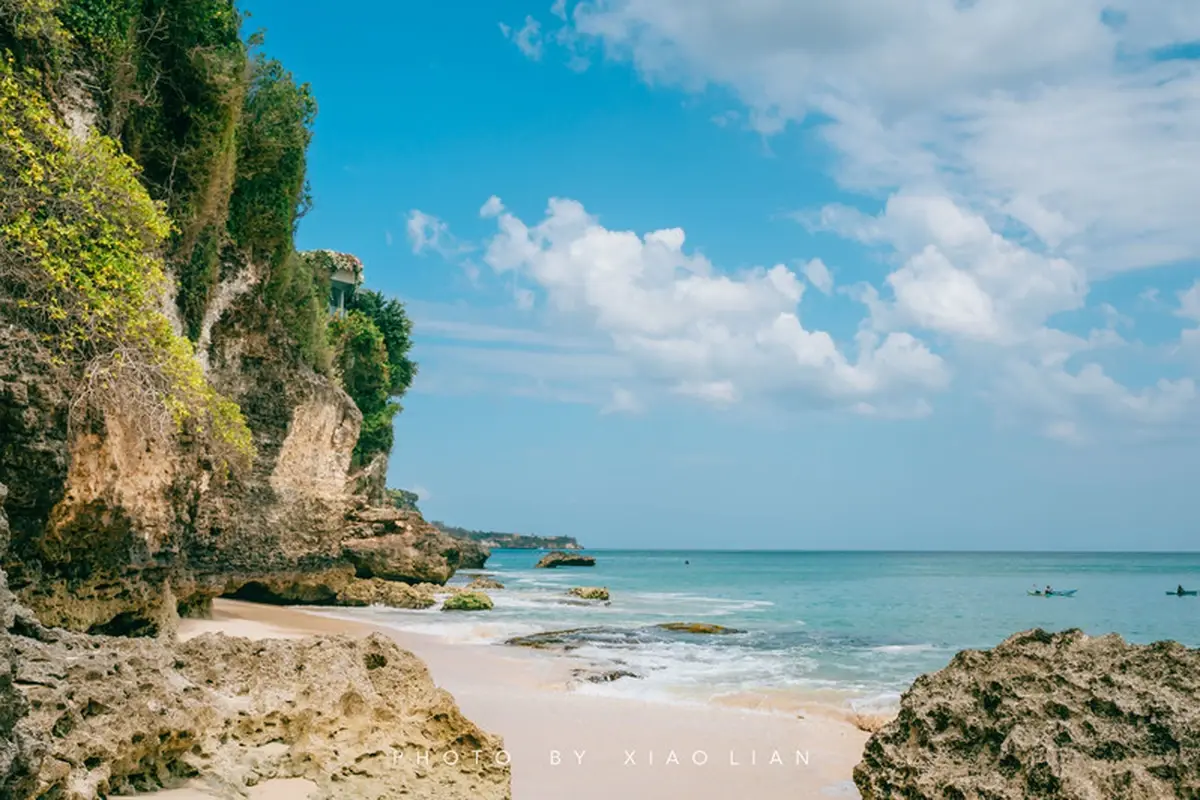
Kuta wasn’t the focus of our trip, so we only planned to visit a very off-the-beaten-path beach called Pantai Tegal Beach. It’s close to Jimbaran, but compared to the lively Jimbaran Beach, it’s still pretty quiet.
Kuta | Find a Hidden Beach to See Rocks and Waves
Transport in Kuta is very convenient; you can take a taxi, a ride-hailing car (Grab), or hire a private car.
For convenience, we booked a full-day private car in advance. I have to say, the price of hiring a car in Bali is really reasonable—200 yuan for up to 10 hours within the designated area, so for two of us, it came to about 100 yuan per person.
You just need to plan your own itinerary, fix the date and time, and the driver will pick you up punctually on the day.
That morning the weather was beautifully sunny, with big fluffy clouds drifting freely in the sky—weather like that always lifts your spirits.
Pantai Tegal Beach lies beneath a cliff. From a high vantage point, you can see the long coastline; like Lombok, southern Bali has many unique landforms.
We followed a path down to the sand. On one side were rocks, on the other, rolling waves. The sea breeze blew hard against our faces, making it feel pleasantly cool.
Pantai Tegal Beach is anything but a plain sandy stretch. It’s dotted with rocks, and the large rock behind the beach provides some shade. If you bring a towel and lie here, feeling the sea breeze, it’s incredibly comfortable.
It’s a fantastic spot for portrait photography. The large rocks add layers to the shoreline, and you can easily find nice shooting angles by strolling around. With few tourists, we had a blast taking pictures here.
Visiting Pantai Tegal Beach is heavily affected by the tides. When the tide is high, seawater covers the rocks, leaving hardly any place to step, and it’s basically impossible to explore.
When the tide is low, the depressions formed by the rocks on the beach look like natural bathtubs, making for fun photo ops.
Tides vary by time, so if you want a good experience, check the tide charts beforehand.
One thing worth noting: sometimes the waves here are huge and fierce. When taking photos and playing, be very careful about safety. If you’re with kids, keep an eye on them at all times.
Island travel is different from city or highland trips. Here, you don’t need to spend loads of time on the road. When we arrive at a beach or a scenic spot, we mostly slow down, stroll leisurely, or just sit and lie down, watching the clouds and feeling the breeze.
I think this is exactly why so many people love island getaways. Facing blue sky, white clouds, and endless ocean just lifts your heart; even doing nothing feels like time well spent.
After a short day in Kuta, we set off for Ubud, the part I was most looking forward to. It’s funny—who would think that on a tropical island trip, what I’d be most excited about would be rice terraces?
Although there are plenty of rice terrace landscapes back home in China, as a northerner I’ve rarely seen rice paddies.
And the tropical rice terraces with coconut palms, scattered with local-style houses—that’s an unmissable sight when visiting Bali.
Ubud is in central Bali; it takes over an hour to get there from Kuta. The road is lined with lush green rice fields, and driving through such scenery is always refreshing.
Ubud’s streets are still bustling, but it would be a shame to only linger in the market area. There are so many lesser-known, hidden-gem sceneries around.
Ubud | Visit the Largest Rice Terraces, Quietly Enjoy That Fresh Green
Our first stop in Ubud was the Jatiluwih Rice Terraces—you can find it on Google Maps as Jatiluwih Rice Terraces.
We’d heard that food inside the attraction was overpriced, so we found a restaurant along the way for lunch.
Very luckily, this turned out to be a restaurant with a view. Dining in front of vast rice terraces was utterly pleasant. It was a buffet, and the food tasted surprisingly good, exceeding my expectations. At about 60+ yuan per person, it was quite a bargain.
After lunch, we drove straight to Jatiluwih. The entrance fee was 60,000 Indonesian rupiah per person, about 30 yuan.
These are some of the largest rice terraces in Bali. Driving through, you can’t see the end of them; everywhere you look are vast expanses of terraced fields. Some places are like that—you know right away you’ve made the right choice. We couldn’t wait to dive into this world of green.
Jatiluwih is huge, with many entrances for walking. It’s basically impossible to explore the whole area in a short time, so we just wandered and picked the most attractive entrance to delve deeper.
Unlike the ‘grand and magnificent’ impression we have of rice terraces in China, Bali’s terraces are more delicately beautiful. Among the neatly arranged paddies, you’ll find dense coconut groves, little pavilions, and occasionally a few ducklings hiding in the fields. Footpaths run between the paddies for walking.
Walking here is pure joy. Beyond the grand scenery, there are many exquisite little scenes; it’s beautiful no matter where you look.
Visiting the terraces also requires a bit of luck, because they grow real rice, and the landscape changes depending on the growth stage.
We went in mid-September, when the rice had just grown to about twenty-something centimeters tall—tender and vividly green, very charming.
I’d prepared a traditional Hanfu outfit to wear here. The pink Hanfu against the fresh green and light blue sky made a perfectly harmonious picture. This time, my Hanfu travel photography added another little dot on the map~
You don’t have to worry about stepping on the rice when walking between terraces, because between each level there’s a grassy path where visitors can walk.
But you do need to be careful of slippery mud; Qiqi took a dramatic fall here.
He was carrying two cameras, earnestly looking for the perfect angle, when he slipped suddenly into the mud. Yet both of us immediately worried about the cameras first! Hahaha.
Luckily, neither cameras nor people were hurt, just covered in mud, and the camera straps were muddy too. So we found ourselves washing clothes at a tap in the fields~
Apart from coconut trees, many tropical plants grow among the terraces. All kinds of plants dotted here and there don’t make it feel messy. Visitors of various nationalities passed by on the paths. It wasn’t exactly empty, but because the area is vast, people are well spread out. Compared to many popular spots in Ubud, this place is practically a hidden paradise~
One thing I felt while walking in Hanfu through the area: I was treated especially kindly. Passersby kept smiling at me, and someone even came up to say, ‘You are beautiful.’ Being liked is always a delight.
Amid such scenery, I suddenly felt a sense of ‘returning to nature.’ All things growing naturally have their unique beauty, and even the rice, a simple crop, has such charm.
In the afternoon, the previously clear blue sky clouded over. Under the overcast sky, the paddies glowed with a soft, deep green. The temperature was perfect—not hot, not sunny. We sat in the fields, taking photos and chatting, completely enjoying the moment.
I’ve come to understand more and more that days like that are rare: perfect weather, perfect mood, no distractions, no worries.
Just simply being present in the moment is already a precious thing.