2016 Spring Festival Mediterranean Cruise + Paris Family Trip to Europe (Group Tour)
2016 Spring Festival family trip to Europe: cruise + Paris 14 days
I had always wanted to take the whole family (5 adults and 1 child) on a long-distance overseas trip. Since my parents were still healthy enough for long journeys, I asked for their opinion and we chose Europe. To avoid the fatigue of changing hotels every day, I decided to take a cruise route in Europe as well.
European cruises are divided into several different routes: the Mediterranean route (mainly classic France, Italy, Spain), the Aegean route (mainly Greece, Italy, Israel), the Baltic route (mainly Nordic Denmark, Germany, Norway, Russia), and the English Channel route (mainly UK, France, Spain). Except for me, who had been to France, Italy, Germany, Switzerland, and Belgium in Europe, and my mother who had been to Sweden, everyone else was setting foot in Europe for the first time. So we chose the classic Mediterranean route to see popular attractions like the Eiffel Tower and the Louvre!
The cruise we chose was Italian. Most entertainment was concentrated on decks 6-7. Deck 5 had the main restaurant and theater. The middle part had some interior cabins and oceanview cabins. Decks 8-13 were various guest rooms. Deck 14 had the buffet restaurant and water recreation area. Decks 15-16 were luxury suites, the yacht club, and the water slide. Deck 18 was the members' area. Cabins were divided into four categories: interior, oceanview, balcony, and suite. All rooms had basic facilities (separate twin beds, private bathroom, TV, air conditioning, wardrobe, etc.). Suites were larger and had bathtubs. Oceanview cabins were neither here nor there—they only had a small window that couldn't be opened compared to interior cabins. So based on budget, you just chose between interior and balcony. Since this trip was relatively long, it was cold outside in winter, and we would spend more time in the room, a balcony cabin was the best choice. Everywhere on the ship, elderly Europeans could be seen leisurely enjoying themselves.
The cruise we chose departed from Genoa, Italy, for a seven-night, eight-day itinerary. It passed through Rome, Italy; Vatican City; Sicily; Malta; Barcelona, Spain; Marseille, France; and Monaco, before returning to Genoa. Since our language skills were limited, and since we had flown such a long way, it was worth spending more time at the beginning and end in Italy and France. We finally booked a trip that started with a flight from Beijing to Milan, Italy; two nights in a hotel in Italy; seven nights on the cruise; and three nights in hotels in Nice/Paris, France; then a return flight from Paris to Beijing—a total of 12 nights.
The temperature in Europe in winter was slightly higher than in Beijing. In February, coastal cities in Italy and France had a Mediterranean climate, with daytime temperatures generally between 10-15°C. However, this period is the rainy season in Europe, and the continuous overcast and drizzle made it feel cooler. Only the last two days in Paris, which was not coastal, were colder, with temperatures similar to Beijing—below 10°C during the day. Also, the outdoor pool on the cruise could not be enjoyed, but otherwise there were no major problems. Traveling during the Spring Festival meant higher airfare, which increased the overall budget. But we didn't need to take a very long vacation, and we could avoid the overcrowded conditions everywhere in China during the Spring Festival. Plus, we learned that many tour prices during the Spring Festival were doubled, so this price difference (about 3000 RMB cheaper after the Spring Festival) was worth it!
Another thing we were most fortunate about on this trip to Europe was having an excellent tour guide. His college major was world history, and he could talk about European history, architecture, and culture effortlessly. You could tell he deeply loved these subjects and didn't need to memorize them. Throughout the trip, he gave various knowledge talks, and sometimes I was sleepy but didn't want to fall asleep for fear of missing his explanations. I learned a lot about European history on this trip—an unexpected bonus that was well worth it.
Foreign currency: easy—just use euros. Following the principle of using cards as much as possible in Europe, I only exchanged less than 2500 euros, mainly for tips and such. It proved to be enough.
Phone and internet: international roaming calls in Europe cost about 1.99-2.99 RMB per minute, so no need to call unless necessary. Internet was needed; nowadays you can't get by without it. I bought a prepaid SIM card with 950 MB of data valid for 15 days, very cheap at 88 RMB including postage. If bought earlier, it could be had for 75 RMB. Used sparingly, it should be enough—after all, there would be no signal when sailing at sea. Phone and internet on the cruise were too expensive, so we gave up on them. It turned out the data was sufficient.
If you need hot water or to heat up food, I recommend bringing a small electric pot. Our electric pot was a lifesaver—boiling water when there was no kettle, and at other times cooking porridge, noodles, or heating up purchased food. Especially at European hotel breakfasts, besides hot coffee, all other milk and drinks were cold. Every morning I used this pot to cook hot porridge for my parents, which was very convenient.
February 5, 0:50 (Beijing time) – 10:00 (Italy time) – Stay in Milan
Beijing – TK21 (10h25min) – Istanbul – TK1873 (3h) – Milan
After lunch, we visited Milan Cathedral in the city center and then checked into the hotel.
The airport was very crowded during the Spring Festival. We were told to gather at 21:30, nearly three and a half hours early. Our tour leader lived in Europe all year round. Except for a few places (like Malta and Marseille) where local regulations required a local guide, he handled all other guiding himself. We completed check-in and boarded on time.
The flight from Beijing to Istanbul departed at 0:50 Beijing time and arrived at 5:15 local time, a 6-hour time difference. Due to waiting on the runway, we took off nearly an hour late, but the actual flight time was less than 10 hours, so it wasn't really delayed. On the plane, they gave out a toiletry bag with slippers and toothbrush. There was a midnight snack and a breakfast, all Western style. The rest of the time, they served coffee, tea, and small bread rolls. I remember when I went to Europe years ago, they had cup noodles available anytime. Our little girl was great—she slept for eight of the ten hours. Meanwhile, we slept fitfully. Jet lag probably takes two or three days to adjust to.
Arriving in Istanbul, it was cloudy and had just rained. The shuttle bus was cold. The airport was huge. We only had two hours before our next flight, so we didn't shop much. We looked around a small supermarket near the gate and found chocolate, cigarettes, and candy were very cheap.
The transfer went smoothly. We landed again in Milan, Italy. A group of 13 of us was assigned a large bus that could hold forty to fifty people—extremely comfortable. (Later we found out that except for Malta, at every other stop, we had such a large bus for just 13 of us, so each person could have a whole row of seats. Definitely commendable.) From the airport, we went directly to Milan city center. After a Chinese lunch, we visited Milan Cathedral. Having had two or three Western meals on the plane, my parents praised the mediocre Chinese restaurant highly. Luckily, our group of 13 split into two tables, and my family of 6 had a table to ourselves with 6 dishes and 1 soup, which was quite good. I noticed another group of 10 had the same standard and ate everything clean, which made me feel fortunate.
Today's itinerary was just Milan Cathedral. The bus could only stop at Piazza Leonardo da Vinci, which faces the Teatro alla Scala, said to be a famous opera house in Italy. But we didn't have time to experience world-renowned Italian opera. From there, we walked through the Galleria Vittorio Emanuele II, a long arcade, to reach the cathedral square in front of Milan Cathedral. This is the center of Milan. In the middle of the square stands an equestrian statue of Vittorio Emanuele II, the first king of the Kingdom of Italy. Countless pigeons strolled leisurely around, allowing people to feed them. Feeding pigeons and seagulls became our little girl's favorite activity throughout this European trip. With the cathedral as the center, several ring roads connect. The Galleria Vittorio Emanuele II has an arched roof with colored glass panels, making it one of Milan's commercial centers. The floor is made of mosaic marble patterns. Inside the arcade are many jewelry, fashion, bag, gift, restaurant, and coffee shops. It is said to be slightly more expensive than Paris.
Milan Cathedral is second only to St. Peter's Basilica in Vatican City in size. It is a typical Gothic building. Standing in the square in front of the cathedral, it is magnificent and absolutely stunning. Construction began in 1386 and was completed in 1897, spanning five centuries—quite efficient!
You can go up to the rooftop or enter the cathedral, but the tour fee doesn't include these; you have to buy tickets. Elevator to the rooftop costs €13/person, entry is €2/person. For our five adults, €15/person; children show their passports to get a free ticket; no discount for seniors. If you're not particularly interested in architecture, just entering the cathedral is enough. From the rooftop, you can overlook the entire city and see over a hundred Gothic marble spires, each topped with a statue. The gilt Madonna on the central spire shines dazzlingly in the sun (though there was a maintenance scaffold nearby that spoiled the view). However, our whole family felt it wasn't worth €13 after going up. Of course, you can also walk up the stairs for €11/person (reportedly over 900 steps—terrible!).
We took the elevator down and queued to enter the cathedral. The front facade is divided into five large bronze doors by six huge square pillars. These doors were completed at different times, with carvings depicting various stories from the cathedral's history. I only remember that the largest central door records the life of the Virgin Mary, and the one on the right records the building's history. Inside, the entire interior is made of white marble. Stained glass windows are a notable feature of Gothic architecture. Light comes in through the side windows, creating a mysterious beauty through the colored glass. Amazingly, the glass from hundreds of years ago still shines brilliantly, looking nothing old.
On the way to the hotel, I observed the streets of Milan's city center. It didn't feel like a big city at all. The buildings along the road were only four or five stories high, with no skyscrapers. Street-side coffee shops and small restaurants were everywhere, with few large hotels or restaurants. You could feel the city's tranquility and slow pace, lacking the hustle and bustle of a metropolis. The hotel we checked into that evening was clean and simple, similar to a budget hotel. It had an electric kettle (Europeans don't drink boiled water) and some toiletries (but no toothbrush or slippers). At this point, jet lag hit us hard. We were extremely tired. Dinner wasn't included, and we had no energy to go out. I used the electric pot to cook noodles for everyone. My husband ate the pizza he had packed from the arcade. Then we went to rest.
February 6 – Milan – Cinque Terre (La Spezia) – Genoa – Stay in Genoa
We left early for Cinque Terre, which consists of five small fishing villages connected by a tiny train. It's said to have a paradise-like feel. This attraction is supposedly only available on in-depth Italy tours, so don't expect too much. Cinque Terre is nearly 200 km from Milan. The mountain roads are bad, and taking the highway is a detour (over 230 km), taking about three hours. According to European tour bus regulations, the driver must rest every two hours. We stopped at a service area for over twenty minutes. We arrived at our destination at 11:30 and caught the 11:55 train.
Due to time constraints and because they are quite similar, we only visited two of the fishing villages. They were small, and since it was the off-season, many shops and restaurants were closed, making the place feel very desolate. But you can imagine how packed it would be during peak season. The villages were smaller than we expected—just one street leading from the train station to the sea. A ten-minute walk was enough to go back and forth. The guide gave us plenty of time because we were supposed to eat there, but very few restaurants were open. We finally found one. Wow, the menu had no pictures, no pizza. We wanted pasta, so we had to manage with broken English. Seafood pasta was €12, tuna €10, tomato sauce €8—not expensive. Before the pasta came, they served two small baskets of bread slices, hard and chewy. But the frustrating part was that at the end, they charged a service fee or utensil fee of €2 per person! Our family of six paid €59 total. The guide said not to convert to RMB to feel better, and indeed it wasn't expensive. But converted, that would buy a lot of zhajiang noodles or knife-cut noodles…
Genoa is in northwestern Italy and is said to be the hometown of navigator Christopher Columbus and violin master Paganini. From Cinque Terre, we drove over 100 km to a hotel near the port of Genoa, taking nearly two hours. Most rooms in the hotel had windows overlooking the port. Fortunately, there was a large supermarket across the street from the hotel. We bought roast chicken, bread, fruit, vegetables, chocolate, pasta sauce, yogurt, drinks, and many other things for just over €30—very cheap. We also bought some large cans of beer, hoping to bring them onto the cruise, because drinks on the cruise were too expensive. The vegetables from the supermarket were pre-washed, so we just seasoned them with dressing. We cooked rice porridge ourselves and enjoyed the roast chicken and bread. It was a hearty dinner.
February 7 – Boarding in Genoa – Stay on the cruise
We slept in. In the morning, we could already see the big cruise ship docked at the port waiting for us. The cruise terminal was huge. As soon as we got off the bus, attendants helped attach luggage tags and took away our large suitcases. They would deliver them to our room within an hour after departure.
Entering the terminal hall, we felt the orderly process. There weren't too many people. You could imagine they had divided the thousands of passengers into time slots with clear signs to follow for check-in. The important thing was to scan your passport and have your photo taken at the service desk to get a cruise card. This card was very important—it served as your ID on the ship. All onboard purchases were charged to this card, and the bill was settled when you disembarked. It was also used to check in and out at each port; you had to swipe the card and verify your photo to leave or board the ship. Key information on the card: Assembly Station: D meant the muster station for the safety drill and actual evacuation was in area D; Seat: 1st meant we were assigned to the first dinner seating, along with the restaurant name—ours was Golden Lobster Restaurant; 12055 meant cabin number 055 on deck 12.
We boarded in less than half an hour and went straight to the buffet restaurant on deck 14 for lunch. It was crowded—everyone had just boarded and came to eat right after dropping off their luggage, so we had to search for seats.
After lunch, we rested a bit. At 16:00, we went to the theater for a Chinese-language boarding briefing. This was specially arranged by the cruise line due to the increasing number of Chinese passengers. Surprisingly, about one-third of the passengers on this ship (over a thousand) were Chinese, to the extent that there was a banner in Chinese saying, "The cruise wishes everyone a Happy 2016 New Year."
When we returned to our cabin from the theater, our luggage was already at the door. On the bed in each room were welcome letters, important instructions, and the next day's activity schedule, including all events in every area of the ship, restaurants, bars, details about the next port of call, embarkation and disembarkation times, dinner times, themes, and dress codes. Very detailed. For the following days, we would receive the daily schedule when they turned down the beds at night.
At 17:00, according to the ship's announcement, passengers were required to go to the designated muster station with the life jackets from their cabins for the safety drill. Basically, we learned how to put on the life jacket—simple, but must attend. Safety is important. Of course, we should also familiarize ourselves with evacuation routes, but we couldn't understand. If you missed it, you had to attend a make-up drill the next evening (since they scan your cruise card, they know who attended).
On the cruise, only dinner was a fixed-seating Western meal. Breakfast and lunch were buffets. Of course, you could also go to the buffet for dinner. Because of the large number of passengers, Western dinner was served in two seatings. According to Chinese dining habits, our dinner was arranged for the first seating at 18:00; the second seating at 21:00 was too late. The main restaurants on decks 5 and 6 strictly followed Western service standards in table setting and service. The menu also followed the order of appetizer, soup, main course, main dish, and dessert. You ordered according to the daily menu. For our convenience, they provided Chinese menus, disposable chopsticks on the table, and hot water kettles. However, the waitstaff were all European, so we just pointed and said "this this." The menu changed daily. Main dishes included beef, chicken, fish, prawns, etc. Staples included rice (undercooked), pasta (al dente), etc. Desserts included ice cream, various cakes, and fruit platters, with sugar-free options. It was quite abundant. But serving each course was slow. So only on the first night were all tables full. Later, when we went for dinner, we found most people (including my parents) had switched to the buffet to avoid the ordeal.
The night we boarded happened to be Chinese New Year's Eve, so that dinner was our New Year's Eve dinner. The cruise specially provided tangyuan (glutinous rice balls) for Chinese guests. But since Italians probably don't know how to wrap the filling (just look at pizza), many tangyuan had leaked.
Bringing your own alcohol was not allowed, and drinks were paid. But the prices were reasonable (over €2 for a large bottle of water, wine from around €10). The buffet offered free coffee and tea, and breakfast included orange juice. From the moment we boarded, they started selling drink packages, but we didn't buy any—you could always buy later. Although bringing alcohol on board was not allowed, the canned beer and bottled liquor (spirits) in our large luggage made it onto the ship without any problem.
After dinner (a full meal usually took two hours), the ship offered many rich activities. The highlight was the theater show. Every night there was a different performance, with the program and introduction detailed in the daily newsletter. There were two shows: one at 19:00 and one at 21:45—very well arranged.
We took a walk around the ship to get familiar, took some photos on the famous crystal steps. To save energy for the next day's shore excursion, we basically went back to our cabin to rest. A pleasant day ended. The ship was sailing toward the port of Civitavecchia (Rome). Back in the cabin, from the balcony, we saw complete darkness and faintly glimpsed high white waves. Our room was on deck 12, and the waves even splashed onto the balcony. There was considerable wind and waves. Compared to the seas around Japan and Korea, the ship rocked more at night here. Perhaps because last time we stayed in an interior cabin on deck 5, lower down, and this time we were on a balcony cabin on deck 12, which made the rocking more noticeable. The ship provided seasickness medication, but I didn't think it was too bad. Our little girl vomited a little twice in the buffet on deck 14 due to the rocking, but otherwise she was fine.
February 8 – Civitavecchia – Tour of Rome (Italy) 7.5 hours – Stay on the cruise
Vatican City – Colosseum – Arch of Constantine – Trevi Fountain – Spanish Steps
I must say that the well-organized, larger travel agencies were almost always among the first to disembark each day. Previously, we were often scheduled to disembark very late, which shortened our time onshore—but this time there was no such problem.
We gathered at a little after 8 a.m. to disembark and had to return by 4 p.m. Today was supposed to be the highlight of the trip, because Rome, the cradle of the ancient Roman Empire—the City of Kings—has countless historical sites. If you had a week to slowly savor this ancient city, that would be about right. But unfortunately, we only had 7 hours to see it. The cruise departs in the evening and won't wait. So it was a whirlwind tour, just scratching the surface. To make matters worse, most of our time was spent queuing at St. Peter's Basilica in Vatican City. Even worse, after queuing for nearly two hours, we had to give up entering the basilica because we were afraid of missing the other attractions. You see, many years ago when I last came to Europe, there was an event at St. Peter's Basilica that day, and it was closed to tourists. I had hoped to make up for that regret this time...
Driving through the streets of Rome felt very surreal. The city is full of ancient ruins, and our guide effortlessly pointed out and explained the buildings along the way. Most of these ruins are over three to five hundred years old and are naturally displayed throughout the city without much protection, earning it the title of "Open-Air History Museum." At the same time, because of these ruins, the streets of Rome cannot be widened, and parking is a huge problem. Seeing all the small cars gives you an idea of how difficult parking is here.
Our first stop: Vatican City, located within Rome, with an area of only 0.44 square kilometers—about three-fifths the size of Beijing's Forbidden City. It's a classic city-state within a city. Interestingly, this trip included two countries: Vatican City and Monaco. We were scheduled to visit the most time-consuming St. Peter's Basilica first. We walked from the parking lot to St. Peter's Square, and the line to enter the basilica was huge...
St. Peter's Square is magnificent. It is surrounded by two semicircular colonnades, like two outstretched arms. It is said to be able to hold 500,000 people (didn't look like it). Above the main facade of the basilica are statues. The two clocks on the sides show different times—Roman time and Greenwich time. In the center of the square stands an Egyptian obelisk. There is an iron fence; inside is Vatican City, outside is Italy. Here you can put one foot in each country. St. Peter's Basilica, designed by Michelangelo, is the largest church in the world. Unfortunately, we queued for nearly two hours. We saw that they only let in a few dozen people at a time.
Just as we were about to reach the front, time was running short, and we didn't know if the next batch would be let in ten minutes or tens of minutes later. Our guide Zhang had to lead us away from the line with regret, exiting through another passage after speaking with security.
We took photos in the square, had lunch at a Chinese restaurant, and then headed straight to the Colosseum.
The Colosseum, in my mind, is the symbol of Rome. It was a place of entertainment for ancient Roman royalty and nobility. What we see now is a building with fragmented beauty. Our visit was limited to the outside; we didn't go inside (tickets were said to be around €10). It is said to be able to hold 80,000-90,000 people, with seating for over 50,000. On the ground floor, you can see dozens of entrances that could evacuate all spectators within minutes—a spectacular scene.
Next to it is the Arch of Constantine. In ancient Rome, emperors liked to build triumphal arches to celebrate significant victories. During this European trip, we saw countless triumphal arches. The Arch of Constantine was named after the Roman emperor Constantine. It is said that the Arc de Triomphe in Paris was designed and built based on this one. Actually, to me, every triumphal arch looks pretty much the same.
The next stop was the Trevi Fountain, which our little girl was eager to see. Her interest was in tossing coins.
The Trevi Fountain, also known as the Fountain of the Maidens, has a beautiful Baroque sculpture as its backdrop. It is said that you must stand with your back to the fountain and throw a coin over your left shoulder with your right hand. One coin thrown ensures you will return to Rome; two coins thrown promises a romantic encounter; three coins thrown grants a wish for love to come true. The guide said only the first one is valid; the other claims are rumors. I had been here before and thrown a coin, and now I was back in Rome—wish fulfilled. We brought our own coins to save money and leave our coins in Europe—perfect. Our little girl tossed more than ten coins, having a great time. It is said that the coins must be collected every day or two, otherwise the fountain would overflow. The money is mainly used for charity.
Next to the Trevi Fountain, there is an ice cream shop that is incredibly popular. The guide said its ice cream was delicious. We bought two cones and agreed—it was excellent. Holding our ice cream, we walked directly to the Spanish Steps (Piazza di Spagna), hoping to recreate the romantic scene from "Roman Holiday" where Audrey Hepburn eats ice cream on the steps. But reality was harsh. When we reached the Spanish Steps, the steps were cordoned off for renovation, and we couldn't go up. So we had to sit on the stone steps by the fountain in front of the steps and eat our ice cream while looking at the steps. The steps have 138 steps in total. At the top is a twin-towered church. This area is considered a romantic meeting place in Rome. There are shopping streets and cafes nearby. We strolled around before taking the bus back to the pier to reboard.
February 9 – Palermo 6.5 hours – Stay on the cruise
Politeama Opera House/Plaza – Monreale Cathedral – City Hall – Norman Palace – Palermo Cathedral – Quattro Canti – Piazza Pretoria – Martorana Church – Teatro Massimo – Seaside walk
Today we didn't need to rush. We slept in and disembarked late, around 9 a.m., arriving in Palermo, Italy. My impression of Palermo comes from that famous movie. Actually, it's an autonomous region of Italy, and Palermo is the capital.
First, we went to a distant attraction: Monreale Cathedral. It's on a small hilltop. The drive from the port passed by the Politeama Opera House, and it wasn't far to the cathedral, but it took an hour because the roads were narrow and local drivers weren't very rule-abiding. The bus could only go halfway up the hill, and we had to walk the remaining dozens of steps. Along the roadside, there were many small shops selling handicrafts, including many mask-like artworks that looked like smiling suns. Something was happening in the square in front of the cathedral—many children in formal attire were lined up singing and dancing, very lively, lifting our spirits under the blue sky. We followed a path beside the cathedral to the end, which led to a high road along the ridge. From the railing, we could overlook the entire city of Palermo and see the blue sea in the distance—very beautiful.
Coming down from the hill, we essentially backtracked to visit other sites. We went to the Norman Palace, but we didn't go inside (you can buy a ticket to visit part of it). We passed through a garden lined with coconut trees and walked along the narrow road to Palermo Cathedral (Cappella Palatina). Under the blue sky, the cathedral with coconut trees at its entrance looked like Arabic architecture. Inside, it was of course Catholic style. There weren't many people, giving a sense of spiritual purification.
From the cathedral, we passed Quattro Canti (Four Corners), which is actually a crossroad. Each of the four corners has a small curved building adorned with many statues. Turning the corner, we came to the famous Piazza Pretoria. The fountain gets its name from the more than twenty plaster statues of mythological fairies and spirits surrounding it. Under the sunlight, these white statues looked holy and harmonious. Next to the fountain, there was another church. In short, there are countless churches in Europe, and eventually you get tired of them.
Our last stop was Teatro Massimo, where the final scene of the movie "The Godfather Part III" was filmed. Therefore, it's a must-see for tourists. After a quick shopping spree, we went to the beach to enjoy the sea breeze for a while. We watched local young people playing baseball and soccer on the lawn by the beach—very pleasant. We returned to the cruise before 4 p.m. Relaxing...
February 10 – Valletta (Malta) 6 hours – Stay on the cruise
Mosta (Rotunda) – Barrakka Gardens – Mdina (St. Paul's Cathedral) – St. John's Co-Cathedral – Rabat
Today's itinerary was relatively light. We didn't leave the ship until 10 a.m., mainly because Malta is a small country with only about 400,000 people. First, we went to the Mosta Rotunda. From the outside, it didn't look impressive, but inside, the dome was magnificent, showcasing an architectural marvel. The huge dome is supported only by side pillars—what precise calculation and design must have gone into creating such a wonder!
From the church, we went to Mdina—the Silent City. This ancient city sits on a small hill in the center of Malta. It preserves well-preserved medieval walls and cliffs on two sides. In front of the city gate, there is a structure similar to a moat. Standing on the ancient city walls, you can overlook the surrounding villages and countryside. Mdina's narrow streets are not suitable for modern vehicles, only for walking. But since local residents were allowed to use cars, and restaurants, bars, and cafes have opened in historic buildings, Mdina is no longer quiet.
The city's buildings are orderly, with many historical sites. The famous one is St. Paul's Cathedral (Baroque). We were lucky that it was open for visits (uncommon). But after seeing N churches, we weren't particularly excited. While waiting for the bus outside the ancient city gate, our little girl played on the slide and swing at a street-side children's playground. For her, that was much more fun than those rigid buildings.
From Mdina, we went to the Barrakka Gardens, where you can overlook the Grand Harbour's magnificent scenery and see the cruise ship waiting for us at the port.
Finally, we went to Valletta, known as the "stone city." It was said to be designed by Michelangelo's assistant. The side facing the sea is protected by Fort St. Elmo. Across the bay, ancient cities guard it from left and right, making Valletta the core. A main road runs through the city center, with many shops on both sides. There is an open-air square with food stalls where you can eat pasta, pizza, drink beer, and sunbathe. The most attractive buildings in the city are St. John's Co-Cathedral, a typical late Renaissance building, and the Grandmaster's Palace opposite. We didn't go into the cathedral. The palace was impressive—we took an elevator up, entered, and saw rows of bronze armor along the walls, beautiful murals and statues on the ceiling and walls, and luxurious crystal chandeliers radiating dazzling light.
The remaining time was for shopping in Valletta. The shops everywhere were mostly mass-market brands at reasonable prices, some high-end brands too. We bought a few casual clothes.
February 11 – Day at sea – Stay on the cruise
Today was a sea day, sailing from Malta to Spain—the longest distance of the trip. That means we spent the whole day at sea with no internet signal, allowing us to enjoy the ship's entertainment facilities and food without interruption.
Every morning we got up, had breakfast, and then left. By the time we returned to the ship and freshened up, it was time for dinner. After dinner, it was already dark, and we never had time to see the full view of the cruise from the deck. Today, we finally had time to explore our ship leisurely.
We started from the photo gallery. From the moment we boarded, many photographers on the ship took pictures of passengers. The developed photos were displayed in this gallery. If you found your photo and liked it, you could buy it as a souvenir. Of course, they were expensive—€20 each. For Europeans, this price was attractive, especially since the photographers set up several backdrops each day for artistic shots. At that price, it was a good deal for portraits. Every time we passed, we saw well-dressed Europeans posing for the photographers—seems business was good.
The ship had many cafes, each with a different theme. For example, "Jazz Bar" had a jazz band playing; "Sports Bar" was next to the gym; "Dessert Bar" offered various tempting cakes and sweets; "Ice Cream Bar" on the deck provided a variety of ice creams. But these were all paid. European passengers often sat in these bars chatting quietly, with a drink or dessert in front of them. Some bars were even full.
On deck 6, there were tables set up in the middle promoting various watches and bags.
The ship had both indoor and outdoor pools. There were two outdoor pools on the deck: one was a children's wading pool with a slide, and the other was an infinity pool. Not many people used the outdoor pools. It was said the outdoor pools used seawater and the indoor used fresh water—unverified, so no comment. The outdoor infinity pool looked inviting, but even at noon on the sunniest day, the ambient temperature was below 20°C. Though the water temperature wasn't low, we didn't dare try. Europeans are tough against the cold; many played in the outdoor infinity pool, especially on the unique outdoor tube slide. Most Chinese and children stayed indoors. Our little girl only played in the indoor Jacuzzi because it was at 37°C, like a hot spring. The indoor pool was cooler than the Jacuzzi.
The ship's gym faced the sea, giving you the feeling of riding the big cruise ship. There were also various activities like dance classes, yoga, aerobics, crafts, parties, disco, etc. The daily newsletter listed everything, so you could plan your own schedule. The claw machines on the ship seemed a bit expensive. With our little girl, many things were off-limits, so we could only take her to play in the water.
The service on the ship was meticulous and thoughtful. On the first day, we told the steward we needed hot water, and every day thereafter, he provided a full kettle of hot water for each of our three rooms, saving us a trip to the buffet. The room was tidied several times a day. In our little girl's room, the steward even folded small towels into animal shapes and placed them on the bed—thoughtful and attentive. So the tips were well worth it.
Tonight's dinner was a lobster feast. The chef came out to take photos with the guests and organized fun activities. It was quite entertaining.
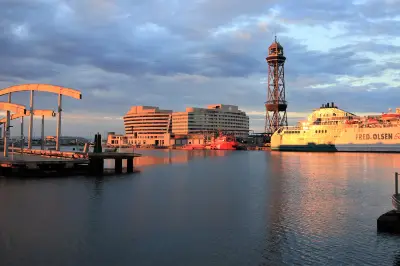
February 12 – Barcelona (Spain) 5 hours – Stay on the cruise
Park Güell – Sagrada Família – Camp Nou – Columbus Monument
Barcelona is the second-largest city in Spain after Madrid. Our familiarity with it probably comes from the Olympics. Barcelona's most famous attractions are its architecture. It is recognized by the architectural community as a city that perfectly combines ancient and modern civilizations. The works of art masters like Picasso, Gaudí, and Miró can be seen everywhere throughout the city. Gaudí's designs, with his romantic, open, and rich ideas, have been embedded in every brick and tile of the city for a hundred years. If you had time to stay for a few days, enjoying architectural beauty, Flamenco dancing, and—seafood rice and beer—how comfortable that would be! But the seafood rice we had in mind turned out to be undercooked seafood mixed rice—a cold shower.
The cruise itinerary only allowed us one full day. We had to visit Park Güell (also called Güell Park), which was originally a residential suburb commissioned by Count Güell from Gaudí, located on the northern outskirts of Barcelona. The residential project was never completed—in other words, it was abandoned—so it was turned into a park—Park Güell. The buildings in Park Güell represent Gaudí's mature period, fully expressing his aesthetic and creative ideas. We didn't enter through the front gate. After climbing the steps slowly, we came to a long colonnade formed by many irregular stone pillars stacked up. The stone bases under the pillars were designed as seats, each different, very unique, like a puzzle or free-form building blocks. The air in the park was fresh. Coconut trees and fat pigeons strutted everywhere, putting you in a good mood.
After exploring, we circled to the park entrance. The roofs of two small buildings at the entrance had many small towers and protrusions, very oddly shaped, covered with colorful broken ceramic tiles in strange patterns. These were originally the guardhouse and office designed by Gaudí, now popular backgrounds for photos.
From the park, we went to the Sagrada Família (Holy Family) Basilica, another church that has been under construction for many years and is still being built. Construction timelines are a feature of European churches! This was also designed by Gaudí, but unfortunately only less than a quarter was completed by his death. It incorporates Gaudí's style as well as Gothic and Art Nouveau styles. Unlike the churches we visited before, the first impression here was not of sacredness and oppression, but of eclecticism and colorful exuberance. Since multiple architects worked on it, different concepts from different eras and people are blended. Three facades show three different styles. One facade has colorful fruits (grapes, corn, etc.), another is typical Gothic, with the exterior carved with many Bible stories... It is said the interior is also rich. Tickets were about €15 or €20. We had no interest in paying to go inside—we had seen too many churches. These ticket sales support the ongoing construction, which is projected to be completed in 2030 (construction started in 1882).
Today's shore excursion did not include lunch. We had hoped to find a place to try Spanish seafood rice. But the local guide in Barcelona was a seasoned one who had been doing this for years. He still arranged a free lunch for us. I felt this Chinese meal had a promotional motive. Next to the restaurant was a shopping store typical of tour groups—likely one of those places where the Chinese restaurant gets a commission from purchases. The leather shoes and bags there were clearly more expensive than those in the street shops we saw on our own, and the brands were unknown. After all, there's no free lunch. We didn't buy anything, but we saw other tour buses bringing in tourists who complained about the high prices but still spent lavishly.
After the extra free Chinese lunch, the bus took us to the famous Gothic Quarter pedestrian street in Barcelona. Actually, they brought us here to continue seeing Gothic architecture, including Barcelona Cathedral, etc. But all the tourists in our group were extremely tired of churches, so we all dispersed to shop. The streets had many brand-name stores and small shops. It happened to be some kind of festival, so most shops were closed. Europe is so great—on holidays and weekends, all shops close, even if they lose money. Luckily, there was an event in the central square: a band playing and students in plaid skirts doing group dances—very lively, attracting many onlookers. Around the square were many stalls, like a temple fair, mainly selling handmade crafts and clothes at reasonable prices. It was crowded. Time was tight; I only had time to buy a backpack at a bag store before gathering time. Spanish local brand bags were very affordable, generally €20-50, with various styles.
Football fans couldn't miss Camp Nou. But among our group of 13, including elderly and children, only my husband was a true fan. The rest were just casual observers; most didn't even want to go, but the itinerary required it. Our little girl was tired and fell asleep on the bus, so I didn't get off to see Camp Nou. When my husband came back, he told me they could only go to the club shop for jerseys and souvenirs. Entering the stadium required a fee, about €20-something, to see the players' locker room, stands, etc., and there was a team history museum. Souvenirs were a bit expensive. Since the group were all fake fans, they just walked around and left.
The final stop was the Columbus Monument. Along the way, we took a detour to a viewpoint (I forget where), which was high enough to overlook Barcelona's city and on the other side the harbor, even our cruise ship.
In the afternoon, we had a good nap on the bus. After returning to the cruise, our little girl played in the Jacuzzi for a while before settling down.
February 13 – Marseille (France) 6 hours – Stay on the cruise
Aix-en-Provence – Basilique Notre-Dame de la Garde – Palais Longchamp
The cruise arrived early in the morning at Marseille, the second-largest city in France and a major port. Several large cruise ships were docked there. It was raining when we got off. The local guide was talkative. He took us first to the farther Aix-en-Provence. It rained the whole way, sometimes heavy, sometimes light. We passed the old port of Marseille, where many private yachts were moored—very beautiful.
After about 1.5 hours, we arrived at the famous Provençal town of Aix. Luckily, by then it had turned into a light drizzle. After the rain, the streets were quiet and peaceful. Strolling through the streets, watching the slow-paced life of locals in roadside cafes, I felt envious. Since it was the weekend, most shops were closed. We found a small supermarket and bought some local almond candy for our little girl. The candy was very pretty, and she loved it. A place like this—if you could stay for two days without visiting any attractions, just strolling leisurely—would be enough.
From the town, we returned to Marseille city. First, we had a Chinese lunch. Across the street was the old port, where we again admired the luxury of private yachts. Then we went to the Basilique Notre-Dame de la Garde, located on a hill. We had to climb dozens of steps to reach the basilica. My parents couldn't make it up because the steps were too high. Above the main building, there is a gilded statue of the Virgin Mary, 9.7 meters tall, said to be visible from any angle in Marseille, making it the city's symbol. Inside, we had seen too many churches to care. The view from the basilica overlooking all of Marseille was excellent. From another angle, we could see the famous Île d'If from the sea, made famous by Alexandre Dumas's novel. When the wind and waves are calm, you can buy a ticket from the old port to visit the island—should be interesting.
The last stop was the Palais Longchamp. This was the palace of Napoleon III, built above a reservoir to commemorate a water diversion project (similar to the Luanhe-Tianjin diversion). Actually, it felt like a water tower. Looking at it, I had a feeling of seeing a "Big Water Method" (like in the Old Summer Palace). The basic layout of the Palais Longchamp has a central group of sculptures and fountains, with two colonnades extending outward. At the end of each colonnade is a museum: one for fine arts and one for history. The overall style blends Baroque, Roman, and Oriental architecture. Under such a blue sky and white clouds, with no other tourists, every photo looked like a desktop background.
Back on the ship, we enjoyed the last sumptuous dinner. We packed our luggage, attached luggage tags, and left it outside the door before midnight. We could pick it up at the pier tomorrow morning after disembarking, saving a lot of effort. The most important thing was to settle all onboard expenses. I used the onboard account, which was convenient—I received payment notification immediately. The total including tips and some toys and snacks was €354 for the whole family.
February 14 – Depart Genoa – Monaco, Cannes, Nice (France) – Stay in Nice
Monte Carlo – Cannes – Nice Côte d'Azur / Bay of Angels
At 8:20 a.m., we were among the first group to leave the comfortable cruise ship. We were very reluctant. Our little girl said she wanted to take another big cruise; she had only played in the water (Jacuzzi and pool) twice and hadn't had enough.
The morning itinerary was relatively easy, mainly on the road. In fact, after disembarking in Genoa, we had to go back along the coast to France. The first stop was Monaco, about less than 3 hours away.
Monaco covers only 1.98 square kilometers, but it is a wealthy country with many billionaires. One reason is that its citizens pay no income tax. Having such a place in Europe attracts many wealthy people who want to join this country.
Monaco is surrounded by mountains on three sides and faces the Mediterranean on the fourth. The hillsides are densely packed with tall buildings. The streets are narrow and very steep. Although the country is less than 2 square kilometers, it has medieval-style streets and a palace, luxury hotels, a tropical botanical garden, an oceanographic museum, and many elite yachts in the port. The country has little industry; its economy relies mainly on tourism and banking, so it has no pollution. It had just rained when we arrived, and the air was exceptionally fresh and transparent. People live every day in an oxygen bar.
Monaco hosts the Formula 1 Grand Prix. My husband is a huge F1 fan. The unparalleled Monte Carlo city circuit here was a place he had always longed to see. The Monte Carlo circuit uses the very streets we walked on—they are closed for the race. My husband said this is one of the most challenging circuits in F1 because the streets are narrow and have many corners, with very few overtaking opportunities. The lap length is only 3.367 km, and the race has 78 laps. Only top drivers can win here—driver Ayrton Senna won here six times.
Climbing a small hill brings you to Monte Carlo. This building looks like a magnificent palace. On both sides of the square are hotels and cafes. The limited parking spaces in front are occupied by super expensive sports cars. We were only allowed to stop in the square for photos; there wasn't enough time to go inside. According to Monaco law, ordinary Monaco citizens are not allowed in, but tourists are welcome. You need to buy a ticket (maybe €10). On the side streets near the square, there were several designer clothing stores that looked very expensive. This should be one of the most expensive holiday resorts in the world.
Leaving Monaco, we drove directly to Cannes. We had a Chinese-Western buffet lunch on the way. Coincidentally, it was Valentine's Day. Besides tourists like us, there were many European couples dining at the restaurant.
Cannes is a town in the south of France, near the Mediterranean. It is a famous tourist destination in Europe, known for its beautiful beaches (about 3 km) and the Cannes Film Festival held every May. The Cannes International Film Festival takes place annually in May for about two weeks, with the top prize being the Palme d'Or. We went directly to the main venue of the film festival—the Palais des Festivals. One side faces the blue sea, and the other side is the Boulevard de la Croisette. Inside there are reportedly many movie screening halls; we didn't go in. We just took photos on the most famous red carpet outside. At this time, the red carpet looked a bit worn, without the luxurious feel you see on TV.
Cannes' beautiful seaside boulevard is wide and clean. On one side is the sandy beach and bay; on the other side are elegant old buildings like hotels, with some modern ones mixed in. During the film festival, Cannes' hotels are exorbitantly expensive and almost impossible to book unless you are a big star; otherwise, you have to rent a private yacht. The guide gave us plenty of time to enjoy the sunshine, sand, and sea. The sun was perfect today. It was the warmest time of the afternoon, and some Europeans on the beach were wearing short sleeves. Seagulls and pigeons gathered on the sand. Our little girl and several other children from the group fed the seagulls with bread, throwing pieces in the air that the seagulls caught precisely—they had a blast. The color of the sea lived up to the name "Côte d'Azur" (Azure Coast). With white waves raised by the sea breeze, it was incredibly beautiful. Although it was still a bit cool for the season, several group members couldn't resist taking off their shoes and wading into the sea, not caring that their pants got wet. On the shore, there were some recreational facilities for locals: slides, merry-go-rounds, and other children's rides. Our little girl spent €2 to ride a European carousel. Across the street, there were some shops. Since it was the weekend, most were closed. However, the cafes were open and almost full; many Europeans sat at outdoor tables drinking coffee and chatting, enjoying the warm afternoon sun.
From Cannes, we drove along the coast to our hotel in Nice for the night. Nice is a holiday paradise in the South of France, like Cannes. In summer, Europeans flock here to enjoy the clear blue waters of the Mediterranean and the unique sandy beaches. It is said that if you aren't suntanned after the holidays, you'll be laughed at. Our little girl had played so hard on the beach in Cannes that she fell fast asleep during the 30-minute drive. So when we arrived at the Bay of Angels in Nice, I had to stay in the bus holding her while she slept, missing out on Nice's sunshine, sand, and sea. But I could feel that by this time (5 p.m.), as the sea breeze picked up, the temperature had dropped significantly—there was a clear temperature difference.
After dinner, we checked into our hotel in Nice. It was an apartment-style hotel in the city center. The room had a microwave, induction cooktop, and simple kitchen facilities, which would be convenient for independent travelers. We went to bed early because we had to take an early high-speed train from Nice to Paris the next morning.
February 15 – Nice TGD6172 (6 hours) high-speed train to Paris – Stay in Paris
Notre-Dame de Paris – Louvre – Eiffel Tower (evening light show)
We took an early high-speed train at around 7 a.m., with a 6-hour journey, arriving in Paris around 1 p.m. We were asked to be at the train station by 6:30. Although the hotel was close to the station, we still had to get up early. We even missed the hotel's free breakfast; they packed us some food to go. Since it wasn't peak season, the train had less than one-third occupancy. The ticket price was listed as €89—not cheap.
Arriving in Paris, we suddenly shifted from Mediterranean to continental climate, from warm weather to winter chill. For the previous days, daytime temperatures were generally between 15-18°C, very comfortable. Especially around noon on shore days, a single layer was enough. In Paris, the maximum temperature suddenly dropped to 4°C, with a light wind making it feel very cold.
Today's highlight was the Louvre, which required a reserved time for the guide. Since we had some time, we first visited Notre-Dame de Paris, a paid optional tour. This cathedral on the Seine in central Paris was made famous by Victor Hugo's novel. The bell that Quasimodo rang is a point of interest. The building is tall and majestic, with two towers; inside one tower is the bell described in the novel. Inside, it is solemn and magnificent. There is a large rose window that casts colorful light into the church. At the front, there is an inconspicuous staircase leading to an underground archaeological crypt containing remains of the city from Roman times. We weren't interested, so we didn't go down.
At the Louvre, I felt that our visit was just a quick look. When I came to Europe years ago, the Louvre only had us see the Mona Lisa, the Venus de Milo, and the Winged Victory of Samothrace. Although the Louvre has hundreds of thousands of art pieces including sculptures and paintings, this time it was the same. It felt like a waste of the €15 ticket. The Louvre was originally a French royal palace, now a museum and the largest art treasure house. The glass pyramid in front was designed by Chinese-American architect I.M. Pei. It was controversial when built but later widely praised.
We queued to enter the Louvre. The guide gave each person an earpiece and spoke softly, so the environment was not noisy—much better than in Chinese attractions where tour groups compete with loudspeakers. The Louvre has many sections, including Oriental Antiquities, Egyptian Antiquities, Greek and Roman Antiquities, etc., and displays sculptures and paintings separately. Our whirlwind tour followed a fixed route: first to see the marble statue of Venus de Milo (missing arms), then the Winged Victory (missing head and arms), and finally da Vinci's immortal Mona Lisa. Along the way, the guide explained some key pieces. After leaving the Louvre, we took photos in the square with the pyramid and some triumphal arch whose name I forget.
After dinner, we went to the Eiffel Tower for the 7 p.m. light show. It is said that the tens of thousands of bulbs cost tens of thousands of euros in electricity per show, which lasts 5 minutes. It was especially cold and windy that evening. I held our little girl tightly, afraid she might get sick. After seeing the lights sparkle, I immediately went back to the bus. Though it was spectacular, our little girl's health came first.
Our hotel was not far from the city center. Because we traveled during the Spring Festival, the tour fee was relatively high, so the conditions were better than usual tours. We weren't staying in a suburban hotel. Often, thanks to the guide's privilege, our standard meal was upgraded from 6 dishes to 8 dishes—quite fortunate.
February 16 – Paris (France) – Stay in Paris
Palace of Versailles – Seine River Cruise – Shopping
Today we first went to the farther Palace of Versailles, located in the southwestern suburbs. We arrived early as one of the first groups when it opened, so there weren't many people. The palace covers over one million square meters, a large part being the gardens. The ticket was about €20. Since it's far from the city (the metro alone costs over €10), the €65 optional fee for this tour was not too expensive. The palace is magnificent and extravagantly decorated inside, with carvings, large oil paintings, and tapestries everywhere—well worth seeing. The Hall of Mirrors is a highlight: a long hall with luxurious crystal chandeliers on the ceiling, 17 large arched windows opening onto the garden on one side, and 17 mirrors corresponding to the windows on the other side. The ceiling is painted with huge oil paintings—very impressive. Another interesting fact: because of Louis XIV's personal preferences, there wasn't a single toilet in the palace. You have to wonder how people managed living in such luxury.
Outside, the French formal gardens feature creatively designed trees and flowers, with many fountains—but closed in winter.
Returning from Versailles to central Paris, we stopped for photos in front of the Eiffel Tower. Our tour did not include going up the tower. I had been to the second floor before—it just gives a higher view, but photos taken from in front are better, especially with clear skies and light clouds.
Just before lunch, we managed to take a Seine River cruise. I would have preferred a night cruise to see the illuminated buildings along the banks, but unfortunately... The cruise went up and down the Seine for about an hour. There was an audio guide in Chinese—showing the strong presence of Chinese tourists.
After lunch, we were free to shop until evening, when we gathered to go back to the hotel. We left my parents in a rest area at the mall. I found that shopping in Paris, which I had anticipated, turned out to be the most expensive place of the entire trip—not as good value as in Italy or Spain. The sales assistants all spoke Chinese. There was a dedicated tax refund area. Without Chinese tourists, this commercial district would probably go bankrupt. I needed to buy some chocolate and candies to give to friends and family back home, but they were more expensive here than on the cruise. Better to buy at the Istanbul airport.
Dinner wasn't included, but luckily there was a supermarket near the hotel. We bought some ingredients and cooked a comfortable dinner at the hotel. Then we packed our bags—tomorrow evening we would return to Beijing.
February 17 – Paris 18:20 – TK1828 (3h35min) – Istanbul 22:55
Arc de Triomphe – Place de la Concorde – Shopping – Airport – Return to Beijing
The Arc de Triomphe is at the western end of the Champs-Élysées. It is one of the four representative buildings of Paris (along with the Eiffel Tower, the Louvre, and Notre-Dame). During this European trip, we had seen several triumphal arches—they all looked similar. On the two pillars of the arch, there are four large reliefs representing Departure, Victory, Peace, and Resistance. Inside the arch are inscribed the names of over five hundred heroes from Napoleon's empire.
Then we went to the Place de la Concorde, on the north bank of the Seine. The square is octagonal, with an Egyptian obelisk in the center and large fountains beside it. The obelisk was a gift from the Egyptian governor to Charles V, covered with Egyptian hieroglyphs. Around the square, there are eight statues symbolizing the eight major cities of France. There is a park and a Ferris wheel nearby. We arrived early, and the Ferris wheel was being cleaned—each cabin was being washed. Our little girl wanted to ride it; the price was €8 or so (I don't remember exactly), but unfortunately it wasn't open yet. Standing in the center of the square, looking at the broad Champs-Élysées, you could see the Arc de Triomphe at the other end, as well as the Palais Bourbon and the Madeleine Church on either side.
After visiting these last two attractions, we had less than three hours to shop and have lunch. We were taken to the airport at a little past 1 p.m. Although our flight was at 6-something, we needed to go through tax refund etc., so it was better to have ample time. Paris airport is about an hour's drive from the city. Each checked bag had a weight limit of 23 kg. My large suitcase was just under that limit. The airport didn't feel very big; there were only a few duty-free shops. Probably because we were flying a short-haul flight to Istanbul, this area was small.
The flight was very punctual. Arriving at Istanbul airport, we quickly bought toys, chocolates, and candies for the child at very reasonable prices. The transfer time was too short; otherwise, this airport is well worth exploring.
February 18 – Istanbul 00:50 (Turkey time) – TK20 (9h15min) – Beijing 16:05
It was said to be over 9 hours, but we actually arrived an hour early. We slept through the flight and arrived smoothly at Capital Airport.



![Global Stroll [12] the Walk of the World Season 1 Episode 8 Spain](/img/d04fbd8776bb7ee8_s.webp?src=https%3A%2F%2Fdimg04.c-ctrip.com%2Fimages%2F01059120009be1xfy2D06_W_320_0_Q80.jpg)