A Blossom Among Europe's Renowned Cities - Barcelona's Many Delights (Part 1)
In May 2019, I traveled to Europe. The main purpose of this trip was to board the MSC Meraviglia (MS Seaview) cruise ship in Barcelona on May 18, and also to visit Spain and Portugal. After weighing the options, I chose a classic eight-day, seven-night Western Mediterranean itinerary, embarking and disembarking in Barcelona, Spain. The ports of call were Ajaccio (France), Genoa (Italy), La Spezia (Italy), Rome (Italy), Cannes (France), and Mallorca (Spain). These are all dazzling, renowned places along the Mediterranean coast, each with clear skies, transparent sunlight, blue waters, rows of yachts, wide promenades, beautiful scenery, rich culture, and tempting cuisine, all brimming with the unique charm of the Mediterranean.
To meet the cruise schedule, I split the overland tour of Spain and Portugal into two segments. So although this was my first visit to Spain, I ended up entering and leaving Barcelona three times. I knew this arrangement was not ideal, but it was the only option.
On May 5 at 2:00 AM, I took off from Beijing Capital Airport on a direct flight to Barcelona, Spain.
After nearly 12 hours of flight, the plane began to descend, and I could already see the port of Barcelona. More than ten days later, we would board the MSC Mediterranean cruise here to explore the enchanting Mediterranean.
Barcelona is a famous European city and the second largest city in Spain, older than the capital Madrid, with a history of over 2,000 years. Because of its unique historical traditions, charm, and developed industry, writers and poets call it the "Flower of Europe." With its pleasant Mediterranean climate, long beaches, and bright sunshine, the city is filled with flowers and trees all year round and has moist air. The great writer Cervantes praised it as "the most beautiful city in the world." The architectural masterpieces of the famous architect Gaudí fascinate architecture enthusiasts from all over the world; football fans also love its dynamism, wildness, and passion, going crazy for it.
Barcelona is the capital of the wealthy Catalonia region, a unique area with a history and culture quite different from the rest of Spain. Since ancient times, due to its excellent port environment, it has been a frequent hub for Mediterranean commerce. Being close to France, it has been deeply influenced by continental Europe, seeming more like the capital of Spain than Madrid.
Antonio Gaudí (June 25, 1852 – June 10, 1926) was born in the small Catalan town of Reus. Gaudí designed many works in his lifetime, including Park Güell, Casa Milà, Casa Batlló, and the Sagrada Família, among others. Seventeen of his works are listed as national monuments in Spain, and seven are UNESCO World Heritage sites. The Sagrada Família is his stunning masterpiece.
Outside the Sagrada Família, tourists gather in crowds. The Sagrada Família has long been an undisputed landmark and symbol of Barcelona, one of the most famous attractions in the world, like the Statue of Liberty in New York, the Eiffel Tower in France, or Big Ben in London. In November 2010, Pope Benedict XVI designated the church a basilica.
The Sagrada Família, also translated as the Holy Family Basilica, is located in the center of Barcelona. Construction began in 1882, and Gaudí took over the project in 1883, incorporating his own architectural style. When Gaudí died at age 73 in 1926, less than a quarter of the church was complete. Even today, it is still under construction, with conservative estimates suggesting completion around 2050, and the most optimistic estimates seeing the finished product by 2026. Although unfinished, it has been selected as a UNESCO World Heritage site.
The Sagrada Família has three grand façades: the Nativity Façade, the Passion Façade, and the Glory Façade, corresponding to three important events in Jesus' life. The main structure is based on Gothic style, with slender lines, and the spires and decorations on top, as well as the interior structure, reveal the designer's superior and unique approach. This is Gaudí's most important work and greatest building, the culmination of his life's effort, a symbol of his honor.
The 170-meter towers, colorful mosaic decorations, spiral staircases, and lifelike statues that seem to grow from the walls make the massive building appear very light, full of childlike charm, like a sandcastle built by children on the beach.
The towers of the Nativity Façade were built under Gaudí's supervision and are the first completed façade of the Sagrada Família. The theme is the birth of Christ, with detailed, realistic carvings presenting a joyful scene. The Tree of Life above the central gate also represents peace and hope. The Nativity Façade is also called the Façade of Life, Joy, or Christmas.
I walked around the cathedral, but no spot allowed me to capture its entire panorama.
On the Nativity Façade side, there is a small artificial lake where many tourists waiting for their visit rest by the shore. Visiting the cathedral requires advance booking in time slots; buying tickets on the spot is basically impossible. If you come to Barcelona and don't see the Sagrada Família, it's as if you never visited Barcelona.
The interior of the church is extraordinary. With nature as its theme, stepping inside feels like entering a forest. Stone pillars shaped like tree trunks rise up, with large joints carved on them. The "leaves" and "flowers" at the top adorn the ceiling. This is Gaudí's structural concept derived from trees. Sunlight streams through stained glass windows of various shapes, casting magical, changing light that amazes visitors.
The interior design of the Sagrada Família is a Latin cross, with a total of five aisles. The vault of the nave is 45 meters high, and the vaults of the side aisles are 30 meters high. His architecture is not just about bizarre shapes and bright colors; it contains scientific elements.
In the nave, above the four tallest central columns are the names of the four evangelists and their corresponding symbols.
Gaudí valued color changes greatly, once saying that color is the moving aspect of life. He designed stained glass windows of different shapes and colors, arranged according to direction. The east side is cooler, the west side warmer, creating different light and tones in the church.
The elevator to the top had a long line, allowing only eight people at a time; patience was required.
I don't know how high the elevator goes. After exiting, the space for visitors was small, like a corridor with safety nets, serving as a high-altitude observation point overlooking the city.
From the high vantage point, I could see many subtle details invisible from the ground: intricate decorations, various carved patterns, colorful mosaics. When asked why he was so meticulous at such heights where people below could not see, Gaudí replied, "The angels will see." From this, it's easy to appreciate that the Sagrada Família is a work Gaudí dedicated to God with reverence and passion, a life's work poured with all his heart.
One cannot stay long on the high observation deck. There is no elevator down; one must descend step by step along the spiral staircase. Looking down, the depth was unfathomable. After countless turns, even though going down, my legs were sore.
A portrait of Gaudí; he is buried in the crypt of the Sagrada Família. On June 10, 1926, Barcelona held a tram inauguration ceremony, and the whole city was jubilant. The tram, decorated with flags and flowers, started moving amid cheerful music and thunderous applause... Suddenly, the tram hit an old man! The old man was shabbily dressed and gaunt, and people thought he was just a beggar. He was taken to the hospital and died shortly after. Unexpectedly, an old woman recognized him as Antonio Gaudí. On the day of his funeral, the entire city of Barcelona came out to mourn and pay respects.
Gaudí can be called Barcelona's greatest architect and most distinguished citizen, the pride of all Spain. People call him a genius, a wizard, an eccentric, a prodigy—but no matter the title, it is the highest praise and accolade.
Gaudí's success is inseparable from the discerning eye and strong support of Eusebi Güell. As early as 1878, shortly after graduating from the School of Architecture at the University of Barcelona, Gaudí not only earned the title of architect but also met Eusebi Güell, who later became his patron and ally. Güell did not mind Gaudí's reserved character and eccentric temper, believing Gaudí was an architectural genius. He was convinced that "normal people often have no talent, but geniuses often seem like madmen." After Güell introduced Gaudí to Barcelona's high society, wealthy trendsetters asked him to design mansions and villas.
Their relationship was not simply that of artist and benefactor; it was a true friendship. Every novel idea of Gaudí's might seem utterly crazy to others, but it always elicited ecstatic reactions from Güell. Gaudí could fully unleash his imagination and express himself freely without worrying about financial constraints. The two complemented each other perfectly. Without Güell, it is hard to imagine Gaudí achieving such success later.
Located in the southeastern part of Barcelona, the Olympic Port was the center of the Olympic Village during the 1992 Barcelona Olympics and is now a new residential and water sports area. It is adjacent to the Municipal Sailing School, and the harbor is filled with masts and densely packed yachts.
The area of the Olympic Port was once old warehouses and factories, completely renovated for the Olympics. The warehouses and factories were removed, replaced by parks, green spaces, modern hotels, office buildings, and the beautiful Olympic Village.
It was only early May, but people were already eager to come to the beach for sports, leisure, and to enjoy the sun and sea.
The Olympic Port has many restaurants, and La Fonda Seafood Restaurant is quite famous.
Famous as it is, it attracts many diners.
Although there were empty seats inside, they were probably reserved. Locals start lunch after 2 PM. As for dinner, it's after 8 PM.
The restaurant is large, with a simple and elegant decor.
Many old photos hang on the walls, capturing the passing years and memories, also showing the restaurant's long history.
Above the counter hung Spanish hams.
The tour guide set a 40-euro per person set meal for us, a bit expensive, but with a wide variety of dishes and generous portions. Red wine and beer were unlimited, enough to go around.
Looking at the table next to us, ordering à la carte was just as good.
This was our first meal in Spain and the first in Barcelona—a true seafood feast, eating heartily and drinking freely.
Casa Batlló is a masterpiece from Gaudí's mature period. To be precise, Gaudí completely renovated the original building from 1905 to 1907. The building was originally funded by the industrialist Batlló. After renovation and expansion, Casa Batlló became a strikingly original apartment building, fully presenting Gaudí's magical natural style, echoing the then-emerging Art Nouveau movement that admired natural plant forms. It was listed as a UNESCO World Heritage site in 2005.
Descendants of Batlló still live in it. Unable to afford the entire building's high maintenance costs, they opened the ground floor, part of the second floor, the top floor, and two attics to visitors, using ticket revenue to maintain this precious heritage.
The entire building has six floors. Looking up, the most distinctive feature is the façade design. Gaudí used custom tiles and glass to cover the walls, creating a riot of colors, like scales shimmering in the sunlight. The whole façade is like a huge sculpture, every part and detail ingenious, unconventional, and unique.
The roof resembles dragon scales, full of magical charm. The protruding balconies look like masks, while the bone-like windows and supporting columns seem as if Gaudí molded them with his nimble hands like clay.
The interior follows Gaudí's consistent style, with no sharp edges, only soft, wavy shapes. The design is inspired by the Catalan legend of Saint George slaying the dragon to save the princess. When the building was completed, even Gaudí himself excitedly praised: "It looks like a house from heaven."
There were slightly fewer tourists here than at the Sagrada Família, but it was still crowded; we had to queue to enter.
Walking up the staircase that resembles a dragon's spine, we reached the main hall on the first floor, the highlight of the building, where the Batlló family once lived. It has its own entrance and staircase.
The interior doors, furniture, chandeliers, as well as the decorations on ceilings and walls, are unique and irreproducible, perfectly matching Gaudí's eccentric and novel style.
Throughout the main hall, modern-style artworks are everywhere. The ceiling has a large spiral shape, like a whirlpool, with an anemone-shaped chandelier at the center.
On the street side of the main hall, there are large floor-to-ceiling windows, varied and undulating like waves, with stained glass, offering views of Passeig de Gràcia.
On the other side, a door leads to a large terrace. At the terrace entrance, there is a pillar shaped like a human leg, leading to a modernist courtyard that provides outdoor space for various events.
The terrace floor is paved with colorful tiles, and the mosaic patterns on the opposite wall are also from Gaudí's design.
Usually, roof terraces of buildings are unremarkable, but in Gaudí's hands, they become varied and interesting, adorned with many bizarre, sculpture-like decorations, covered with colorful mosaic patterns. Inside, they actually contain chimneys and ventilation ducts. At night, they light up charmingly.
The souvenir shop inside the building.
The building management can take photos for visitors on the highest terrace.
The neighboring buildings on both sides of Casa Batlló are also beautiful, with equally exquisite, intricate, and pleasing decorations, though more conventional.
Casa Milà is another of Gaudí's masterpieces, not far from Casa Batlló on Passeig de Gràcia. Built between 1906 and 1910, it was the last residential building Gaudí completed, and is considered his most mature work of naturalism. In his words, it is "the most convincing work of using naturalism to embody romanticism and anti-traditional spirit in architecture."
The building's façade, roof, and decorations feature groundbreaking designs, and it was listed as a World Heritage site in 1984. From a distance, it looks very strange, even absurd. The whole building rises and falls unevenly, with undulating curves on the surfaces, no sharp edges or straight lines inside or out, paired with intricately crafted wrought iron balconies, creating a boundless sense of spatial flow. There is a small museum on the roof introducing Gaudí's architectural works with analysis, explanations, films, images, and many models explaining his use of mechanics.
On the roof of Casa Milà, there are oddly shaped protrusions. Some look like fully armored soldiers, some like mythical monsters, some like church bells, and some are even called "alien visitors." In fact, these are specially shaped chimneys and ventilation ducts, which Gaudí embellished into astonishing landscapes.
La Boqueria Market is the oldest market in Barcelona, located on the bustling La Rambla, and has become a must-visit attraction for tourists in Barcelona.
It is crowded with people, bustling and colorful; a dazzling array of goods fills the eyes.
Stalls display fresh fruits, vegetables, ham, seafood, and candies in orderly arrangements, colorful and dazzling, like a palette in Picasso's hands, all glowing with a pleasant luster.
Stalls selling Iberian ham, cheese, and seafood are always the most popular.
Some stalls also offer ingredient processing services. You can select your own ingredients. Paella and local tapas are quite popular.
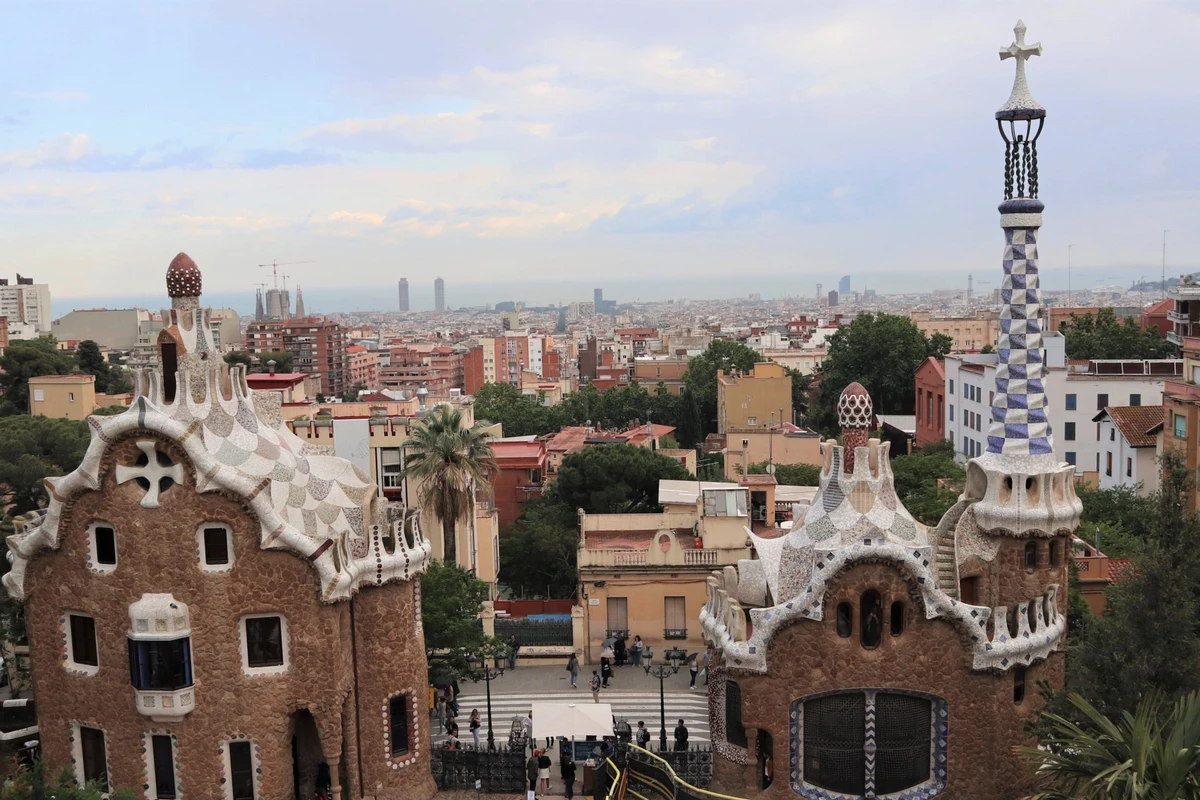
Park Güell, built between 1910 and 1914, is a paradise designed by Gaudí for his close friend Güell. With its unique environmental art, it has been recognized by UNESCO as a World Heritage site. However, it was not originally a park but a planned upscale residential area.
In 1900, Güell had a sudden idea to build a garden-style wealthy residential area. He bought a barren hill on the outskirts of Barcelona and commissioned Gaudí to design it. Gaudí lived up to Güell's expectations, giving full play to his artistic imagination and architectural style, successfully blending nature and architecture into a perfect whole, creating a poetic atmosphere. Whether in spatial form or light and color, from the whole to the details, everything is filled with charm and beauty. There are a columned central square, bridges, paths, and a long bench inlaid with colorful mosaics, winding and flowing. The whole park seems like a fairy tale world, like a giant art piece suspended in the air, amazing at every turn.
The buildings on both sides of the park entrance feel very lively and colorful. Their floor plan is oval with lovely domes. The exterior walls are built with stones and colorful mosaics, resembling candy houses in fairy tales.
A bronze plaque reads "Park Güell," named by Mr. Güell, who hoped to replicate a British-style residential area with shared public spaces. Güell understood the significance of Gaudí's architecture better than anyone of his time. The two had in-depth discussions on the technical aspects and symbolism of the future community. Beyond artistic value, Park Güell is also a typical example of the strong capital power of Barcelona's industrial elite in the early 20th century.
The park map shows that Park Güell is built on a hillside, an open space with a central axis from the gate, with buildings arranged on both sides. In fact, this area has an excellent location, pleasant environment, and panoramic views of the Barcelona plain and the Mediterranean. In the first few years, construction progressed smoothly. However, the complexity of land sales, the uniqueness of the community, and the inconvenient transportation at the time ultimately prevented the project from being fully realized.
Entering the gate, a grand staircase leads up to a hundred-column hall built into the hillside, with the roof of that hall forming the charming central square.
Going up the stone steps along the central axis, there is a famous mosaic fountain. The fountain consists of two separate sculptures: the front is the Catalan serpent fountain (a combination of a serpent and the red-and-yellow stripes of the Catalan coat of arms); behind is Gaudí's dragon, shaped like a giant lizard. All surfaces are made of mosaic tiles, bright in color and vivid in form. Besides being the park's mascot and treasure, they also serve important drainage functions. When it rains heavily, the lizard and chameleon's mouths spout water flowing down from the hundred-column hall, full of vitality.
The Catalan serpent fountain, some call it Gaudí's dragon.
Behind the colorful dragon fountain, there is also a large lizard sculpture, vivid in form. This colorful lizard is the park's mascot, much like the dragon is a mascot for the Chinese.
In Park Güell, one of the most prominent and striking features is the ubiquitous colorful mosaic collages. No matter where you go, you can appreciate the designer's spontaneous, colorful embellishments.
After passing the colorful fountain, you reach the hundred-column hall. Although called the "hundred columns," it is actually supported by 86 stone pillars, similar to the forest-like support structure in the Sagrada Família—a clear Gaudí style. The ceiling is undulating with tilted surfaces, all decorated with mosaic patterns.
The hollow columns not only support the roof but also have water drainage functions. If there is enough rain, the colorful fountains on the stairs leading to the candy houses will spray water.
The central square of the park, called Plaza de la Naturaleza (Nature Square) by Gaudí, or Greek Theatre, is Gaudí's masterpiece and the most brilliant part of the entire park. It efficiently uses space and handles functional details ingeniously. The most striking feature is the long bench, shaped like a dancing dragon or rolling waves, winding around the square, making it the most beautiful sight.
Every visitor must sit on the bench to feel the unique masterpiece of the architectural genius Gaudí and capture a beautiful memory. The seemingly hard seats were designed with ergonomics in mind, making them comfortable to sit on. The mosaic tiles look randomly placed, but each pattern is different and carries hidden meanings.
This longest bench in the world is actually the edge of the roof of the hundred-column hall. Gaudí integrated the wall and bench into one, covered with colorful ceramic tiles like lace trim, creating a rich visual experience and a lively atmosphere.
It is also an observation deck with wide views, overlooking the city of Barcelona (with the Sagrada Família clearly visible), the port of Barcelona, and the Mediterranean Sea.
Around the central square, on the undulating terrain, Gaudí designed unique corridors, like natural caves in the rock, some with two levels. Built among the trees, they wind and twist, providing shade in sunny weather and shelter from rain.
The columns are mostly modeled after animals and plants. Some are upright, but many are slanted. Some resemble elephant legs, some palm trees, and some human forms. All these pillars are made of local stone, appearing rough and rustic, yet seemingly natural.
Gaudí's former residence is located along the winding mountain path of Park Güell, hidden in the greenery. It is now a museum introducing Gaudí's life, displaying furniture designed by Gaudí and items he used.
As the designer of Park Güell, Gaudí lived and worked here for a full 20 years, from 1906 to 1926. Although the project eventually only completed the gatehouse, central park, viaducts, and a few auxiliary buildings (the "public facilities"), Gaudí's naturalistic architectural philosophy gradually matured and was fully demonstrated here, making it an extraordinary artistic creation. Now, thinking about it, if Güell had not had the whim to buy the land, and without Gaudí's whimsical, superhuman creativity, the world would have lost a precious cultural heritage.
Nothing in the world is perfect; there are gains and losses. From an architectural art perspective, Park Güell is a great achievement, but financially it was a major failure. Of the 16 plots of land planned for private residential construction within the park, only one was sold. After all, it was too far from the city center and too high in elevation. In 1914, Mr. Güell decided to abandon the project. After Güell's death, his heirs offered the unfinished community to the Barcelona City Council, which bought it in 1922 and opened it as a park to the public four years later.
Travel Journal Directory:
1. Sagrada Família
2. Spanish Seafood Feast
3. Casa Batlló
4. Casa Milà
5. La Boqueria Market
6. Park Güell
Travel Info
Hotel Index
Strategy Index
Ticket Index
Website Navigation
Travel Index
Cruise Index
Corporate Travel Index
Affiliate Cooperation
Distribution Alliance
Friendship Links
Corporate Gift Card Purchase
Insurance Agent
Agency Cooperation
Hotel Partnership
Destination and Attraction Partnership
More Cooperation
About Ctrip
About Ctrip
Ctrip Hot Topics
Contact Us
Careers
User Agreement
Privacy Policy
Business License
Security Center
Ctrip Content Center
Intellectual Property
Trip.com Group Algorithm Disclosure



![Global Stroll [12] the Walk of the World Season 1 Episode 8 Spain](/img/d04fbd8776bb7ee8_s.webp?src=https%3A%2F%2Fdimg04.c-ctrip.com%2Fimages%2F01059120009be1xfy2D06_W_320_0_Q80.jpg)