A Flower Among Europe's Famous Cities - The Joys of Barcelona (Part 2)
Barcelona is one of Europe's famous cities, but it is significantly different from many European cities and even cities in Spain. As the capital of the Catalonia region, it boasts unique charm and character, with masters like Gaudi and Picasso, its own history, culture, and language, and a distinct regional identity. It is a vibrant, enchanting place, praised as the 'Flower of Europe,' attracting tourists from all over the world.
Upon arriving in Barcelona, our first stop was the historic Gothic Quarter.
The Gothic Quarter is the heart of Barcelona's old town and the birthplace of the city, stretching from La Rambla to Via Laietana and from the Mediterranean coast to Ronda de Sant Pere. Centered around the Barcelona Cathedral, many buildings here date from the Middle Ages, featuring a strong Gothic style.
Barcelona Cathedral, the seat of the Archbishop of Barcelona, was built between the 13th and 15th centuries, with the main work completed in the 14th century.
The Neo-Gothic main façade was designed in 1408 but was only finished in the late 19th century, making it a relatively new part of the church. The exterior of the church is simple, decorated only with vertical buttresses.
The interior includes magnificent Gothic and Baroque altars, a baptismal font, the tomb of Saint Eulalia, and side altars with stained glass windows that brighten the interior.
The square in front of Barcelona Cathedral is bustling with tourists. A flea market is held here every week, and on weekends, it's a place where locals perform traditional dances.
The Gothic Quarter preserves a labyrinth of narrow streets, filled with squares, churches, and tourists. It is dotted with cheap hostels, lively bars, unique restaurants, and charming boutiques. The combination of ancient, historical spaces with trendy, modern goods makes it perfect for a leisurely stroll.
However, our initial exploration of the Gothic Quarter was brief and superficial. We didn't delve deep, only making a short stop in front of the cathedral before heading to Plaça de Catalunya.
Passing by a chocolate shop, the 'Spanish churros' made us stop. Although we have them in our home country, this is the place of origin, so we had to try them.
Plaça de Catalunya is a large square in the center of Barcelona's old town, where several major streets converge. Covering an area of 50,000 square meters, it is famous for its fountains and sculptures, and flocks of pigeons are also a sight here.
On one side of the square, a large crowd had gathered. Bright flags were fluttering in the wind, some with double-headed eagles, others with sickles and hammers and Russian text. Some people were wearing Soviet uniforms from WWII, and some even had helmets on. The guide mentioned that they might be Russian immigrants (or expatriates) celebrating Victory Day (May 9).
Children, even very young ones, were also wearing military uniforms, holding photos and waving flags. The old photos appeared to be of their ancestors who fought in the war. It was clear that these children were being raised with patriotism and heroism.
An old Volga car, reminiscent of the models that appeared in China in the early 1960s.
Monumento Francesc Macià - the main body of the sculpture is an inverted, incomplete staircase. This Francesc Macià was the so-called 'first president' of Catalonia, who founded a Catalan political party in 1931 and declared independence.
The square is also a stop for tourist buses.
The famous La Rambla, between the Gothic Quarter and El Raval, serves as a natural boundary between the two districts. It is a bustling tree-lined boulevard in the city center, connecting Plaça de Catalunya with Barcelona's old port. The boulevard is 1.8 kilometers long and is conceptually divided into five distinct sections.
This street is hailed as 'the most beautiful avenue in the world.' Every day, you can see endless streams of tourists and locals strolling along. The street is lined with newspaper kiosks, flower shops, and food stalls, as well as numerous bars and cafes. The palaces and architectural monuments nearby are a feast for the eyes. Walking along La Rambla, you can experience the most authentic Spanish life.
This most beautiful tree-lined avenue in Europe is no less impressive than the Champs-Élysées in Paris, making it a must-visit in Barcelona. A famous Spanish poet once said that La Rambla is 'the only street in the world I hope never ends.' The Chinese scholar Yu Qiuyu called it the 'Street of Wanderers,' where street performers from all over the world, speaking different languages and from different ethnicities, gather to perform, showcasing the essence of street art to the fullest.
Look at these old guys, relaxed and carefree, basking in the sun, enjoying the view, chatting—most likely locals.
The Canaletes Fountain. Legend has it that anyone who drinks from this fountain will return to Barcelona. Since the 1930s, it has also been a place for FC Barcelona fans to celebrate victories.
Intersecting La Rambla are many small streets and alleys that extend outward. Many of these alleys are very interesting, with as many tourists as the main boulevard, especially on the Gothic Quarter side. To explore them all would take at least a whole day.
The Boqueria Market on La Rambla is Barcelona's oldest market. Today is Sunday (May 5th), so the market is closed as usual.
During three visits to Barcelona, we stayed at different hotels. The third hotel was right on La Rambla.
Eurostars Ramblas - the entrance is unremarkable, but its location is excellent, convenient for shopping, dining, and close to the old port, just a few minutes' walk away.
On the boulevard, there are many human statues; taking photos with them costs money.
Occasionally, you see street vendors and homeless people. Although it seems a contrast, it's understandable—this is the normal, real-life scene.
Seeing this tall building marks the end of La Rambla; beyond it is the Columbus Monument.
The Columbus Monument towers into the sky.
The Columbus Monument is at the end of La Rambla. It was built in 1886 to welcome the Universal Exposition and to commemorate Columbus's voyage around the world. Made of reddish marble, it stands about 60 meters tall. The column is carved with five goddesses flying in the air, and bears the inscriptions 'Glory to Columbus' and 'Tribute to Columbus' in large Spanish letters.
At the top of the monument, a 7-meter-tall statue of Columbus looks out toward the sea.
The base is decorated with multiple relief sculptures and large relief panels, likely telling the story of Columbus and his voyages.
Eight stone lions guard the base of the monument.
The monument is surrounded by a roundabout. Along the roadside, several imposing buildings with elaborate façades and statues on top are mostly government offices, such as the Customs and Tax Office and the Port Authority.
Walking south to the end of La Rambla brings you to Barcelona's seaside area—Port Vell (Old Port), also known as Port de Bell. The Columbus Monument is the most iconic landmark of the old port.
Port Vell faces the deep blue Mediterranean Sea and features a large shopping center at sea and various entertainment facilities. Before the 1992 Barcelona Olympics, the city began an urban renewal plan, and the old port was transformed. It has now become a modern water entertainment center, attracting many tourists.
It is said that the old port dock is most charming at sunset.
The old port is the base for two yacht clubs. The harbor is filled with yachts from wealthy people around the world—white boats of various sizes, with tall masts densely packed, creating a spectacular sight.
A beautifully shaped wooden boardwalk extends from the Columbus Monument to the Maremagnum shopping center in the middle of the harbor. It forms a natural extension of La Rambla and is called 'La Rambla de Mar.' The wooden bridge has many benches, making it a great place to get close to the sea, take a leisurely walk, and enjoy the sunset and night view.
As mentioned earlier, on our third visit to Barcelona, our hotel was on La Rambla. Stepping out of the hotel, we were right on the boulevard, so convenient that it was hard not to go for a stroll.
After a day of sightseeing, we returned to the hotel to recharge and then went out to find dinner, taking the opportunity to explore La Rambla in the evening. It was sunset, and the tops of the buildings were gilded with a touch of gold, making La Rambla even more charming.
In the semi-backlit lens, the bustling crowd moved about, and the evening boulevard was still lively.
We passed by an ice cream shop that opened in 1820. The sweet and tempting ice cream, combined with its long history, made the ladies eager to go in. Since it was still light out, I suggested we take a walk first and come back for ice cream later.
A narrow alley intersecting La Rambla, on the Gothic Quarter side, caught our attention with a medieval building. The tall brick tower looked like a church. We walked forward, now able to appreciate the small streets and alleys of the Gothic Quarter in detail.
Upon checking, we found this was the Basilica of Santa Maria del Mar, dedicated to Our Lady of the Sea. It was built by local fishermen who prayed for safe voyages. This is a 14th-century Roman Catholic Gothic church located on Plaça del Mar in the Gothic Quarter, built between 1329 and 1383, with distinct Catalan architectural features. Many guilds near the church also participated in its construction, and their emblems can be found on the main portal.
The façade of the church is simple and austere, with a pursuit of perfect symmetry, soft lines, and harmonious layout. Concerts are sometimes held inside, allowing visitors to experience the wonderful acoustics created by the architecture.
We returned to the 200-year-old ice cream shop, only to find it had already closed, leaving the ladies deeply regretful. A nearby shop was still open, with many customers pointing and choosing.
Lights were already on along La Rambla, and the number of tourists hadn't diminished. Many people had already taken seats in the restaurants.
At the end of La Rambla, we glanced down Columbus Avenue next to the old port. Tall palm trees lined the avenue, and there were far fewer vehicles and pedestrians.
Near our hotel, we found a Spanish tapas restaurant and ordered a few dishes. The food was average and a bit pricey.
At a neighboring table, a group of locals were drinking. About a dozen burly men, flushed with alcohol, were shouting and getting excited from time to time. Perhaps this is the Spanish way of life. It is said that romantic Spaniards often hop between several bars in the two to three hours between work and dinner, ordering a few snacks and drinks, chatting happily. Tapas in Spain is not just a type of food; it's a lifestyle concept: convenient, casual, hedonistic... In their view, life should be like this.
Early in the morning, I went out for a short walk. Taking advantage of the convenient location, I chose to go to Port Vell, just a few steps away, to watch the sunrise at the beach.
From afar, I saw thick clouds over Port Vell. The tall Columbus Monument appeared as a silhouette, with Columbus standing tall, pointing toward the Americas.
I quickened my pace, almost jogging along Columbus Avenue. The eastern sky was already glowing red with the dawn, a brilliant display of colors.
The timing was perfect—the best moment for viewing.
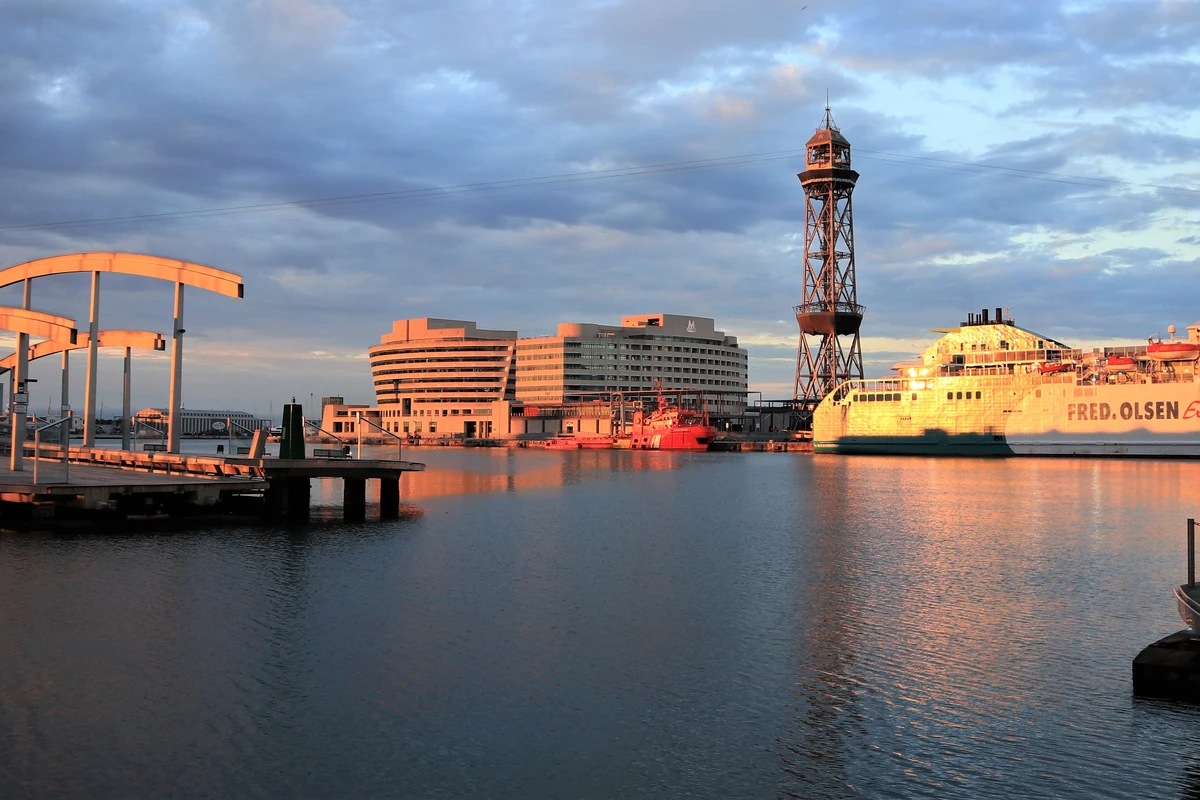
The distant buildings were bathed in golden sunlight, with reflections shimmering on the water.
The clock on top of a building showed 6:20. To see the sunrise, you have to get up early.
Barcelona Wax Museum - Museu de Cera de Barcelona.
At this time, La Rambla was still asleep, unusually quiet and almost empty.
Plaça Reial is located in the Gothic Quarter. It was once the palace of the Counts of Barcelona and the Kings of Aragon, and during the Middle Ages, it became the central square of the Aragonese palace, used for important events. Today, it is still a gathering place for major Barcelona festivals, such as La Mercè and New Year's celebrations.
The buildings surrounding the square were built on the site of a former Franciscan monastery, with generally consistent architecture. Some of the buildings still bear symbols related to voyages and exploration of the Americas.
Plaça Reial is one of Barcelona's liveliest squares, buzzing with activity all year round. The square is filled with bars and restaurants, and countless stalls selling old books, niche antiques, and handicrafts. Every Sunday morning, a stamp and coin market opens here.
In the center of the square is a sculpted fountain, surrounded by palm trees.
There are several street lamps designed by Gaudi in the square. It is said these were Gaudi's first commission after obtaining his architecture license. The helmet-shaped design already shows his unique style.
At night, Plaça Reial becomes even more lively, home to several famous bars in Barcelona.
Around the square, tall, spacious porticoes are filled with tables and chairs, perfect for the many Europeans who enjoy dining outdoors.
On May 24, after an exciting Mediterranean cruise, we disembarked at the Barcelona cruise terminal, arriving in Barcelona for the third time.
Our post-cruise itinerary was handled by another local agency. A very capable guide named Mr. W picked us up as arranged. When he learned we had already been to Barcelona, he asked during the slow drive what else we wanted to see, which felt very considerate.
Along the way, I snapped a few street views.
This is Columbus Avenue near the old port.
The famous sculpture 'El Peix' (The Fish) near the Port Olímpic was designed by the renowned American architect Frank Gehry in 1992. It is about 54 by 35 meters, made of intertwined golden stainless steel strips, forming a large leaping 'goldfish' with a unique structure.
The 1992 Olympics sparked a construction boom in Barcelona, with many new buildings, the renovation of old neighborhoods, and original sculptures erected everywhere. International masters also contributed, turning this medieval port city into a trendy, leisurely, and modern holiday destination.
The sculpture 'The Face of Barcelona' near the old port is 15 meters high, made of brightly colored tiles, extremely eye-catching. It was designed by pop artist Roy Lichtenstein.
Montjuïc is a small hill covered with lush trees in the southwest of Barcelona. It is now a central park, with a peaceful environment and fresh air, ideal for relaxation and exercise.
With its elevated position, it is also a great spot for panoramic views of Barcelona.
The cruise terminal is close by. We could clearly see our cruise ship, the MSC Seaview. The Port of Barcelona is a must-stop for Mediterranean cruises. Cruise passengers must come ashore to see the charm of this famous European city.
Zooming in, the towering spires of the Sagrada Família stand proudly, reaching toward Gaudi's vision of heaven.
The park also has a cable car for visitors to go up and down the hill.
The Olympic Stadium is also on Montjuïc. It was the main venue for the 1992 Barcelona Olympics, hosting the opening and closing ceremonies as well as track and field events.
The streamlined torch tower is right next to the north gate of the stadium. During the 1992 Olympics opening ceremony, Antonio Rebollo shot a flaming arrow to light the Olympic cauldron, a spectacular ceremony that amazed viewers worldwide. Since then, every Olympics has racked its brains to design unique and surprising lighting methods.
This needle-like building is the symbol of the Olympic Village.
Near the Olympic Stadium are attractions such as the National Art Museum of Catalonia, the Magic Fountain, the Joan Miró Foundation, and the Poble Espanyol (Spanish Village).
The National Art Museum of Catalonia is one of Barcelona's most important museums. It has sections for Romanesque art and Gothic art. The former houses a comprehensive collection of murals and wood carvings found in the Pyrenees, making it the largest collection of Romanesque art in Europe. The latter boasts many splendid religious paintings from the Gothic period.
The National Art Museum of Catalonia stands on an elevated position, built into the hillside, imposing in scale. Looking down from in front of the museum, you see the famous Plaça d'Espanya.
Along the axis, from near to far: four tall columns symbolizing Catalonia. In 1928, they were demolished by order of the dictator Primo de Rivera. They were re-erected at the end of 2009. In front of the columns is the striking Magic Fountain. Further ahead, two brick-red square pillars resemble the campanile of St. Mark's Square in Venice, called the Venetian Towers. Finally, there is a large marble group sculpture.
Going down the high steps, sculptures, fountains, and pools are arranged in order, descending level by level. The trees along the sides are trimmed into neat squares, typical of European garden style.
The Magic Fountain is a project from the 1929 Barcelona International Exposition and has been preserved to this day. During its shows, it constantly changes colors and shapes, especially after nightfall, with lights twinkling, colors dazzling, and water jets dancing, creating a beautiful spectacle—hence the name 'Magic Fountain.'
At the bottom level, looking up at the National Palace of Art, the building appears even more majestic against a backdrop of a huge waterfall.
The high steps decorated with blue and yellow tiles on both sides are also a sight. Our car was parked at the top, so we had to climb up step by step.
Plaça d'Espanya was designed in 1915 and built in 1929 for the International Exposition. This site was once used for executions, but the gallows were removed around 1715 when a castle, now demolished, was built.
Our car drove past Plaça d'Espanya. We couldn't stop there, so we just glimpsed it and snapped a few street views. The arcaded building on one side of the square is the Barcelona Convention Centre.
Passing through the Venetian Towers, the iconic giant sculpture stands directly in front of the square. It has three marble faces with exquisite carvings and many figures, with a petal-shaped pool at its base.
Next to the square is a prominent circular building—the former bullring. Its exquisite red brick exterior and red-and-white arched doors have a strong Moorish style. After bullfighting was banned in Barcelona, it was converted into a shopping mall, but the original exterior was preserved. Climbing to the top of the bullring offers a great viewpoint.
If time permits, it would be ideal to explore Plaça d'Espanya and its surroundings on foot. But perfection is rare, especially in this kind of free-and-easy foreign travel. It's impossible to plan everything in advance, and leaving some regrets is almost inevitable. Moreover, after three visits to Barcelona, we had basically covered all the important places. Tomorrow, we have a niche tour to the small coastal town of Tossa de Mar, a Catalan town on the Costa Brava, adding a final brilliant touch to our Barcelona trip.
Travel Directory
1. Gothic Quarter
2. Plaça de Catalunya
3. La Rambla
4. Columbus Monument
5. Port Vell
6. Evening Street Scene
7. Dinner
8. Harbor Morning
9. Plaça Reial
10. Olympic Stadium
11. Montjuïc Park
12. Olympic Main Venue
13. National Art Museum of Catalonia
Tourism Information
Hotel Index
Itinerary Index
Ticket Index
Website Navigation
Travel Index
Cruise Index
Corporate Travel Index
Join Us
Distributor Alliance
Friendship Links
Corporate Gift Cards
Procurement
Insurance Agency
Agency Cooperation
Hotel Franchise
Destination & Scenic Spot Collaboration
More Collaborations
About Ctrip
About Ctrip
Ctrip Hot Topics
Contact Us
Careers
User Agreement
Privacy Policy
Business License
Security Center
Ctrip Content Center
Intellectual Property
Trip.com Group Algorithm Disclosure


![Global Stroll [12] the Walk of the World Season 1 Episode 8 Spain](/img/d04fbd8776bb7ee8_s.webp?src=https%3A%2F%2Fdimg04.c-ctrip.com%2Fimages%2F01059120009be1xfy2D06_W_320_0_Q80.jpg)