
Barcelona and Mediterranean Cruise Journey
DAY1 (Sep 26) Depart from Beijing at 02:30 Beijing time on flight CA845, arriving at Barcelona at 8:15 local time. In the morning, explore the area around the hotel or visit the aquarium; in the afternoon, rest at the hotel; in the evening, go to Barceloneta Beach.
DAY2 (Sep 27) Hire a car from the hotel at 9:30 a.m. to visit Sagrada Família, Park Güell, Casa Milà, and Casa Batlló.
DAY3 (Sep 28) Hire a car from the hotel at 9:30 a.m. to visit the Gothic Quarter, Plaça de Catalunya, Barcelona Cathedral, La Rambla, and La Boqueria Market; in the afternoon, visit Plaça d'Espanya and Barceloneta Beach.
DAY4 (Sep 29) In the morning, visit La Rambla; check out at noon and take a taxi to the cruise terminal, boarding the Royal Caribbean Brilliance of the Seas to depart from Barcelona port, starting an 8-day, 7-night Mediterranean cruise.
DAY5 (Sep 30) NICE (VILLEFRANCHE), FRANCE
DAY6 (Oct 1) PORTOFINO, ITALY
DAY7 (Oct 2) Livorno (23 km from Pisa), visit the Leaning Tower of Pisa.
DAY8 (Oct 3) ROME (CIVITAVECCHIA), ITALY (88 km from Rome)
DAY9 (Oct 4) AMALFI COAST (SALERNO), ITALY
DAY10 (Oct 5) Cruise at sea.
DAY11 (Oct 6) Return to Barcelona port at 6:00 a.m., then depart from Barcelona on flight CA846 at 11:25 a.m.
DAY12 (Oct 7) Arrive in Beijing at 4:15 a.m.
2020 was truly a very special year. All overseas travel plans for the following years were canceled. Staying at home, looking at countless travel photos stored on the computer, they are all full of beautiful memories.
From September 26 to October 7, 2019, our family took advantage of the National Day holiday to embark on a 12-day Barcelona and Mediterranean cruise journey. Every time the whole family travels, we choose a cruise. This trip began planning in February 2019: booking flights, cruise tickets, and hotels. With the three main orders completed and a visa obtained, we were ready to go. The travel plan included a three-day stay in Barcelona, followed by boarding the ship at Barcelona port for an 8-day, 7-night Mediterranean cruise.
On September 26, 2019, at 02:30 Beijing time, we took flight CA845 from Beijing and arrived at Barcelona at 8:15 local time. In the morning, we dropped off our luggage at the hotel, then went to the Columbus Square opposite the hotel and had lunch at the shopping center on the adjacent pier. Afterward, we visited the aquarium. In the afternoon, we returned to the hotel to rest. In the evening, we went to Barceloneta Beach.
On the night of the 25th at 10:00 p.m., we left home and arrived at Beijing Capital Airport at 11:00 p.m. to check in. The tickets from Beijing to Barcelona were booked with Air China in February 2019, six months in advance. The adult ticket price was 6,556 RMB per person, and the child ticket was 5,566 RMB.
Waiting to board the flight to Barcelona, the child couldn't hold on and fell asleep in the waiting hall around 12:30 a.m.
On September 26, at 02:30 Beijing time, we took flight CA845 from Beijing and arrived at Barcelona Airport at 8:15 local time.
Barcelona, bordering the Mediterranean Sea, is the second-largest city in Spain and the capital of the autonomous community of Catalonia.
Before the trip, we booked a private car on Ctrip to pick us up at the airport. Since we were a group of five, a regular taxi would have been overcrowded. The driver was from Fujian, had lived in Barcelona for seven or eight years, and spoke Spanish. He accompanied us for the next two days in Barcelona.
After picking up our luggage, we drove to the hotel. The airport is about 17 km from the hotel, taking less than half an hour to reach.
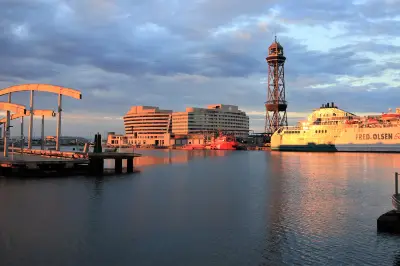
The hotel was also booked on Ctrip. Due to the National Day holiday in China, the hotel was more expensive than usual. The round building was our hotel, Eurostars Marítimo. It is located at the port of Barcelona, very close to Columbus Square. The pier on the right side of the photo is a commercial center where we had dinner every evening.
Eurostars Marítimo Hotel has an excellent location. It is situated on an artificial pier, surrounded by the sea on three sides, directly facing Columbus Square and La Rambla. To the right of the photo is the cruise terminal with many ships docked; to the left is the beach, shops, and dining areas.
Hotel room view.
Hotel rooftop lounge area.
Panoramic view of Barcelona from the hotel rooftop.
Pier and shopping center.
Just outside the hotel, we saw a ticket booth for the tourist sightseeing bus. The buses come in four colors, representing four loop routes covering various attractions in Barcelona. Further ahead is Columbus Square.
We arrived at the hotel around 10:00 a.m. Since the rooms were only available after 2:00 p.m., we completed the check-in procedure, left our luggage, and walked to Columbus Square not far from the hotel.
Columbus Monument.
Located 550 meters from our hotel, at the end of La Rambla near the port of Barcelona, the Columbus Monument was built in 1886 for the Universal Exposition and to commemorate Columbus's circumnavigation of the globe. Made of ocher marble, the monument is about 60 meters high, topped with a 7-meter statue of Columbus overlooking the Barcelona port.
The monument features five flying goddesses and inscriptions in Spanish reading "Glory to Columbus" and "Tribute to Columbus." Eight stone lions guard the base.
Barcelona Maritime Museum, next to Columbus Square, is right in front of our hotel—a must-pass every day.
The sailing club in the bay beside the hotel.
Flea market in front of Columbus Square.
The Barcelona city sightseeing car in front of the hotel comes in different colors for different routes. This time, we mainly hired a private car, so we didn't use the sightseeing bus.
At noon, we had lunch at the Maremagnum shopping center on the pier next to the hotel.
A must-try in Spain: Spanish paella.
View of our hotel, Eurostars Marítimo, from the pier.
Walking along the coast from the hotel to Barceloneta Beach, there were many activities.
Barceloneta Beach offers numerous activities. The beach is backed by the city center, with seafood restaurants, bars, and pavilions everywhere.
Handstand—thrilling enough!
There are many exciting activities at Barceloneta Beach. The Ferris wheel spins very fast—too thrilling for us to try.
On the way to Barceloneta Beach, we tried some local ice cream.
Barceloneta Beach is now one of the most popular beaches in Barcelona, the most exquisite among them, with various bars and restaurants. In summer, it is often crowded. The beach is a triangular area formed by alluvial sand from the sea. In the 17th century, the Barcelona dock began to be built in this area. In the mid-18th century, after re-planning and construction, the small Barcelona area became filled with Baroque colors. The Marítim Palace, converted from a warehouse, now houses the Museum of the History of Catalonia.
Barceloneta Beach.
The private car and driver-guide booked in Beijing picked us up at the hotel lobby at 9:30 a.m. to visit Sagrada Família, Park Güell, Casa Milà, and Casa Batlló.
Hotel breakfast.
Hotel breakfast.
Hotel breakfast: Spanish churros dipped in chocolate, Spanish sausage, and dried apricots—must-try local snacks in Spain.
Sagrada Família is 3.58 km from the hotel. The Basílica i Temple Expiatori de la Sagrada Família, also known as Sagrada Família, is a large Roman Catholic church in Barcelona, Catalonia, Spain, designed by Catalan architect Antoni Gaudí (1852–1926).
Construction began in 1882; Gaudí took over in 1883, incorporating his architectural style, Gothic, and Art Nouveau. He devoted his later years to the church and died in 1926 at age 73, with less than a quarter completed. Progress was slow, relying on private donations and ticket sales, and was interrupted by the Spanish Civil War. By 2010, half was complete, but major challenges remained. It is expected to be finished in 2026, the centenary of Gaudí's death.
Sagrada Família has long been controversial: doubts about Gaudí's design, concerns that posthumous construction might deviate from his intentions, and the impact of a high-speed rail tunnel between Spain and France on the church's stability. Nevertheless, it has become an iconic Barcelona landmark.
In October 2018, it was revealed that the church did not have a building permit from the Barcelona City Council, resulting in a fine of 36 million euros (about 280 million RMB), payable over 10 years.
We arrived at Park Güell and found a parking spot.
Park Güell entrance.
Park Güell is 5.62 km from the hotel. Also known as Parc Güell, it was originally a housing estate designed by Gaudí for Count Eusebi Güell, built from 1900 to 1914. It is a UNESCO World Heritage Site. In 1922, the city bought it and opened it as a public park.
Leaving Park Güell around noon, we asked our guide to recommend a local Spanish restaurant.
Neighboring table guests were American tourists, very talkative. They chatted with us and asked many questions.
The guide joined us for lunch. We asked the American tourists to take a group photo of us.
After lunch, we went to the next stop—Casa Milà.
Casa Milà, located at 92 Passeig de Gràcia in the Eixample district of Barcelona, was built between 1906 and 1912. It is the last private residence designed by Gaudí, covering 1,323 m², with 33 balconies, 150 windows, three light courts, six floors, one attic, one underground parking, and three façades.
Casa Milà rooftop.
Casa Milà rooftop.
Leaving Casa Milà, we went to Casa Batlló.
Casa Batlló (1904–1906) is a renowned building designed by Gaudí, famous for its bizarre shape, a classic in architectural history, and a representative of Catalan Modernisme. It is one of Gaudí's most completed works of naturalistic style. Located in Barcelona, it has six floors. It was designated a UNESCO World Heritage Site in 2005.
View of the street from a window of Casa Batlló.
Leaving Casa Batlló.
Since the private car service was good yesterday, we decided to book another car on Ctrip for today. The car picked us up at the hotel at 10:00 a.m. In the morning, we visited Plaça de Catalunya, La Rambla, and La Boqueria Market; in the afternoon, Plaça d'Espanya and Barceloneta Beach.
Plaça de Catalunya is 2.05 km from the hotel.
Plaça de Catalunya is a large square in central Barcelona, where several important streets meet. It covers 50,000 m², known for its fountains and sculptures, and flocks of pigeons.
Plaça de Catalunya is a major square in the old city center of Barcelona, a hub for shopping, entertainment, and transportation.
There is a kiosk selling pigeon food—sunflower seeds, 2 euros per pack.
Surrounded by high-rise buildings, shops, and various restaurants and bars. The square covers 50,000 m², featuring fountains and sculptures, and many pigeons.
Plaça de Catalunya.
Plaça de Catalunya.
Gothic Quarter (El Gòtic or Barri Gòtic).
The Gothic Quarter is the center of the old city of Barcelona, stretching from La Rambla to Via Laietana, and from the Mediterranean coast to Ronda de Sant Pere. It is the birthplace of Barcelona and the area with the most concentrated attractions. Many buildings date from the Middle Ages, some even from Roman times. Remains of the Roman walls can still be seen. The medieval Jewish quarter El Call is also here. The old cathedral and royal palace are still in use. The Gothic Quarter retains its intricate street plan with many small streets and squares, and is perfect for walking.
Gothic Quarter square—reportedly a painting by Picasso.
Barcelona Cathedral is 1.43 km from the hotel. Some young people sit in front of the cathedral in the old town.
Barcelona Cathedral is one of the most iconic buildings in the city. The main structure is in Gothic style, with slender lines as a key feature, while the dome and interior show Neo-Gothic style.
The Parliament of Catalonia is located in the Gothic Quarter. A journalist is doing a program.
Drinking fountain on La Rambla.
Leaving the Gothic Quarter, we went to La Boqueria Market.
La Boqueria Market.
Located on La Rambla, La Boqueria Market is the oldest market in Barcelona and a popular spot for locals to buy fresh ingredients. It's a true "food paradise" with stalls displaying fresh fruits, vegetables, ham, seafood, and sweets in an orderly and colorful manner, like a palette in Picasso's hands. Vendors enthusiastically attract passersby. Iberian ham, cheese, and seafood stalls are always popular. Some stalls also offer food preparation services. Paella and tapas are particularly popular.
La Boqueria Market.
La Boqueria Market.
We had lunch here.
Lunch at La Boqueria Market.
We had lunch at this restaurant in La Boqueria.
After lunch, we went to Plaça d'Espanya.
Plaça d'Espanya is 3.50 km from the hotel. Although not as grand and authentic as Madrid's Plaza de España, it occupies an important location in Barcelona, second only to Plaça de Catalunya. The landmark of Plaça d'Espanya is a pair of brick-red square Venetian towers standing on either side of Avinguda de la Reina Maria Cristina, harmoniously aligned with the Palau Nacional (National Palace) on the hilltop.
Plaça d'Espanya is one of the largest squares in Barcelona, where one can enjoy the spectacular Magic Fountain show in the evening.
Entering Plaça d'Espanya, one sees an exquisite palace building shining magnificently in the sun—it is the famous Palau Nacional. The Palau Nacional was built for the 1929 International Exposition, covering 31,000 m², with four bell towers and a central large dome.
Barceloneta Beach.
Barceloneta Beach.
Barceloneta Beach.
The food at Tapa Tapa restaurant was very delicious. Our guide said this restaurant is a must-eat in Barcelona, with authentic taste and reasonable prices. We had dinner here for two consecutive nights.
Dining at Tapa Tapa: paella is essential. The dishes were ordered, waiting... The waiter brought a pen and drawing paper for the child.
Dining at Tapa Tapa: meals have been ordered.
Tapa Tapa menu.
In the morning, we visited La Rambla and the coin market. At noon, we checked out of the hotel and took a taxi to the cruise terminal to start the 7-night, 8-day Mediterranean cruise.
La Rambla is the first wide avenue built in Barcelona. It is also known as "Las Ramblas" or the "Street of the Drifters" because of the various street performers and "living statues" along the way.
Various "living statues" line the street.
Various "living statues" line the street.
On September 29, we checked out of the hotel at noon and took a taxi to the cruise terminal. We boarded the Royal Caribbean's Brilliance of the Seas to begin the 8-day, 7-night Mediterranean cruise.
At the terminal entrance, we handed our suitcases to the cruise staff. When we arrived at our room, our luggage was already placed at the door of the room corridor; the green suitcase in front was ours.
Arriving at our room.
Just after boarding, the chef greeted us with a welcome cake.
The child looked at so many lovely cakes and didn't know which one to choose.
Our cruise ship was docked at Barcelona port. Below is where we got off the taxi.
Watching the sunrise on the second morning of the cruise.
Taking a photo of the sunrise from the cruise ship.
NICE (VILLEFRANCHE), FRANCE. Nice is a city in the southeast of France, with a typical Mediterranean climate, warm all year round. The blue Mediterranean Sea and the majestic Alps are eternal landmarks. The sacred ancient Roman history and culture, the romantic fragrance of Provence lavender fields, and the exotic Mediterranean cuisine—from any perspective, Nice is an absolute holiday paradise for the French.
Our cruise ship anchored several hundred meters from the shore of Nice. The huge ship, seemingly a massive giant, stopped between the blue sky and sea, adding a scenic spot to the small town. We took a small shuttle boat (similar to a lifeboat) from the cruise ship and landed in the town of Nice after about ten minutes.
Passengers boarding the shuttle boat from the cruise cabin.
Beautiful town of Nice.
Visitor center at Nice port—we inquired about the tourist routes in the town.
As soon as we got off the shuttle boat, we saw dolls—absolutely overwhelming.
Too many dolls—hard to choose.
We took one, 59 euros.
Walking on the mountain roads of Nice.
Passing a small shop, we bought some ice creams and sat down to rest.
Passing a small shop, we bought some ice creams and sat down to rest.
Nice port parking lot.
Our cruise ship was anchored far out at sea.
Baie des Anges (Angel Bay) is adjacent to the Promenade des Anglais. It is named for its shape like an angel's wing and is the most beautiful beach in France, famous for topless sunbathing. It's a great place to cool off in summer. Climbing to the castle and looking east from above offers the best view of the bay. The beach is unique—covered in pebbles. You can use your backpack as a pillow and lie on the shore, enjoying the luxurious sunbath while listening to the sound of waves crashing on the pebbles.
The Promenade des Anglais was built by the British in Nice in 1822. It stretches 5 km, adjacent to the Baie des Anges, connecting Nice Airport and Castle Hill. The avenue is lined with palm trees, luxury boutiques, and hotels. Many British chose Nice as their winter vacation destination in the 19th century. Lewis Way initiated a public subscription in 1820 to widen the then-2-meter path into today's avenue, naming it "Promenade des Anglais." Notable historical buildings include Hôtel Negresco (1912) and Palais de la Méditerranée (1929). In 2015, Nice submitted it for UNESCO World Heritage status.
Nice's shared bicycle.
Promenade des Anglais.
Nice is located on the northern coast of the Mediterranean, where strong winds and waves are frequent. The beach is harder—walking barefoot on the round pebbles is a bit painful, but comfortable with shoes.
Baie des Anges is next to the Promenade des Anglais, named for its angel-wing shape. It is the most beautiful beach in France.
Lying on the beach, enjoying the sun.
An artistic structure on the Promenade des Anglais. From a distance, it looks like a chair.
From the side, it is just a flat shape.
We boarded the return shuttle boat.
Leaving Nice town by small boat, returning to our cruise ship just ahead.
Third day of the cruise: PORTOFINO, ITALY.
Portofino is a famous tourist seaside town on the eastern Ligurian coast in northwestern Italy. In Italian, "Portofino" means "small border port."
Colorful houses surround a small green bay, backed by lush green hills and facing the vast blue sea. The house facades are painted in bright colors—pale green, yellow, brown—contrasting sharply with the green hills and blue-green sea. Sea, sails, green trees, large rocks, orange wooden boats, bright flowers, small bars on the cliffs—indescribably beautiful. Sails come and go in the harbor, where the passion of the sea meets the gentle calm of the bay…
In Portofino, one can sit facing the sea, snuggle into a chair, with seagulls landing at your feet, half-asleep in the warm Mediterranean sun and breeze. Or slowly walk along streets hugging the water, with stone-paved alleys lined with green trees winding to a castle at the end. Suddenly, one realizes that by the sea in Portofino there is a special attachment—a sense of returning home in the soul.
In Portofino, Italy, ancient buildings and mottled brick walls reflect with the mountains, sea, clouds, and rain to create vivid dreamy scenes. Cafés and bakeries set tables right by the blue seawater, each table becoming a bright spot of scenery. In the bright sunshine, people chat softly, laugh heartily, enjoying aromatic coffee, wine, and Mediterranean cuisine. Everyone's face shines with relaxation, peace, satisfaction, and happiness; the air is filled with a sweet and relaxed atmosphere.
Masterpieces by great architects and skilled artisans have made Portofino world-famous, attracting many influential politicians, financiers, and celebrities from around the world. It is a very comfortable city, where all houses are strategically arranged, each with at least one window facing the blue bay. Public facilities are built with individuality and character, using bright and vivid colors to express their love for life.
Returning to the cruise ship by shuttle boat.
Fourth day of the cruise: Livorno (Pisa Tower).
FLORENCE/PISA (LIVORNO), ITALY. Livorno is a port city on the western coast of Italy, with a coastal plain to the west and low hills to the east and south.
Livorno is a port city on the Tyrrhenian Sea, in western Tuscany, capital of the Province of Livorno. It is the third largest port city on the western coast of Italy, with a population of 160,512 in 2014.
Livorno.
Livorno port is large. We had to take a port shuttle bus to the city center.
Livorno was founded in 1577 by architect Bernardo Buontalenti and expanded by Leopold II in the late 18th century.
We got off at the city center, where we would also board the return shuttle. Upon getting off, we saw a travel agency and bought round-trip bus tickets to the Pisa scenic area, 15 euros per adult, free for children. This was cheaper than the excursion tickets sold on the cruise (65 USD per person round trip).
Our bus to Pisa departed at 11:00.
Arriving outside Pisa.
There are many souvenir shops in front of the scenic area.
Pisa: Livorno is 23 km from the Leaning Tower of Pisa, about half an hour by bus. Pisa's fame is largely due to the Leaning Tower. The tower was completed in 1350, but construction began as early as 1174. During the third floor, leaning was discovered due to foundation and structural issues, so work stopped. Later, under new rulers, a new architect continued. Over time, the tilt increased to 4.5 meters and continues to increase by about 1 mm per year. Its uniqueness draws many visitors.
Construction of the Leaning Tower of Pisa began in 1173, under architect Bonanno Pisano. It is located behind the Romanesque cathedral and is a symbol of Pisa. After 1838, the tilt accelerated for a few years, then stabilized to about 0.1 cm per year, with the tower leaning about 5 meters from its original position.
The tower is 58.36 meters from foundation to top, 55 meters from ground to top, with a wall width of 4.09 meters at the base and 2.48 meters at the top. Its total weight is about 14,453 tons.
Pisa is famous for the Leaning Tower, the Cathedral, Piazza dei Miracoli, Piazza dei Cavalieri, and the Baptistery. It is also known for Galileo's experiment of dropping two balls from the tower in 1590.
To the left upon entering the square is the circular building of the Baptistery, begun in 1153.
We returned to the drop-off point before 2:00 p.m.
Fifth day of the cruise: ROME (CIVITAVECCHIA), ITALY.
Rome: The cruise ship docked at Civitavecchia port, about 80 km from downtown Rome. After breakfast on the cruise, we disembarked at 10 a.m., took the shuttle out of the port, and saw many agencies offering tours to Rome. A round-trip private car to Rome covering nine famous attractions cost 250 euros in total, a very reasonable price. And the car could park very close to each attraction, saving time and energy.
After a 10-minute shuttle ride from the cruise terminal, we saw many tour companies soliciting customers. The port strictly regulates these companies, so there was no chaotic scene. They waited in their places for us to approach, only greeting from a distance.
We chose a company for a day trip to Rome: private car tour of city attractions, 250 euros, much lower than expected. The bald foreigner behind was our driver for this trip.
We took a photo of the car and license plate for easy identification later. It was a nine-seat Mercedes.
Our car parked by the roadside. Each time we parked, we took a photo to avoid forgetting where it was.
Mouth of Truth: Famous worldwide after the film "Roman Holiday." It is said that if a liar puts their hand into the mask's mouth, it will be bitten. Tourists queue up to put their hands in for a photo. The Mouth of Truth is actually a large marble mask of a face with eyes, nose, and a wide-open mouth.
Piazza Venezia is located in the center of Rome, the largest square. It is rectangular, 130 meters long and 75 meters wide, a junction of five major streets. The square was once a gathering place for buses, taxis, and horse-drawn carriages, a transport hub. Since the second half of 1980, the city government has renovated it to enhance its beauty.
Our car managed to park very close to each attraction. The car drove into an alley and stopped at the end; behind the iron gate was the Colosseum. Only a local driver would dare park here.
The Colosseum (Italian: Colosseo), originally the Flavian Amphitheatre, is an oval amphitheatre built between AD 72 and 80. It is a symbol of ancient Roman civilization. Located in the center of Rome, south of Piazza Venezia and near the Roman Forum, it was commissioned by Emperor Vespasian to entertain victorious generals and soldiers and to glorify the Roman Empire.
The Colosseum is also known as the Flavian Amphitheatre. It was used for gladiatorial contests and public spectacles.
At noon, we had lunch at a pizzeria.
Trevi Fountain (Fontana di Trevi) is the largest and most famous fountain in Rome, designed by architect Nicola Salvi in the 18th century.
Trevi Fountain: making a wish.
Column of the Immaculate Conception (Colonna dell'Immacolata) is located at the southern end of Piazza di Spagna. It was erected in 1857 to represent Pope Pius IX's doctrine of the Immaculate Conception. It is a landmark of the Spanish Steps.
Piazza Navona is located in the historic center of Rome and is considered the most beautiful square in Rome. In 1644, Pope Innocent X initiated a radical Baroque renovation, resulting in two famous fountains by Bernini: the Fontana del Moro at the southern end and the Fontana dei Quattro Fiumi in the center.
Our car drove through several small alleys in Rome, turned a few corners, and stopped at the edge of Piazza Navona—the black car behind the small truck.
Piazza Navona is in the historic center of Rome, the most beautiful square.
The Four Rivers Fountain features sculptures representing the four major rivers (Danube, Nile, Ganges, and Rio de la Plata) and the four continents (Asia, Africa, Europe, and America).
After leaving the Vatican, we started looking for our car. When we arrived, the driver dropped us off at the entrance and drove away, telling us to wait for him on a nearby street.
Going further, we saw our car ahead.
Sixth day of the cruise: SALERNO.
Salerno is a city in Campania, southwestern Italy, the capital of the province of Salerno. It is located on the Gulf of Salerno on the Tyrrhenian Sea, about 48 km northwest of Naples. Population 157,000 (1982).
To the south of Salerno are the UNESCO World Heritage sites of Cilento and Vallo di Diano National Park with the ancient Greek temples of Paestum, the best-preserved in Italy. To the north of the Gulf of Salerno is the Amalfi Coast. To the northwest, near Naples, are the ruins of Pompeii and the imposing Mount Vesuvius. From Salerno's tourist port, one can take a one-hour boat ride to the resort island of Capri.
Salerno: a sculpture in a park.
A statue of pirates from history stands by the street.
A statue of pirates from history stands by the street.
Our cruise ship.
Each ice cream has two scoops, topped with a little cream and a small cookie—very delicious, 2.5 euros.
Seventh day of the cruise: Mediterranean cruising, returning from Salerno to Barcelona port.
The restaurant manager talked with the child. Though they didn't speak the same language, they understood each other perfectly.
On the last day, breakfast was served with rich desserts. At the restaurant entrance, various special desserts were displayed, very tempting.
Our cabin steward performed a towel-folding demonstration for the guests.
Towels folded into little elephants, rabbits, frogs, bears...
The cruise also offered a kids' club. Parents could enjoy their time while the children were cared for. Our child attended two sessions of about two hours each in the morning and afternoon, playing games with over a dozen children from different countries (our child was the only Chinese one). Our child had a great time, and so did we.
While our child was in the kids' club, we could enjoy ourselves.
This is a GPS location map from a mobile phone photo. Reading clockwise, from Barcelona back to Barcelona, it shows the route of our 8-day, 7-night cruise.
On October 6, we started disembarking in the morning.
Disembarkation went smoothly; passengers were orderly and not crowded.
At the cruise terminal gate, we hailed a taxi (7-seater) to Barcelona International Airport. The fare was 39 euros. Taxis were plentiful and convenient.
Arrived at Barcelona International Airport at 8:20.
After boarding a shuttle to the tarmac, we boarded flight CA846 at 11:25 on October 6. After a 10.5-hour flight, we returned to Beijing at 4:15 on October 7.
THE END



![Global Stroll [12] the Walk of the World Season 1 Episode 8 Spain](/img/d04fbd8776bb7ee8_s.webp?src=https%3A%2F%2Fdimg04.c-ctrip.com%2Fimages%2F01059120009be1xfy2D06_W_320_0_Q80.jpg)