
Land Ends Here, Sea Begins Here – Self-Drive Tour of Spain and Portugal, All the Way to Europe's Land's End (Including Detailed Self-Drive Guide)
In unfamiliar countries and unfamiliar places, every trip brings different surprises and different emotions.
Spain and Portugal Self-Drive Itinerary
D-1, 5th: Beijing Capital Airport T3, pick up Wi-Fi at airport, depart at 00:05 - Madrid Barajas T1, arrive at Madrid Barajas Airport T4 at 5:35 on February 6th.
D1, 6th: Madrid - Barcelona 620km
Pick up car at Barajas Airport T4, 6 hours to Barcelona
D2, 7th: Barcelona
Attractions: Gothic Quarter, Barcelona Cathedral, La Rambla, Columbus Monument, Port of Barcelona
Cuisine: From ever-changing Tapas to carefully prepared Paella, located on the Mediterranean coast, the food here is mostly based on seafood, with a wide variety of cooking methods.
D3, 8th: Barcelona
Attractions: Sagrada Familia, Casa Batlló, Casa Milà
D4, 9th: Barcelona - Valencia 350km - Murcia 200km
Depart at 8:30, lunch in Valencia
Valencia attractions: Sunny Beach, City of Arts and Sciences, Cathedral, City Square
Cuisine: Valencia is the birthplace of Spanish paella
D5, 10th: Murcia - Granada - Seville 455km
Granada attractions: Alhambra Palace
D6, 11th: Seville
Seville: Former capital of the Spanish Empire during the Age of Discovery, hometown of bullfighters.
Attractions: Plaza de España, Seville Cathedral, Alcázar of Seville, Plaza de Toros de la Maestranza, Torre del Oro
D7, 12th: Seville - Cabo da Roca - Lisbon 465km
Cabo da Roca: The end of the Eurasian continent, where land ends and sea begins.
D8, 13th: Lisbon
Attractions: Jerónimos Monastery, Belém District, Belém Tower, Monument to the Discoveries, Praça do Comércio
Cuisine: Seafood, pastéis de nata, wine
D9, 14th: Lisbon - Madrid 625km
D10, 15th: Madrid - Toledo 60km
Toledo is a historic European city, occupied by the Romans in 192 BC. In 527 AD, the Visigoths ruled Spain and made it the capital. In 711 AD, it was captured by the Arabs. In 1085, Alfonso VI reconquered Toledo, making it the capital of the Kingdom of Castile and the national religious center. In 1561, Philip II moved the capital to Madrid, and Toledo declined from then on.
D11, 16th: Madrid
Attractions: Royal Palace of Madrid, Plaza de España, Prado Museum, Plaza Mayor, Puerta del Sol
D12, 17th: Madrid - Beijing
Fill up gas, return car at airport
Madrid Barajas T4, Air China CA908, February 17th 11:30 - Beijing Capital Airport T3 D13, 18th 6:15, return Wi-Fi when picking up luggage at Beijing Capital Airport
I. Iberia Is No Longer Far Away
Before deciding to go to Spain, my knowledge was limited to La Liga Barcelona and Real Madrid, bullfighters, and olive oil. During the Spring Festival, the self-drive trip through Spain and Portugal started from Madrid, passing through Barcelona, Valencia, Murcia, Granada, Seville, Cabo da Roca in Portugal, Lisbon, and back to Madrid. In twelve days, covering 3,000 kilometers, we traversed the Iberian Peninsula back and forth twice, reveling in the scenery, cuisine, culture, and geography along the way. Iberia is no longer mysterious or distant.
Geographical Location of Spain and Portugal
Spain is located in southwestern Europe on the Iberian Peninsula, bordering France to the east, Portugal to the west, the Atlantic Ocean to the north, and across the Mediterranean Sea to the southwest facing Africa. The Strait of Gibraltar is only tens of kilometers from North Africa's Morocco. Portugal faces the Atlantic Ocean to the west and only shares a land border with Spain. The peninsula's history is tumultuous. Around the 2nd and 3rd centuries BC, Carthage of North Africa and the Roman Empire vied for control of the Mediterranean. The Carthaginian general Hannibal led his army across the Iberian Peninsula, crossed the Pyrenees (now the border between France and Spain), and marched on Rome, nearly destroying the Roman Empire. After the Roman victory, Spain became a Roman province. In the 5th century, the Western Roman Empire fell, and the barbarian Visigoths became the rulers here. This has a connection with China: the Visigoths were driven from northeastern Europe to the southwest by the Huns, who in turn had been driven westward by the Han dynasty's Wei Qing and Huo Qubing. History is interesting, isn't it? In the 7th century, the Mediterranean was under Muslim control. In the 8th century, Arab Muslim Moors occupied Spain. With the resistance of the Frankish kings, the Muslim advance into Europe stopped at the Pyrenees. Over the next few centuries, Christianity and Islam clashed on the peninsula until the Muslims were finally defeated in the 15th century. During the 15th century Age of Discovery, Spain and Portugal led the way with their maritime advantages. Wealth from the New World flowed in continuously, and an empire that dominated the world for a century rose, becoming the first empire to claim the sun never set. In 1588, Spain's Invincible Armada was defeated in the English Channel, and the empire gradually declined. Overseas colonies changed hands, the Netherlands gained independence, and the port of Gibraltar was occupied by the British and remains a British Overseas Territory to this day. It is this mixture of multiple religions, ethnicities, and cultures that produced passionate flamenco and proud bullfighters, world-famous works like Don Quixote and Don Juan, as well as paella and many delicious snacks, and especially Gaudí's unparalleled architectural masterpieces.
II. Pre-trip Preparations – Prepare Thoroughly to Avoid Mistakes and Enjoy More
Route Planning: Research destination travel guides and must-see attractions, allocate time reasonably for each place, determine driving routes, and try to avoid backtracking. Leave some buffer for daily driving distance, considering slow city entry/exit, rest stops, meals, and refueling. On highways, 600-700 km per day is appropriate.
This time, we planned to pick up the car at Madrid airport and drive to Barcelona the same day, stay three nights in Barcelona and play for two days, stay one night in Valencia, pass through Córdoba, stay two nights in Seville, two nights in Lisbon, and three nights in Madrid, including one day in Toledo. After arriving in Spain, we thought it better to go via Granada to Seville, which was over 100 km longer but allowed us to visit the more famous Alhambra. Ultimately, we adjusted our stay from Valencia to Murcia to achieve this.
Accommodation Selection and Booking: Except for Murcia, all our accommodations were rental apartments with full furniture and kitchenware, very convenient for cooking dinner ourselves and very comfortable. I couldn't handle this important task; my daughter (a business professional from THU with a degree in engineering management and excellent foreign language skills) took care of it. Details omitted; refer to other guides. Booking apartment-style hotels on Ctrip is also good.
Vehicle Booking: For car rental, you can compare based on needs and prices to choose a rental company and car. Having experienced manual transmission cars in Europe that were not very comfortable, this time we booked an automatic Golf. We chose full insurance. Although full insurance is much more expensive than partial insurance, if you don't have full insurance in Europe, you might have to pay several thousand euros out of pocket in case of an accident, so it's better to spend more for full insurance. Our business professional added tire and glass insurance at pickup, which proved to be a very correct decision within 20 minutes of driving out of the airport.
Collecting Traffic Information: Traffic rules in Spain and Portugal are similar to the rest of Europe. Differences from China mainly include: no right turn on red, yield or slow down when entering roundabouts based on signs, yield to pedestrians, do not occupy the passing lane on highways, and avoid honking. Spain also requires the engine to be turned off if parked for more than one minute. Our car adapted to local conditions; the engine shuts off when the car stops and automatically restarts when the brake is released. Some traffic signs are different from China, so familiarize yourself to avoid violations. Most Spanish highways are free, while toll sections are self-service: take a ticket on entry and pay by card on exit. Portuguese highways are all tolled, with two types: regular self-service payment and an automatic payment system that is inconvenient for foreign vehicles.
Hardware Preparation: GPS navigator, portable Wi-Fi, and power bank are essential for overseas self-drive trips. We used a TomTom navigator, which worked well on our previous European trip. This time, we were more proficient and it guided us accurately through large cities, small towns, streets, and alleys without a single wrong turn. In Europe, it's recommended to use latitude and longitude coordinates for navigation, with accuracy within 2-3 meters. Once, it even directed us to the center of a parking spot. Before departure, we saved the coordinates of all accommodation locations in the navigator's favorites for quick access. The portable Wi-Fi was from "Global Roaming," with good signals along the way and long battery life.
III. Picking Up the Car at Madrid Airport and Departing – Twists and Turns Don't Affect the Mood
We arrived at Madrid Airport T1 terminal and exited around 7:00 AM local time. We easily found the rental car counter. The agent said the pickup time was scheduled after 8:00, so we had coffee and breakfast and waited. Car rental in Europe is different from China: even full insurance does not cover tires and glass. The agent explained this and asked if we wanted to add coverage. Our business professional added it immediately. Big praise! Very wise; if we hadn't, the consequences would have been severe.
Madrid Airport has four terminals. Some people on the booking website said that after arriving at T1, you need to go to T4 to pick up luggage and clear customs. We were torn between picking up the car at T1 or T4, but finally decided on T1 as usual. The rental car parking lot is across the street from the airport exit. The counter gave us the keys, and we went to the parking lot to get the car. After more than ten hours of flying, everyone was dazed, and it took a while to find the car. Once on board, we drove around the parking lot several times before finally exiting the airport.
Shortly after leaving the airport, a problem arose: the dashboard showed a tire pressure warning. The Golf even had tire pressure display – good European configuration. We quickly turned on hazard lights and slowed down. Spotting a gas station, we pulled in to check. Indeed, one rear tire was completely flat. The Golf's spare tire was not full-size, so we couldn't drive on it for long. Our business professional immediately contacted roadside assistance, hoping they would either bring a replacement car or a tire. The rental company said assistance was outsourced; the process was to call a tow truck to change the tire, then drive to a parking lot to swap cars. So we waited. About 20 minutes later, the tow truck arrived. The mechanic was experienced and quick, soon replacing the flat with the spare. The removed tire had a nail prominently stuck in it. After finishing, the mechanic showed an English message on his phone, roughly meaning: control speed – no more than 80 km/h on highways and 60 km/h on regular roads. Returning to the airport was easy; we had the airport coordinates saved in the navigator. It showed 8 km to the airport, but the coordinates were for the terminal, so we did an extra loop to find the parking lot.
Self-service air pump at the gas station
Changing the car went smoothly. We got another automatic Golf (which would have more stories later). By the time we were on the road again, it was past 11:00 AM. We had lost over two hours and missed out on more than 200 km of driving. But if we hadn't bought the tire insurance, we would have had to pay the tow fee ourselves. If the problem had occurred halfway, the delay would have been longer. Look on the bright side, and you'll feel better.
Keep going, keep a good mood!
I really enjoy the feeling of driving on the road, the rhythm of the engine roar and the wind outside the window, the unfamiliar land rushing toward me and then speeding away. Unconsciously, the beautiful scenery along the way is stored in memory, leaving behind memories of having been there. That's the main reason I choose self-drive.
Dozens of kilometers from the city, traffic gradually decreases. Especially on toll roads, it's smooth sailing.
Barcelona is northeast of Madrid. The entire route is in northern Spain, where the land looks not very fertile, some areas even barren. Later, seeing the fertile south in Seville, we seemed to understand why Islam lasted only a hundred years in northern Spain but maintained its presence for over six hundred years in the south.
In the afternoon, we crossed the prime meridian (0° longitude), returning from the Western Hemisphere to the Eastern Hemisphere. A sign flashed by, and then we saw rows of wind turbines. Spain places great importance on environmental protection, providing high subsidies for clean energy and vigorously developing wind and solar photovoltaic power, resulting in clear blue skies and white clouds.
On European highways, drivers don't occupy the passing lane, making driving easier. With few cars, we could maintain 120 km/h. Including rest stops, we covered over 600 km in less than six hours, arriving in Barcelona at dusk.
IV. Barcelona – The Bright Pearl of the Mediterranean
Barcelona is a city with a long history and vibrant energy. Its history dates back to the 6th century BC, with footprints of Phoenicians, Carthaginians, Romans, Visigoths, and Arab Moors. It is the largest port on the Mediterranean and now Spain's largest industrial city. It has both towering mountains and azure sea and sky. Historical cultural heritage and modern fashion charm are perfectly combined here. Perhaps you come to see Gaudí's century-old masterpiece – Sagrada Familia, or to trace Picasso's childhood traces, or to pay homage to Camp Nou, the home of FC Barcelona, or simply to lazily walk on the beach, soak up the Mediterranean sun, and taste delicious seafood and various snacks. Whatever the reason, this city has countless reasons to make you fall in love and linger.
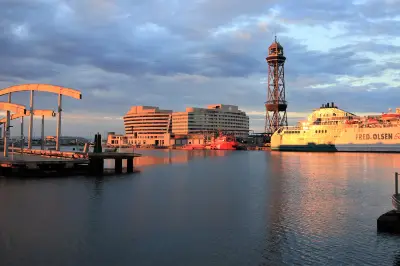
Seaside Glimpse: From Port of Barcelona to the Olympic Port, ten kilometers of coastline, docks, and sandy beaches. Tourists revel in the gentle breeze; seagulls soar under sunlight and blue waves.
Columbus Monument
Olympic Port at Night
Square Dance in Front of the Cathedral: Barcelona Cathedral, centuries old, is located in the Gothic Quarter of the old city. It is the main cathedral of the Archdiocese of Barcelona. Inside the cathedral, it is solemn; outside, the square is a lively scene. As the band plays, circles of people grow larger and dance happily.
Ancient Gothic Cathedral
Small Band in Front of the Cathedral
Lively Square Dance
Casa Batlló: "Curves belong to God" – Gaudí's masterpiece turning ordinary into extraordinary.
Barcelona Cuisine: Legendary paella, Spanish ham, and grilled mushrooms.
Barcelona Metro: The Barcelona metro system is very convenient. Most famous attractions can be reached by metro. Each line is marked with different colors, easy to distinguish. The entrance has a red diamond-shaped light box with the letter M. Single ticket price: €2.15; day pass: €7.6 (for one person only); 10-trip ticket: €9.8 (no limit on number of people or time). We bought a 10-trip ticket, which was very convenient.
V. Sagrada Familia – Unprecedented and Unmatched Magnificent Architecture
Sagrada Familia is located in the city center of Barcelona. Construction began in 1882, and in 1883, the genius Gaudí took over, giving birth to this stunning masterpiece. Over a hundred years, at this so-called "century-long unfinished building," no matter where you come from, whether you have religious feelings, understand architecture, or appreciate sculpture, once here, you will feel awe, shock, emotion, and admiration. No one remains unmoved in front of Sagrada Familia. Even if this is the only place on the long journey, it is worth it.
Nativity Facade: The church has three facades carved with biblical stories: the completed Nativity Facade, the Passion Facade, and the still-unfinished Glory Facade. The Nativity Facade uses a completely realistic approach to depict the birth of Jesus. Each sculpture tells a story, and the entire facade is covered with mountain caves and a natural botanical garden with lifelike plants. Everything rejoices at the birth of Jesus, contrasting with a soldier holding a baby aloft.
Dreamlike Church Interior – The Essence of Sagrada Familia: Entering the main hall, everyone exclaims in awe. Dozens of columns in different colors of basalt, granite, and marble rise to the vaulted ceiling. The arches at the tops of the columns support each other, resembling towering trees with dense foliage. Golden sunlight pours down from the dome, while light through the stained glass windows is colorful. You feel as if you are in a vast primeval forest reaching the sky, even sensing the sounds of animals and plants. The soul transcends time and space, merging with nature. Above the hall, a statue of Jesus hangs high, with sunlight streaming through an opening in the dome, forming a natural beam of light that illuminates Jesus beneath a canopy. The contrast between light and dark adds solemnity and realism. Here, what you feel and sense is far more than what you see. It is a shock and emotion brought by a mysterious force beyond art, religion, and even nature.
Tower View: Take an elevator next to the Nativity Facade to the middle of the tower, then climb narrow spiral stairs to a small viewing platform and stone windows, offering a view of Barcelona's cityscape and a close-up of Gaudí's architectural art. Since the elevator can only carry a few people and the upper corridor is narrow, tower access is limited. You need to buy a separate ticket and reserve a time to queue. It's best to buy tickets online in advance and also reserve a Chinese audio guide.
Passion Facade: Outside the door is a sculpture of Jesus tied to a pillar, expressing the sorrow of suffering and torture. The sculptures on this facade are cold, abstract, and angular, quite different from Gaudí's other works. Perhaps the theme no longer suits curves, or maybe it was Gaudí's new exploration. Although the sculptures were completed decades after Gaudí's death, according to the audio guide, they were made exactly according to his original design. The entire facade represents the Passion of Christ, with a dozen independent sculptures depicting different moments of the process. Starting from the lower left with the Last Supper, the sculptures wind upward in a zigzag pattern, culminating at the top with Jesus on the cross. Scenes include Jesus being arrested by Roman soldiers on horseback and on foot, being judged in a Roman court, and carrying the heavy cross stumbling forward.
VI. Barcelona – Valencia – Murcia
Valencia, on the Mediterranean coast about 300 km from Barcelona, is Spain's third-largest city. The highway runs along the coast, with the Mediterranean appearing and disappearing. This section is tolled. From Valencia onward, the highways within Spain are free.
We arrived at the Valencia coast at noon, but there was a strong wind, with sand flying and trees swaying. Tourists sought shelter, so we couldn't stroll on the beach.
A seaside restaurant served seafood in its original flavor. The owner recommended small sea shells, saying they were still swimming in the sea that morning. Valencia is the birthplace of paella, though we had already eaten it in Barcelona.
Valencia is rich in oranges; even the street trees are orange trees.
We welcomed the sunset in Murcia.
VII. Alhambra in Granada
Arab Moors occupied Granada in the early 8th century and established a prosperous Islamic kingdom here. In the late 15th century, the Moors could not resist the Catholic reconquest, and Granada was finally taken by the Spanish Kingdom. This special history shaped Granada today. People can see palaces built by the Moors and remnants of Catholic architecture. It is a city that blends Muslim, Jewish, and Catholic styles.
Alhambra Palace: The Arab Muslims existed for over 700 years on the Iberian Peninsula. The Kingdom of Granada was the last Arab dynasty to fall. The Alhambra, built in the 13th century, is a treasure of Arab-style architectural art left by Muslims to Spain.
VIII. Arriving in Seville at Night – Tire Pressure Warning Again, Chinese vs. Spanish Communication
We got on the highway from Granada at 5:00 PM. This stretch of over 200 km had many curves, steep bends, and numerous highway entrances and exits, making driving challenging. By the time we were halfway, night had fallen. Worse, about 20 km from our accommodation, the tire pressure warning light suddenly came on. We had just exited the highway. We quickly found a place to pull over and check. Fortunately, the tires didn't seem too flat. Anxiously, we drove to the accommodation.
We contacted the rental company. The process was the same – they would send roadside assistance. The parking spot was a few minutes' walk from our accommodation, but all one-way streets made driving there confusing. Early the next morning, we went to the parking garage and located it on the map.
The tow truck arrived quickly. I went with the driver. The problem: I only understand Chinese, and the driver only spoke Spanish. How to communicate?
I showed him the map with the pinned location on my phone, and he understood immediately. We reached the garage smoothly. Local traffic management was excellent; even small alleys were passable, though pedestrians had to squeeze sideways for cars to pass. Since they were one-way, there was no congestion.
The driver started the car, checked the dashboard, observed the tires (looking puzzled), added some air to the front tires, but the warning didn't clear. He then consulted the manual and tried to reset the onboard computer, but after more than ten minutes, it didn't work. I used a translation app on my phone to ask: "What's wrong?" The driver shrugged, indicating he couldn't fix it. I asked: "What should we do then?" He translated into English (his phone didn't have Chinese), roughly: "The tire pressure is fine, you can drive. You need to go to the rental company to clear the warning display." He pointed to the pressure gauge showing normal range and gestured to the car rental logo. Finally, he had me sign the service slip. The tire insurance came into play for the second time.
The resolution of the tire pressure warning: Our business professional managed to clear it using the onboard computer. Really joyful news! You can't beat a THU graduate!
IX. Charming City Seville
Seville is the largest city in southern Spain, with a history dating back to Roman times. It also experienced 600 years of Arab Muslim rule. Buildings from different eras abound, and various cultures blend, giving rise to Don Juan, flamenco, bullfighters, and many delicious snacks.
Seville Cathedral: A grand Gothic structure built in the Middle Ages, converted from a mosque. It is said to be the third largest Christian church in Europe and the largest Catholic church. The religious atmosphere is very strong.
Orange Trees in the Cathedral Courtyard
Former Palace of the Arab Moors (Alcázar)
Plaza de España, site of the World Expo:
Roman remains?
Arab-style architecture
Delicious snacks and lively shops
X. Driving to Portugal, Straight to Cabo da Roca – Gazing at the Atlantic from the End of the Land
Departing from Seville, we drove westward into Portugal. The road conditions were decent. Portuguese highways have various toll methods: self-service ticket, manual, and electronic toll (like ETC) linked to a bank card, convenient for locals but troublesome for foreigners. We missed the registration point upon entry. When we passed through an electronic-only toll section, our license plate was scanned. Within a week, we had to pay at a post office. We went to a Portuguese post office, stood in a long line, met with slow service, and finally emailed for help. After much trouble, we managed to pay online.
Crossing the April 25th Bridge in the rain
Cabo da Roca, at the westernmost point of the Eurasian continent. Beyond the vast Atlantic lies the American continent. When we arrived at the coast, it was foggy, visibility less than 20 meters. We drove with headlights and fog lights on, relying entirely on the navigator to reach the foggy parking lot at the Atlantic shore. Locals said the fog was probably intermittent and would clear after a while. So we waited and had coffee.
Finally, the fog cleared, and the Atlantic gradually appeared. Below the cliff, waves surged.
The famous cross-shaped stone monument stands facing the sea, inscribed with the motto: "Land ends here, sea begins here." Simple and profound. How many adventurous journeys began here, sailing bravely into the waves. Remember the coordinates: 38°47'N, 9°30'W.
There is also a small stone marker, like Europe's end of the earth.
A lighthouse on the shore, calling ships home from the waves.
XI. Lisbon Between Mountains and Sea
This is the westernmost metropolis of the Eurasian continent. Its history mirrors that of the Iberian Peninsula: Phoenicians, Romans, Visigoths, and Arab Moors left their marks. In the 12th century, Afonso I founded the kingdom and made it the capital. During the Age of Discovery, it prospered alongside neighboring Spain, but also suffered from great earthquakes and tsunamis. The city is built on hills and by the water.
City Transport: Lisbon's transport includes metro, trams, trolleybuses, and buses. You can buy a rechargeable Viva Viagem card (cost €0.5). Single trip with card: €1.4 (€1.8 if bought on board). 24-hour unlimited pass: €6, valid for metro, buses, and funiculars. Convenient.
Santa Justa Lift
Cityscape: Built on hills, houses packed closely, yellow walls and red roofs, vivid colors.
Jerónimos Monastery: Built during Portugal's golden age, taking 100 years to complete. It is the most magnificent and grandiose monastery in Portugal, a perfect blend of Gothic and Renaissance styles, using locally produced golden limestone. Its scale is astonishing, with a facade over 300 meters wide.
Monument to the Discoveries: The front is a cross, the side a ship. The monument is carved with figures related to Portugal's Age of Discovery, recording the explorers who sailed into the sea, showcasing the glory of this maritime empire.
Belém Tower: Initially for defense, later used as a customs house, telegraph station, and lighthouse. It was also a starting point for navigators.
Must-eat pastéis de nata. The most famous old shop lived up to its reputation.
A restaurant run by Nepalese people served paella that tasted even better than the original in Spain, and at a cheap price.
XII. Lisbon to Madrid
Early morning departure from Lisbon, crossing a bridge over 10 km long (reportedly second only to the Hangzhou Bay Bridge), heading for the highway to Madrid. The rural scenery in Portugal was beautiful.
Have you ever seen such a good-looking transmission line tower?
Although food and accommodation in Portugal are cheap, gasoline is expensive: €1.418 per liter. So we filled less, not wanting to spend too much. Seeing Portugal's gas prices, do you feel China's prices are acceptable?
When we reached a gas station in Spain, the price was €1.083 per liter. Quite a difference!
Gas stations on highways are self-service. You fill up and then pay at the station's supermarket. Last time in Europe we drove a diesel car; this time it was gasoline. Pay attention to fuel type and grade; don't make a mistake.
The morning alternated between sunny and rainy. In the afternoon, after entering Spain, the weather cleared.
Solar photovoltaic station by the road
Heading toward Madrid under blue sky and white clouds.
XIII. Traveling Through Medieval Toledo
Toledo is a historic European city, becoming the capital of Spain in the 6th century. It was later occupied by Arabs for over 300 years. After reconquest, it remained the capital and religious center until the 16th century when the capital moved to Madrid. Toledo then declined but preserved its original appearance. Five hundred years have passed, but its splendor hasn't faded.
My wife and I went to Toledo alone. Driving from Madrid to Toledo is about 60 km, taking one hour. I set the navigator destination to the cathedral. The roads were narrow; sometimes the front radar showed insufficient width on both sides. Pedestrians had to press against walls for the car to pass carefully. It was uphill. Fortunately, it was an automatic transmission; if manual, a stall would have been troublesome. We drove very accurately to the cathedral. Using a translation app, I asked a policeman if we could park there. He said no. I asked where the parking lot was. He gestured: down, left, then down, then left again... I got a vague idea but roughly knew it was a parking lot we had passed on the way. So we started navigating the narrow streets again.
In Spain, white line parking is free, green lines for special people, blue lines for limited free parking, and yellow lines for paid parking. Although there were empty blue and green line spots, we didn't dare park. We drove to a yellow-line parking lot. It was self-service payment. We watched others pay, then tried. The machine displayed the current time. When we inserted coins, it showed how long we could park. We used almost all our coins (over €4), and the display showed until 17:00, which should be enough. We pressed the button to print a ticket and placed it on the front windshield for inspection. If they check and find no ticket, you get fined.
After parking, we walked along narrow streets back to the cathedral. Was this path once walked by Spanish kings?
Toledo Cathedral: The seat of the Cardinal Archbishop of Spain. The Gothic architecture and interior sculptures are exquisite and grand. Among the several cathedrals we visited, although the theme is the same, each is unique in architecture and sculpture. Compared to others, the sculptures and paintings here have a more natural and lifelike quality, no longer strictly medieval religious culture, but radiating the artistic brilliance of the Renaissance. It shows that religious art can also be pleasing to the eye. Unfortunately, no Chinese audio guide was available, so this is just my impression.
Monastery of San Juan de los Reyes
Walking through the narrow streets of the old town, surrounded by various styles of ancient buildings, you really feel like you've traveled back to the Middle Ages.



![Global Stroll [12] the Walk of the World Season 1 Episode 8 Spain](/img/d04fbd8776bb7ee8_s.webp?src=https%3A%2F%2Fdimg04.c-ctrip.com%2Fimages%2F01059120009be1xfy2D06_W_320_0_Q80.jpg)