Spain and France Trip (3) - Barcelona
This post continues from: Spain and France Trip (2) – Seville, Córdoba, Málaga, Ronda, Granada
Spain has countless reasons to make you yearn for it: the aqueducts of ancient Rome, the passionate flamenco, the mystery of the Alhambra, the magic of Gaudí's architecture, and the fusion of diverse cultures – all make it impossible to stop exploring. And then there is neighboring France, with the romance of Paris and the treasures of the Louvre that haunt your dreams.
We were fortunate on this trip to obtain a 30-day Schengen visa for Spain.
Where did we go in 30 days?
1. Madrid and nearby Segovia and Toledo (7 days)
2. Andalusia: Seville, Córdoba, Málaga, Ronda, Granada (10 days)
3. Barcelona (5 days)
4. Paris (9 days)
Since the account is too long, I have divided it into four parts by region to share the details of our trip.
Tickets for the Sagrada Família and Casa Batlló were purchased in advance on the official website.
Accommodation was booked online in advance.
We flew from Granada to Barcelona on Vueling Airlines, and the tickets were booked online in advance.
In Barcelona we bought a multi-person 8-ride ticket: T-Familiar (valid for 30 days).
Barcelona exudes a pure Mediterranean charm. The people here prefer to be called Catalans, not only for historical and geographical reasons but also because of the unique character they have developed over time. Barcelona is beloved by tourists for its many historical buildings and cultural attractions. The architectural works of Antoni Gaudí and Lluís Domènech i Montaner are listed as UNESCO World Heritage sites, with eight in total. Barcelona also has two famous football clubs: Barcelona and Espanyol, with Barcelona being one of the most renowned football clubs in the world.
On the afternoon of May 22, we took a Vueling flight from Granada to Barcelona. Our hotel was about 300 meters from Plaça de Catalunya, where we stayed for five days.
There is a viewing terrace on the top floor of the hotel.
Across the street from the hotel, there were numerous restaurants, bars, and food shops.
This ice cream shop was packed every day. With twenty flavors of ice cream, having one cup daily never made us tired of it – my wife highly praised it.
This Spanish tapas bar served delicious grilled foie gras and squid rings, with a constant stream of customers every day.
Casa Rocamora is a modernist building in Barcelona. It was built by the architect Joaquim Bassegoda i Amigó between 1914 and 1917, likely also with his brother Bonaventura. It consists of three buildings with separate entrances but a unified façade, located at the beginning of Passeig de Gràcia.
The Palau de la Música Catalana was designed by architect Lluís Domènech i Montaner (also the architect of the Hospital de la Santa Creu i Sant Pau, equal in fame to Gaudí), built between 1905 and 1908 in the modernist style, and is now listed as a World Heritage site.
Basilica of Santa Maria del Pi is a 14th-century Roman Catholic Gothic church located at Plaça del Pi in the Gothic Quarter of Barcelona, Catalonia, Spain. Dedicated to Our Lady of the Pine, it was built from 1319 to 1391 in Catalan Gothic style.
The Wall of Kisses is a mosaic mural made of thousands of ceramic tiles; each tile is a separate photograph when viewed closely.
The Royal Palace of Barcelona (Palau Reial Major) is a group of historical buildings in Barcelona, Catalonia, Spain, located at Plaça del Rei in the Gothic Quarter. It was the residence of the Counts of Barcelona and later the Kings of Aragon.
It includes three different buildings: the Chapel of Saint Agatha, the Royal Chapel (Gothic), and an octagonal tower from the early 14th century.
In front of the church, what instrument is this musical messenger playing?
Plaça del Rei is a grand square in Barcelona, surrounded by Gothic and Renaissance buildings, with only the southwest side leading to the Barcelona Cathedral. To the north of the square is the Royal Palace; the Gothic tower on the left is a good place to overlook the medieval quarter; the staircase on the right leads to the east side of the square and the Chapel of Saint Agatha; on the southeast side is the Barcelona City History Museum, a Gothic building; on the west side is a 16th-century Renaissance building.
The Cathedral of the Holy Cross and Saint Eulalia is the Gothic cathedral of the Archdiocese of Barcelona, built from the 13th to the 15th century.
Frederic Marès Museum in Barcelona. Frederic Marès devoted his life to his obsession with sculpture; this museum preserves and displays the final results of his life's work.
Next to the Frederic Marès Museum is a park.
The Bridge of Sighs is located on the most beautiful small street in the Gothic Quarter, on the southwest corner behind the cathedral.
Els Quatre Gats café opened in 1897 and was once a gathering place for Barcelona artists. Picasso frequented it early in his career, and his first solo exhibition was held here. The café's cover is a poster Picasso once created for it.
Plaça de Catalunya is a large square in the center of Barcelona's old city, where several major streets converge. It is known for its fountains and sculptures and gathers countless pigeons.
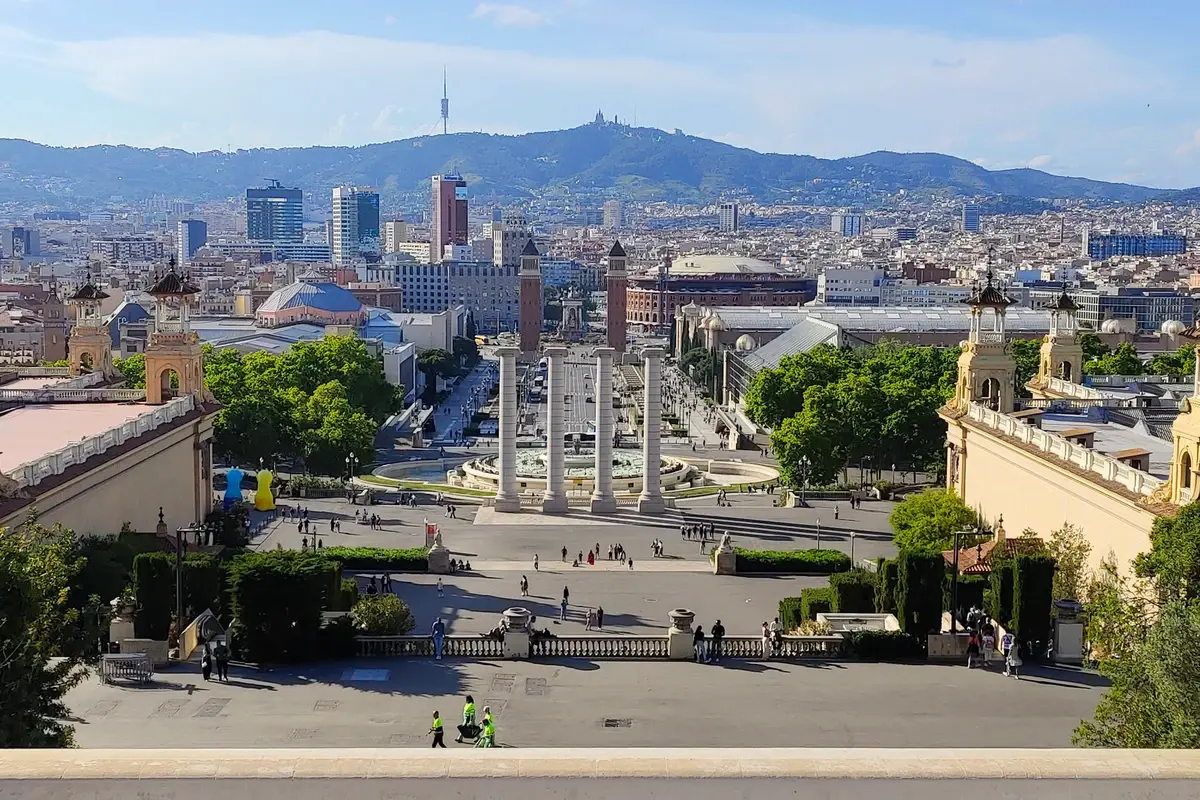
Plaça d'Espanya was built for the 1929 World Exposition. The square is the intersection of several major roads: Avinguda del Parlament de Catalunya, Gran Via de les Corts Catalanes, Carrer de Tarragona, and Avinguda de la Reina Maria Cristina.
The Venetian Towers are 47 meters high, at the entrance of Avinguda de la Reina Maria Cristina (the entrance to the 1929 World Exposition).
Plaza de Toros de Barcelona (Bullring) was built in 1900 in Moorish Revival style. Since the Catalan Parliament passed a law banning bullfighting in 2010, which took effect in 2012, this venue became the last place in Catalonia to host bullfights. It is now converted into a shopping center.
The National Art Museum of Catalonia (MNAC) is housed in the Palau Nacional, a building built in 1929 as an exhibition pavilion for the World Exposition.
Looking down from the entrance of the National Art Museum.
Barcelona is rich in seafood products.
A local wine shop in Barcelona.
The monastery is carved into the cliffs, a perilous location that requires a cable car or funicular to reach. Despite its remote location, the monastery is majestic and splendid, housing many classical works of art.
Montserrat Monastery is the most important religious site in Catalonia and has played a significant role in Catalan cultural and spiritual life. Its publishing house is one of the oldest still operating in the world, with its first book published in 1499. The monastery houses the statue of Our Lady of Montserrat (also known as the 'Black Madonna' due to its dark color), who is the patron saint most loved by Catalans. The Escolania de Montserrat, a boys' choir, is one of the oldest in Europe and performs during religious ceremonies.
On the wall of the main church are Jesus and the twelve apostles.
Basilica of Our Lady of Montserrat.
Visiting and venerating the chapel of Our Lady of Montserrat.
Exquisite marble portal.
Our Lady of Montserrat is named for her dark complexion and is depicted with the baby Jesus. She holds him on her lap and places her left hand on his shoulder to indicate he is her son. Her right hand holds a sphere symbolizing the universe. The infant Jesus gives a blessing with his right hand and holds a pinecone in his left, considered a symbol of fertility and eternal life.
This inner courtyard is not open to tourists. After we finished venerating Our Lady of Montserrat, we passed by just as a group of students finished a lesson and the door opened. We walked in, and the staff did not stop us, so we were fortunate to get a close-up view of the interior of the sanctuary.
After visiting the church, we took the rack railway up to Montserrat Mountain. Montserrat Mountain reaches an altitude of 1236 meters, composed of conglomerate rock, with continuous steep mountain ranges. It is named for its saw-toothed appearance.
A short walk from the rack railway stop, there is a small exhibition hall. From the viewing platform of the exhibition hall, you can see the Montserrat Monastery.
Sant Jeroni, the highest point of Montserrat.
A small chapel on Montserrat Mountain.
We hiked halfway around Montserrat Mountain and arrived at the Sant Miquel viewing platform.
If you feel tired and don't want to walk, you can also hike directly from the monastery for about half an hour to reach the Sant Miquel viewing platform. Standing there, you can take in the entire Catalan plain and the monastery.
Hospital de la Santa Creu i Sant Pau is one of Barcelona's World Heritage sites, designed by the master architect Lluís Domènech i Montaner (also the designer of the Palau de la Música Catalana), built between 1901 and 1930. Montaner tailored the hospital's design so that each building had a different functional division. Not only were underground passages connecting the buildings for easy movement, but he also planned a network of intersecting main roads, combining above-ground roads with underground passages for effective traffic flow and improved hospital efficiency. This forward-thinking planning concept was very avant-garde at the time and is still used in the construction of large hospitals today. This massive hospital, officially opened in 1930, was used until the early 21st century. It is the largest collection of modernist architecture in the world and a model of public architecture in Catalonia.
Montaner wanted the hospital to be a space full of life and beauty. He carefully arranged many decorative details in each building, such as colorful glass and mosaic tiles; almost all decorative materials were made in collaboration with the finest artisans of the time. The Hospital de la Santa Creu i Sant Pau is so vast and beautiful that it exceeded our expectations. Unfortunately, we had booked a visit to the Sagrada Família at 1:00 pm, so we had no time to properly explore the interior exhibition halls and just hurried through.
Antoni Gaudí i Cornet (25 June 1852 – 10 June 1926) is regarded as one of the most representative figures of Catalan Modernism. He is known for his complex, novel, unique, and highly personal architectural works.
Gaudí's architectural works display a fantasy for life, a fervor for religion, and inspiration from nature. He often considered every detail of his creations and integrated traditional craft techniques such as ceramics, stained glass, ironwork, forging, and carpentry into his architecture. He also used new techniques in material processing, such as trencadís tiles made from waste ceramic pieces.
Gaudí rarely drew detailed plans of his works; he preferred to create them as three-dimensional scale models, shaping the details according to his vision. "Not seeing Gaudí's architecture means not truly visiting Barcelona." Gaudí dedicated his talent to Barcelona. His masterpiece, the Sagrada Família, enjoys global renown. Between 1984 and 2005, six of his works were declared UNESCO World Heritage sites.
The neighbor of Casa Batlló is also beautiful, isn't it?
Casa Milà (La Pedrera) is the last private residence designed by Gaudí, built between 1906 and 1912. It was commissioned by the wealthy Pere Milà, who admired Gaudí's design for Casa Batlló. It was listed as a UNESCO World Heritage site in 1984.
The wavy exterior of Casa Milà is composed of white stone masonry walls, twisted wrought iron balconies, and large windows, stimulating the imagination. Some see it as a cave-like dwelling built by African natives on steep cliffs, others as waves, a sandy beach after low tide, a honeycomb, or waves formed by lava. Casa Milà has some religious symbolism: high on the exterior wall, you can see an 'M' representing the Virgin Mary, and a rose relief representing Our Lady of the Rosary.
Inside Casa Milà, each unit has dual exposure, with light entering from the central light well and the street. The rooms are almost all round in design—ceilings, windows, hallways—with very few right-angled rectangles.
The attic has a vaulted structure and now houses a small exhibition area where you can see models of the building.
The rooftop is the highlight of Casa Milà, with 30 peculiar chimneys, 2 ventilation shafts, and 6 staircase exits. The tower-shaped staircase exits are the largest, and inside the spiral stairs are hidden water tanks.
From the rooftop, you can see the Sagrada Família in the distance.
The Sagrada Família, designed by Gaudí, began construction in 1882 and is still under construction, expected to be completed by 2026. The Sagrada Família has three façades: the Nativity Façade, the Passion Façade, and the Glory Façade (still under construction). It has 18 towers, representing the twelve Apostles, the Virgin Mary, the four Evangelists, and Jesus Christ. Only eleven towers have been completed so far. The Sagrada Família is the only unfinished building to be listed as a UNESCO World Heritage site.
The Nativity Façade was built before 1935 during Gaudí's lifetime. Its sculptures are ornate and complex, depicting the birth of Jesus.
The Passion Façade, built between 1954 and 1976 based on Gaudí's 1917 design, depicts the scenes of Jesus' crucifixion.
The sculptures on the Passion Façade have very modern lines, sharp and direct, making all the characters appear more haggard and sorrowful.
Anyone who enters the interior of the Sagrada Família will be awestruck. The towering columns make you feel as if you are in a forest. The interior columns are unique to Gaudí's design; besides supporting the loads and their branches, their constantly changing surfaces are the result of intersecting various geometric shapes. The simplest example is when a column rises from an octagonal base to a sixteen-sided shape and finally becomes circular. This effect is the result of the three-dimensional intersection of helical columns.
The main altar of the Sagrada Família.
Color and light are unique characteristics of the Sagrada Família. Many subtle elements on the towers and roofs are mosaics made of Venetian glass, coated with colorful glazes. The interior light effects, besides reflecting off various stone and building materials, are also due to many symbolic decorations such as stained glass. From sunrise to sunset, the light inside the Sagrada Família changes continuously with the direction of the sun. The light of God illuminates the Sagrada Família; Gaudí dedicated this church to God, and ultimately he rests here forever, beside God.
The stained glass on both sides of the church is in cool tones (blue, green, purple) on one side and warm tones (red, orange, yellow) on the other, filling the interior with brilliant, dreamlike light and color.
You can only choose one of the two bell towers to climb: the Nativity Façade tower or the Passion Façade tower. We climbed the Nativity Façade tower.
We took the elevator up and walked down the spiral staircase, which seemed bottomless.
Passing by a street market, we observed the daily life of Barcelona's citizens.
Park Güell is a work by Gaudí, built between 1900 and 1914, and opened as a public park in 1926. It was listed as a UNESCO World Heritage site in 1984. The buildings in the park use ochre rough stone, mosaic tiles, and special trencadís tiles to create a colorful, lively, and playful style. Entering the park feels like stepping into a fairy-tale kingdom, where Gaudí's naturalist philosophy is vividly expressed.
Gaudí lived here from 1906 to 1926, and since 1963 it has been the Gaudí House Museum. In 1969, it was declared a historical-artistic monument of national property.
The porter's lodge at the main entrance of the park has a roof made of trencadís tiles.
The Hypostyle Hall (Room of the Hundred Columns) is supported by 86 Doric columns and has a water drainage function. The wavy eaves supported by the columns are decorated with exquisite mosaic tiles.
The central area of the park consists of a large oval open plaza that overlooks Barcelona. Beside it are three unique fountains, the most famous of which is called the Dragon Stairway, featuring a giant lizard shape. Its surface is covered with mosaic tiles, and besides its important drainage function, it is also the most famous landmark of Park Güell.
On the way to the beach, this exotic building attracted my attention.
The Columbus Monument is located at the end of La Rambla, near the port of Barcelona. It was built in 1886 to welcome the Universal Exposition and to commemorate Columbus's voyage around the world. The monument is made of reddish marble, about 60 meters high, with a statue of Columbus about 7 meters high on top, enough to overlook the port of Barcelona.
The monument's shaft is carved with five flying goddesses, and two large Spanish inscriptions read 'Glory to Columbus' and 'Tribute to Columbus'. At the base, eight stone lions guard it, solemn and majestic.
Barceloneta Beach is the main beach closest to the city center, stretching from the Port Vell in the west to the Olympic Port in the east.
Playing mahjong on the beach in the sun – how does that feel?
A very distinctive sculpture composed of four tilted steel cubes with windows stacked on top of each other, with the beautiful name 'Estrella Herida' (Wounded Star) or 'Estrella Solitaria' (Lonely Star).
Dancing of a Barcelona beauty near Plaça de Catalunya.
The ice cream we ate most often in Barcelona was from this shop.
This is a Chinese restaurant run by people from Qingtian, Zhejiang. After being away from home for a long time, we craved rice. In our five days in Barcelona, we had dinner here twice.
This restaurant had a particularly nice ambiance and was very popular. The grilled beef and grilled prawns were excellent.
Spanish tapas: grilled foie gras, squid rings, and grilled small fish were very good.
1. Tickets for Park Güell should be reserved in advance. We assumed tickets wouldn't be too tight and did not book. On Saturday, May 25, we went straight to Park Güell only to find it closed. Tickets for the 25th and 26th were all sold out; only tickets from the 27th onward were available. Fortunately, we were staying in Barcelona for five days.
2. At major metro stations, there is staff service for buying transport cards, so you don't need to worry about operating the self-service machines.
3. Plaça de Catalunya has an airport express bus; you can buy a ticket and board directly.
4. At Plaça de Catalunya, there is a tourist ticket center. We bought our combo ticket to Montserrat Monastery there. There are two types of combo tickets: the rack railway ticket (Cremallera) or the cable car ticket (Aeri).
1) Round-trip ticket for the day (including metro; on that day you do not need a transport card, just scan the combo ticket).
2) Round-trip ticket for the rack railway or the cable car (you can only choose one; you cannot use different modes for outbound and return). In other words, if you buy a cable car ticket, you must take the cable car both up and down; the same applies to the rack railway.
3) The funicular from the monastery to the top of the mountain or the caves can be used unlimited times (both the rack railway ticket and the cable car ticket allow this).
4) The combo ticket does not include tickets for the Montserrat Basilica or the chapel.
There is no good or bad between these two methods; it depends on your preference, but you must decide when buying the ticket.
No matter which direction in Barcelona you come from to go to Montserrat Monastery, you need to transfer to the R5 train. When you enter the station, check the route timetables; find the R5 line and the corresponding platform. For the cable car, get off at the station named Aeri de Montserrat (easily recognizable because both have 'Aeri'). For the rack railway, get off at the next station, Montserrat-Monestir.
Looking back on our 22-day trip to Spain: over thousands of years of history, so many peoples and cultures have converged here, leaving a brilliant world cultural heritage. In Spain, we learned to say 'Gracias.' Once again, 'Gracias.' Thank God for giving us a wonderful vacation in Spain. Goodbye, Spain!
To be continued: Spain and France Trip (4) – Paris
Directory of travel notes
1. Overview
2. Preview
3. Foreword
4. Barcelona
5. Montserrat Monastery
6. Hospital de la Santa Creu i Sant Pau
7. Approaching Gaudí
8. Casa Batlló
9. Casa Milà
10. Sagrada Família
11. Park Güell
12. Barcelona Beach
13. Barcelona Cuisine
14. Postscript
Tourism Information
Hotel Index
Guide Index
Ticket Index
Website Navigation
Tourism Index
Cruise Index
Corporate Travel Index
Franchising
Distribution Alliance
Friendship Links
Corporate Gift Card Procurement
Insurance Agency
Agency Cooperation
Hotel Franchising
Destination and Attraction Cooperation
More Collaboration
About Trip.com Group
About Trip.com Group
Trip.com Group Hotspots
Contact Us
Careers
User Agreement
Privacy Policy
Business License
Security Center
Trip.com Group Content Center
Intellectual Property
Trip.com Group Algorithm Disclosure



![Global Stroll [12] the Walk of the World Season 1 Episode 8 Spain](/img/d04fbd8776bb7ee8_s.webp?src=https%3A%2F%2Fdimg04.c-ctrip.com%2Fimages%2F01059120009be1xfy2D06_W_320_0_Q80.jpg)