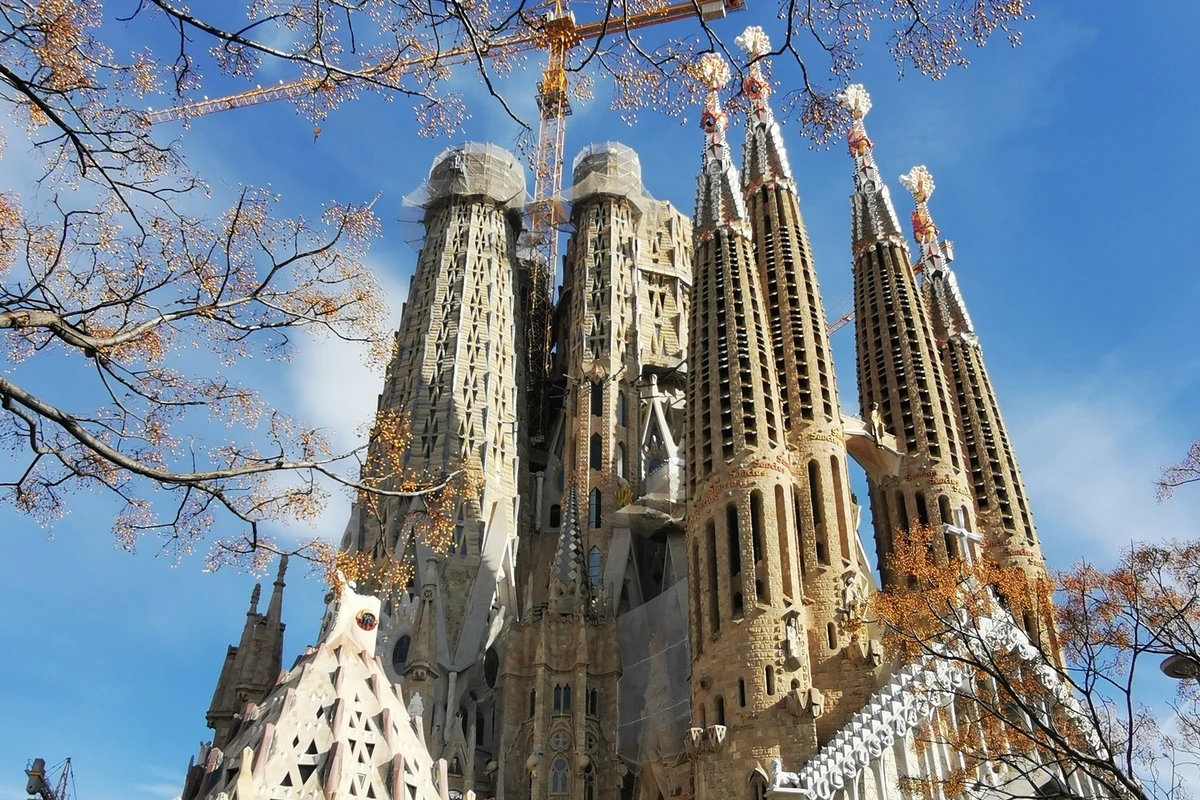
The Symphony of Flowing Light — Sagrada Familia in Barcelona, Spain
How can I describe the feeling of catching sight of the Sagrada Familia from amidst the trees? Is it awe, mystery, or incredibility? Gaudí completely overturned the design of traditional churches. He entirely reimagined a sacred place according to his own vision. Yes, reinvention should be the key theme of this church. With this thought, I followed the crowd into this long-dreamed-of sanctuary.
The morning sunlight streamed through the stained glass, casting mottled shadows on the floor of the Sagrada Familia. Standing in this unfinished architectural marvel, I watched the dust dancing in the golden beams of light, as if I could see Gaudí’s soul leaping in the radiance. The towering columns rose like ancient trees in a forest, their branches interlacing to form a canopy of light. This must have been Gaudí’s inspiration from nature: the church’s pillars resemble tree trunks, the ceiling like leaves, and the overall structure is filled with curves and organic forms, symbolizing the vitality of life.
By day, the Sagrada Familia is bustling and fervent. Tourists from all over the world queue up, cameras in hand, eager to capture every detail of this building. But at this moment, as the first rays of sunlight entered the church, all the noise turned into silence. I looked up at the lofty vault, watching the light filter through the colorful windows and fall in dappled patterns on the ground, as if it were poetry written by the hand of God on earth. The stained-glass windows create a sacred atmosphere; the shifting light symbolizes divine revelation and grace, while the complex geometric structures, such as hyperboloids and parabolas, are both beautiful and stable, demonstrating his profound understanding of architectural mechanics.
Inside the church, the Holy Family sculpture is one of the most symbolically significant artworks, depicting Jesus, the Virgin Mary, and Saint Joseph forming the Holy Family. The composition centers on Jesus, with Mary and Joseph on either side, creating a stable triangular arrangement that symbolizes the harmony and stability of the sacred family. Jesus crucified, his body contorted but his face calm, hangs in the nave of the church. The crucified Jesus, symbolizing sacrifice and redemption, conveys love and forgiveness for humanity through his serene expression.
The Virgin Mary stands high on the altar on the second floor, her arms outstretched, looking down upon the congregation. The colorful stained-glass windows behind her create a halo of rainbow light, further highlighting the love, purity, and sanctity symbolized by this white marble sculpture. Her expression is gentle and devout, conveying complete submission to God and selfless love for Jesus. Mary’s image is not only a symbol of motherhood but also a model for believers to emulate; her piety and obedience inspire the faithful to pursue depth in their faith.
The twelve apostles’ sculptures inside the church are located at the bases of the towers, each apostle with a unique posture and expression, symbolizing their different roles and contributions in spreading the gospel. These sculptures inspire believers to imitate the apostles’ loyalty and dedication. The sculptures of the four evangelists (Matthew, Mark, Luke, and John) are positioned at the four corners of the church, symbolizing the spread of the gospel and the foundation of the Church. Each evangelist has its distinctive symbol (such as Matthew’s angel, Mark’s lion, Luke’s ox, and John’s eagle), conveying the multidimensionality and richness of the gospel. Unfortunately, my understanding of the Bible and Christianity is only superficial, so I cannot truly grasp the saintly images in Gaudí’s mind, but the different appearances these sacred figures take on under the changing light and shadow are truly breathtaking.
Compared to the play of light inside the church, the carvings on the exterior are even more ingenious. These carvings are divided into three facades: the Nativity Facade, the Passion Facade, and the Glory Facade. The Nativity Facade is the earliest completed part of the Sagrada Familia, designed and built under Gaudí’s direct supervision. This facade depicts the birth of Jesus, filled with an atmosphere of joy and hope. The central sculpture group portrays the scene of Jesus’ birth: the Virgin Mary, Saint Joseph, and the infant Jesus form the core. Mary holds Jesus in her arms, symbolizing the purity and sanctity of maternal love; Joseph stands beside them, guarding this holy family. Surrounding them are angels, shepherds, and animals, symbolizing the universal celebration of Jesus’ birth. The scene of the angel Gabriel announcing to Mary is another important sculpture, symbolizing divine revelation and Mary’s unconditional submission. The angel’s elegant posture and Mary’s devout expression convey sacred peace and joy. The sculpture of shepherds worshiping Jesus symbolizes humility and piety. Shepherds were the lowest class in society, and their adoration indicates that Jesus’ birth is for everyone, regardless of wealth or status.
The Passion Facade was completed by later architects based on Gaudí’s design concepts, with a simple and expressive style, using highly abstract carving techniques to depict the process of Jesus’ suffering. Among them, the sculpture of the Last Supper depicts the scene of Jesus dining with his disciples. Jesus is in the center, surrounded by the twelve disciples, each with different expressions and postures, reflecting their complex emotions upon learning of Jesus’ impending crucifixion. Judas’ betrayal is key to this scene; the sculpture subtly hints at his betrayal through his posture and expression, reminiscent of Leonardo da Vinci’s famous fresco. The sculpture of the flagellation of Jesus shows the physical torment he suffered before his passion. Jesus is tied to a pillar, his body covered with wounds, his expression pained yet resolute. This sculpture symbolizes Jesus’ sacrificial spirit for the redemption of humanity. The central sculpture of the Passion Facade is the Crucifixion, depicting Jesus nailed to the cross. His body is twisted, his face anguished, but his eyes reveal peace and forgiveness. Below the cross, Mary and Saint John are overwhelmed with grief, symbolizing humanity’s mourning for Jesus’ suffering.
The Glory Facade, which is the main facade of the Sagrada Familia, is still under construction. It will depict the resurrection and ascension of Jesus, symbolizing eternal glory and redemption. The sculpture of the Resurrection will show Jesus rising from the dead. Jesus emerges from the tomb, radiant with light, symbolizing victory over death and sin. The surrounding soldiers and angels express amazement and awe, conveying divine power and glory. The Ascension sculpture will depict Jesus ascending into heaven. His body is surrounded by light, with angels around him, symbolizing divine triumph and eternal glory. This sculpture will convey a message of hope and redemption, inspiring believers to pursue eternal life.
The sculptures inside and outside the Sagrada Familia are not only masterpieces of art but also carriers of religious and symbolic meaning. From the joy and hope of the Nativity Facade, to the pain and sacrifice of the Passion Facade, and then to the glory and redemption of the Glory Facade, these sculptures together form a complete religious narrative, inspiring believers to pursue faith and eternal life. Each sculpture is meticulously designed to convey profound theological and philosophical ideas, making the Sagrada Familia an architectural masterpiece that combines art and spirit. This series of sculptures, vivid in the sunlight, tirelessly tells the complete story of Jesus from birth to death and resurrection. Gaudí, this master architect, poured his understanding of faith and reverence for nature into this unfinished masterpiece. In this noisy world, the Sagrada Familia reminds us: some beauty is worth waiting a lifetime for; some faith is worth pursuing for eternity.



![Global Stroll [12] the Walk of the World Season 1 Episode 8 Spain](/img/d04fbd8776bb7ee8_s.webp?src=https%3A%2F%2Fdimg04.c-ctrip.com%2Fimages%2F01059120009be1xfy2D06_W_320_0_Q80.jpg)