Spain Travelogue: Park Güell in Barcelona
On the morning of April 14, 2025, I had a buffet breakfast at the hotel at 7 am and set off for Park Güell in Barcelona at 8:30. Although it's called a park, it is also a famous tourist attraction in Spain.
Park Güell is located in the northern part of Barcelona, covering 20 hectares. It was originally a community planned by the wealthy Barcelona businessman Count Eusebi Güell and designed by Gaudí, built between 1900 and 1914. In 1922, the city government purchased it and opened it to the public as a community park.
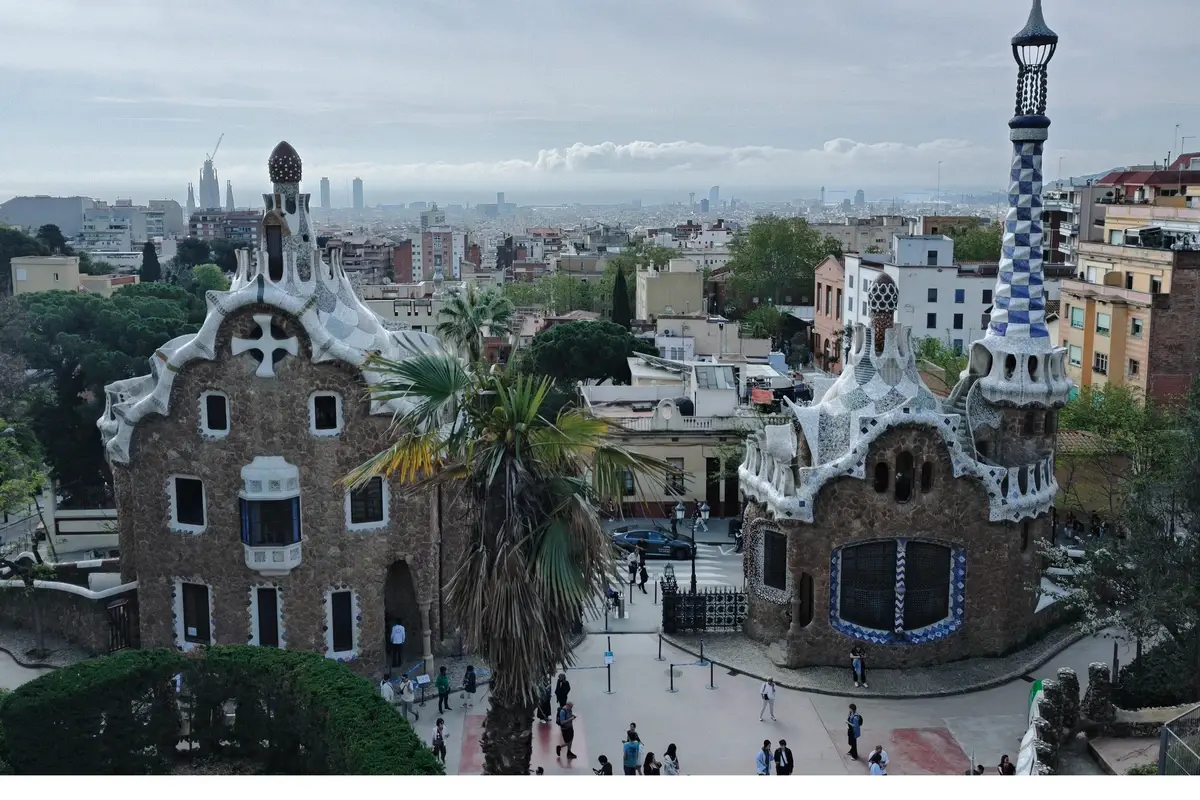
Gaudí was the architect of Park Güell. From 1906 to 1926, he lived and worked here for a full 20 years. Although only the 'public facilities'—such as the gatehouse, central park, elevated walkways, and a few ancillary buildings—were completed, Gaudí's naturalistic philosophy gradually matured and was fully expressed here. As a result, Park Güell has been listed as a UNESCO World Heritage site. Park Güell seems to be Gaudí's playground, where he let his imagination run wild and brought it to life with his architectural expertise. At the entrance of Park Güell are two houses covered in bright glazed tiles, like fairy-tale gingerbread houses. Seeing their adorable shapes, one can't help but wonder: if a park starts like this, how will the rest unfold? The famous attractions of this park are not just these two gingerbread houses; there is also the world's longest bench. Calling it a bench is not quite accurate, as it breaks the conventional impression of a park bench. This longest seat in the world is actually the edge of the roof of the Hall of a Hundred Columns. Gaudí combined the wall and seating into a winding seat akin to lace ruffles, decorated with colorful mosaic tiles, creating a rich visual experience and a lively atmosphere. One can sit or lie here; the curved corners can serve as a single seat or a love seat, and if you take over the entire arc, it becomes a space for five or six friends to chat. Although it looks hard, the seat is ergonomically designed for comfort. From here, you can overlook the city of Barcelona and gaze at the port and the Mediterranean Sea. This viewing terrace is called the Greek Theatre or Nature Square.
There are three uniquely shaped fountains in the park. The first is a combination of a ring and a compass; the second combines a snake with the red and yellow stripes of the Catalan coat of arms; the third is Gaudí's dragon, shaped like a giant lizard. All are covered with mosaic tiles in bright colors and vivid forms. Besides being the park's iconic symbols and treasured centerpieces, they also serve important drainage functions. During heavy rain, water flows down from the Hall of a Hundred Columns and gushes out through the mouths of the lizard and chameleon, making them especially lively and endearing.
Climbing the steps, you reach the famous Hall of a Hundred Columns. This structure, supported by 86 Doric (Roman-style) columns, was originally intended as a market. The hollow columns not only support the roof but also serve to channel and drain water. The roof supported by the columns is decorated with wonderful mosaic discs, making the hall more vivid and beautiful.
In Park Güell, many pathways feature sloping colonnades resembling natural caves. Some have two levels, both walkable. The columns are often slanted, appearing ready to collapse at any moment, yet they have stood firmly for nearly a century, as if intentionally demonstrating a mechanical experiment comparing slanted and straight columns.
Due to time constraints, the guide only led us through a few main attractions, but they were already breathtaking and highly praised. Although reluctant to leave, we had to hurry away because even more wonderful sights awaited on the itinerary.



![Global Stroll [12] the Walk of the World Season 1 Episode 8 Spain](/img/d04fbd8776bb7ee8_s.webp?src=https%3A%2F%2Fdimg04.c-ctrip.com%2Fimages%2F01059120009be1xfy2D06_W_320_0_Q80.jpg)