Spain Travelogue: Sagrada Familia in Barcelona
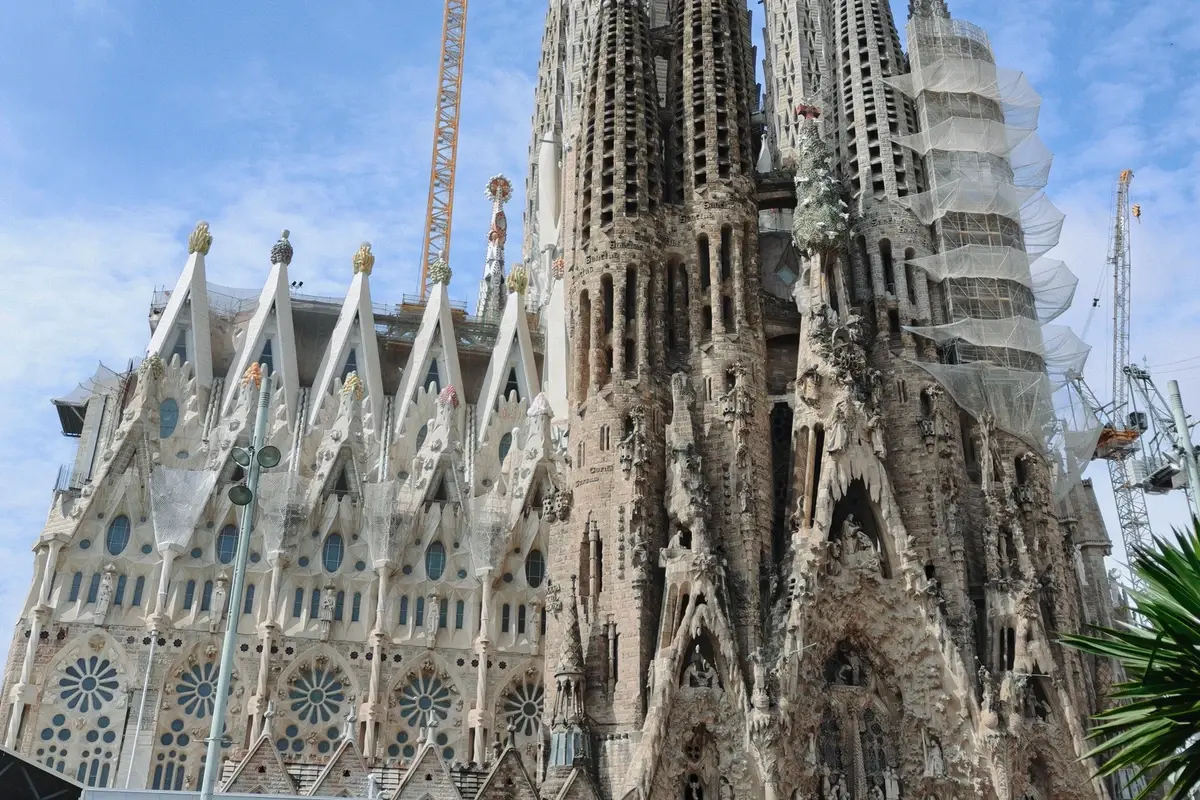
Around noon on April 14, 2025, we arrived at the Sagrada Familia in Barcelona. The Sagrada Familia is another masterpiece by Gaudí and a famous landmark in Barcelona. Due to the large number of visitors, entry times must be reserved in advance each day. For various reasons, it is common to be unable to secure a reservation. The tour guide had informed us beforehand to be mentally prepared. We were lucky; after waiting outside for about 20 minutes, we were allowed to enter.
The Basílica de la Sagrada Família, also translated as the Holy Family Church and commonly referred to as the Sagrada Família, is a large Roman Catholic church in Barcelona, Catalonia, Spain, designed by Spanish architect Antoni Gaudí (1852–1926). The Sagrada Família is a Gothic church with a rectangular floor plan, an irregular multi-column facade, and an asymmetrical design. Its main structure consists of five naves and three side naves. Construction began in 1882, and Gaudí took over the project in 1883, incorporating his own architectural style along with Gothic and Art Nouveau elements. Gaudí devoted his later years to the church's construction; when he died at age 74 (1926), less than a quarter of the building was complete. Construction proceeded intermittently during the 1950s. By 2010, the project was more than halfway finished, but some of the greatest challenges in the entire construction process remained unresolved. On November 29, 2021, the tower of the Virgin Mary was topped out, and a lighting ceremony was held on December 8 of the same year. The towers and most of the church’s structure are expected to be completed by 2026, the centenary of Gaudí’s death; decoration work is projected to be finished by 2030 or 2032. The Sagrada Família has become a landmark of Barcelona with its unique appearance. In 1984, a part of the Sagrada Família, along with six other works by Gaudí in Barcelona, was declared a UNESCO World Heritage Site.
From the outside alone, the cathedral is still under construction, with scaffolding standing outside and tarps covering parts of the building. However, the interior is open to visitors, and the main hall is resplendent with multicolored lights and magnificent splendor.
The Sagrada Família is designed in a Latin cross plan, with five aisles. The central nave vault reaches a height of 45 meters, while the side nave vaults are 30 meters high. The transept has three aisles. The columns are spaced 7.5 meters apart. The columns in the semicircular apse, based on the design by Villar, have slightly different spacing, and some column designs were adjusted in the ambulatory to create a horseshoe-shaped distribution on the floor plan. At the crossing of the cross, four porphyry columns support a large hyperboloid structure, surrounded by twelve hyperboloids arranged in a ring (still under construction). The central dome of the Sagrada Família reaches 60 meters in height, and there is another hyperboloid dome above the semicircular apse that rises to 75 meters. Gaudí's intention was that visitors standing at the main entrance could directly see the vaults of the nave, transept, and apse; therefore, the heights of the vaults increase progressively.
The interior columns are Gaudí's unique design. Besides branching to further support the weight, their ever-changing surface textures are the result of combining multiple geometric shapes. A typical example is a column that starts with a square base, then becomes octagonal, then hexagonal, and finally circular as it rises – a product of three-dimensional spiral column assembly. The surfaces of the various structures inside the church are not flat; the interior decoration is comprehensive and rich, with most abstract shapes composed of smooth curves and jagged nodes. Even details such as the iron railings of the stairs are processed with graceful curves. Gaudí skillfully used light effects to enhance the emotional impact and solemnity of the Sagrada Família. Color is a distinctive feature of the Sagrada Família. Many finishing touches on the towers and roofs, such as small decorative elements, are mosaics made of Venetian glass decorated with colorful glazes. The interior light and shadow effects, in addition to the reflection of various stone and building materials, also benefit from many symbolic decorations, such as stained glass.
The Sagrada Família has three facades: the Nativity Facade facing east, the Passion Facade facing west, and the Glory Facade facing south, which is still unfinished. The Nativity Facade was completed before the construction interruption in 1935 and is the most directly influenced by Gaudí's style. The Passion Facade was built according to Gaudí's design concept from 1917, started in 1954 based on a brief plan, and completed in 1976. The overall character of the Passion Facade is simple and weathered, and the crucifix on the tower top depicts a haggard figure of Jesus. Construction of the Glory Facade began in 2002; it will be the largest and most monumental of the three facades, mainly symbolizing the Ascension of Jesus. The facade will also depict scenes such as Hell and Purgatory, and will include elements like the Seven Deadly Sins and the Seven Virtues.
There is also a museum at the north exit of the cathedral, which introduces the history of the cathedral. Due to time constraints, we did not look closely and ended the visit hastily. Around 2 p.m., we took a bus to the next attraction.



![Global Stroll [12] the Walk of the World Season 1 Episode 8 Spain](/img/d04fbd8776bb7ee8_s.webp?src=https%3A%2F%2Fdimg04.c-ctrip.com%2Fimages%2F01059120009be1xfy2D06_W_320_0_Q80.jpg)