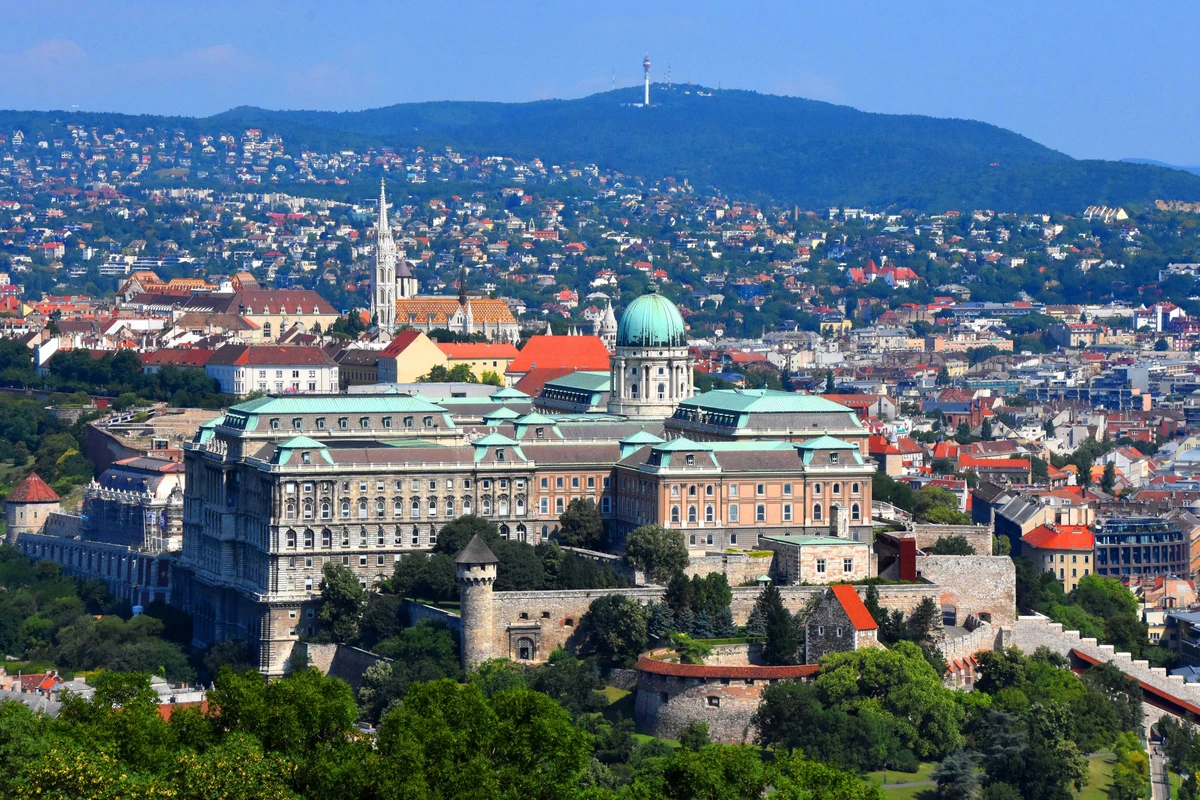
Into the Hungarian Capital Budapest (Photo)
Speaking of the famous waltz 'The Blue Danube', many people immediately think of it as the masterpiece of the famous Austrian composer Strauss. Thus, they naturally imagine the touching Danube scenery flowing in its beautiful melody. However, although the Danube flows through multiple countries including Austria and Hungary, the Danube scenery viewed in Budapest, the capital of Hungary, is particularly captivating and unforgettable. I remember on June 30, 2018, at 8:30 a.m. Hungarian time, the journalist's Balkan tour group departed from the Hungarian Guest Hot Spring Hotel they were staying at, and drove to downtown Budapest to start a one-day tour.
Overlooking Budapest (Photo by Feng Ganyong)
The itinerary for the day was: first, go to Gellért Hill, the highest point in Budapest, to overlook the panorama of Budapest and visit the Statue of Liberty and its square; then descend to the famous Fisherman's Bastion, where they viewed St. Mary's Church, the Holy Trinity Column, the Hungarian Royal Palace, and overlooked the scenery on both sides of the Danube and the Chain Bridge; finally, pay homage to the statue of the Hungarian patriotic poet Sándor Petőfi. The entire schedule was well-organized, and the journalist sensed that Budapest's charming scenery and profound cultural landscape would leave an unforgettable impression.
Staying at the Hot Spring Hotel (Photo by Feng Ganyong)
On the evening of June 29, when the tour bus entered Budapest, the capital of Hungary, and the beautiful Danube once again appeared before their eyes at close range, the journalist was already excited. Although the Austrian composer Johann Strauss created the famous 'Blue Danube' waltz, frankly speaking, in the journalist's view, the scenery of the Danube flowing through Vienna, Austria, is not as beautiful as that of Budapest, Hungary!
Bridge over the Danube (Photo by Feng Ganyong)
During the journey, Shen Chenwei introduced Budapest: Budapest is the capital of Hungary, the main political, commercial, transportation center and largest city of the country; it is also a famous ancient city in Europe, located in the north-central part of the country, on both sides of the middle reaches of the Danube. Originally two cities facing each other from afar, after centuries of expansion, in 1873, the city of Buda and Óbuda on the left bank of the Danube and the city of Pest on the right bank were merged. Before that, there was no name 'Budapest'; it was usually called Pest-Buda.
Danube Riverside (Photo by Feng Ganyong)
Budapest has the reputation of 'Paris of Eastern Europe'. The most important attractions of Budapest are all located on the banks of the Danube. On the west bank, on the steep rocky hill of Buda, stand the Liberty Monument and the castle. At the foot of the hill is the Gellért Bath, and downstream is the main building of the Budapest University of Technology and Economics. North of the castle, on the hill, is Buda Castle. Today, the castle houses the National Library, the Hungarian National Gallery, and the Budapest History Museum. Sándor Palace, next to the castle, is the residence of the Hungarian President.
Overlooking the Danube (Photo by Feng Ganyong)
The Danube flows through Budapest to the Black Sea. The river is easy to navigate, so Budapest was once a major commercial port. Today, inland shipping is of little significance to Budapest. Besides sightseeing boats, there are flights to Bratislava, Slovakia, and Vienna, Austria.
Both Sides of the Danube (Photo by Feng Ganyong)
As we spoke, our bus first arrived at Gellért Hill in Budapest. Besides overlooking the beautiful scenery on both sides of the Danube, one can also see a statue of the Statue of Liberty, facing east, holding an olive branch. It is a landmark of the city. If the weather is fine, the statue, standing tall and looking up, can be seen from far away. Sometimes, newcomers to Budapest have difficulty distinguishing directions. If people lose their sense of direction, they can look up at the Statue of Liberty, and the goddess will point them the way.
Statue of Liberty (Photo by Feng Ganyong)
This Hungarian Statue of Liberty was originally named the 'Liberation Monument'. In 1945, German SS troops held the last Gellért Castle in Budapest for a final desperate resistance. The Soviet Red Army launched several fierce attacks from the foot of the hill, thousands of Soviet soldiers died on the battlefield, and finally conquered the fortress, liberating Budapest. To commemorate the Soviet martyrs, in 1947, the famous Hungarian sculptor Kisfaludi Strobl Zsigmond created this set of statues. After completion, the Statue of Liberty narrowly escaped demolition twice in 1956 and 1992. Below the goddess statue, there are two other statues: one of a youth holding a torch, and the other of a figure fighting demons with a raised fist.
Statue of a Youth Holding a Torch (Photo by Feng Ganyong)
Shen Chenwei said that this sculpture also appeared on the Hungarian ten-forint coin used from 1971 to 1995. After the dissolution of the Soviet Union in 1991, Budapest removed all public memorials expressing communist movements and ideas, but retained this symbol of peace and freedom, a landmark of Budapest, giving it new meaning and renaming it the 'Freedom Monument'.
Fighting Demons with a Raised Fist (Photo by Feng Ganyong)
Perhaps because every goddess has proud characteristics, her upward-looking posture prevents people from seeing her expression and face, adding mystery and space for imagination to her beauty. Maybe this is also the freedom of the goddess. But some friends have experienced that sitting here waiting for the sunset, watching Budapest in the twilight, is absolutely an indescribable enjoyment.
Group Photo on Castle Hill (Photo by Sun Tao)
Indeed, besides paying homage to the goddess statue, Gellért Hill is also one of the best spots to overlook the Danube scenery of Budapest. Everyone knows 'The Blue Danube', but what people see here is far from that romantic and blue clarity.
Group Photo by the Danube (Photo by Feng Ganyong)
Someone has counted that the river changes color eight times in a year: 6 days brown, 55 days turbid yellow, 38 days turbid green, 49 days bright green, 47 days grass green, 24 days iron grey, 109 days gem green, and 37 days dark green. But the beautiful scenery on both sides of the river, complementing each other, far exceeds the charm of the river itself.
Overlooking a Bridge on the River (Photo by Feng Ganyong)
Budapest is also called the 'Pearl on the Danube'. Therefore, everyone who has been to Budapest is attracted by the several bridges over the Danube. From north to south, they are: Újpest Railway Bridge, Árpád Bridge, Margaret Bridge, Chain Bridge, Elizabeth Bridge, Liberty Bridge, Petőfi Bridge, Rákóczi Bridge, and the Deák Ferenc Railway Bridge, totaling nine bridges. Through them, the two cities of Buda on the west bank and Pest on the east bank are connected.
Overlooking the Chain Bridge (Photo by Feng Ganyong)
Each bridge has its own story. The oldest and most famous is the 'Széchenyi Chain Bridge'. The Chain Bridge is also considered the premier bridge in Budapest. In early times, there was no bridge over the Danube, and the connection between Buda and Pest relied solely on ferries. Later, to facilitate communication, a temporary wooden pontoon bridge was built that allowed people and vehicles to cross without hindering navigation.
Chain Bridge Head (Photo by Feng Ganyong)
In the first half of the 19th century, the famous Hungarian politician and writer Széchenyi István proposed building a proper bridge. Construction began in 1839 and was completed in 1849. It was the oldest and most magnificent of the nine bridges connecting Buda and Pest. This steel bridge, with huge steel cables as the framework and two stone piers in the river as supports, is 375 meters long. It was the longest chain bridge in the world in the mid-19th century.
View of the Chain Bridge in the Distance (Photo by Feng Ganyong)
At both ends of the bridge stand a pair of huge stone lions, the work of the famous Hungarian sculptor János. This bridge has become a landmark and symbol of Budapest. During World War II, the German army blew up all the bridges to consolidate their fortifications on Castle Hill. Later, the Hungarian people restored it according to the original design. After post-war reconstruction, the Chain Bridge was reopened in 1949, one hundred years after its completion. The stone lions, now over 150 years old, still stand proudly at the bridgeheads.
Elizabeth Bridge (Photo by Feng Ganyong)
If the Chain Bridge embodies the heavy architectural features of 19th-century Europe, the Elizabeth Bridge reflects the style of the 1960s. This bridge is located at the narrowest point of the Danube in Budapest, with a span of only 290 meters. It is named after Empress Elisabeth Amalie Eugenie of Austria, known as Sisi, who was assassinated in 1898.
Crossing the Elizabeth Bridge (Photo by Feng Ganyong)
Today, a giant bronze statue of Sisi is placed in a small garden on the Buda side of the bridge. The original bridge was built from 1897 to 1903, with a single span of 290 meters, making it the longest span bridge in the world at that time. It was also destroyed by the fascists in World War II and was rebuilt on the original site in 1964. The bridge is pure white, with a simple design, combining elegance with grandeur, giving a pure and refreshing modern feel.
View of the Sisi Bridge in the Distance (Photo by Feng Ganyong)
Hungarians love this legendary empress, so the Elizabeth Bridge, named after 'Sisi', is a fitting memorial to her.
Green Bridge on the Danube (Photo by Feng Ganyong)
The Liberty Bridge on the Danube, commonly called the 'Green Bridge' due to its color, was inaugurated by King Joseph Franz of Austria-Hungary, Sisi's husband, in 1896. The bridge was originally named after him (Joseph Bridge) and kept that name for 50 years. Romantic Budapests see these two bridges, facing each other from afar, as a symbol of the eternal love between the king and queen.
Petőfi Bridge (Photo by Feng Ganyong)
The Petőfi Bridge on the Danube was first named after Regent Miklós Horthy, later renamed after Sándor Petőfi, becoming Petőfi Bridge. It was first built between 1933 and 1937, with a total length of about 514 meters including approaches, and a width of 25.6 meters. After decades of wind and rain, it still stands over the Danube.
Tourists on Castle Hill (Photo by Feng Ganyong)
Gellért Hill in Budapest, also called Castle Hill, is a 160-meter-high hill facing the Danube. The castle walls built in the 13th century are still well preserved. This is the area with the most concentrated attractions for tourists visiting Budapest, gathering most of the sights in Buda. It is not only the 'first stop' for many tourists starting their tour of Budapest, but also the first scenic spot for the group, leaving an unforgettable memory.
Fisherman's Bastion (Photo by Feng Ganyong)
Two other famous attractions on Castle Hill are the uniquely shaped Fisherman's Bastion, built in 1905, and St. Mary's Church, over 700 years old. After leaving the goddess statue, the group arrived at the famous Fisherman's Bastion on Castle Hill. The Fisherman's Bastion is a 100-meter-long white stone wall built on the foundations of medieval city walls. Tourists climb the stairs along the wall to see a wide city top and half-height parapets on both sides, and there are round watchtowers resembling beacon towers inside the city.
Arcade of Fisherman's Bastion (Photo by Feng Ganyong)
This fortress, named in memory of the fishermen who defended the Danube in the past, is a two-story white building complex blending Neo-Gothic, Neo-Romanesque, and Hungarian local architectural styles, facing the Danube and the Parliament Building. Along with the Parliament and the Opera House, it is rated as one of the most impressive architectural complexes in Hungary.
Round Tower of Fisherman's Bastion (Photo by Feng Ganyong)
Looking around the courtyard of Fisherman's Bastion, one sees five pointed small round towers around the bastion, connected by arcades to the main tower, full of fairy-tale charm. The surroundings are beautiful and the scenery is very attractive.
Group Photo at Fisherman's Bastion (Photo by Sun Tao)
Today, Fisherman's Bastion is an important place for Budapest residents to take a leisurely walk after dinner, especially for couples who like to date here. A survey concluded that the highest proportion of first kisses among young people occurs here.
Couple on the Bastion (Photo by Feng Ganyong)
Standing on Fisherman's Bastion, one can see magnificent views that cannot be fully seen from the top of Castle Hill: the Danube, Margaret Island, the Chain Bridge, the Hungarian Parliament Building, and Liberty Hill all in one view. Fisherman's Bastion at night also has unique charm; everything around looks especially enchanting under special lighting. The performances of street musicians on the platform add a touch of romance.
Musician Performance (Photo by Feng Ganyong)
It is also the best place to view the Hungarian Parliament Building from a distance. The building's design imitates the London Parliament Building, designed by architect Imre Steindl, adopting the popular Gothic style of the time, incorporating many vertical slender elements and spires into the whole building, successfully shaping a new appearance for many important public buildings at that time. Its large structure stands majestically on the Danube, with red roofs and white walls, every detail finely carved, making it endlessly fascinating.
Overlooking the Parliament Building (Photo by Feng Ganyong)
Construction of the Hungarian Parliament Building began in 1896 and was completed and opened in 1904, taking 8 years. It is 96 meters high, about 32 stories. Besides using 400,000 bricks and 1 million precious stones, the building lavishly used 40 kilograms of gold as building material. At that time, it was already fully equipped with electric lights, elevators, mechanical ventilation, air conditioning, and other advanced facilities, showing the level of luxury at that time.
Parliament Building (Photo by Feng Ganyong)
Another attraction on Fisherman's Bastion is St. Mary's Church, also called Matthias Church, because in 1470, King Matthias of Hungary ordered his royal emblem to be hung on the south gate of the church. The church was originally built in the mid-13th century during the reign of Béla IV. Over the next centuries, many kings were crowned here, hence it is also called the Coronation Church.
Matthias Church (Photo by Feng Ganyong)
In addition, many royal weddings and ceremonies to celebrate the army's victorious return from expeditions were held here. St. Mary's Church is a witness to Budapest's history. Architecturally, it is Gothic. On both sides of the arched pointed west gate are two asymmetric spires, one high and one low. The south spire is 80 meters high, with colorful stone patterns, the most beautiful part of the church's exterior. The other, very short and thick, is the Béla Tower with four turrets. The vaults are inlaid with colored glass, shimmering in the sunlight. The walls and corners are varied in shape, giving a delicate and elegant feeling.
Sculptures at Fisherman's Bastion (Photo by Feng Ganyong)
On the St. Mary's door of the church, there is a 14th-century relief depicting the Assumption of the Virgin. The church's interior murals depict the deeds of saints. In front of the church stands an octagonal stone tower with very special carvings. The church was converted into a mosque during the Turkish occupation, and after the recapture of Buda, it was restored as a Catholic church. Its current appearance was determined during renovations from 1874 to 1896, when many outstanding artists participated in the restoration of the castle.
Close-up of the Church (Photo by Feng Ganyong)
Castle Hill not only has important historical value but is also a unique natural landscape. The beautiful Danube forms a semicircle here, and Castle Hill sits in the middle of the river bend. The oval main peak at the southern end of the hill stands on the banks of the Danube, overlooking Pest city. Viewed from the concave opposite bank, the mountain and water complement each other, making Castle Hill majestic and magnificent. Behind the hill is the huge silhouette of Gellért Hill, forming a beautiful landscape painting.
Statue of the King (Photo by Feng Ganyong)
Today, part of the castle is used as a restaurant. The bronze statue between Matthias Church and Fisherman's Bastion is of Saint Stephen I, the first Hungarian king, also known as Saint Stephen. King Saint Stephen was crowned the first Catholic king of Hungary in 1000 AD and can be considered the founder of the Hungarian state. The Hilton Hotel next to Fisherman's Bastion reflects the reflections of Fisherman's Bastion and the nearby church in its brown glass curtain wall, beautiful and charming. Fisherman's Bastion has now become a famous tourist attraction in Budapest, visited by a steady stream of tourists every day. It was inscribed as a UNESCO World Heritage Site in 1987.
Holy Trinity Column (Photo by Feng Ganyong)
Descending from Fisherman's Bastion, the group headed to the Buda Hungarian Royal Palace area. On the way, they saw a very peculiar monument-like structure in the middle of a street. Shen Chenwei said it was the Holy Trinity Column. It is a triangular column rising from a high base, with many figures of saints, symbolizing the Holy Trinity (Father, Son, and Holy Spirit). The Holy Trinity Column was built to commemorate the Black Death in 14th-century Europe.
Street Architecture (Photo by Feng Ganyong)
In 1347, the city of Caffa on the Crimean Peninsula suddenly fell into hellish panic. Healthy people fell one after another, the number of dead soon exceeded the living, corpses piled up like mountains, and stench reached the sky. Unable to bury them, the government used poles to push the bodies into the sea. The port was abandoned. This is commonly regarded as the beginning of the Black Death in Europe, which then swept across the continent.
Railway Station (Photo by Feng Ganyong)
In six years, at least 23.5 million Europeans lost their lives, accounting for 3/8 of the pre-epidemic European population (about 62.5 million). For comparison, the six-year-long World War II only eliminated 5% of the European population. This was indeed an unprecedented disaster for humanity. After this catastrophe, Europe probably truly understood the importance of social civilization and sanitation. Budapest was also a hard-hit area of the Black Death, so the Holy Trinity Column was erected in commemoration.
Buda Castle (Photo by Feng Ganyong)
Continuing a short distance from the Holy Trinity Column, they arrived at Buda Castle, also known as the Hungarian Royal Palace. The palace was built in the 13th century by the Árpád dynasty on the right bank of the Danube, originally used as a military fortress. Later, after catastrophic destruction from Mongol, Turkish invasions and World War II, a special reconstruction committee was established after the war to rebuild Buda Castle. The palace seen today is the post-war reconstruction. The exterior architectural form of the new palace retains the original Baroque style, but the interior uses new structures suitable for modern needs.
Museum (Photo by Feng Ganyong)
The central part of the palace houses the Budapest History Museum, the National Széchényi Library, the Gallery, and the Contemporary Art Museum. The museum displays historical materials about Budapest and Hungary, arranged in chronological order. The central hall is the Hungarian National Gallery, displaying a large number of masterpieces by famous Hungarian painters and sculptors throughout the ages. On the south side of the hill are the ruins of medieval city walls.
Turul (Photo by Feng Ganyong)
On the pillar of Buda Castle stands an eagle spreading its wings for flight. It is the Hungarian mythical bird 'Turul', sculpted in 1896 to commemorate the 1000th anniversary of the Hungarian migration to Buda. Legend says that when the Hungarians came here, the Turul flew ahead to guide them. The eagle holds a 'Sword of Attila' in its claws, said to have the power to conquer the world. On the square in front of the palace facing the Danube stands an equestrian statue of Prince Eugene of Savoy, the military commander who liberated Buda in 1686.
Presidential Palace (Photo by Feng Ganyong)
In the palace garden behind, there is the Matthias Fountain, behind which is a set of sculptures called 'King Matthias's Hunting Scene', with a statue of King Matthias in hunting clothes at the top. The white building north of Buda Castle is the Presidential Palace. In the old palace on Buda Hill in Budapest, various bronze sculptures are lifelike, leaving a deep impression. The sculptures vary in form and content, but one thing they share is exquisiteness.
Scenery Around the Palace (Photo by Feng Ganyong)
The last stop of the Hungarian tour in Budapest was the statue of Petőfi, located on the southeast side of the Elizabeth Bridge. There are several small countries in Europe that, though small, often have at least one or two figures famous in China. Hungary has Petőfi and Sisi, which undoubtedly adds a sense of familiarity for tourists visiting here.
Petőfi Statue (Photo by Feng Ganyong)
Speaking of Petőfi, in the minds of many Chinese, he is undoubtedly the most famous Hungarian literary figure. Perhaps you don't know Imre Kertész, the Hungarian novelist who won the Nobel Prize in Literature in 2002, but you must have heard the well-known poem 'Life is dear, love is dearer; for freedom, both can be given up.' This popular poem was written by Hungary's Petőfi.
Petőfi Statue Surroundings (Photo by Feng Ganyong)
Petőfi (1823-1849) was born into poverty; he was poor in his youth. He published his first work, the poem 'The Drunkard', at age 19, which made him famous. At that time, he wrote poems in the style of Hungarian folk songs. He said that only the people's poetry is true poetry. Many of his early works were set to music by composers such as Liszt and became popular. At age 21, he came to Budapest to work as a newspaper editor and published his first collection of poems.
View of the Palace in the Distance (Photo by Feng Ganyong)
His works established his position in Hungarian literature. His 'Patriot's Song' and 'Against the King' became famous in poetry circles. In Budapest, he participated in and led the radical youth organization 'Young Hungary', using his poems to call on the Hungarian people to oppose Austrian oppression. At age 23, in the preface to his complete poetry collection, he wrote the epigram poem 'Freedom and Love', the classic line 'for freedom, both can be given up', like a bugle sounding the poet's oath to revolution. Thereafter, he continuously used poetry to inspire the Hungarian people's resistance.
Street Scene (Photo by Feng Ganyong)
Petőfi was not joking. In 1847, at age 24, he joined the revolutionary army and devoted himself to Hungary's war of independence. At that time, he left his beloved wife, who was four years younger and pregnant. She was a noble's daughter who had broken through family barriers to marry him. To suppress the Hungarian uprising, Austria brought in Russia to jointly suppress it.
Group Photo at Petőfi Statue (Photo by Wang Jue)
In 1849, Petőfi died under the sabers of Cossacks. Petőfi wrote more than 800 lyric poems and eight long narrative poems in his lifetime, as well as over 800,000 words of novels, political essays, and travel notes. Many of these works were completed amid the war. Such high productivity is rare in European literary circles.
Street Sign (Photo by Feng Ganyong)
The official Hungarian account is that Petőfi died in the great Battle of Segesvár, and his body was buried in a mass grave of 1,050 martyrs. However, there is also a claim that he did not die at that time but was captured and exiled to Siberia. Regarding the mystery of Petőfi's death, recently Chinese forensic experts, through DNA identification, confirmed that the remains found by Lake Baikal belong to Petőfi.
Family Outing (Photo by Feng Ganyong)
If we say that the Balkan Peninsula tour, starting from Beijing, passed through Berlin, Germany; Warsaw, Poland; Brno, Czech Republic; Bratislava, Slovakia; Budapest, Hungary, these are all European countries but not yet Balkan Peninsula countries. With the end of the group's itinerary in Budapest, Hungary, on the afternoon of that day, they would drive to Belgrade, the capital of Serbia, which would officially begin the journey into the Balkan Peninsula. (Text and photos: Feng Ganyong)


