Weekend Trip to Beijing Daxing Airport and Tianjin Haihe River
Beijing Daxing International Airport, one of the new seven wonders of the world, quickly became a famous check-in spot after its official operation before the 70th anniversary of National Day. New landmark of Beijing, new national gate, beauty of lines, beauty of structure, combination of art and aesthetics... Full of praise, I really wanted to find a chance to see it for myself. After the national winter-spring flight schedule change on October 27, 2019, Nantong Xingdong International Airport opened flights to and from Daxing Airport, making it possible to realize this wish at my doorstep. On a weekend in early November, with nothing urgent on my mind and cheap flight tickets, I started a 2-day tour of Beijing Daxing Airport + Tianjin Haihe River.
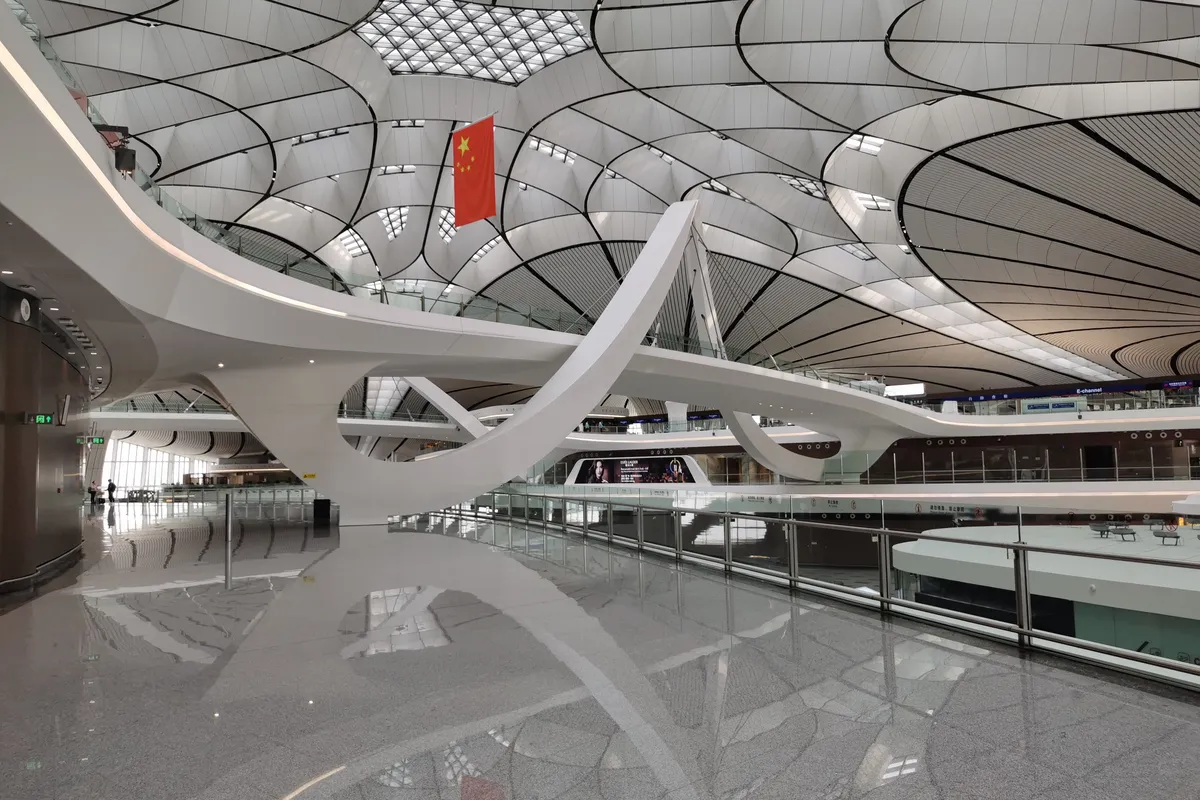
At Daxing Airport, I experienced the smooth and dynamic design, the unrestrained and graceful curves, the spacious and bright spaces, and kept taking photos non-stop.
In Tianjin, I took a night cruise on the Haihe River. The water shimmered, the lights painted beautiful pictures. Jinmen, Jinta, Jiefang Bridge, Dagu Bridge, Jingang Bridge, Shizilin Bridge, Jintang Bridge, Jinbu Bridge, Bei'an Bridge. Not satisfied with the night view, I walked along the river again during the day, walking and walkingnon-stop.
Departure, let's go—
Daxing Airport is located at the junction of Beijing Daxing District and Langfang Guangyang District, Hebei Province, 46 kilometers from Tiananmen in Beijing, 26 kilometers from downtown Langfang, and 55 kilometers from Xiong'an New Area. It has a total construction area of 1.43 million square meters and a total investment of about 80 billion yuan. Construction started in December 2014 and was officially put into operation on September 25, 2019.
The airport adopts a five-finger corridor layout, with five long corridors radiating from the main terminal building. Seen from above, it looks like a phoenix reborn from fire. The terminal building was designed by ADPI of Paris Airports Group and Zaha Hadid Architects, based on ADPI's plan and incorporating the strengths of other bidders' proposals, and finally integrated and implemented by the consortium of Beijing Institute of Architectural Design and Civil Aviation Design Institute, a fine work that draws on the best of many.
Zaha Hadid, famous for "Zaha curves," was born in Baghdad, Iraq in 1950. She was the first woman to win the Pritzker Prize, the Nobel Prize of architecture. Her designs are known for bold shapes, skillfully using geometric structures and dynamic curves to create space, and she is called a "master of deconstructivism" in architecture. In China, the Guangzhou Opera House, Beijing Lizhong SOHO, Nanjing Youth Olympic Center, and Hong Kong Polytechnic University's building are all works of her team. Unfortunately, she passed away from a sudden heart attack on March 31, 2016.
Let's experience the dreamlike design together: the C-shaped columns in the hall, curved seats, curved skylights, "Belt and Road" suspension bridges, transparent glass curtain walls...
On the C-shaped columns, bundles of steel bars resemble huge lotus leaves, spreading outward, light and lively yet strong and powerful.
Smooth as flowing clouds and water, elegant and romantic, the organic unity of function and form makes me want to go back to school and choose an art major.
Soft lighting, clean floors, wonderful reflections.
The terminal building has five floors above ground, with many shops already moved in.
Daxing Airport is located at the southernmost point of Beijing's central axis. It inherits history, echoing Tiananmen, the Bell and Drum Towers, and the Bird's Nest, while facing the future, directly serving the connection between Xiong'an and the world.
From the surrounding tower cranes and exposed yellow earth, it's clear that construction is not yet fully complete. I believe that in the near future, this airport economic zone, which relies only on blue skies without coastal or border advantages, will become more mature with support from all sides, becoming an engine driving the development of the Beijing-Tianjin-Hebei urban agglomeration.
The terminal building has two underground floors, where you can transfer to high-speed rail and subway.
Take the Beijing-Xiong'an intercity railway to Beijing West Railway Station (28 minutes, 30 yuan), then transfer to the subway to Beijing South Railway Station (20 minutes), then take high-speed rail to Tianjin.
From Daxing Airport to downtown Beijing, you can also take the subway to Caoqiao Station, 20 minutes, 35 yuan. Of course, there are also airport buses and taxis, but the time is hard to guarantee.
My itinerary in Tianjin was arranged as follows: take a night cruise on the Haihe River in the evening, then the next day walk along the river to "review" the scenic spots. I also visited Xikai Church, the Porcelain House, and the Italian Style Area. For reading smoothness, I put the night and day pictures of the same scenic spot together, so you can compare them and savor the different flavors.
The cruise tickets on the Haihe River are divided into daytime and nighttime. Daytime tickets can be purchased through the WeChat public account "Tianjin Haihe Cruise" or Ctrip and other websites. Nighttime tickets must be purchased through the public account. The cruise route is from Jiefang Bridge to Yongle Bridge Ferris Wheel (Tianjin Eye) round trip, 50 minutes in total, 80 yuan during the day, 100 yuan at night. There are four docks: Tianjin Station Dock, Yifeng District Dock, Ancient Culture Street Dock, and Dabei Yuan Dock for boarding and disembarking. The cruise does not stop midway; you get off at the same dock where you boarded.
A reminder: due to climate changes, the cruise ships are suspended in winter to ensure passenger safety and prevent equipment damage from freezing. Last year it stopped on November 8, this year on November 11.
The cruise departing from Tianjin Station Dock passes through its first bridge, Jiefang Bridge.
Jiefang Bridge spans the Haihe River between Tianjin Station and Jiefang North Road, 97.64 meters long and 19.5 meters wide. Built in 1927, because at that time Tianjin had concessions from Britain, France, Russia, the United States, Germany, Japan, Italy, Austria, and Belgium, it was named Wanguo Bridge (Bridge of Ten Thousand Nations). After the victory of the Anti-Japanese War, the Nationalist government renamed it Zhongzheng Bridge. After liberation in 1949, it was renamed Jiefang Bridge.
Jiefang Bridge is a double-leaf bascule steel bridge, the only opening bridge on the Haihe River within the urban area. On major holidays, when there is no adverse weather, Jiefang Bridge opens. This year's opening times were Qingming Festival, Labor Day, Children's Day, Dragon Boat Festival, Party Founding Day, Army Day, Mid-Autumn Festival, and National Day (October 1 and October 4), from 8:30 PM to 10:00 PM. I didn't see the bridge opening in person this time, so I found two pictures online and pretended I was there.
Next time, if I have a chance, I'll choose the right time to watch it on site.
At the north end of Jiefang Bridge, there is an iconic spot—Century Clock.
The side of the clock face has a huge pendulum shape, with the "sun" on top and the "moon" hanging below. The pendulum frame is Tai Chi S-shaped, symbolizing the alternation of yin and yang, interdependence.
Between the outer ring and inner ring of the dial, there are inlaid patterns of the twelve zodiac signs. At the top, 12 o'clock position is Aries (sheep symbolizes good luck in China), and at the bottom, 6 o'clock is Libra (scales represent fairness), reflecting the fusion of Chinese and Western cultures.
Next is Dagu Bridge.
Dagu Bridge is 243 meters long and 32 meters wide, designed as "Sun and Moon Shining," called the "Sun Moon Arch Bridge." It was opened to traffic in November 2005. In 2006, it won the world bridge award Eugene Figg Award. Only one bridge in the world wins this award each year. Domestically, Jiangyin Yangtze River Bridge and Shanghai Lupu Bridge won in 2002 and 2004 respectively.
The feature of Bei'an Bridge is its sculptures. At the bridgeheads, there are four sculptures representing the four directions: Azure Dragon, White Tiger, Vermilion Bird, and Black Tortoise. On the railings, there are four statues of female musicians in different dancing postures, holding Ruan, Sheng, Paixiao, and Pipa respectively.
Jinbu Bridge, from a distance, looks like a speeding bullet train.
Jintang Bridge was built in 1906, 19 years earlier than Jiefang Bridge, and is the earliest large iron bridge still in existence in Tianjin. In 2018, it was included in the first batch of China's Industrial Heritage Protection List.
Jintang Bridge is a landmark symbolizing the liberation of Tianjin. During the Pingjin Campaign starting at the end of November 1948, the People's Liberation Army formed two assault groups from east and west with five corps and launched a general offensive against the Tianjin defenders, successfully meeting at Jintang Bridge at dawn on January 15, 1949. To protect this bridge with both cultural relic and historical commemorative value, glass steel approach bridges and a meeting park were built at both ends.
Now Jintang Bridge is a landscape bridge. The deck is paved with wooden planks, the body retains the original steel structure, and the approach bridges and steps are glass steel. It is not open to vehicles, only for pedestrian sightseeing.
Wanghailou Church, built in 1859, was the first church built after the introduction of Catholicism to Tianjin. The "Tianjin Massacre" of 1870 took place here.
The Tianjin Massacre was a typical event in modern Chinese history of anti-foreign church struggles, offering a glimpse into late Qing history. Those interested can search online.
Next to Wanghailou Church is Shizilin Bridge (Lion Forest Bridge), characterized by 184 lions in different shapes, each one unique.
The Hundred Blessings Pillar. The 12 blessing characters on the pillar, from top to bottom, were written by: Mao Zedong, Wang Xizhi, Wei Guan, Sun Guoting, Huaisu, Su Xun, Huang Tingjian, Zhao Mengfu, Deng Wenyuan, Dong Qichang, Wang Duo, Yu Youren, and Kangxi. The blessing on the pillar base was written by Kangxi.
Nearby is the Ancient Culture Street.
Here comes the famous Yongle Bridge Ferris Wheel (Tianjin Eye).
The Ferris wheel is built on Yongle Bridge, 110 meters in diameter, the largest in Asia. It has 48 360-degree transparent cabins, each can accommodate 8 people, taking 28 minutes for one rotation. When visibility is good, from the highest point you can see scenery within 40 kilometers, hence the name "Tianjin Eye." When the Beijing 2008 Olympic torch was passed through Tianjin, it went over Yongle Bridge.
Tianjin Eye is located at the three-river junction, where Ziya River, South Canal, and Haihe River meet. At the estuary, there is a monument for the Luanhe River Diversion Project to Tianjin, with the inscription personally written by Deng Xiaoping on August 20, 1986. At the base is a statue of "Drinking water, thinking of the source," a young mother holding a baby facing the Haihe River, symbolizing not forgetting the well-diggers when drinking water.
The Luanhe River Diversion to Tianjin was a major water supply project in the early 1980s, diverting water from the Luanhe River in Qianxi County, Hebei Province to Tianjin. The total water conveyance distance is 234 kilometers, with an annual water volume of 1 billion cubic meters. The key was tunneling through the oldest geological age Yanshan Mountains in China, digging a 12.4-kilometer water diversion tunnel through over 200 fault zones. With the technology and equipment at that time, the difficulty was unprecedented. Among the railway soldiers and local troops involved, 107 were injured or disabled, and 21 sacrificed their precious lives.
Jingang Bridge is a double-deck arch bridge, also called "Rainbow Bridge." It is the best spot to view and photograph the Tianjin Eye.
This Jingang Bridge was rebuilt in 1996. The original Jingang Bridge, Jintang Bridge, and Wanguo Bridge (Jiefang Bridge) were all designed by foreign bridge designers. To facilitate navigation on the Haihe River, they were all designed to be openable. Currently, only Jiefang Bridge retains the opening function.
The cruise turns back from Tianjin Eye, and you can see the previous attractions again.
Jinmen and Jinta are landmarks of Tianjin International Finance Center. Jinmen includes a high-star hotel (St. Regis Hotel) and two symmetrical high-end residential buildings. Jinta includes a 336.9-meter office tower and a matching apartment building.
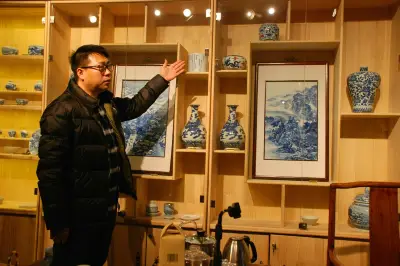
With some time left before departure, I hurriedly visited Xikai Church, the Porcelain House, and the Italian Style Area. Tianjin's tourist attractions are relatively concentrated, mainly around the Haihe River, Wudadao (Five Great Avenues), and Ancient Culture Street, which can be toured in two or three days.
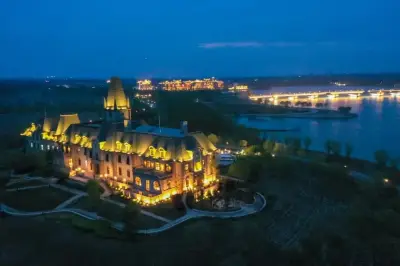
Xikai Church is located on Binjiang Road in Heping District. It is the largest Romanesque building in Tianjin, built by French missionary Paul Marie Dumond in 1916. In 2018, it was selected into the third batch of China's 20th-century Architectural Heritage.
Romanesque architecture is a style from the European Middle Ages, characterized by semi-circular arches, most commonly used in monasteries and churches.
Because Xikai Church was originally located in the French Concession and built by a French missionary, locals used to call it the "French Church."
Nanshi Food Street, built in the style of the Qing Dynasty, has three floors of shops along the street, gathering the eight major cuisines including Shandong, Anhui, Sichuan, and Cantonese. It is a large-scale food gathering place in China and was once named one of the Ten Scenes of Tianjin by the Tianjin municipal government. Due to time constraints, I didn't go inside to see it in detail.
Former Austrian Consulate.
The Italian Style Area is located in Hebei District, Tianjin, originally the Italian Concession. There are nearly 200 well-preserved European buildings.
Marco Polo Square.
Liang Qichao Memorial Hall.
Scenery, stories, interesting.
Actually, I didn't want to leave; I wanted to stay and see all the seasons — spring, summer, autumn, winter.
Every time I travel, I always want to set off with unknowns, but prejudices still sneak in. The biggest prejudice about Tianjin was that there was nothing fun to do here. After just two days of what I saw and heard, my prejudice completely vanished. Tianjin, as one of the four municipalities, has a glorious history, profound heritage, and strong development potential. It was once the forefront of northern openness and the base of the Westernization Movement in modern China. In the Republic of China period, it was the largest city and commercial center in the north. When it was first liberated in 1949, it was the second largest city in the country. Later, after Beijing regained its status as the capital, the brilliance of this pearl of the Bohai Sea gradually dimmed. In recent years, with the in-depth implementation of the Beijing-Tianjin-Hebei coordinated development strategy, Tianjin has been entrusted with greater responsibilities, becoming a "dual center" together with Beijing to lead the development of the urban agglomeration, and its urban capacity will be greatly enhanced.
Today's Tianjin, still prosperous, calm and elegant, is worth staying a few days and slowly savoring.