A Visit to Shengfang Ancient Town on August 30, 2020
Shengfang Ancient Town is situated east of Bazhou in Langfang, Hebei, not far from Beijing and Tianjin, each about a hundred kilometers away. It lies right at the edge of the Dongdian water region, which is another wetland depression in Hebei Province second only to Baiyangdian. Thus, Shengfang Ancient Town has long been a renowned water town in the area, and its long and glorious history began from such an ancient and pristine small fishing village.
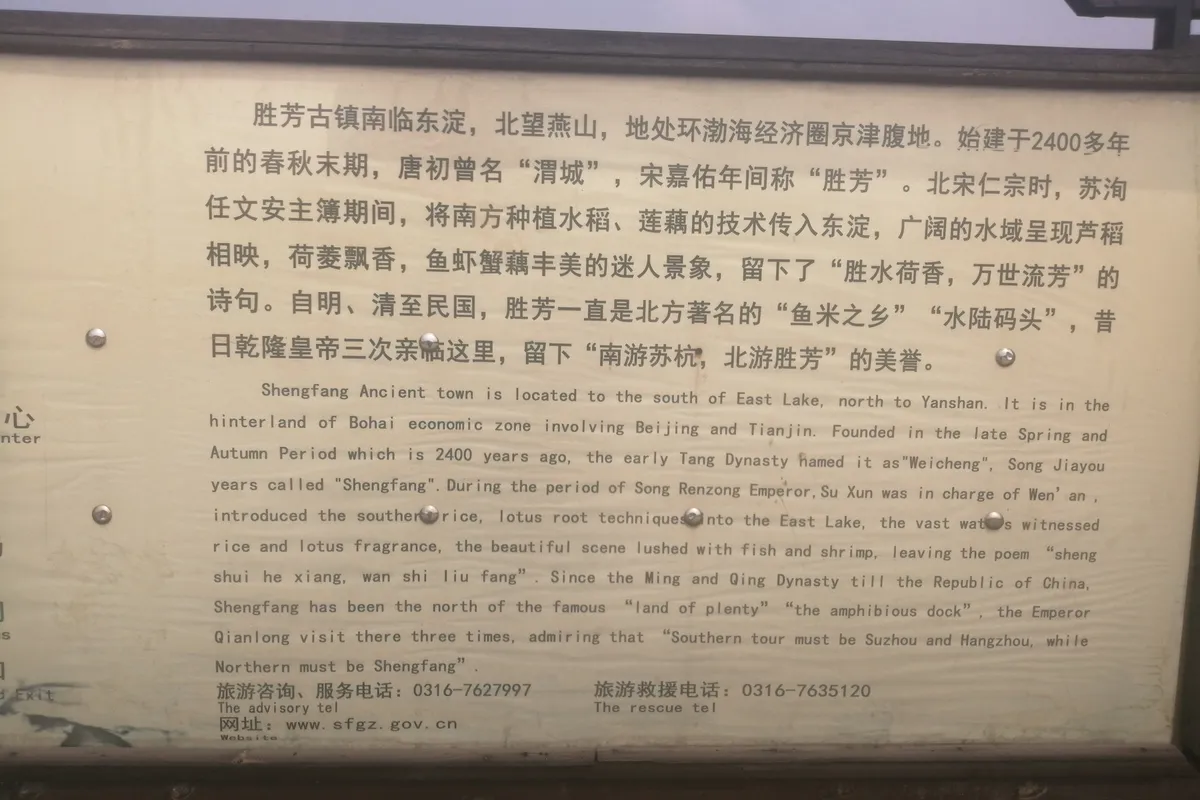
Shengfang was founded at the end of the Spring and Autumn Period, 2,400 years ago, originally as a water town. It was first named Ditou Village because it was located at the confluence of river embankments. In 278 BC, the King of Yan recaptured the area by force and, wishing to share peace, renamed Ditou Village as Wupingting. Later, to avoid the emperor's reign name and because the Weishui River flowed through, Wuping was changed to Weicheng. During the reign of Emperor Renzong of the Northern Song Dynasty, Su Xun, the father of Su Dongpo, served as a local registrar and introduced rice and lotus cultivation techniques from the south to Baiyangdian and Dongdian. The vast waters of Weicheng then presented a scene of reeds and rice reflecting each other, with water chestnuts and lotus fragrance wafting. Literati and scholars vied to compose poems like "Shengshui Hexiang" and "Shengshui Liufang", and thus Weicheng was renamed Shengfang.
Shengfang Ancient Town later developed into a famous water town, first relying on its natural water resources. In the era when water transport dominated, the Zhongting River here was a necessary route for places along the upper reaches of the Daqing River and even the Hai River to travel to Tianjin. The smooth water transportation, integration of diverse civilizations, convergence of material resources, and accumulation of various cultures boosted the local economy and formed an architectural style in the ancient town that blended Chinese and foreign influences, as well as northern and southern styles. The layout of the ancient town fully demonstrates this. Now, the old city streets and lanes are centered on the Chuanxin River, spreading out in all directions with great openness, interspersed with alleys and passages. The narrow lanes are deep, the stone streets are long, and walking among them feels like crossing a thousand years. Look at the houses built along the water, every household facing the river; they still stand by the riverbank, giving a sense of time reversal, as if one can see the unique local lifestyle of fishing, reed weaving, and trading in the past. Additionally, the rise of Shengfang Ancient Town also benefited from the famous large-scale immigration at the beginning of the Ming Dynasty. With a surge in the外来 population, merchants from all directions gathered, and for a time, a thousand sails competed, shops lined the streets, traffic was heavy, and the market flourished. By the early Qing Dynasty, Shengfang had rapidly developed into one of the six wealthy towns of Zhili, with the historical saying, "In the south there are Suzhou and Hangzhou; in the north there is Shengfang." Legend has it that Emperor Qianlong made three incognito visits to Shengfang town.
The ancient history of Shengfang Ancient Town spans over two thousand years, even dating back to the late Spring and Autumn Period, but it truly became a town only after the early Ming Dynasty. The old buildings in the ancient town are at most from the Ming Dynasty. Even so, with the passage of time, natural and man-made disasters, the surviving ancient wooden buildings are few and far between. Most Ming and Qing ancient buildings were either destroyed in war or damaged by age. The current town buildings, from pagodas and temples to pavilions, from residences to ancestral halls, from top to bottom, inside and out, except for a few ancient buildings like several grand courtyards, many other structures have been rebuilt in the last decade or so. Shengfang Ancient Town cannot really compare with Pingyao Ancient City or Langzhong Ancient City, but for those who love searching for ancient relics, it's still worth a visit. I have been to Qingzhou Ancient City, Pingyao Ancient City, etc. Compared to these, Shengfang Ancient Town is quite small. On the surface, it still has the appearance of ancient streets and roads. It boasts the "Three Treasures of the Ancient Town": the Theater, the Wenchang Pavilion, and the Dabei Temple. The Theater is very eye-catching, located in the town center, also known as Jiucheng Tower. It is a typical Qing Dynasty style, with a stable stage and flying eaves with glazed tile roofs. It has always been an important place for leisure and entertainment for the town's residents. The Wenchang Pavilion is majestic and imposing, standing at the town entrance, with long corridors and pavilions, beautiful and magnificent. The nearby pond full of lotus leaves not only creates a cultural atmosphere for the town but also beautifully interprets the auspicious meaning of Shengfang. Dabei Temple seems divinely blessed. In terms of cultural relic value and观赏性, the most distinctive ancient buildings in the town are the Zhang Family Courtyard and the Wang Family Courtyard. Both courtyards were built during the Qing Dynasty. Their owners were wealthy businessmen and were among the eight great families of Shengfang at the time. The Zhang Family Courtyard is tucked away in a quiet lane, simple and elegant, still retaining four connected siheyuan courtyards. The Wang Family Courtyard, adjacent to the Theater, is small and exquisite, with a westernized exterior, appearing more stylish. Apart from serving as office spaces during the Pingjin Campaign and being used as filming locations for one or two movies, these two courtyards have little else to commend.
1. Town Streets
4. Wang Family Courtyard
5. Wine Culture Museum
6. Zhang Family Courtyard
Travelogue Directory1. Historical Origins2. Town Architecture3. Town PhotosTravel InformationHotel IndexGuide IndexFlight IndexWebsite NavigationTravel IndexCruise IndexCorporate Travel IndexFranchise CooperationDistribution AllianceFriendship LinksCorporate Gift Card ProcurementInsurance AgencyAgency CooperationHotel FranchiseDestination and Scenic Area CooperationMore CooperationAbout CtripAbout CtripCtrip HighlightsContact UsCareersUser AgreementPrivacy PolicySecurity CenterCtrip Content CenterIntellectual PropertyTrip.com Group Algorithm Disclosure