My Chengdu Food Journey: Authentic Chengdu Flavors
If you come to Chengdu, you must not miss this attraction—Kuanzhai Alley.
Although it's called Kuanzhai Alley, it is actually composed of Jing Alley, Kuan Alley, and Zhai Alley. Here you can experience the city's everyday street life.
Kuanzhai Alley has always been a symbol of a leisurely and carefree lifestyle. Some say Kuanzhai Alley is like Beijing's Nanluoguxiang, but in my opinion, Nanluoguxiang has an ancient and traditional charm, while Kuanzhai Alley is relaxed and soothing. However, they share one common point: both have a wide variety of specialty snacks. The local famous foods here will definitely fill you up!
Because Kuanzhai Alley preserves so much of old Chengdu culture, when you stroll through it, you'll see a blend of history and modern fashion. Yet you'll find that it's not at all incongruous; on the contrary, it gives a wonderful feeling. The rows of walls built with bricks from different eras, and the relief-like pictures of old street life, make this Chengdu afternoon leisurely and beautiful.
When you come to Kuanzhai Alley, don't say you're just here to see the scenery and not eat anything. I'm afraid you'd be embarrassed to say you've visited. There are so many Chengdu snacks here, it's a feast. I love all kinds of wontons—sweet, salty, numbing, spicy—super tasty and super cheap. Mom's Rabbit Head, Diced Rabbit, roadside skewers, Guokui (stuffed pancake), Zhong Dumplings, and Bebop Chicken are all good. I also recommend a place here that sells Sweet Noodles, which really suits my taste—delicious and affordable, truly great.
Wandering around Kuanzhai Alley and soaking in its charm, you'll find that here you can slowly enjoy a tranquility that's hard to find in daily life. Sipping a cup of tea while eating Chengdu's specialty snacks—perhaps this is true enjoyment.
In ancient times, there was the saying, "The wren nests in the deep forest"; today, there is "The wren nests in Kuanzhai." Speaking of Kuanzhai Alley, this is a bustling area of the city. From ancient times to the present, dignitaries have settled here, and even ordinary people often linger and wander around.
Now tourists and visitors come in an endless stream. From afar, you can smell the aroma of snacks wafting from every corner of the alley, and your ears are filled with the voices of vendors, rhythmically hawking their goods.
The Jiaoliao Humanistic Boutique Hotel, nestled in the midst of noise and seeking tranquility, stands gracefully and modestly at No. 28 Kuan Alley within the Kuanzhai Alley scenic area. The hotel is near Metro Line 4. It is about 19 km from Chengdu Shuangliu International Airport, about a 40-minute drive. Surrounding it are famous attractions such as Kuanzhai Alley, Jinli, Tianfu Square, and Chunxi Road.
If you want to enjoy a peaceful vacation without missing the city's hustle and bustle, the Jiaoliao Humanistic Boutique Hotel is the perfect choice.
Before coming, we had already asked about the origin of the hotel's name. It is said that 'Jiaoliao' was originally a kind of bird, originating from Zhuangzi's writing: 'The wren nests in the deep forest, content with just one branch.' This embodies a poetic dwelling that casts aside worldly troubles, stays true to the heart, returns to nature, and finds freedom and ease—a philosophy of life that retreats from the noise and returns to nature.
And this time, the wren did not nest in the deep forest but chose this alley full of the smoke and fire of human life, located beside a long street bustling with visitors, creating a haven of urban forest for those arriving from afar.
Amid the noisy crowd, we pushed open this large, aged door. First映入眼帘的是正大门,两边的屏门上有镂空雕刻的花纹,其中的蝙蝠图案,借喻福气和幸福之意,对角的两个福,上面有水的波纹,是福如东海的寓意,位于中轨线的福,则是福从天降,加上中间这个,凑齐了五福临门。希望来这里的各位贵宾能够长寿,善终,富贵,康宁,好德。
Crossing the courtyard into the corridor, we saw bamboo, tiles, flowing water, and rockery, giving an antique and elegant feel, as if entering a parallel space parallel to the worldly splendor, separated from the bustling outside by just one wall. My friend, as if powered by a cheat code, kept saying how beautiful it was, taking photos nonstop, happy like a child.
Entering the lobby and looking closely, the entire hotel's decoration style is full of the characteristics and elegance of Western Sichuan residential architecture. The simple and elegant antique buildings imitating the Qing Dynasty combine movement and stillness, showcasing the essence of mountains and waters within a small space. It seems the hotel owner put a lot of heart into it, decorating so exquisitely—no wonder it's so popular.
As we passed through the corridor, the parrots hanging on both sides, jumping up and down, became unusually active because of our arrival, chirping incessantly, amusing my friend. It seems these birds were also welcoming our stay!
The hotel's grey bricks and black tiles interact with the birds' chirping, one moving and one still, complementing the hotel's design style in a harmonious interplay, vividly embodying both movement and stillness.
The 'movement' is reflected in the meticulous details throughout the hotel's decoration, with bird-shaped ornaments echoing the hotel's name everywhere.
The 'stillness' is embodied in the antique quadrangle courtyard of grey-black bricks and tiles. Every plant and tree exudes elegance, every bamboo and stone has charm, establishing a quiet and leisurely life tone—riding on things and roaming freely in the mind, experiencing ultimate carefree bliss.
Crossing the corridor, we arrived at the accommodation area. Entering the guest room, we found that the materials used were all natural, pure solid wood. The room also features Shu embroidery, one of the four famous embroideries, and a duiwo (a stone mortar for rice tools), fully interpreting the original intention of returning to simplicity.
Upon closer inspection, we found that the hardware facilities in the room were also of great origin. Whether it's the bathroom fixtures, fully intelligent sensor toilets, or the mattress, they are all configured according to the top standards of international five-star hotels. Understated luxury exudes a high-end aura—such configuration far surpasses other hotels. How could our group not be tempted?
Inheriting the culture of Laozi and Zhuangzi, creating high-end facilities without being vulgar or abandoning the world. The Jiaoliao Hotel allows you to find the perfect balance between bustling excitement and peaceful seclusion, letting you enjoy both the tranquility away from the world and the convenience of urban hustle—all for your unique experience.
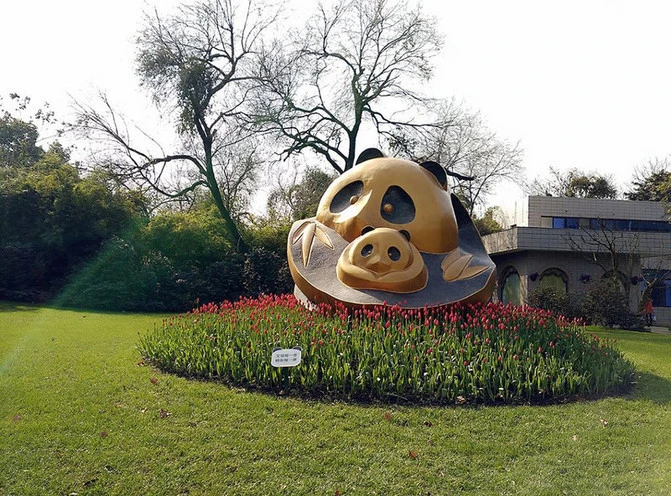
Speaking of Sichuan, you absolutely cannot forget the place where giant pandas live—the Chengdu Research Base of Giant Panda Breeding. Many people love the adorable and clumsy appearance of giant pandas. In the past, we could only see pandas online; browsing their pictures, we found them really soft, cute, and adorable. This time coming to the base, thinking about seeing real giant pandas, we were especially excited—after all, they are our national treasures. 'Serving the country by being cute' is the true talent of these panda babies.
At this base, you will see many, many giant pandas—a completely different feeling from browsing pictures online!
The panda babies here enjoy a national treasure-level treatment, with the environment completely simulating the wild living conditions of giant pandas.
There are lakes, streams, and of course, their favorite food—bamboo!
Most notably, 'Panda Villas' have been built for them. These are also their daily leisure and entertainment venues. When the weather is cool, the panda babies play here—some leisurely stroll in the yard, others roll on the ground—what a carefree and happy scene!
Visitors can also watch the cute pandas through the railings. When it's hot, the pandas cleverly hide in their rest rooms, and visitors can only watch them snoring through the glass.
In short, when you come to Sichuan, you must check in at the Chengdu Research Base of Giant Panda Breeding. The pandas here are truly diverse—whatever you want to see, they have it.
The national treasure giant pandas are really too cute, silly and adorable, free and happy. Suddenly I found myself quite envious of these pandas—maybe, I'm not the only one who thinks so!
Feasting on Chuan Chuan
Location: Exit A of Huazhaobi Metro Station, just a few minutes' walk to Chengdu Gua Chuan Chuan. The sign is really eye-catching. When I walked in, I felt the style was unique, very Chinese, quite interesting.
I must say their storefront decoration is very grand. Inside, the tables are square and neatly arranged, with enough space between them so it doesn't feel crowded. Sitting inside is also very comfortable.
The serving speed is quite fast. I have to mention that their skewers are cold-pot skewers—you choose your ingredients, and the shop cooks them and brings them directly. No need to worry about whether they are cooked; just eat them as soon as they arrive—very convenient.
The dry dip is their specialty, with an excellent flavor and lots of crushed peanuts on top. It felt really good. My friend loved it so much that he wanted to ask the shop for the exact seasoning, but that's impossible—the shop won't reveal it. The dry dip tastes good, but for someone like me who doesn't handle spiciness well, it's not quite suitable. If you love spicy food, this is your dipping weapon!
Of course, they not only have skewers but also small bowl dishes as their specialty. Many small bowl dishes, all quite tasty. Recommended must-order: Mao Huoguo Fen (spicy hot pot vermicelli). The hot pot vermicelli is really delicious and very flavorful, each strand soaked in broth. The taste is simply indescribable—absolutely amazing!
Mao Tuduotuo (spicy mashed potato balls) is my favorite. Not too spicy, the potato chunks paired with the toppings are incredibly tasty. The potatoes are neither too hard nor too soft, with just the right texture. After one bowl, you'll want another.
My first time eating rabbit kidney was at Chengdu Gua Chuan Chuan. Unexpectedly, the rabbit kidney was quite tasty, even better than I imagined. Tender texture, one bite each—really satisfying.
After finishing the skewers, a bowl of bing fen (ice jelly) to cut the grease—life is so wonderful.


