A Four-Day Chengdu Travelogue: Absolutely Worth Keeping!
Some say that at the mention of Chengdu, what comes to mind are not the city name but one delicious dish after another. Because Chengdu is a city brimming with culinary delights. In every alley and on every street of this city, you can stumble upon a wealth of tasty treats and interesting snacks at any moment.
The locals' passion for food has led to a highly developed dining scene. Any out-of-town visitor to Chengdu can't help but be intrigued by its hot pot, Sichuan cuisine, street snacks, and spicy hot pots. To visit Chengdu without indulging in its food is like leaving a treasure mountain empty-handed.
Every city has its own history and culture, as well as its own distinctive neighborhoods. To understand a city's history and culture, you should step into its characteristic streets, learn about the cultural origins and anecdotes of historical figures they preserve, feel the lingering warmth of history up close, and experience the prosperity of commerce and the vibrant hustle and bustle that have survived the changes of time.
With some rare leisure time and family by our side, we decided to take a stroll around Jinli, enjoying the sights and savoring every moment.
If Kuanzhai Alleys represent the classical and artistic, like a crescent reflected in a mirror of time, then Jinli embodies the bustling and worldly, like a few fireworks blooming beyond that mirror.
Upon entering Jinli, irresistible aromas of delicious food greet you. Shops are wide open, mainly selling food and drinks. Fresh fruits and delicacies, beautifully arranged, appear and disappear amid the hazy smoke. Their shapes are pleasing, their colors vivid, their scents fragrant, making your mouth water and impossible to resist.
Beside the storefronts, Sichuan opera actors in costume greet visitors. They gesture dramatically, and with a sudden shrug and thrust of the head, their white face turns red, giving you a start. Before you can recover from the shock or get annoyed, they pull you in and make a funny face, causing you to burst out laughing. In that playful moment, your mood instantly brightens.
When we first arrived, the sky was clear, and as we strolled through Jinli, there were fewer tourists, giving it a hazy, classical charm. The lanes in Jinli are not wide, but ancient buildings face each other on both sides, and strings of red lanterns hang at various heights from upturned eaves or from tree branches, twinkling in the misty rain and creating a unique allure.
Walking along the ancient street feels like strolling through the imagery of a melodious poem. The carved, lattice windows, the old walls draped with trailing vines, the winding corridors leading to secluded spots—all like poetic backdrops. Amid the varying shades of elegance, there is a contrast between age-old charm and vibrant life.
Jinli is an ancient street perfect for nostalgia, a place where elegance and earthly pleasures coexist. Here you can uncover memories of Chengdu from the Three Kingdoms era, while also enjoying a leisurely pace of life amidst a fast-moving city.
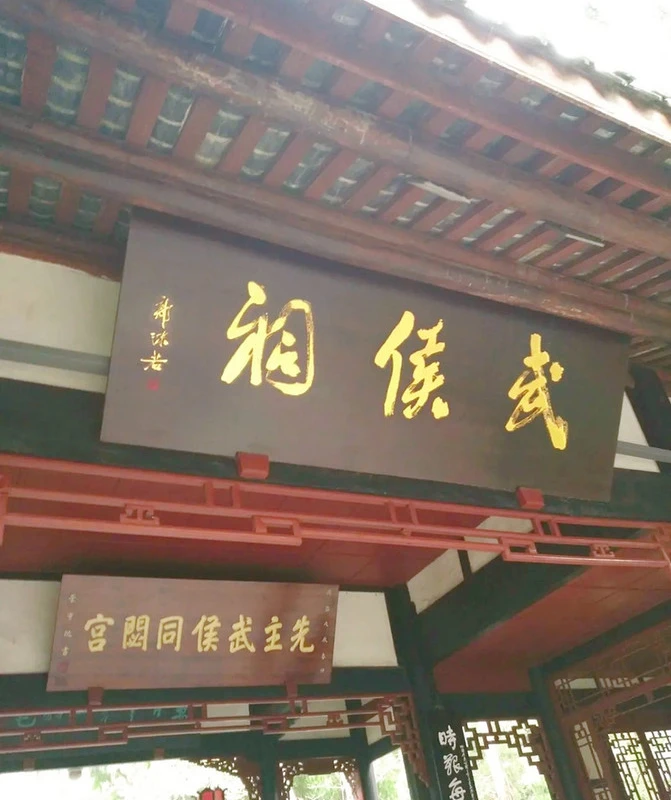
When you hear the title "Marquis Wu," anyone familiar with the Three Kingdoms will find it familiar—indeed, it is the renowned alias of Zhuge Liang, "Zhuge Wuhou." If your favorite kingdom in "Romance of the Three Kingdoms" is Shu, then the famous Chengdu attraction, Wuhou Shrine, is a must-visit; it will surely fulfill all your desires.
Soon it was afternoon, and my family and I prepared to visit Wuhou Shrine to immerse ourselves in the legendary tales of the Three Kingdoms and realize our long-held Three Kingdoms dreams.
Legend has it that Wuhou Shrine was first built in the year 223 AD. Originally constructed as a memorial temple for Liu Bei, later generations merged Liu Bei's mausoleum with Zhuge Liang's ancestral hall, creating the current Wuhou Shrine—the only temple in China where a ruler and his minister are enshrined together.
The heroes of Shu, amidst the shifting winds of change, have turned to dust here. The great deeds they accomplished are buried and rest in this place. All their historical stories have settled and brewed here, giving us today's solemn Wuhou Shrine, a memorial to the heroes of Shu Han.
From the Sanyi Temple to Wuhou Shrine, from the Oath of the Peach Garden to the Three Visits to the Thatched Cottage, we arrived at the main hall of Zhuge Liang's shrine. In the center of the hall hangs a horizontal plaque inscribed with "Eternal Fame Throughout the Universe," undoubtedly the highest praise for Master Zhuge. The first line of the couplet reads: "Win hearts, and opposition subsides; since ancient times, true warriors have not relished bloodshed." The second line reads: "Misjudge the situation, and neither leniency nor strictness will succeed; later rulers of Shu must deeply reflect."
These two lines succinctly summarize Zhuge Liang's lifelong dedication to Shu, his loyalty and ambition, serving with all his heart and might until his dying breath. He repaid with his entire life the gratitude for the three visits to his thatched cottage and the recognition he received.
Wuhou Shrine is not large; situated in the bustling city, it doesn't occupy much space and can be covered in just over an hour. Yet, Wuhou Shrine is also vast, because what it holds is not just a scenic spot but the history of an entire dynasty—a tribute and remembrance of that era.
We strolled, paused, turned into quiet corners, admired potted landscapes, observed flowers and plants, and smelled subtle fragrances. We gazed at ancient trees with gnarled roots, at reflections of arched bridges on the water, and sighed at the dilapidated remnants of Han palace pillars. Bearing a respectful homage to the Shu Kingdom, we slowly made our way out.
What people refer to as the leisurely life of Chengdu is not found in the office towers of the Hi-tech Zone, nor in the crowded Kuanzhai Alleys, nor on the fashion-snapped Chunxi Road. Head to People's Park—this is the place where Chengdu locals most eagerly live out their lives.
People's Park, with a history of 100 years, serves as both a physical and spiritual vessel, preserving the authentic old Chengdu way of life.
On weekends, People's Park becomes the liveliest place.
There are two old tea houses in the park: Yongju and Heming, with Heming being the more famous. It was first built in the 1920s, nearly a century old, almost as old as People's Park itself. Hence it's called "Century-old Heming." You must learn to act fast—"the early bird catches the seat"—because Heming is always packed. As soon as someone leaves, you snatch the spot. Once seated, an auntie dressed in blue-and-white porcelain-style attire will come to clear the table and take your tea order.
The amusement area is the noisiest. The sounds of children clamoring and laughing never stop. With mini trains, carousels, and roller coasters, every child and even the child at heart can find a source of joy.
But the most popular activity in People's Park is boating. The mottled little boats bear the imprint of Chengdu childhoods from the last century. On fine days, crowds peak, and you need to queue for a boat. Young parents bring their children here to boat and enjoy happy family moments; of course, young couples on dates are also a common sight.
In short, whoever is on the boats, they're all as happy as children.
|II. Natural Culture and Exquisite Sentiments | The Unique Charm of Jiaoliao
Jiaoliao—a name that instantly sparks a desire to learn more. The two characters come from Zhuangzi's "Free and Easy Wandering": "The wren builds its nest in the deep forest, yet it occupies but a single twig; the mole drinks from the river, yet it takes no more than a bellyfull." In this world of ever-unsatisfied desires, we mustn't be too greedy. We should try to "let neither praise from the world nor its blame move us; let us determine the boundary between inner and outer, and distinguish between glory and disgrace." Perhaps such a state is truly hard to attain, and that's why Jiaoliao exists—a place that invites us to slow down and let go of the pursuit, offering a retreat of one's own.
The Jiaoliao Hotel is a sturdy branch in this vast forest, embracing the philosophy of seeking free and easy wandering, unwilling to drag its tail through the mud. It draws nourishment from the culture of old Chengdu, pursuing a "slow life" amid the bustling city and a return to a natural state of living.
Pushing open the door, a corridor greets the eye. At the far end hangs a plaque inscribed with "Ride the material world to let the heart roam free," a phrase from Zhuangzi's "The Human World." Upon understanding its meaning, one can't help but admire the great wisdom of the old sage.
After entering the hotel, we took a tour of all four floors. The design and decor are truly impressive, exuding a sense of comfort and tranquility.
During our tour, we noticed that each room has its own unique name, such as Yanqian, Youwei, Shiwei, and so on. We decided to stay in Yanqian, because the moment we saw the name, my friend and I liked it very much—it seemed to carry profound meaning, leaving us with endless reverie.
The hotel's security is also excellent. Guest rooms can only be accessed with a key card or by having the butler open the door. After checking in, the butler gave us a charmingly cute Jiaoliao-shaped key card. Looking closely, we saw a butler service window outside the door; upon opening it, we realized it provides a passage between inside and out. When we call, the butler will place whatever we need inside, and we can simply retrieve it. This thoughtful design is convenient and avoids disturbing the guests.
Though Jiaoliao appears quaint and elegant from the outside, the in-room items are on par with a five-star hotel. The mattress, linens, bathroom fixtures, and fully automatic toilet are all top-notch. All sorts of ornaments are neatly arranged, creating a supremely comfortable and cozy atmosphere. The branded amenities subtly highlight the hotel’s upscale quality, and we simply couldn’t get enough of it! My friend kept saying it feels even more warm and inviting than home.
Upon entering, we found that each room has an affectionate Jiaoliao bird figurine by the bedside, gazing intently as if deep in thought or listening carefully. The expression and posture of the Jiaoliao differ from room to room. My friend and I treated it as our confidant, trying to talk to it. All the troubles hard to express could be poured out to this little creature that understands without words. After voicing all our worries, we felt much lighter.
On the TV wall, a large hand-stitched Shu embroidery peony blooms, and on the Shu brocade, koi fish seem to leap up. As we reached out to touch them, we couldn’t help but marvel at our ancestors' masterful craftsmanship and the profound culture.
Overall, the rooms are filled with elements of traditional Sichuan culture, allowing you to be immersed in a cultural experience while staying.
My friends and I travel often and have stayed in many good hotels, but one as thoughtful and attentive as this is truly rare. We definitely made the right choice this time.
The room also offers four types of top-quality tea from Mengding Mountain. After drinking too many carbonated beverages, it can be a burden. When we sit still and brew a cup of tea, savoring the gift of nature, we instantly feel refreshed and invigorated.
My friend and I also discovered that the most thoughtful aspect of this hotel goes beyond the room's amenities and decor; it’s the excellent butler service. They can customize travel routes, plan itineraries, and resolve any issues within the hotel. Even breakfast can be tailored to our taste and schedule, delivered to the room. It is the first cultural dining experience in Kuanzhai Alleys themed around Zhuangzi's philosophy, presenting culture, Sichuan cuisine, drinking games, and performances in a set-menu format, immersing you in an era of pavilions, towers, ancient zither music, and theatrical singing.
In the morning, we pushed open the wooden window and breathed in the first breeze and rays of sunlight in Kuanzhai Alleys—so fresh and pleasant. After freshening up, we enjoyed our customized breakfast, filled with gratitude.
After breakfast, we stood in the small garden, breathing fresh air, admiring the clear night sky, brewing a cup of hot tea, and up close, exploring the stories of time woven into this ancient lane.
Looking closely, we noticed a spider weaving its web on the opposite rooftop and a drifting leaf landing on the table... Look, everything in the world is striving to grow!
In the midst of a busy, noisy city, there is always a place of relaxation and comfort where you can release both body and mind.


