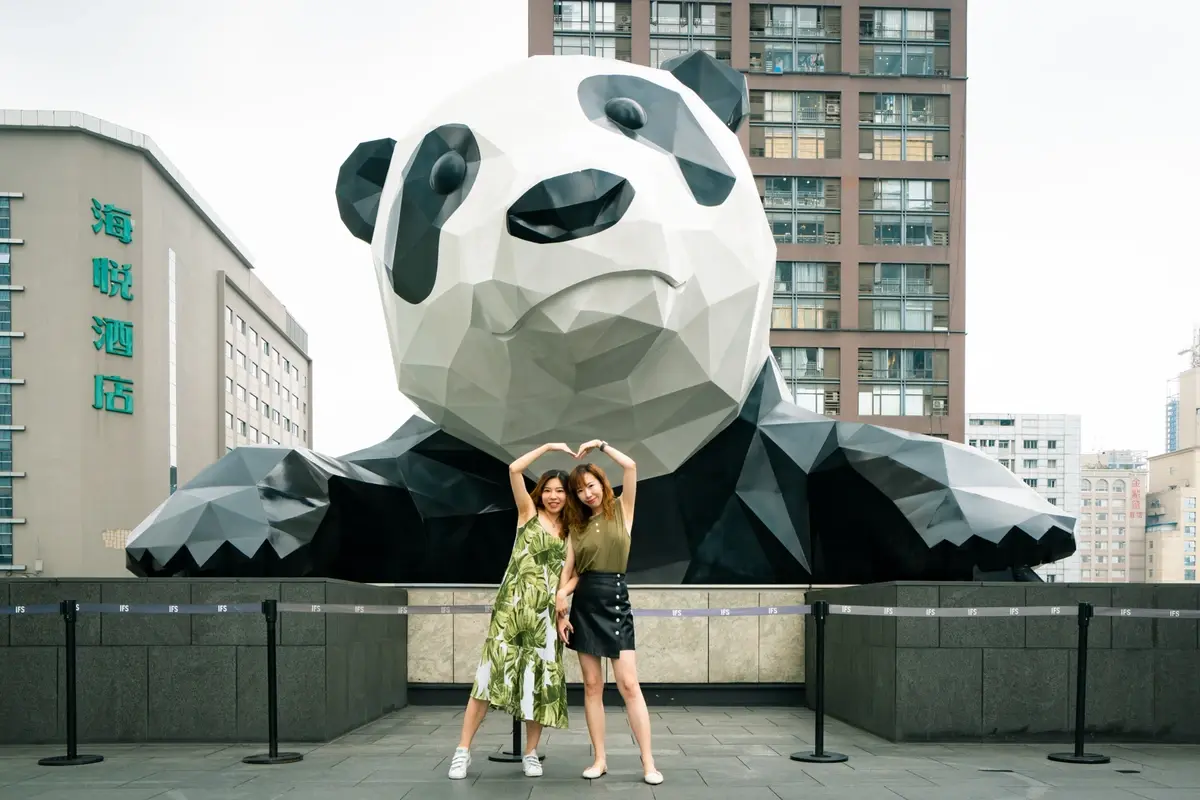
Chengdu: Everything I Want to Take Away Is Un-takeable, but It Can Be Written into Travelogues and into the Anthology of Memories.
I've been to Chengdu several times, which is enough to show my love for this city. Besides the hospitality, driven by my nature of being a 'foodie,' I have even more affection for Chengdu. So in previous trips to Chengdu, most of the time I was either in a restaurant or on the way to a restaurant. This time I unlocked a new way of playing—exploring new territories outside the city.
"Bai Suzhen at the foot of Qingcheng Mountain~" Tell me you didn't start singing involuntarily when you saw this title~
Qingcheng Mountain is divided into the Front Mountain and Back Mountain scenic areas. The Back Mountain is not as well-known as the Front Mountain; the Front Mountain has mostly Taoist architecture, while the Back Mountain focuses on hiking and enjoying the scenery. The entire hike takes about 6 hours and is suitable for those with good stamina. However, if you really can't make it, you can turn back the way you came—that's what I did (innocent face).
Attractions: Tai'an Ancient Town, Wulong Bridge, Wulong Gully, Youyi Village, Baiyun Cableway, Cuiying Lake, Jinli Cableway.
Tai'an Ancient Town, located at the foot of the Back Mountain, was the first attraction we encountered. It is full of the charm of western Sichuan mountain village dwellings, with quiet streets and fresh air. Inside the town is Tai'an Temple, where you can burn incense and pray.
The town's folk customs are still relatively simple. Small restaurants line both sides of the road, and prices are not as daunting as those in overly commercialized ancient towns. Smoked pork and sausages hang in front of every restaurant—clearly the local specialty.
We had lunch in the town. There are many restaurants here, and the prices are quite fair; it doesn't feel like they're ripping off tourists. We drove to Wulong Gully, from where we could only hike on foot. I had thought the mountain would be stuffy and hot with mosquitoes and bugs, but it turned out I was overthinking.
Waterfalls of all sizes accompanied us along the way, their "rushing" song echoing in the valley—just hearing it felt cooling. Small stalls selling grilled sausages and corn continuously wafted their aromas. By the riverbank, people chatted while drinking tea; children played happily in the water; even dogs ran freely... The spiritual energy of heaven and earth and the smoke of human life converge here—no wonder Bai Suzhen cultivated herself here.
Although I hadn't hiked in a long time and expected a tough journey, I was completely immersed in the picturesque landscape, not even daring to blink. How could I feel tired?
We had to return to Chengdu tonight, so we chose to leave before dark, having only "cultivated" for 3 hours in the Back Mountain. I don't know if Bai Suzhen really exists on Qingcheng Mountain, but the life I yearn for is here. Next time, I'll come back to absorb more spiritual energy.
In my opinion, families with elderly people are more suited for the Front Mountain, while family trips with children are better for the Back Mountain.
Qingcheng Mountain Transportation Guide:
1. Self-driving route: Chengdu - Riyue Avenue Section 1 - Chengdu Ring Expressway - Chengguan Expressway - Get off at Chongyi Interchange from Chongyi Station exit - Pengqing Road - Dongruan Avenue - Qingchengshan Road - Scenic area.
2. You can take a high-speed train from Chengdu North Station to Qingcheng Mountain. There are over twenty trains departing from Chengdu each day, about one every 45 minutes, and it takes 30 minutes to reach Qingcheng Mountain.
3. There is convenient public transportation in the city. Tourists can easily reach various attractions by bus, and taxi fares in the city are also very affordable.
4. Take bus 101 from Dujiangyan Passenger Transport Center (or directly from Lidui Gate in Dujiangyan Scenic Area) to the front mountain of Qingcheng—30 minutes.
Back in the city, back to the bustling world of mortals, a one-day escape gave me a more comprehensive understanding of Chengdu.
Chengdu's nights are lively, and this liveliness carries the city's warm hospitality. It seems anyone can find a reassuring sense of belonging, without any distance or strangeness, easily blending in.
Although city travel is full of check-in spots, everyone's experience is different. Those who have never been here must visit the famous landmarks. Even after many visits, there are some places in Chengdu that never tire. It's a city meant for slow travel—feelings matter more than rushing.
Address: Basement floor of Taikoo Li
Transportation: Metro Line 2 or 3, Chunxi Road Station, Taikoo Li exit
Opening hours: 10:00-22:30
Fang Suo opened its first store in Guangzhou Taikoo Hui in 2011, and its Chengdu store opened in 2015. Despite being a young brand, it has achieved much. In 2019, Fang Suo Bookstore was awarded "World's Best Bookstore" by the London Book Fair, known as the Oscar of bookstores. This was the first time an Asian bookstore won the award.
Upon entering Fang Suo, you wouldn't think it's a bookstore. Cement with cut lines, deliberately exposed ventilation ducts—a strong industrial style, but under the dim, warm lighting, it doesn't feel cold or distant; they blend together to form a "masculine-feminine" style.
Fang Suo is a bookstore, but not just a bookstore. Books, aesthetic living, coffee, spatial exhibitions, fashion—all mixed in this space of over a thousand square meters. It's more like a cultural platform. You can find traces of Eslite Bookstore. In an era where physical bookstores are disappearing, Fang Suo encourages people to step out of their homes and enjoy the joy of reading.
With the fragrance of books and coffee, as well as crafts, accessories, and even clothing, Fang Suo gives new meaning to bookstores. Order a cup of coffee and immerse yourself in the scent of ink from paper books—here, amidst the chaos of the city, it's quiet. Besides reading, you can also appreciate other cultural content. Why not? Here you can experience a different kind of slow life.
Address: No. 231, Wuhou Temple Street, Wuhou District
Bus: 1, 57, 82, 334, 335, 1126 to Wuhou Temple Station
Metro: Line 3 to Gaoshengqiao Station, walk 600-800 meters along Wuhou Temple Street
Ticket: 50 yuan per person
Summer (May 1 - Oct 31): 8:00-20:00, ticket sales stop at 19:00
Winter (Nov 1 - Apr 30): 8:00-18:30, ticket sales stop at 17:30
Note: Wuhou Temple has an underground parking lot with ample spaces, and parking is quite cheap. Starting at 5 yuan for 2 hours, then 1 yuan per hour.
Wuhou Temple commemorates Zhuge Liang, the prime minister of Shu during the Three Kingdoms period. Initially built adjacent to the temple of Emperor Zhaolie (Liu Bei), it was merged into Han Zhaolie Temple in the early Ming Dynasty, becoming the only temple in China to enshrine both a ruler and his minister.
In addition to the tomb, temple, and shrine, Wuhou Temple houses 50 statues of heroes of Shu, including Liu Bei and Zhuge Liang, as well as Three Kingdoms culture inscriptions, plaques, and more. Anyone who loves Three Kingdoms history must not miss this place. However, young people come to Wuhou Temple more often to check in at the famous "red wall and bamboo shadows." The sunlight casts bamboo shadows swaying on the red wall, instantly invoking scenes from Qing dynasty palace dramas.
To quickly check in at the red wall, after entering the park, avoid the regular route and go left. Wearing white or clothes with green elements make for great photos. I deliberately added some elements echoing the bamboo forest, and the effect was good.
Besides the "red wall and bamboo shadows," it's also the season for lotus flowers—seize the moment. There are also many quaint details perfect for photos. I've set an example; it's up to you to find them.
Address: No. 66, Wenshu Temple Street, Qingyang District
Transportation: Metro Line 1 to Wenshu Monastery Station, walk 771 meters
Opening hours: 08:00-16:30
Wenshu Monastery is similar in style to Wuhou Temple, built in the Sui Dynasty (605-617). It is one of the key Buddhist temples in China designated by the State Council and the head of the four major Chan forests along the Yangtze River. Listening to this... it's full of Buddhist radiance.
Everyone knows that Manjushri Bodhisattva governs studies and wisdom. Inside the temple, there were many young people, probably here to fulfill their vows, I thought.
You don't have to come only to worship and chant sutras. There is plenty of leisure and entertainment in Wenshu Monastery. In fact, tea drinking and mahjong are ubiquitous in Chengdu people's lifestyle. You can even stay overnight for a deeper spiritual cleansing.
Girls who love taking photos shouldn't miss this treasure—it's photogenic and free. On the left side of the entrance, through a circular arch, you can see the "red wall and bamboo shadows." Although it's small and only one side of the wall, few people notice it, so it won't hinder you from getting great shots.
The temple's cloisters have a strong sense of depth, making for good photo spots. You can lean against a door frame or sit down—the vibe of "calm as a chrysanthemum, peaceful time" instantly emerges.
Before entering, on the left side facing the main gate, there is a long red wall inscribed with "World Peace." It's also great for portraits—for example, walking by holding an umbrella.
Address: No. 12, Shaocheng Road, Citang Street, Qingyang District
Transportation: Bus 57 to Dongchenggen South Street Station, walk 504 meters
Opening hours: Winter 6:30-22:00; Summer 6:00-22:30
Renmin Park was founded in 1911 and is an undisputed old landmark of Chengdu, as well as a ukiyo-e of Chengdu people's life. At the park entrance, there's the widest... widest... wide zebra crossing.
Tea drinking, card games, mahjong, ear cleaning... The hedonistic life of Chengdu people is concentrated here. It's enviable to the point of being disconcerting.
At this moment, I sit in the Crane Ming Teahouse. Time seems stolen; the hot water pouring from the thermos seems like elongated time. Tea leaves unfurl in the cup like a hypnotic film. Coupled with the occasional "jingle" of ear-cleaning tools, if I didn't fight my drowsiness, I'd fall asleep in no time. "Stealing a moment of leisure" is my blessing.
Metro: Line 4, Kuanzhai Alley Station
Bus: 51, 62, 70, 93, 126, 127, 163, 340, Wenbo Sightseeing Line, Panda Express
Opening hours: 05:00-23:00
Not visiting Kuanzhai Alley is like going to Beijing without climbing the Great Wall, to Wuhan without ascending the Yellow Crane Tower, to Luoyang without seeing the Longmen Grottoes... We still need that "I've been here" ritual, especially since it's near Renmin Park.
One wide alley, one narrow alley, and a well alley are the complete components of Kuanzhai Alley. The well alley requires retracing your steps, so there are relatively fewer tourists.
5-6 PM is the best time to visit Kuanzhai Alley. It's not too sunny then; if you're tired, you can watch a Sichuan opera face-changing show; if you're hungry, have dinner~ After dinner, you can continue to explore the alleys at night. I like the night scene here even more than during the day—the rustic simplicity becomes even more elegant.
Although it's now a commercial street, it condenses the essence of Chengdu. The historic buildings are densely packed, serving as a quick gateway to Chengdu's history. I don't really recommend eating snacks here; they look tempting, but considering they've been on display all day...
Stumbling across this bridge was a serendipity. We took a taxi to eat rabbit, and the enthusiastic Chengdu driver told us we could take a stroll to Wuchazi Bridge after eating. So, arriving at the restaurant very early to avoid waiting, we reached the bridge before 7 PM... forcing us to linger until sunset.
I've seen many photos taken after the bridge lights come on, full of cool futuristic vibes. But we couldn't wait that long; we walked and took photos as we headed toward the New Century Global Center.
This place was strongly recommended by the driver who took me from the airport. "This is one of the largest single buildings in the world," he told me with pride. "You must visit, but don't buy or eat inside—it's more expensive than outside." Such warm and honest Chengdu people.
To be honest, it looked close but took nearly an hour to walk from Wuchazi Bridge to the Global Center. When we arrived, we had little time before closing.
We had a quick look around. It was indeed eye-opening: not only commercial, shopping, food, theater, and concert hall, but even an InterContinental Hotel, and an ocean park connected to the outdoors. It's like a small world.
This place is perfect for taking kids and for indulging yourself in shopping~
Food is an unavoidable topic in travel, especially in a foodie city like Chengdu. When talking about food, Chengdu people proudly say, "Any random restaurant here is good—otherwise, it wouldn't survive." I often say I don't just love eating; I love gourmet food. In Chengdu, these two are the same. The beauty of Sichuan cuisine lies in its varied flavor profiles—spicy can be aromatic, fresh, numbing, or weird—playing out in multiple versions, spicy but not irritating, oily but not greasy. Chengdu's food can easily last a month without repetition—truly enviable.
Let me recommend a few restaurants I consider must-visits. I've helped you avoid pitfalls, so eat with confidence.
Address: No. 117, Shuanglin North Horizontal Road (diagonal to Gaoyi Hotel)
Transportation: Metro Line 4, Shuangqiao Road Station Exit D, walk 1.1 km
Opening hours: 11:30-24:00
Average cost: 94 yuan
A local foodie said that after eating at this hot pot place, you won't want any other. I went, and I admit it. Hot pot is the backbone of Chengdu cuisine. Large chain restaurants don't exceed my expectations, so I trust local recommendations more.
The enthusiasm of Sichuan people for hot pot is like Cantonese for dim sum—they must have it every so often. We arrived before peak meal time and already saw a long queue. This place is Chongqing-style old hot pot. The broth is hand-stirred daily in the wok, with a rich beef tallow flavor that isn't greasy. Even at the end, it doesn't turn bitter. The spiciness is mild, so it's very acceptable.
Among the vegetables, I highly recommend fresh duck blood and tofu pudding. Don't ask me why—try it and you'll know. The duck blood is as smooth and tender as a young girl's skin, and tofu pudding is basically a healthy substitute for pig brain. It doesn't have the strong smell or high cholesterol of pig brain, but it absorbs the broth's essence with the same texture. Imagine it yourself—I'm sold.
After eating Sichuan hot pot, I often feel I won't want it for a while, but with this place, I can't even wait until tomorrow; I wanted to order again immediately.
Address: No. 4, Shiyi Street
Transportation: Metro Line 3, Xin'nanmen Station Exit B, walk 640 m
Opening hours: 17:30 start
Average cost: 95 yuan
Hole-in-the-wall eateries have a high status in Chengdu. For me, form is secondary; fresh ingredients and delicious food are key. How popular is "Pick Up a Chopstick"? You can't get in without queuing; only 7 tables, non-stop turnover—that says it all.
I was already drenched in sweat when I sat down. I didn't initially plan to order the "Strange Cat" dish, but it's a must-try. The meat is tender, and even the bones can be crushed. Under the "siege" of young ginger and two types of fresh chili, the flavor penetrates deep into the bones—one bite and you're hooked.
Dry-fried beef shreds are also recommended—fragrant and chewy. The fatty parts are the best, with a caramelized surface and fragrant inside. After finishing the beef, I wanted to take the dried chilies home.
Lychee clams are a wonderful combination. Lychee canned fruit and doubanjiang blend to make the spiciness warm and sentimental. The thick sauce is perfect for sucking the clams. I'll order this again.
Address: No. 28, Zhimin East Road, Building 11, next to Haida Shu
Transportation: About 1.3 km walk from Metro Line 3, Moziqiao Station Exit B2
Opening hours: 11:30-14:00, 17:00-22:00
Average cost: 89 yuan
The most intuitive feeling about this restaurant is that it defines what new-style Sichuan cuisine is. It both inherits the essence of Sichuan cuisine—spicy but not irritating, oily but not greasy—and incorporates many innovative cooking methods. Each dish looks very "Instagram-worthy."
Special grilled fish fillets—unlike traditional whole grilled fish, these fillets have strong wok hei. No worries about bones; the meat is smooth and boneless, and each piece is well-seasoned, giving a skewer-like satisfaction.
Bare Shrimp Poppers—the waiter repeatedly reminded us not to touch it, as it's very hot. It's called "bare" because the shrimp are peeled—a thoughtful touch for lazy people like me. The hot oil and fresh shrimp's amino acids collide, releasing full umami.
Baked abalone in paper—another dish full of ritual. The small abalone is smooth and crispy. I'm not particularly obsessed with abalone, but the instant noodles that absorbed the Sichuan pepper broth became my comfort food.
Strange-flavor ribs are also delicious—strange flavor is one of my favorite Sichuan flavor profiles. I won't introduce every dish, but this is a restaurant I'd recommend to out-of-town friends—reasonable prices, comfortable environment, good for gatherings.
Address: No. 56, Shuwabei 2nd Street, Building 1-6 (storefront along Zongfu Building)
Transportation: Metro Line 4, Taisheng South Road Station Exit B, walk 780 m
Opening hours: 7:30-20:00
Average cost: 22 yuan
A collection of authentic Chengdu snacks. After a full meal, we still managed to down several snacks. The four items we ordered were all delicious—hard to choose!
Fried dough twists with tofu pudding add crunch to the smooth, spicy tofu pudding; Zhong Shui Jiao mix meat and chili aromas—I didn't taste much spiciness, just fragrance; Sweet Water Noodles, though slightly inferior to Dongzikou Zhang's, are still tasty; finally, a bowl of cold sweet fermented rice tofu pudding as dessert—instant peak of life happiness.
Address: No. 18, Caotang North Road, Building 16
Transportation: Metro Line 4, Caotang North Road Station Exit B, walk 320 m
Opening hours: 11:30-23:30
Average cost: 37 yuan
A semi-self-service street stall model—I'd never seen anything like it. You grab a plate and put it on a table to claim it. Then you pick your own skewers and pour sauce over them. The sauces come in two types: red oil and Sichuan pepper—take as you like. When eating, first soak the skewers in the sauce, then dip them in the dry rub. The combination of several chili flavors creates an irresistible temptation. One skewer, one bite of ice jelly—eating happily with both hands.
In Chengdu, crowded places aren't just scenic spots but also food joints. Low tables, cramped spaces—yet the happiness from taste buds is magnified. When paying, the young man told me 71 yuan; I couldn't believe it and double-checked. I felt I had eaten heartily, yet the average was only 35.5 yuan per person...
Address: No. 3, Fubin Middle Road
Opening hours: 10:00-22:00
Average cost: 58 yuan
A local taxi driver recommended this place, not far from my hotel. He said it's the best restaurant in the neighborhood, and stressed that although the taste isn't as good as before, it's still delicious, and people start queuing at 5 PM.
So we arrived before 5 PM; there were already a few tables of customers. We chose a seat near the ice jelly stall. The ice jelly stall is outsourced, with many varieties and cheap prices. We randomly ordered two kinds—rice cake and fermented rice—which easily beat the 12-yuan ice jelly in Shenzhen.
Now about the rabbit. The rabbit is killed and cooked fresh (a bit cruel—I chose not to watch, but couldn't resist eating—covering face). You must order a whole rabbit to ensure freshness. Since it's freshly prepared, the wait is a bit longer, but you can enjoy other things while waiting.
When the rabbit pot with plenty of red oil was brought out, I started swallowing saliva. One spoonful of red oil dripped down—mommy~ I couldn't wait another second. It wasn't very spicy, but the oil fragrance and tender meat, combined with the dry dip, gave a satisfying spiciness~
The restaurant has no air conditioning. The steaming heat and sweating reminded me of scenes from "The Hot Pot Heroes." Perhaps the foodie atmosphere in Sichuan naturally turns into a world of brotherhood and heroism.
We finished eating before 6 PM, and there were already 30-50 people waiting inside and outside. You really have to go early!
If you're a seafood lover, I have two more treasure restaurants to recommend.
Address: Left side of Jindiancheng parking lot, No. 88, Dongqing Tree Street
Transportation: Metro Line 4, Taisheng South Road Station Exit C, walk 390 m
Opening hours: 12:00-14:00, 17:00-23:30
Average cost: 80 yuan
The name sounds very down-to-earth, and it is. It's a food stall environment, with an average cost of 80 yuan, letting ingredients speak.
Standing at the entrance of the food market, you can see the sign. On one side is the kitchen, on the other is a large tent. If the tent can't fit everyone, it spills outside. Fortunately, it was near sunset; the heat hadn't dissipated, but it wasn't sunny. The market was closing. Apart from residents, there weren't many people walking around, but all of them would glance at the full table of seafood.
Boiled shrimp—needless to say, fresh and good ingredients naturally taste sweet and savory, matching well with the slight wasabi in the dipping sauce. Boiled small octopus is crispy and refreshing—a great summer companion.
Address: No. 14, Jixiang Street, Building 8, Attached 8-9
Transportation: About 790 m walk from Metro Line 4, Kuanzhai Alley Station Exit B
The name is a bit literary, but the dishes are quite fierce. Only three main dishes—the owner is very focused: Spicy crab, Explosive Blood Congealed, and Numbing-flavor Frog.
Ordinary spicy crab is priced per portion, but the owner can also help you buy larger crabs, priced per jin (500g). Although the spicy crab craze has passed, good food is always popular.
Explosive Blood Congealed differs from regular blood congealed in that all ingredients are fried in oil first, giving the smooth pig blood a crispy surface—very satisfying.
Numbing-flavor Frog has springy, elastic meat. None of the three main dishes disappoint.
Sour and spicy cabbage is especially suitable as an appetizer. The unique flavor of cold mixed potato slices is intriguing—definitely order it.
There are a few more snacks to recommend; you must go~
Address: No. 39, Wenshu Temple Street
Opening hours: 8:30-19:00
Located diagonally opposite the main gate of Wenshu Monastery, easy to find. The mung bean jelly is very smooth, with a sour and numbing spicy flavor that slides into your mouth. Sweet Water Noodles are sweet, numb, and spicy, more like a strange flavor. The noodles are thick and firm; one strand is long but easy to chew. The moment it enters your mouth, you want another bowl.
Address: No. 19, Section 3, Renmin Middle Road
Opening hours: 8:00-19:00
Metro Wenshu Monastery Exit K. From afar, seeing a long queue means you're in the right place. This carb-on-carb combo really shocked me! The flatbread is freshly baked, the filling freshly mixed. The guokui is crispy—crunch at the tooth and it shatters—then the soft, spicy, numbing jelly hits you. So satisfying~
I tried three types, but the jelly one is the best—full of flavor, with a conflicting texture that lingers.
Later I visited a franchise store—quality slightly inferior. I strongly recommend the old store—worth queuing!
Many places have chain stores; you can choose one nearby. These are snacks. Soft egg pancakes with various fillings—you can even get half-half, very user-friendly.
They have a strong egg flavor—a snack that's hard to dislike. If you pass by, don't miss it. Personally, I don't think you need to go out of your way to find it.
Writing about Chengdu food is truly self-inflicted pain and torture. Every time I recall a taste, I have to swallow hard, regretting not eating more... Suddenly an idiom comes to mind: "So happy as to forget home." For me, it should be "Too happy to leave Shu."
Finally, I'd like to recommend the place where I stayed for two nights:
Located in the CBD, convenient transportation with a metro nearby. Especially during this period, the hotel takes guests' safety very seriously. You must scan a code to check in, and everywhere in the room are stickers saying "Disinfected, feel free to use."
Ocean elements spread from the lobby to the rooms. The ceiling is a pointed design with cutting lines; in the dim light, lying in bed feels like sleeping in a tent, gazing at stars.
The cylindrical shower cleverly separates the bathroom from the toilet. There are also thoughtful small designs like jewelry boxes.
This sharing ends for now. Chengdu's slow life contrasts sharply with my fast-paced life in Shenzhen, which is why I lingered and didn't want to leave. Travel is wonderful—it lets you briefly experience others' lives, like them or not, then return to reality with new insights, seemingly continuing your old life, but those insights have grown inside you, perhaps becoming a new life to live forward.
Travelogue Directory:
1. Back Mountain of Qingcheng Mountain
2. Fang Suo
3. Wuhou Temple
4. Wenshu Monastery
5. Renmin Park
6. Kuanzhai Alley
7. Wuchazi Bridge
8. New Century Global Center
9. Da Long Chuan Cheng
10. Pick Up a Chopstick
11. Chengdu Foodie (Jiuyanqiao Branch)
12. Xiyuecheng Tan Douhua
13. Xianzhiwei Boboji
14. Yang Chu Xiongqi Zhonghe Tu (Yang's Rabbit)
15. Penglaifang Seafood (Taisheng South Road Branch)
16. Xie Xie Time
17. Dongzikou Zhang's Cold Jelly (Old Store)
18. Yan Taipo Guokui (Wenshu Monastery Store)
19. He Ji Egg Pancake
20. Hilton Chengdu Hotel
Travel Info Attractions Index Guide Index Air Tickets Index Website Navigation Travel Index Cruise Index Corporate Travel Index Franchise Cooperation Distribution Alliance Friendship Links Corporate Gift Card Purchase Insurance Agency Agent Cooperation Hotel Franchise Destination & Scenic Area Cooperation More Cooperation About Ctrip About Ctrip Ctrip Hotspots Contact Us Careers User Agreement Privacy Policy Business License Security Center Ctrip Content Center Intellectual Property Trip.com Group Algorithm Disclosure


