A Gluttonous Feast: Chengdu's Beauty Under Heaven
Fingertip: The only loves in life are beautiful scenery and delicious food.
Some say that when you mention Chengdu, what comes to mind is not the city name but an array of delicacies. Because Chengdu is a city filled with food. In every alley and on every street of this city, you can encounter many delicious foods and interesting snacks at any time.
And the enthusiasm of Chengdu people for eating has also led to a highly developed catering industry in Chengdu. Almost every out-of-town tourist who comes to Chengdu is interested in its hotpot, Sichuan cuisine, snacks, and malatang. To come to Chengdu and not eat the local food feels like going to a treasure mountain and returning empty-handed.
A city has its own history and culture, as well as its own characteristic districts. To understand a city's history and culture, you should visit its characteristic streets and alleys, learn about the cultural origins and stories of famous figures, touch the lingering warmth of history up close, and feel the bustling commercial atmosphere and the flavor of pleasure-seeking that have persisted through the changes of the times.
With rare leisure time and family accompanying us, we decided to wander around the vicinity of Jinli, strolling and admiring at our leisure. If Kuanzhai Alley is classical and artistic, like a moonlit reflection in a mirror of time, then Jinli is bustling and secular, like several fireworks blooming outside that mirror.
As we entered Jinli, the temptation of delicious food hit us in the face. Shops were open, mainly selling food and drinks. Fresh fruits and delicacies, carefully arranged, appeared and disappeared in the light haze. Viewing their beautiful shapes, discerning their fresh colors, and smelling their fragrant aromas made our mouths water uncontrollably, leaving us unable to resist.
Beside the shops, makeup-clad Sichuan opera xiaosheng greeted customers. They mimicked opera movements, suddenly shrinking their necks and jerking their heads, turning white faces into red ones, startling people. But before you could be surprised or annoyed, they pulled a funny face to make you burst into laughter. With that tease and amusement, your mood instantly lifted.
When we first arrived, the sky was clear. Strolling along Jinli with relatively few tourists, it had a hazy, classical charm. The streets of Jinli are not wide, but ancient buildings on both sides faced each other, with strings of red lanterns hanging high and low—some under flying eaves and upturned corners, some on tree branches—flickering in the misty rain, full of unique charm.
Walking along the ancient street felt like strolling through a poetic realm with harmonious rhythm. The carved lattice windows, ivy-covered ancient walls, and winding corridors with twists and turns were like the background of a poem, contrasting deep elegance with vicissitude and vitality.
Jinli is an ancient street suitable for nostalgia, a place that appeals to both refined and popular tastes. Here, you can find memories of Chengdu from the Three Kingdoms period, and also enjoy a leisurely life amid the fast-paced city.
After finishing our visit to Jinli, we felt hungry. It seems the temptation of food is quite strong. We decided to take the family to Gua Chuan Chuan at Jinfangyuan East Road, which we heard was good. When we arrived, we found that the environment of this Gua Chuan Chuan was really nice.
The overall decoration features green bricks and green tiles, with red walls full of festive cheer. The space is spacious, with clear functional divisions. The Chinese retro style adds unique charm to this shop, making it truly antique.
Although we thought it was still early, once inside we found a hidden world. There were so many people—the entire hall was full, with voices overlapping. Yet it did not affect the enthusiasm of the foodies waiting in line outside. Indeed, good taste is king; that's the true nature of Chengdu foodies.
Pot base: Authentic Chengdu method for preparing the soup base, a properly spicy cold pot skewer pot. The super-rich soup base is freshly boiled every day, with red oil covering a secret stock base. Full of ingredients, it simmers from early morning until noon opening. Fragrant without being numbing, spicy without being dry—this flavor simply cannot be imitated. Only the recipe passed down from the older generation can be called the old Chengdu taste.
70+ kinds of skewers to choose from: Six large freezers dazzle you with choices. Ingredients are protected by five-star cold chain logistics. Fresh ingredients are carefully selected daily, marinated with care, and skewered. Meat and vegetables are optional—after eating, the sticks are weighed. Take whatever you want and start crazy skewer mode!
Handmade special double dipping sauce: How fragrant is the dry dip? The combination of crushed peanuts + chili powder easily takes the crown. A gentle roll brings peanut fragrance. The laborious handmade process makes it unique. The oil dip, made with sesame oil, minced garlic, and chopped green onions, is also a great helper for reducing spiciness and adding fragrance.
Beef skewers are versatile: Give me a slice of beef, and you can wrap up a world. Five-spice, spicy, coriander, pickled pepper, spring onion—the beef must be marinated in a secret sauce for two to three hours. Plump pickled peppers with tender beef, a hint of green in the middle of red beef, stand out. When eaten, the heavy flavor bursts on the tongue. In the thick beef pieces, the pickled peppers are ready to explode with juice. Your mouth says no, but your body is honest—you keep sending skewers to your mouth.
Small sausages: Small sausages are a Chengdu specialty. Plump little sausages with a balance of fat and lean are cut into bite-sized pieces. The slightly sweet taste is very Cantonese-style. The dual sensation of sweet and spicy is intoxicating, doubling the satisfaction while relieving spiciness! You will never regret coming to this shop—it's so delicious you can't stop eating.
Two | One: Bar "Overlord," Find Your Own Ecstasy
When you hear the name "Wuhou," anyone who has read the Three Kingdoms will not be unfamiliar. That's right, it's the alias of the famous Zhuge Liang—"Zhuge Wuhou." If your favorite kingdom in "Romance of the Three Kingdoms" is Shu, then Chengdu's famous attraction—Wuhou Shrine—is a must-visit. It will surely satisfy all your desires.
Soon it was afternoon. My family and I planned to visit Wuhou Shrine, to experience the legendary stories of the Three Kingdoms and fulfill our Three Kingdoms dream.
It is said that Wuhou Shrine was first built in 223 AD, originally as a mausoleum for Liu Bei. Later generations combined Liu Bei's mausoleum with Zhuge Liang's ancestral hall to form the current joint temple of ruler and minister—the only one of its kind in China.
The heroes of Shu, with their ever-changing fortunes, have turned to dust here. Their great achievements are buried and rest here. All historical stories are precipitated and brewed here, resulting in the weighty Wuhou Shrine, a place to commemorate the heroes of Shu Han.
From Sanyi Temple to Wuhou Shrine, from the Oath of the Peach Garden to Three Visits to the Thatched Cottage, we arrived at the main hall of Zhuge Liang's temple. In the center of the hall hangs a horizontal plaque inscribed "Ming Chui Yu Zhou" (Fame Spreads Across the Universe)—surely the highest praise for Master Zhuge. The upper couplet reads: "If you can attack the heart, opposition will disappear; since ancient times, those who know war are not fond of fighting." The lower couplet reads: "If you do not assess the situation, leniency or severity will both be wrong; later generations governing Shu should think deeply."
These two lines highly summarize Zhuge Liang's lifelong loyalty and ambition to serve Shu with utter devotion until his death. He used his entire life to repay the kindness of the three visits to his thatched cottage. Wuhou Shrine is not large; situated in the bustling city, it occupies a modest area. You can finish visiting in about an hour. Yet Wuhou Shrine is also huge, because it carries not just a scenic spot but the history of a dynasty, a tribute and remembrance of that era.
We walked and stopped, turning into quiet paths, admiring bonsai, observing flowers and plants, smelling subtle fragrances. We looked at gnarled old trees, observed the reflection of delicate arched bridges in the water, and sighed at the dilapidated remnants of Han palace pillars. Carrying our respect for Shu, we slowly walked out.
In Chengdu, a city that prides itself on leisure, there are many bars large and small. But Bie Yuan Li, surrounded by greenery, lit by neon lights, and stocked with various liquors and snacks, is unique in Chengdu. To provide customers with a better in-store experience, they specially invited a lighting design company to design the lighting effects.
We couldn't waste the evening; we planned to take the family to Bie Yuan Li to enjoy the night's comfort.
Upon entering, as the lights turned on, the entire bar became a colorful neon world. Under the interplay of light and shadow, colorful lights shone like stars in the sky, enhancing the entertainment and leisure atmosphere.
The range of liquors in the bar is as rich as its lighting: foreign liquor, Chinese-style cocktails, cocktails, and pure imported beer—everything you want to drink is available here!
Night Suit Mask Kiss: The rose wine, whose appearance alone wins the favor of young ladies, has a refreshing rose fragrance. With a low alcohol content, it's perfect for a small gathering of girlfriends or a leisurely moment. The rose flavor is not strong at first, but the more you drink, the clearer the wine's taste becomes, intoxicating.
Ancient Qiang Wheat Straw Zha Wine: A blue-and-white porcelain bottle with a jianghu feel! Wheat straw as a straw, sipping wine amid laughter—it has a unique charm.
Barbecue Platter: Fine wine and grilled skewers have always been an inseparable pair. Eating barbecue without wine feels like missing the point of the gathering! Mini sausages, shrimp, corn kernels, dried tofu, green beans, and more—the platter is spicy and fragrant, satisfying different cravings.
Lemongrass Grilled Fish: Besides barbecue, this grilled fish is a must-order. Although the fish is not large, the aroma was already enticing. The addition of lemongrass makes the fish's fragrance fresher! The fried fish is crispy on the outside and tender inside, delicious and satisfying. Sitting and playing in such a music bar is the best way to enjoy leisure and comfort.
| Two: Tip-of-the-Tongue Sichuan Cuisine, Unforgettable Yuan Gong
What people call Chengdu's leisure life is not the office buildings in High-tech Zone, not the crowded Kuanzhai Alley, nor the street photography at Chunxi Road. Come to People's Park—this is the life Chengdu people most look forward to.
With a history of 100 years, People's Park serves as a material and spiritual carrier, preserving real old Chengdu life. On weekends, People's Park becomes the liveliest.
There are two old tea houses in the park: Yongju and Heming, with Heming being the most famous. Built in the 1920s, nearly a century old, it is almost as old as People's Park. So it is called a century-old Heming. You must learn to "get in first," because Heming is always full. As soon as someone leaves, grab a seat. Once seated, a waitress dressed in blue-and-white porcelain style will clear the table and let you order tea.
The playground is the loudest place. The sounds of children playing and laughing are endless. Small trains, merry-go-rounds, roller coasters—every child and big child can find their joy.
But the most popular activity in People's Park is boating. The colorfully worn boats bear the childhood memories of Chengdu people since the last century. On good weather days, it's the busiest, and you need to queue for a boat. Young parents bring their children to row boats, enjoying family happiness. Of course, dating couples are also common. On the boats, no matter who they are, everyone is as happy as a child.
After visiting the park, we planned to take the family to Yuan Gong on Chunxi Road. A friend had told me this place is an authentic Zigong-style Sichuan restaurant, very popular and bustling, so we came specially to try it.
When we arrived, many people were already dining! The decoration of this restaurant is quite down-to-earth, with an antique environment that is very attractive. The atmosphere highlights old Chengdu characteristics. Private rooms, the main hall, and booths are all tastefully designed, decorated with flowers, revealing a unique charm.
Many of the customers here are tourists visiting Chengdu. The dishes they ordered were very characteristic of Chengdu: Maoxuewang, sliced chicken, and their signature rabbit were the reasons I had to come. I hadn't eaten such fresh, fragrant, and spicy dishes in a long time—big thumbs up!
Yuan Gong Sliced Chicken: The chicken slices are tender and smooth, with excellent flavor. Added with chopped green onions and white scallion slices, refreshing and tasty, drizzled with secret red oil seasoning—the spiciness is just right.
Longmen Hanging Meat: It looks like a whole fried crispy pork strip. The young lady cuts it while saying auspicious words—nice ceremonial touch. The meat is tender, smooth, and even better when dipped in chili powder.
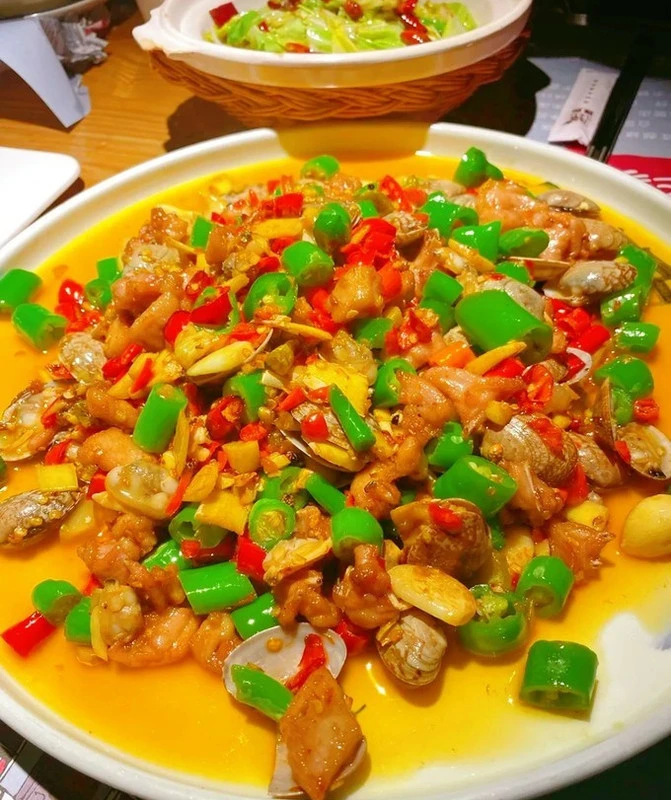
Yuan Gong Signature Rabbit: Tender and smooth rabbit meat paired with juicy clams—the texture layers are instantly elevated. Spicy and fragrant, it's super enjoyable.
Yuan Gong Braised Duck: The duck meat is delicate and tasty, with a rich braised flavor. The skin parts are especially smooth and delicious, with excellent texture.
Live Water Silver Carp: The silver carp is quite large. The back is cut into several slices for better flavor absorption. The flesh is white and tender. The celery and green chili segments are particularly tasty—absolutely my favorite. Such delicious food must not be missed. Action speaks louder than words.
| Two: Natural Humanity, Delicate Sentiments | The Unique Charm of Jiaoliao
Jiaoliao—a place whose name itself makes you want to learn more. The name comes from Zhuangzi's "Free and Easy Wandering": "The wren nests in the deep forest, but only takes one branch; the mole drinks from the river, but only takes a bellyful." In this insatiable world, we cannot be too greedy. We must try to be "unmoved by the praise of the whole world, and not discouraged by the blame of the whole world; determine the distinction between internal and external, discern the boundaries of honor and disgrace." Perhaps such a state is too difficult; hence Jiaoliao exists, allowing us to slow down and let go of the pursuit in a corner of the world.
Jiaoliao Hotel is a sturdy branch in this myriad forest, pursuing freedom, unwilling to drag its tail in the mud. It draws on old Chengdu culture, seeking a "slow life" in the busy city, returning to a natural state of living.
Pushing open the door, the corridor comes into view. At the end of the corridor hangs a plaque that reads "Ride Things to Travel the Mind" (Chengwu Yi Youxin), from Zhuangzi's "The World of Men." After understanding its meaning, one cannot help but admire the great wisdom of the old man Zhuang.
Entering the hotel, we looked through all four floors. The design and decoration of this hotel are really good, giving a comfortable and relaxed feeling. During our tour, we found that each room has its own unique name, such as Yanqian, Youwei, Shiwei, etc. We planned to stay in Yanqian, because when we first saw the name, my friend and I both liked it—as if the two characters contained deep meaning, leaving us with endless imagination.
The hotel's security is also very good. Guest rooms require a keycard or the butler to open the door. After confirming our stay, the butler gave us a wren-shaped door card—cute and charming! Looking closely, we saw a butler service window outside the door. Opening it, we found it connected inside and out. When we called, the butler would place what we needed inside, and we could take it directly. This design is very thoughtful, convenient without disturbing guests.
Although from the outside Jiaoliao appears simple and elegant, the items in the room are all consistent with five-star hotels. For example, mattresses, linens, sanitary ware, and automatic toilets; the hardware facilities are superb. Various ornaments are complete and neatly arranged, everything appearing comfortable and cozy. Various branded equipment reflects the hotel's high-end atmosphere—we loved it! My friend kept saying it feels warmer than home.
After entering, we found a deep-looking wren on the bedside in each room, gazing intently, as if deep in thought or listening. The wrens in each room have different expressions and moods. My friend and I treated it as our listener, trying to talk to it. All the unspeakable worries could be poured out to this wordless little creature. After expressing all the unhappiness, we felt much lighter.
On the TV wall, a large hand-embroidered Shu embroidery peony blooms, along with a koi leaping on Shu brocade. As we touched it, we couldn't help marveling at the skilled craftsmanship and long-standing culture of our ancestors. Overall, the rooms are full of traditional Sichuan cultural elements. While staying, you can also feel the cultural influence. My friends and I often travel and have stayed in some good hotels, but such thoughtful and considerate hotels are rare. This stay was definitely the right choice.
The room also offered four top-grade teas from Mengding Mountain. Drinking too many carbonated drinks can be burdensome. When we calmed down, we brewed a cup of tea, savoring nature's gift, and instantly felt refreshed and revitalized.
My friend and I also found that the most thoughtful part of this hotel is not just the room configuration and decoration, but also the excellent butler service. They can customize travel routes, trip plans, and solve any problems encountered in the hotel. Even our breakfast each morning could be customized according to our taste and time, delivered to the room. Lunch was at Zifei, the first restaurant in Kuanzhai Alley themed on Zhuangzi's culture. It integrates culture, Sichuan cuisine, drinking games, and performances, taking you into pavilions, pavilions, and an era of guqin and opera songs. Opening the wooden window in the morning, breathing the first breeze of Kuanzhai Alley, the first rays of sunlight—so refreshing and pleasant. After washing up, we enjoyed the customized breakfast, feeling deeply moved.
After eating, we stood in the small garden breathing fresh air, admiring the clear night sky. We brewed a cup of hot tea and explored the stories of time in this ancient alley up close.
Observing carefully, we saw a spider weaving its web on the roof opposite, and a falling leaf landing on the table... Look, everything is growing hard!
In the busy and noisy city, there is always a leisurely, comfortable place for your body and mind to release.


