The Charm Everywhere: What I Miss About Chengdu Is Its Lively Atmosphere
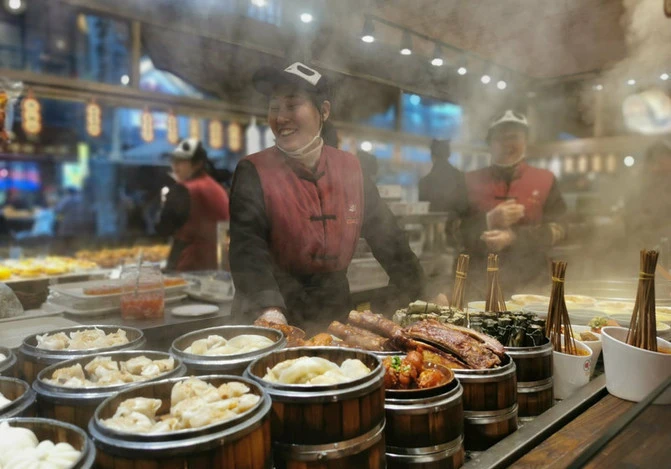
Chengdu is not a place that wears down your willpower; on the contrary, it makes you feel vibrant. The only reason to indulge is that you can't resist the city's unrestrained imagination. Its beauty lies in innocence. The people living here—men, women, young, and old—all possess a captivating, relaxed charm. They never doubt the meaning of life; they are doers. If they want to play mahjong, they play mahjong. If they love eating little spicy peppers, they eat them. The people of Sichuan have a certain spirit—calm, fearless, and unpretentious, living their beloved simple lives. Rather than saying I like Chengdu, I should say I love the lively atmosphere of Chengdu.
Chengdu locals love food, and Chengdu is a food capital! The best feelings in life are surely hidden in journeys. Others' journeys have sweetness, sourness, and the myriad tastes of life, but my journey has only one flavor: the aroma of food. So, I came to Chengdu, to this city full of delicious food!
Yuán Gòng, Yuán Gòng, a name that sounds like 'fate brings tribute.' The red plaque with gold characters instantly struck me. The moon-white verses on the ground also echoed the theme of 'fate.' It seems I truly have a destiny with this restaurant.
The ceiling of Yuán Gòng is covered with red flowers like flames, giving a particularly fresh feeling, and my mood unconsciously began to lift.
This restaurant is on another street behind Chunxi Road near Qingshi Bridge. The location is a bit off the beaten path. Compared to the bustling nightlife of Chunxi Road, this place seems somewhat detached from the worldly hubbub, and I love this kind of secluded spot.
The restaurant is quite spacious. Each table has its own separate booth with decent spacing, perfect for small gatherings. It doesn't feel crowded at all—I absolutely love this environment!
Nowadays, restaurants also have stylish decor, and this one is no exception. The lighting and color tones, whether in private rooms or the main hall banquettes, are quite design-conscious!
The dishes here are also authentic Zigong-style Sichuan cuisine, and the flavors are excellent. The environment actually gives a very homey feel. The red flowers and umbrellas as decorations feel very festive and warm. This atmosphere instantly brought a wave of warmth to my heart. Perhaps this is the taste of home.
The service staff were quite good, truly warm and attentive, always available when called. Even though we were seated in a relatively remote spot, a waiter could always be summoned, with no instances of being ignored. Their attitude toward guests was genuinely friendly and courteous, with dedicated staff guiding us from entry to exit—I find that a very positive point.
Now, about the dishes: The one that left the deepest impression on me is Yuán Gòng's Signature Clam Rabbit. The green and red peppers beautifully set off the tender, flavorful rabbit meat, and the clams looked enticingly glossy. One bite—tender, slightly numbing, with moderate spiciness—and instantly my taste buds danced. 'Golden wind and jade dew meet, surpassing countless worldly pleasures!'
The Dragon Gate Hanging Meat: This dish has a special young man who cuts the meat and arranges it on the plate. It has a crisp texture, and the outer batter is perfectly fried. Even eating a lot doesn't feel greasy. This is one of their signature dishes, quite distinctive.
The Old Duck Soup left a deep impression. It wasn't heavy on MSG or chicken essence; it was clear, slightly sweet, and refreshing, perfect for relieving dryness. One sip made me feel soothed in body and mind—so comfortable and delicious.
Another dish, Yuán Gòng's Sliced Chicken, was absolutely the best of the night. The flavor was superb, with lotus root slices underneath. The red chili oil was very fragrant, and mixing it with the chicken was simply heavenly. My friend and I couldn't stop praising it—truly exquisitely made!
The Black Bean Fish was a large fish, covered with plenty of fermented black beans and minced pork. Even without the fish, the seasoning alone could go with several bowls of rice. The fish was exceptionally tender and not fishy at all!
'Destiny brings us together across a thousand miles, meeting at Yuán Gòng.' An authentic Sichuan restaurant that keeps surprising you!
As everyone knows, Chengdu is a food capital. When talking about representative foods, skewers (chuan chuan) definitely occupy a spot. Big handfuls of bamboo sticks, hot red broth, numbing and spicy aromas—make your mouth water uncontrollably. This Chengdu Gua Chuan Chuan (flagship store) on Jinfangyuan East Road could be a choice for you.
The variety of skewers in the shop is quite rich—dozens of types. There are plenty of choices for both vegetables and meats, making me overwhelmed with options.
The ingredients are pre-skewered and placed in refrigerators for customers to pick freely. You just choose the items you like. A special feature here is that the kitchen staff boil the skewers and serve them directly in a large basin, saving you the wait of cooking your own. For lazy people like me, it's incredibly convenient.
After a short wait, a steaming pot of skewers arrives at the table. The broth looks oily and spicy, but the heat is moderate—numbing and aromatic. They also provide dry and oil dipping sauces. The dry dip is their specialty, very tasty, and worth recommending.
Besides skewers, there are also several hot dishes worth trying, such as numb-spicy brain (soft and delicate), numb-spicy duck blood (tender and smooth), numb-spicy duck intestines (crisp and tasty), numb-spicy luncheon meat, instant noodles, and more, all quite memorable.
This Chengdu Gua Chuan Chuan might not be the best skewer place in Chengdu, but it is certainly the most distinctive.
In Chengdu, a city known for its leisurely lifestyle, there are many small bars of all sizes. But a bar like this one—surrounded by greenery, lit by neon lights, and filled with various alcohols and snacks—only exists in Chengdu at Bie Yuan Li (The Other Yard).
The unique 'Cat Girl' at the bar adds a touch of mystery to their nightlife, making people look forward to the evening even more.
I heard that to offer customers a better experience, the bar hired the company that designed the lighting for the Bird's Nest (National Stadium) for their lighting effects. I can only secretly say: what a big production! The boss is really generous!
As the lights turn on, the whole bar becomes a colorful neon world. Under the interplay of light and shadow, colorful lights resemble stars in the sky, shining brightly in the bar. Seeing this, I couldn't help but marvel. Indeed, the owner's decision was great—the customers' experience is the greatest affirmation.
Since this is a small bar, alcohol is a must. They have an enormous selection: foreign spirits, cocktails, and pure imported beers—everything you could want. There are even many kinds of drinks I couldn't name, dazzling my eyes. Basically, whatever you want to drink, you can find it here!
Not only that, even the food containers are carefully selected Jingdezhen blue-and-white porcelain, elegant and beautiful, stirring the heart.
Although there are many alcoholic beverages, my favorite is not the strong, fiery kind. A Long Island Iced Tea looks clear and mild like black tea, but it also has the strong, rich aroma of alcohol. With lemon juice and cola added, Long Island Iced Tea tastes sweet, similar to lemon black tea, so it's always popular with girls. A friend who knows a lot about alcohol told me this drink is a 'wolf in sheep's clothing' in the cocktail world—high in alcohol content, so those who can't hold their liquor shouldn't overindulge.
Another drink here is called Metropolitan. Calling it one of the most popular cocktails in the world is no exaggeration. To this day, it has remained in vogue for over thirty years. With its relatively low alcohol content, sweet-and-sour taste, and strong fruit flavor, it won me over and became my personal favorite.
At Bie Yuan Li, if you happen to order one of their bartender's special cocktails, congratulations—you'll be treated to a spectacular cocktail show. The finished cocktail slowly 'exhales' a mist from the rim of the glass, creating a very artistic atmosphere. As you savor it, the deeper the contact between your tongue and the cocktail, the more wonderful the flavor becomes.
I must recommend this Chinese-style cocktail: Ancient Qiang Wheat Straw Wine—rice wine sipped through a wheat straw. This is the first time I've seen such a thing. The rice wine is sweet and rich, smooth and mellow. Drinking a small bottle in winter makes your whole body feel warm.
Don't think you can only drink here; actually, it's also a hidden Sichuan restaurant. The taste and portion sizes rival those of outside Sichuan eateries. Dan dan noodles, Zhong dumplings, and childhood-tasting fermented rice with brown sugar—you can find them all here!
Their signature grilled fish has always been a popular dish. The fish is well-grilled and flavorful, crispy on the outside and tender inside. I guarantee that after a few bites, you'll be won over.
After seeing so much, if you're curious, go experience it yourself!
From the entrance of Kuanzhai Alley to the Jiaoliao (Wren) hotel, it's only about two hundred meters, but it can take a full half hour to walk through. Rows of snack shops, all kinds of gold and silver utensils—if your mind wavers even a little, you'll be captivated by the sights and sounds.
In your eyes, you see gray bricks and black tiles, ancient trees and long streets. In your ears, there's the ding-dong of coppersmiths and silversmiths, and the calls of shop owners. The tip of your nose catches the aroma of sugar-oiled fruits and egg-wrapped cakes. Escaping from all this requires quite a bit of willpower.
It's full of worldly hustle and bustle. Walking back and forth once feels like doing a somersault through the mortal dust—your eyes, ears, nose, tongue, body, and mind are all fully satisfied.
The Jiaoliao hotel right in the middle of Kuanzhai Alley is a special case in this centuries-old lane. Its two tightly closed gates, the copper lock perpetually hanging—seems to declare the concept of 'retreating into a small courtyard to create one's own world.'
I truly realized what 'urban forest' means! Step out and it's bustling; step in and you keep your inner peace. Build a pure land amidst prosperity and leisure, with luxury hidden inside and spirit within.
And that's true: the heavy copper lock separates the gaze of passing tourists, and also isolates the lively world steeped in three hundred years of the alley.
Wind can pass through the courtyard, birds can perch on the eaves. But the chaos outside can hardly enter a bit. Taking a peaceful spot in the midst of commotion—this is Jiaoliao.
The wooden structure made entirely of paulownia wood represents the encounter of traditional aesthetics and modern techniques—natural yet robust. Long-term immersion in the faint scent of wood helps with sleep, calms the mind, and soothes the body.
The hotel's architectural style also combines movement and stillness. 'Movement' is embodied in the details of the interior decoration: birds appear from the entrance corridor all the way to the guest rooms' bird-shaped ornaments, echoing the hotel's name, Jiaoliao (Wren).
'Stillness' is found in the antique gray-black brick-and-tile courtyard house: every plant and tree is exquisitely tranquil; every bamboo and mat holds elegant charm. Each guest room here has its own poetic name, as if coming to life with vitality!
The rooms are mostly decorated with raw wood—fresh and clean. The facilities are complete: King Koil Quiet Moments co-branded mattresses, Kohler bathroom fixtures, TOTO smart toilets... a variety of drinks, snacks, fruits, tea—everything is provided, giving an overall warm and comfortable feeling. There's also a small open-air balcony. Waking up in the morning, you can look out at Kuanzhai Alley, being in the world while staying out of it—this is the life I want. And if you want to relax your tired body, they also offer professional spa services.
Breakfast is also particularly warm. When checking in, the butler will ask about your meal time and taste preferences— very attentive. You can choose between Chinese and Western food, and it's also paired with fruits, dried fruits, and various pastries, delivered to your room by the butler! Full of love.
Staying here, I truly feel leisurely and comfortable, enjoying this beautiful scenery alone, fully experiencing the joy of carefree living!
Taiziling Ski Resort is located in Jiuding Mountain Scenic Area, Maoxian County, about 180 kilometers from Chengdu. It takes about three and a half hours to drive from Chengdu to the ski resort. The highest altitude of the ski resort is 2,971 meters, the lowest is 2,733 meters, with a drop of 238 meters. Most people won't experience altitude sickness, so you can enjoy the trip with peace of mind. The total length of the ski trails is 2.5 kilometers, making it the longest ski resort in southern China.
Taiziling Ski Resort has relatively professional slopes: 3 advanced runs, 3 intermediate runs, and 3 beginner runs. Whether you're a first-timer or a seasoned pro with all kinds of skills, you can find fun here.
Jiuding Mountain Scenic Area boasts beautiful natural scenery and abundant vegetation resources. It is a multi-functional scenic area integrating outdoor camping, tourism, sports, and leisure. The concentration of negative oxygen ions is extremely high, and PM2.5 is consistently below 10. During the snow season, 70% of the days are sunny, making it a true 'City of Sunshine, Land of Snowscapes.'
The ski trails inside are naturally winding and undulating, called 'dream trails' by skiing enthusiasts. There are many trails to choose from—lots of options, full of surprises—providing beginners and ski masters with a splendid stage to enjoy themselves and show off their skills.
Skiing is a very physically demanding activity. Plus, ultraviolet rays are extremely strong. After playing for a while, you'll be sweating profusely and feeling exhausted. Be sure to rehydrate and rest appropriately. During breaks, look at the blue sky, take photos, and admire others' cool poses—it's also very enjoyable. The weather is good, and sunlight reflects off the snow, creating strong glare, so it's best to bring sunglasses in your gear.
To go on advanced runs, you must take the cable car, and wearing a helmet is mandatory. So if you plan to hit the advanced slopes, remember to rent a helmet.
Taking the cable car, with white snow beneath your feet, the sun overhead, and skiers whizzing by below—I was particularly afraid of dropping my equipment or phone. It was quite thrilling.
After about ten minutes on the cable car, you reach the start of the advanced run. The moment I got off, my legs went weak. The first slope is at least 40 degrees.
Indeed, 'it's lonely at the top.' There were even fewer people on the advanced runs. Very few used two skis; most were excellent snowboarders with their own boards. They went down in a few moves, disappearing from sight in moments.
If you get hungry, you can buy some food. There are places to eat inside the ski resort, but you can also bring your own—rice and self-heating hotpot are quite good. The hotpot at the hotel restaurant was tasty, no worse than outside. A big pot of bright red broth, but it wasn't greasy. Enjoying the snow view while being stimulated by the hotpot's spiciness—that's true enjoyment.
From the moment you step into Jiuding Mountain, you will experience a natural realm away from the hustle and bustle, full of poetry, harmony with nature, and ancient tranquility. And at Taiziling Ski Resort, you can have a wonderful, harmonious holiday with family and friends, creating close bonds—why not?
Du Fu Thatched Cottage in Chengdu is located on the bank of Huanhua Creek, west of Chengdu's city gate. It is a must-visit for tourists coming to Chengdu.
As the name suggests, Du Fu Thatched Cottage was Du Fu's former residence. However, although the Du Fu Thatched Cottage scenic area is built on a grand, luxurious scale, Du Fu's actual residence is just a very small part of it—a few small and dilapidated thatched huts. The extensive constructions were actually built by later generations to commemorate Du Fu.
After entering the cottage, there are many forks in the road, with signposts guiding visitors toward the scenic spots. A little further in, a quaint, ancient-looking alley comes into view: the walls on both sides are vermilion, the tiles above are embedded with round bricks carved with beast faces, and the mottled moss on the tiles indicates that this alley was built some time ago. The bluestone slabs underfoot have been worn black and have developed cracks.
Passing through the alley, a winding creek comes into sight, both banks covered with green bamboo and towering ancient trees—a truly poetic scene.
Before we knew it, we arrived at a place like a thatched cottage—yes, this is Du Fu's former residence! There are paths on both sides, with bamboo fences enclosing the small garden.
The roof doesn't incorporate modern building materials, but it is no longer the same hut Du Fu lived in back then. Here, I just want to stand in front of the house and feel the timeless verse: 'Could I get a vast mansion covering ten thousand rooms, sheltering the world's cold scholars with joyful faces!' I saw the soil on the walls loosening, exposing the bamboo strips used as a framework. The wood on the threshold felt like it could be crushed with a single step.
Walking through the thatched cottage, I was enveloped by a strong sense of history and poetic charm, drowning in it, reluctant to leave for a long time...
What I miss is the scenery of Chengdu; what I miss is the food of Chengdu; what I miss most is that lively atmosphere of Chengdu...


