A Sichuan Trip on a Whim~~
I just wanted to take a spontaneous, aimless trip to a place where spring has flowers and winter has snow, where I could quietly and slowly do nothing. I think there's a restless bug in everyone's blood that wants to stir up trouble; someone not sensitive enough might not feel its presence, but I can feel it squirming uneasily. A winter without snow, no matter how cold, is just autumn's grumbling.
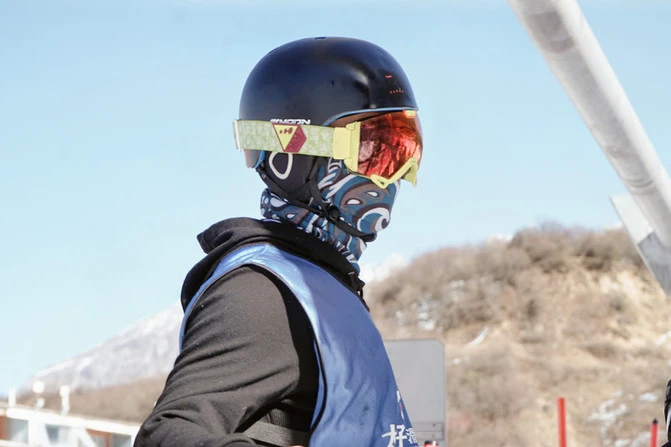
Southerners always have an indescribable joy for snow. The rare snowfall in Chengdu stirred my anticipation for snow. There are several well-known ski resorts in Sichuan, such as Xiling Snow Mountain, Zhegu Mountain, and our destination, Taiziling at Jiuding Mountain.
I had heard about JianTu Bus travel a long time ago. Just like in the Korean movie 'A Journey to the End,' a car, three friends, rivers vast, and a peaceful life. So, with a quirky literary heart, I boarded the JianTu Bus and started my first road trip.
As the altitude gradually rose, the temperature dropped. The bus wound up between the mountains; in the distance were ridges and blue sky, and beneath us was a winding road.
Suddenly, looking up I saw specks of white—yes, snow—thinly layered on the soil. Continuing on, more and more snow appeared, thicker and thicker, and the fog also thickened. This fog wasn't like the heavy, murky smog in the city; it was milky white, gently hanging among the branches, adding a sense of mystery to Jiuding Mountain.
You can either bring your own food or eat at the ski resort (there are small shops and restaurants).
Be sure to bring all your gear. Gloves and a hat are essential. Most importantly, take sun protection measures; it's good to bring sunglasses and such (the altitude is high, UV is strong).
Of course, there are other costs, like the entrance fee: the entrance fee for Jiuding Mountain doesn't include the ski resort ticket, plus some ski equipment rental and fees for hiring a coach (coach fees depend on your negotiation).
The ski resort here includes several areas: the beginner slope, which is simplest and suitable for novices, and the advanced slope, perfect for high-level skiing enthusiasts to let loose (you can take a cable car to the advanced slope). I happened to see an expert gracefully ski past me—envy, jealousy, and hatred indeed.
For a novice like me, I only belonged on the beginner slope. I don't know how many times I fell, but with snow it didn't hurt much. I finally learned, and I hope next time I can go to the intermediate or advanced slope. You can take the cable car to the advanced slope.
But beginners are not advised to go on the advanced slope.
Escaping the fast pace and smoggy weather of the city, without life's trivialities, without work emails, only pure snow. Skiing by day, blessed by sunlight; skiing by night, caressed by stars.
'Jiaoliao' conveys the carefree, unrestrained Zhuangzi culture, preserving a quiet space in the bustling city, both spiritual and refined.
Located in Kuanzhai Alley, known as 'Chengdu's Living Room,' the butler said Jiaoliao adheres to the concept of freedom and ease. The hotel, with its ancient charm and tranquil, elegant layout, creates a paradise with old Chengdu characteristics.
Different from Jiangnan gardens with deep courtyards, misty willows, and painted bridges.
Jiaoliao is small, as its name suggests—not aspiring to be a roc but having a unique charm in its smallness. Small building, small courtyard, small pond, small corridor; small yet refined, showing that the owner is particular.
You can hear the wind on the eaves, see the moon in the pond, enjoy willows by the steps, and admire flowers in the courtyard—everything is there. The location is clever, with thoughtful details everywhere without falling into clichés. It is a rare elegant place, a clean and refined dwelling.
The three-entrance courtyard represents the traditional return home etiquette of large families, and the long corridor feels like walking through a time tunnel.
I checked online; the hotel has only 10 independent suites. Each room has a different name, said to originate from the 'Jiaoliao Fu' with various meanings. After arriving at Jiaoliao, the butler explained the origin of each room name. For example, room names on the first floor are the living environment of the wren (like 'Haolai' meaning weeds; the wren is born among weeds). Room names on the second floor are various Zhuangzi fables expressing important ideological realms (like 'Yanqian', meaning words are simple but can convey deep significance).
The rooms on the second floor are all large, around 100 square meters. There are two 100-square-meter double-bedroom suites and one triple-bed family suite.
The third-floor Cangying room has a large viewing balcony that also serves as a garden. I personally like to enjoy the view and sip tea on the balcony, watching the flow of people in Kuanzhai Alley while slowly tasting my tea, feeling joyful.
Additionally, on the fourth floor of the hotel there is an indoor tea room and an outdoor sunroom with lush bamboo, revealing attention to detail everywhere.
Breakfast has a huge variety, nutritious, delicious—the most sumptuous breakfast I've ever had in a hotel.
There is an indoor spa experience, and like the room toiletries, it uses the high-end niche luxury American brand 'JUNEJACOBS,' with pure natural plant essential oils, patented antioxidant products, and professional American therapy techniques integrated with local elements. The butler's technique is practiced, gentle, relieving the fatigue of the day. At this moment, I deeply experienced the slow luxury of Kuanzhai Alley (PS: spa must be booked in advance).
Nearby dining recommendations: Next door is the popular street—Paotongshu Street, with many small private kitchens. Kuixinglou Street is also not far from Kuanzhai Alley, where you can try Sichuan snacks. If you don't know what to do or what to eat, ask the butler! The butler service is superb, available 24/7. Add WeChat in advance and they provide very local travel tips! It feels like staying one night in the hotel gets you a full Chengdu travel consultation service.
The hotel is quiet in the midst of noise. Kuanzhai Alley is lively, but entering the hotel feels like another world—very quiet.
According to the hotel butler, the name 'Jiaoliao' comes from 'The wren nests in deep woods, yet only needs one branch,' implying a small corner in the bustling city.
Placing a refined dwelling in a busy city takes the Taoist principle of seeking quiet in noise, a hermit in the city. It can also be called a paradise among Chengdu's scenic spots.
Chengdu Jiaoliao Humanistic Boutique Hotel
Jiaoliao Humanistic Boutique Hotel
A quiet little retreat, a former paradise.
Take a quiet place in the middle of the hustle and bustle.
Waiting for guests from north and south, welcoming people from all directions.
I have to say, Chengdu's tea house culture and bar culture are truly rich. Bieyuanli is near 339. I personally like the name Bieyuanli—it carries a sense of leisure, which is very Chengdu.
A must-visit bar in Chengdu, no doubt. It's very popular, especially at night. The bar environment is great, with a very modern decoration style, magnificent. There are several handsome guys greeting at the door.
At the entrance, there is a foreign girl wearing a glowing cat ear headband. She is very elegant, and when we entered, she gave one to us too.
The interior decoration mixes Chinese elements with modern flashing neon lights, and the light at the door sets a great atmosphere. My favorite was the moving colorful bubble lamp on the ceiling.
There are two floors inside. On the second floor there is a balcony from which you can see the night view of the TV tower at a glance.
We went to the second floor but ended up sitting on the first floor because we could see the live singers. We watched a girl and a band perform; they were really good, very professional. Especially the girl, her singing was immersive and melodious, and we couldn't help singing along.
Most of their liquors are fruit wines, so you don't have to worry about getting drunk. My favorite was the passion fruit wine and the hot pot wine. The passion fruit wine came with a misty effect, with ice inside; it was cool and refreshing. Actually, its taste was more like passion fruit juice, not very alcoholic, very tasty.
Then there is the special hot pot wine, served in a pot like a hot pot, filled with fruit wine with plenty of ingredients—oranges, dragon fruit, grapes, and many other fruits, with a few rose petals floating on top. It tasted great, with a rose fragrance, sweet and delicious; you still want more after finishing.
The barbecue platter should be eaten while hot, with various skewers of meat and vegetables, each well-seasoned and tasty. To my surprise, there were several large shrimp, and the squid was also very fragrant.
Also, their snack—Sandapao—is soft and sticky, dipped in brown sugar, sweet but not greasy, very authentic. This also should be eaten hot; it gets a bit hard when cold.
In short, it's a place worth visiting. It's perfect to spend New Year's Eve here this year.
In winter, Chengdu is shrouded in thick fog. Going out, you don't feel the need to moisturize; it's not dry at all. Even in this cold winter, there are still waves of people on this street.
No one in Chengdu doesn't know Chunxi Road, I think no one would object. Many cities have imitated the layout and architectural style of Chunxi Road, but it has always been 'imitated but never surpassed.'
Chunxi Road is Chengdu's most prosperous commercial street, also a concentration of commerce, fashion, and food. Chunxi Road is a microcosm of Chengdu's prosperity and fashion. It gathers world brands, Chengdu cuisine, and the most eye-catching handsome men and beautiful women. There is no off-season or peak season here.
Even though it was a weekday, there were still many people, very lively. I feel this place is really suitable for tourism, especially for a foodie like me. What I love most is the entire atmosphere and state of Chengdu; no matter where I go, I can't forget about eating. The snacks here are varied, each with strong Chengdu characteristics.
There is also the internet-famous climbing panda, really adorable; I couldn't take enough pictures.
When you're in a bad mood, come here for a stroll, and instantly your mood improves. As Chengdu's oldest and most prosperous commercial street, it's a must-visit for every out-of-town tourist. A stop in Chengdu you cannot miss.
Life is a one-way journey. Even if there are regrets, we have no chance to start over. Instead of struggling with the unchangeable past, it's better to smile, cherish the present, and welcome the future, because in life, there are no ifs.


