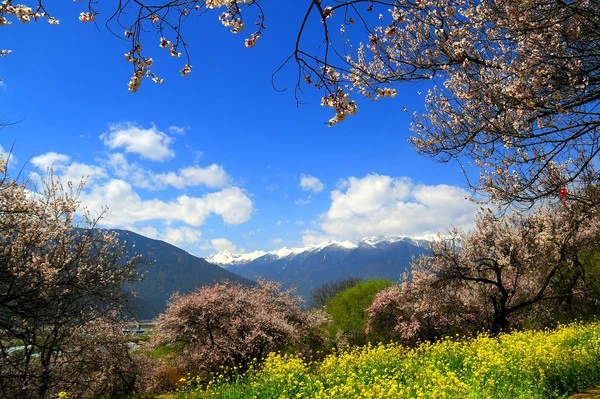
A Date with Spring - Self-Drive Tour Guide for Peach Blossom Season in Linzhi, Tibet, March 2021 (Part 2)
Linzhi - Bayi District - Gala Village Peach Orchard
Linzhi - Milin - Yarlung Tsangpo Grand Canyon - Suosong Village - Namjagbarwa Peak
Linzhi - Gongbo'gyamda - Ouba Village
Linzhi - Bayi District - Gala Village Peach Orchard
Linzhi - Bayi District - Gala Village Peach Orchard
Linzhi - Milin - Mirui Township
Linzhi - Milin - Yarlung Tsangpo Grand Canyon
Linzhi - Milin - Pai Town - Yarlung Tsangpo Riverside
Linzhi - Bomi - Galang National Wetland Park
Linzhi - Bomi - Bomi Peach Blossom Valley - Galang Village
Chamdo - Baxoi - Palong Zangbo River
The peach blossoms in Linzhi, Tibet, have long been renowned. Due to its special geographical location, not many people came to see the blossoms in previous years. In recent years, riding the wave of Tibet's tourism boom, the media has intensified its promotional efforts, and local authorities have also fueled the trend. Gala Peach Blossom Village in Linzhi and Bomi Peach Blossom Valley have become popular attractions that people flock to. During the blossom season, tourists come from all directions to encounter the most beautiful spring in China.
Although I had been to Tibet many times before and had always wanted to see the unique snowy region peach blossoms in the 'Jiangnan of Tibet', the timing was never right, and I never had the chance to behold their intoxicating beauty and charm.
This time, during the wonderful Linzhi peach blossom season, I made a special trip to Linzhi to see the blossoms, fulfilling a long-cherished wish. From March 26, when I left my hometown Shantou in Guangdong, to April 4, when I returned to Shantou, the trip lasted a total of 10 days.
The brief itinerary for this trip was: Shantou - Lhasa - Linzhi - Milin - Bomi - Ranwu Lake - Lulang - Lhasa - Shantou. The round trip between Shantou and Lhasa was by plane; sightseeing in Linzhi and elsewhere was by rented self-drive car, with a self-drive distance of about 2,200 kilometers. In just a few days, I visited all four main peach blossom viewing spots in Linzhi: Laru Peach Blossom Village (Gongbo'gyamda County), Gala Peach Blossom Village (Bayi District, Linzhi), Suosong Village deep in the Yarlung Tsangpo Grand Canyon (Milin County), and Bomi Peach Blossom Valley (Bomi County). Although the cold was not yet gone, these places had already become a sea of flowers. It was a 'short, fast, and efficient' trip that was a feast for the eyes and very rewarding.
1. In March, the weather in Tibet is still very cold. Due to the season and climate, the scenery in most other places is not very attractive. Therefore, a special trip is generally needed to see the peach blossoms in Linzhi.
2. The flowering times vary greatly between different peach blossom viewing areas due to differences in geographical location and altitude. In most places, the peak blooming period is generally from mid-to-late March to early April.
3. If you come only to see the peach blossoms, a week's time should be enough to arrange.
Linzhi - Milin - Yarlung Tsangpo Grand Canyon - Suosong Village - Namjagbarwa Peak
Linzhi - Milin - Yarlung Tsangpo Grand Canyon - Suosong Village - Namjagbarwa Peak
Linzhi - Bayi District - Gala Village Peach Orchard
Linzhi - Bayi District - Gala Village Peach Orchard
Linzhi - Bayi District - Gala Village Peach Orchard
Linzhi - Bayi District - Gala Village Peach Orchard
Linzhi - Bayi District - Gala Village
Linzhi - Milin - Mirui Township
Linzhi - Bomi - Galang National Wetland Park
Linzhi - Bomi - Bomi Peach Blossom Valley - Scenery along the way
Chamdo - Baxoi - Palong Zangbo River
D1, March 26 (Friday, clear, temperature 1-8°C). Today was the first day of entering Tibet. I flew from Shantou to Lhasa (with a stopover in Luzhou) on Tibet Airlines flight 19:15-00:55. The plane arrived at Lhasa Gonggar International Airport at 1 a.m., and it took nearly half an hour to get the luggage. Fortunately, the hotel I booked for the night offered 24-hour airport transfer service (the service was indeed very good, worthy of praise), and I soon arrived at the City Convenience Hotel (Lhasa Gonggar International Airport Branch). Time to pack up and sleep; tomorrow I'll have to sightsee and self-drive over 500 km to Linzhi.
1. Fly directly to Linzhi is the best choice for seeing peach blossoms in Linzhi. However, there are fewer flights to Linzhi, and ticket prices during the peach blossom festival are very high. Lhasa, being a provincial capital, has more flights and greater discounts on ticket prices.
2. For car rental, there is a larger selection in Lhasa, and prices are slightly cheaper than in Linzhi. Although Lhasa is over 400 km from Linzhi, the Linzhi-Lhasa Expressway has few cars, nice scenery, and no tolls. It is really good and convenient.
3. During the Linzhi peach blossom season, car rentals are very popular. If you need one, be sure to book a vehicle in advance. The road conditions in Tibet are now very good, making self-driving convenient.
D2, March 27 (Saturday, clear, temperature 3-9°C). Today's most important task was to complete the car rental procedures. This time, I rented a Toyota Highlander 2.0T SUV from Anda Car Rental on Ctrip more than 20 days in advance. Originally, the pick-up location was set for delivery at Gonggar International Airport. Later, because we were staying at the City Convenience Hotel near the airport, we contacted the rental company to deliver the car directly to the hotel for more convenience. They were happy to do so and delivered the car on time. The car was in good condition, with brand-new tires and thoroughly cleaned. The procedures were simple. Thumbs up!
After getting into the just-received Highlander SUV, I set the navigation on my phone and headed straight for Laru Peach Blossom Village in Gongbo'gyamda County, over 400 km away. From the moment we entered Linzhi, peach blossoms accompanied us along the way, making the journey pleasing to the eye and very enjoyable. We stopped from time to time to admire and take photos.
Today, we visited the Xiuba Thousand-Year Ancient Fortresses (Gesar Ancient Fortress), Ouba Village, the Nyang River, and other scenic spots along the way. Unfortunately, the peach trees on the hillsides of Laru Peach Blossom Village had only just begun to form buds, so the scenery was average. But along the way, the scenery, including some villages with partially bloomed peach blossoms, was so beautiful that it was overwhelming and made us linger, and we never felt that the extra dozens of kilometers were not worth it.
At night, we stayed at the Vienna Hotel (Linzhi City Government Binhe Road Branch), which was also booked more than 20 days in advance. However, rooms were already very tight, and we couldn't book the same room for two consecutive nights; we had to switch rooms the next day, which was a bit troublesome, but it was already quite good to have a room.
1. Laru Village is on the way to Basum Lake, only a few kilometers from Basum Lake. Along this route, the scenery is stunning, especially around Ouba Village. It is well worth making a detour from the Linzhi-Lhasa Expressway to go there (about 100 km round trip, very good road conditions).
2. Basum Lake is very beautiful and is a place worth arranging to stay for a day or two. Since I had been there before, I didn't schedule time to go this time.
3. During the Linzhi Peach Blossom Festival, hotel and homestay rooms everywhere are very tight. Be sure to book accommodation in advance.
4. The peach blossoms in Laru Village bloom much later than the few blossom viewing spots mentioned above. It is said that this year's Peach Blossom Festival opening ceremony there is on April 15, more than half a month later than the opening of the Gala Peach Blossom Village festival.
Linzhi - Gongbo'gyamda - Linzhi-Lhasa Expressway
Linzhi - Gongbo'gyamda - Linzhi-Lhasa Expressway
Linzhi - Gongbo'gyamda - Xiuba Thousand-Year Ancient Fortresses
Linzhi - Gongbo'gyamda - Ouba Village
Linzhi - Gongbo'gyamda - Ouba Village
Linzhi - Gongbo'gyamda - Ouba Village
Linzhi - Gongbo'gyamda - Laru Village
Linzhi - Gongbo'gyamda - Laru Village
Linzhi - Gongbo'gyamda - Laru Village
D3, March 28 (Sunday, clear, temperature 4-12°C). Today I arranged a whole day to visit the most famous place for peach blossom viewing in Linzhi: Gala Village Peach Garden.
Gala Village Peach Garden is located along National Highway 318, only about ten kilometers from downtown Linzhi. It was the main venue of the 19th Tibet Linzhi Peach Blossom Tourism Cultural Festival in 2021, and is known as the 'No. 1 Peach Blossom Village in Linzhi, Tibet.' This is an enviable paradise: dense peach trees covering the entire hillside; peach blossoms in full bloom in various poses. On the foothills and slopes, they are layered and well-proportioned; under the trees and in open spaces, the rapeseed flowers, yellow and green, are full of vitality; in the distance, there are fields, villages, rivers, and snowy peaks, with intertwining mountain ranges, unique to Tibet; climbing to the several-story-high observation deck and looking out, dreamlike beautiful scenes come into view, a rich visual feast that is refreshing and eye-opening.
In the afternoon, with some time left, I went to the nearby Jiemai Village and Duodang Village to play. At night, I returned to Linzhi and stayed at the Vienna Hotel again.
1. Gala Village Peach Garden is right next to National Highway 318, not far from the city center and easy to reach. The crowd here is dense, and tour groups also come here, making it the most popular peach blossom viewing spot.
2. There are two or more large parking lots, convenient and free, but if you come late, it will still be full of cars.
3. There are no restaurants inside the garden or nearby, only a small stall near the entrance selling drinks, fruits, instant noodles, etc. At noon, we could only have a bucket of instant noodles each to stave off hunger.
Linzhi - Bayi District - Gala Village Peach Orchard
Linzhi - Bayi District - Gala Village Peach Orchard
Linzhi - Bayi District - Gala Village Peach Orchard
Linzhi - Bayi District - Gala Village Peach Orchard
Linzhi - Bayi District - Gala Village Peach Orchard
Linzhi - Bayi District - Gala Village Peach Orchard
Linzhi - Bayi District - Gala Village
Linzhi - Bayi District - Gala Village Peach Orchard
Linzhi - Bayi District - Gala Village Peach Orchard
Linzhi - Bayi District - Gala Village Peach Orchard
Linzhi - Bayi District - Gala Village Peach Orchard - King Peach Tree
Linzhi - Bayi District - Duodang Village
D4, March 29 (Monday, cloudy with breaks, temperature 2-9°C). Today, I had to travel 100 km to Suosong Village, known as the 'First Village of Namjagbarwa', located deep in the Yarlung Tsangpo Grand Canyon (one of China's ten most beautiful canyons) in Milin County. This place is not only another good spot for peach blossom viewing but also an excellent place to overlook Namjagbarwa Peak (one of China's ten most beautiful mountains).
Along the way, we traveled along the north bank of the Yarlung Tsangpo River, visiting the Yani National Wetland Park, Mirui Township, Pai Town, and the Buddha Palm Sand Dune Observation Deck. When we were about to pass through the edge of the Yarlung Tsangpo Grand Canyon Scenic Area to reach Suosong Village, we were told that we needed to buy a scenic area ticket to pass through. We also visited Tunbai Village and the Namjagbarwa Peak Observation Deck along the way, finally arriving at Suosong Village.
In Suosong Village, large patches of peach trees grow along the Yarlung Tsangpo Grand Canyon. Nearby there are fields and the canyon, and in the distance, snowy mountains complement each other, like a fairyland, beautiful and spectacular. Coming here to see the flowers at this time, the season is still a bit early; the peach blossoms were only about 50% open. But nonetheless, the scenery was already very beautiful.
At night and the next early morning, we were fortunate to see a little bit of the golden sunlight on Namjagbarwa Peak. Although the clouds were still thick, visibility was not high, and the scene was not clear, and it lasted only a few seconds, it was still rare and exhilarating.
At night, we stayed at the Milin Guanfengju Inn in Suosong Village, which was the most expensive accommodation on this trip, by far.
1. Suosong Village, deep in the Yarlung Tsangpo Grand Canyon, is highly sought after by tourists for its excellent location for overlooking and viewing Namjagbarwa Peak. Although there are many hotels and homestays, the peak blooming period is only about ten days, during which large numbers of tourists pour in every day, making accommodation very expensive. Prices are generally 3 to 5 times higher than usual. A very ordinary homestay room can cost over a thousand yuan per night, and you need to pay in full well in advance.
2. The advantages of staying in Suosong Village are: first, if lucky, you have more opportunities to see Namjagbarwa Peak and the golden sunlight; second, you have more time to enjoy the peach blossom scenery along the Yarlung Tsangpo River. Of course, the biggest drawback is one word: 'expensive!' Two words: 'very expensive!' Three words: 'especially expensive!'
3. Suosong Village is on the north bank of the Yarlung Tsangpo Grand Canyon, while the Yarlung Tsangpo Grand Canyon Scenic Area is on the south bank. Since I had visited the scenic area before when I came to Tibet, I didn't schedule time to go there this time. According to the owner of the inn, if you have time, you can go to the scenic area on the south bank.
Linzhi - Milin - Yani National Wetland Park
Linzhi - Milin - Scenery along the way
Linzhi - Milin - Mirui Township
Linzhi - Milin - Mirui Township
Linzhi - Milin - Yarlung Tsangpo River - Buddha Palm Sand Dune
Linzhi - Milin - Yarlung Tsangpo Grand Canyon - Suosong Village
Linzhi - Milin - Yarlung Tsangpo Grand Canyon
Linzhi - Milin - Yarlung Tsangpo Grand Canyon - Suosong Village - Namjagbarwa Peak - Sunset
D5, March 30 (Tuesday, cloudy to overcast, 2-7°C). Today's itinerary required driving about 300 km from Suosong Village to Bomi, the location of the last peach blossom viewing spot on this trip.
Early in the morning, I was fortunate to see a little bit of the sunrise over Namjagbarwa Peak from the rooftop terrace of the inn where I was staying. Around 8 a.m., after breakfast, I left the accommodation and continued towards Dalin Village, deeper in the Yarlung Tsangpo Grand Canyon. When we reached the riverside of the Yarlung Tsangpo River, the road bridge over the river had been destroyed by a flood earlier, so we had to turn back the same way.
The weather in the morning was still fairly good, with the sun occasionally showing its face. The over 7,700-meter-high Namjagbarwa Peak was also appearing and disappearing, finally allowing us to see its entire appearance. Although the weather was not very good and visibility was low, it was already very fortunate and rare. It is known that Namjagbarwa Peak is shrouded in clouds and mist all year round, revealing its true face only about 60 days a year, hence it is also called the 'Shy Maiden Peak.' This was the third time I had come here, and only now did I see its beauty. The first time I saw nothing; the second time only a little; this third time, I finally saw the full view. Heaven has been kind to us, and I felt very happy, content, and grateful from the bottom of my heart.
Along the way, we went to a place called Milin Gongzun Demu Farm, located right by the Yarlung Tsangpo River. The location here is advantageous, open and spacious. By the river, there is a large sandy beach where you can play with sand and water, and also overlook Namjagbarwa Peak. The beautiful scenery here made us linger, and we didn't leave until nearly noon. After lunch near the scenic area, we passed by the Sejila Mountain Pass Observation Deck and the Tongmai Bridge Observation Deck. It was past 8 p.m. and dark when we finally reached our destination, Bomi County.
At night, we stayed at the Bomi Yunbo Hotel, where we would stay for three consecutive nights.
1. This year, the peak blooming period for peach blossoms in Suosong Village should be around the beginning of April. When we came, the flowers were only about half open.
2. Currently, Tibet is not like other provinces. Not every township has a gas station. So, when you see a gas station, fill up in time. When refueling, you need all three documents: ID card, driver's license, and vehicle registration certificate.
3 Plan your driving time and try to avoid driving at night for safety.
Linzhi - Milin - Yarlung Tsangpo Grand Canyon - Suosong Village - Namjagbarwa Peak - Sunrise
Linzhi - Milin - Yarlung Tsangpo Grand Canyon - Dalin Village
Linzhi - Milin - Yarlung Tsangpo Grand Canyon
Linzhi - Milin - Yarlung Tsangpo Grand Canyon - Suosong Village - Namjagbarwa Peak
Linzhi - Milin - Yarlung Tsangpo Grand Canyon - Suosong Village - Namjagbarwa Peak
Linzhi - Milin - Yarlung Tsangpo Riverside
Linzhi - Milin - Yarlung Tsangpo Riverside
Linzhi - Milin - Yarlung Tsangpo Riverside - Distant view of Namjagbarwa Peak
Linzhi - Milin - Scenery along the way
Linzhi - National Highway 318 - Sejila Mountain Pass
Linzhi - National Highway 318 - Tongmai Bridge
D6, March 31 (Wednesday, overcast with light rain, 4-9°C). Today, in Bomi, we were to go to the Bomi Peach Blossom Valley Scenic Area, about 20 km from the county town. This is another popular spot for peach blossom viewing in Linzhi.
In the morning, there was a light drizzle, and mist was swirling among the mountains. Passing through Galang National Wetland Park, the beautiful scenery attracted many tourists to stop and admire and take photos by the roadside and on bridges.
When we arrived at the Peach Blossom Valley Scenic Area, starting from Galang Village, we followed the rural road all the way to Runa Village (Peach Blossom Corridor), Baiyu Village, Linqiong Village, Yuxu Township, etc. The Peach Blossom Valley is over 50 km long, with nearly 200,000 wild peach trees, most of which are between 300 and 600 years old. However, most visitors focus on the area of Galang Village and Runa Village, where the internet-famous spot 'Peach Blossom Corridor' is located. Amid the peach blossoms, houses are faintly visible; the villages and wheat fields are also dotted with pink peach trees, colorful and diverse. The scenery was indeed better here. Local tourism is still basically undeveloped, retaining a natural and rustic atmosphere. Because it was raining lightly, and the peach blossoms here had actually already passed the peak blooming period, the overall impression was not as good as the propaganda and imagination suggested.
At noon, we had noodle soup at a small restaurant in Runa Village. In the evening, we returned to Bomi to stay overnight.
1. Originally, there is also Qingduo Town along this route, which is said to be a good place for peach blossom viewing, allowing you to overlook and photograph the blossoms in the valley from a high vantage point. However, the bridge leading to the town was destroyed by a flood, so if you want to go there now, you have to go back to National Highway 318 and take a detour from there to get there.
2. Entering the Peach Blossom Valley Scenic Area does not require a ticket, but along the way, many places with peach trees are fenced off by local farmers. If you want to go inside to see and photograph the flowers, it costs 5 yuan per person.
3. The peak blooming period here should be around mid-March.
Linzhi - Bomi - Galang National Wetland Park
Linzhi - Bomi - Galang National Wetland Park
Linzhi - Bomi - National Highway 318
Linzhi - Bomi - Galang National Wetland Park
Linzhi - Bomi - Bomi Peach Blossom Valley - Galang Village
Linzhi - Bomi - Bomi Peach Blossom Valley - Runa Village
Linzhi - Bomi - Bomi Peach Blossom Valley - Runa Village - Peach Blossom Corridor
Linzhi - Bomi - Bomi Peach Blossom Valley - Scenery along the way
Linzhi - Bomi - Bomi Peach Blossom Valley - Scenery along the way
Linzhi - Bomi - Bomi Peach Blossom Valley - Scenery along the way
D7, April 1 (Thursday, overcast with breaks, scattered light rain and snow, temperature 2-7°C). Once in Bomi, Ranwu Lake in Baxoi County is only a little over 100 km away. Although I had been there before, I wanted to see the different scenery of this famous scenic area in different seasons, so I specially arranged a day to go there.
Traveling along National Highway 318 towards Sichuan, many places had just snowed the night before. The scenery along the way was very beautiful. We stopped and played as we went, and it was noon by the time we arrived after about 100 km. After lunch at a roadside shop, we headed straight to Ranwu Lake. Unfortunately, the weather was not good. It was very windy and cold at the observation deck, and the scenery was just average, somewhat disappointing. Fortunately, the scenery along the way was beautiful; otherwise, the 280 km round trip would not have been worth it.
Returning to Bomi, we stayed at the Bomi Yunbo Hotel again at night.
Linzhi - Bomi - National Highway 318
Linzhi - Bomi - Palong Zangbo River
Linzhi - Bomi - Palong Zangbo River
Chamdo - Baxoi - Palong Zangbo River
Chamdo - Baxoi - Palong Zangbo River
Chamdo - Baxoi - Ranwu Lake
Chamdo - Baxoi - Ranwu Lake - Observation Deck
Chamdo - Baxoi - Ranwu Lake
D8, April 2 (Friday, overcast with breaks, scattered light rain, 1-7°C). From today, we started heading back, going from Bomi to Lulang Town. In the morning, we had some time to visit Gangxiang Spruce Forest Scenic Area, one of the 'Five Most Beautiful Forests in China.' After lunch at Gang Village, we headed to Lulang Town.
Originally, I expected that the coldest accommodation on this trip would be at Suosong Village in the depths of the Yarlung Tsangpo Grand Canyon. But after arriving at Lulang Town, perhaps due to the overcast and rainy weather, it was even colder there. It was said that it was snowing on the mountain (the Sejila Mountain Pass at 4,728 meters is only about 20 km away). The room had no heating, so it was as cold indoors as outdoors. At night, we relied entirely on electric blankets to keep warm. You can imagine how it felt, but it was only for one night.
At night, we stayed at the Lulang Bodhi Lotus Homestay.
Linzhi - Bomi - Gang Village
Linzhi - Bomi - Gang Village
Linzhi - Bomi - Gang Village
Linzhi - Bomi - Gangxiang Spruce Forest
Linzhi - Bomi - Gangxiang Spruce Forest
D9, April 3 (Saturday, cloudy, 2-9°C). According to the itinerary, today we had to drive nearly 500 km from Lulang back to Lhasa. Yesterday, I heard that it had snowed on the mountain (Sejila Mountain, on National Highway 318, the only road back to Lhasa), causing heavy traffic jams and traffic control.
After getting up in the morning, I rushed to the front desk to inquire about the situation. The bad news was that the traffic jam on the mountain was severe last night. Some guests staying in the same homestay who had come from the direction of Linzhi yesterday afternoon only arrived at 5 a.m., and others even later at 7 a.m. The good news was that it had stopped snowing on the mountain, and the weather was gradually improving. The snow on the road would melt by afternoon, making it safer to travel then. However, we needed to have snow chains in the car.
After learning this, we quickly prepared. First, we went to a gas station to fill up the car. Second, we went to buy snow chains as a backup. Unfortunately, the snow chains at the small shop early in the morning had been sold out. Fortunately, with the help of some kind people, we finally managed to buy a pair of snow chains.
While waiting for the snow chains to be delivered, I took a stroll near the Lulang Alpine Pasture and Zhaxigang Village, taking a few photos. As soon as we got the snow chains, we immediately departed from Lulang, hoping to reach Lhasa by 4 p.m. and then go to the Potala Palace Square for photos. Every time I come to Tibet, I go to the Potala Palace Square for photos.
But things turned out contrary to our wishes. The unexpected massive traffic jam not only completely ruined today's itinerary plan but also forced us to drive for several hours at night before returning to Lhasa. We arrived at the mountain area just before 11 a.m. The vehicles on the mountain were already in a long line, moving occasionally but soon stopping completely. In the following six hours, we only managed to cover about 20 km in fits and starts. Fortunately, not far after crossing the Sejila Mountain Pass, we left the congested section.
It was 5 p.m. when we reached the foot of the mountain. That is, we had spent nearly six hours stuck in traffic around the Sejila Mountain Pass at an altitude of over 4,700 meters. It was tough, and it would have been terrible if we had altitude sickness symptoms. Fortunately, we had been taking 'Nodikang Capsules' (main ingredient Rhodiola rosea) daily for 10 days before leaving for Tibet, and everyone was fine. When we arrived at the town at the foot of the mountain, we quickly found a restaurant for lunch. It was 5 p.m. by the time we had lunch. Then we got on the Linzhi-Lhasa Expressway and finally arrived safely at our accommodation in Lhasa, the Vienna Hotel Lhasa Potala Palace Park Branch, at 11 p.m. Unexpected things can really be serious when traveling.
D10, April 4 (Sunday, cloudy, 4-10°C). Today was the last day of this special trip to Linzhi for peach blossom viewing. I flew from Lhasa to Chongqing on Air China flight 11:05-13:35, then transferred to another Air China flight 18:15-20:40 back to Shantou.
The big traffic jam yesterday disrupted the plan to go to the Potala Palace Square for photos. Before going to the airport in the morning, I managed to squeeze out a little time to make up for this. Everyone got up very early. Before the restaurant started serving breakfast at 7 a.m., we loaded our luggage into the car. After breakfast, we immediately took a Didi to the Potala Palace Square. In about half an hour, we completed the routine thing we do every time we come to Tibet. Then we took another Didi back to the hotel. At that time, the rental company driver who had arranged to handle the car return procedures also arrived at the hotel lobby. After simple procedures, the car was inspected at the parking lot, and then the driver took us to the airport. In the evening, we returned safely to Shantou, successfully concluding the trip to enjoy peach blossoms in Linzhi.
Linzhi - Lulang - Lulang Town
Linzhi - Lulang - Lulang Town
Linzhi - Lulang - Lulang Alpine Pasture
Linzhi - National Highway 318 - Sejila Mountain Pass - Traffic jam section
Lhasa - Potala Palace
Although this trip to enjoy peach blossoms in Linzhi was short, the harvest was still substantial. Overall, I felt both satisfied and regretful, and there was also an incident.
Satisfaction: First, the overall itinerary arrangement was still relatively feasible. We went where we needed to go and saw the sights we wanted to see. Second, the weather was generally good. Although we encountered overcast, rainy, and light snowy days, it basically did not have much impact on the sightseeing. Third, the rented Toyota Highlander 2.0T SUV performed well, with good conditions and strong horsepower, ensuring a smooth and safe self-drive trip.
Regret: Mainly, the blooming period was not as ideal as expected. This is an objective phenomenon because the several main peach blossom viewing spots in Linzhi vary greatly in distance and altitude. Affected by altitude and climate, the peak blooming periods naturally differ greatly. It is simply impossible to encounter all peak blooming periods in such a short time. Therefore, when choosing a time to come for peach blossom viewing, you have to prioritize.
Incident: Refers to the unexpected major traffic jam. Not only did it waste six hours of precious time, but more critically, we had to drive back to Lhasa at night. You must know that although this approach is a last resort, it is a big no-no for self-driving. Driving at night reduces safety. Fortunately, we got on the Linzhi-Lhasa Expressway before dark, which has much better road conditions than National Highway 318.
1. Although late March in Linzhi is the end of winter and beginning of spring, the weather is still very cold. During our stay in Tibet, the temperature was about 1-10°C. So be sure to bring enough warm clothing. Also, it often rains during this period, so bring rain gear.
2. Although the altitude along this route is not very high (Lhasa 3,600m, Linzhi 2,800m, Bomi 2,700m; the pass of Sejila Mountain on National Highway 318 is 4,728m, but under normal circumstances you pass through quickly; previously you also had to pass the Milha Mountain Pass at over 5,000m, but a tunnel has now been opened), it is still necessary to take some preventive medication for altitude sickness beforehand. This time, if we had not taken measures to prevent altitude sickness while stuck on the mountain at over 4,000m for so long, the consequences could have been unimaginable.
3. The peach blossom spots in Linzhi are numerous, spread out along long routes, and quite scattered. Current public transportation cannot take you anywhere you want to go at any time. Therefore, the best way to enjoy peach blossoms in Linzhi is to self-drive or charter a car. This way, you can stop and go, and take photos anytime.
4. According to on-site observation this year, the approximate peak blooming periods for the four main peach blossom viewing spots in Linzhi are: Bomi Peach Blossom Valley in mid-March, Gala Peach Blossom Village in late March, Suosong Village along the Grand Canyon in early April, and Laru Peach Blossom Village in mid-April. The exact peak period varies each year due to weather and other factors.
5. If you have limited time and want convenience, you only need to go to Gala Peach Blossom Village in Bayi District and Bomi Peach Blossom Valley. Both spots are along National Highway 318, with convenient transportation, and their peach blossom viewing seasons are relatively close and concentrated. In Bayi District, you only need to go to Gala Peach Garden; in Bomi Peach Blossom Valley, just go from Galang Village to Runa Village for a few kilometers. The peach blossoms at these two places should be the most large-scale, representative, and famous in Linzhi.
Linzhi - Bomi - Bomi Peach Blossom Valley - Runa Village
Linzhi - Bomi - Bomi Peach Blossom Valley - Scenery along the way
Linzhi - Bayi District - Gala Village Peach Orchard
Linzhi - Bayi District - Gala Village Peach Orchard
Linzhi - Bayi District - Gala Village Peach Orchard
Linzhi - Bayi District - Gala Village Peach Orchard
Linzhi - Bayi District - Duodang Village
Linzhi - Bayi District - Gala Village Peach Orchard


