Latest 3-5 Day Chengdu Free Travel Guide for Summer 2021
"Fat baby, round and plump, rides a horse to Chengdu. Chengdu is so much fun, the fat baby rides a white horse." This folk rhyme perfectly captures the image of the fat baby. Chengdu, the "Land of Abundance" since ancient times, welcomes tourists from all over the world with its most heartfelt and warm hospitality, making everyone fall deeply in love with this "city you never want to leave once you arrive."
Day 1: Kuanzhai Alley – Jinli, Wuhou Shrine
Day 2: Chunxi Road – Giant Panda Base
Day 3: People's Park – Jiuyan Bridge
Day 4: Mount Qingcheng – Dujiangyan (depending on your itinerary, you can also spend 2 days here)
DAY 1: Time Flows, Wandering in the Slow Life of Old Chengdu – Kuanzhai Alley
Though I'm practically drooling talking about food, the story of Chengdu should begin with its scenery. After dropping off my luggage, the first stop was Kuanzhai Alley, the liveliest, most distinctive, and most well-known neighborhood in Chengdu. Compared to the recently rebuilt Jinli, I prefer the original, ancient charm of Kuanzhai Alley. The predecessor of Kuanzhai Alley was a hutong built during the Kangxi reign. Legend has it that after suppressing the Dzungar rebellion in the 57th year of Kangxi, a Manchu city was built in Chengdu. Wide Alley was then called Xingren Hutong, Narrow Alley was called Taiping Hutong, and Well Alley was called Ruyi Hutong.
There is not only Wide Alley and Narrow Alley but also a "Well Alley," with black bricks and gray tiles, long and winding, preserving the old appearance of Old Chengdu from hundreds of years ago.
Wide Alley is a nostalgic zone of Old Chengdu, mostly with late Ming and early Qing buildings, along with some Western-style buildings left by churches. It represents the "leisure" aspect of Old Chengdu, where the charm of Chengdu's past lingers.
Narrow Alley is a long alley filled with a petty bourgeois ambiance. It makes full use of the courtyard culture of the old neighborhood, harmoniously blending it with bars, restaurants, cafes, and art galleries, allowing visitors to take a break and enjoy a leisurely moment. The "slowness" of Chengdu life is vividly displayed here.
The Three Kingdoms Mist Outside Jinguan City – Wuhou Shrine
Flipping through the Twenty-Four Histories, you can't get enough of the prosperity of the Han and Tang dynasties or the iron horses of the Mongol Empire, but what is most unforgettable is the Three Kingdoms era with its fierce generals and brilliant strategists. Other dynasties also had many famous generals and ministers, but none are as famous as the Three Kingdoms. Why? No other reason than "Romance of the Three Kingdoms."
The park is divided into the Three Kingdoms historical relics area, cultural experience area, and folk custom area. The folk custom area is the famous Jinli in Chengdu. The relics area consists of Huiling (Tomb of Liu Bei), Han Zhaolie Temple, and Wuhou Shrine. The main existing buildings of the temple, except for Huiling, were rebuilt during the Qing Kangxi reign, arranged on the central axis from south to north: the main gate, second gate, Han Zhaolie Temple, passage hall, Wuhou Shrine, the relocated Sanyi Temple, and the newly built Jieyi Tower, totaling seven layers. Inside the shrine are over 50 statues of heroes from the Shu Han dynasty, including Liu Bei and Zhuge Liang, over 50 stone inscriptions from the Tang dynasty and later, and over 70 plaques and couplets, most notably the "Three Perfections Stele" from the Tang dynasty and the famous "Attack the Heart" couplet from the Qing dynasty.
In addition, the famous "Red Wall and Bamboo Shadows" of Chengdu's Jinguan is located at Wuhou Shrine.
To avoid the crowds, it's best to visit early in the morning when it opens.
Next to the Vicissitudes of History, the Bustling World of Mortals – Jinli
Adjacent to Wuhou Shrine is Jinli Pedestrian Street, which is the folk culture area of Wuhou Shrine.
Jinli has many shops with Three Kingdoms characteristics, various Sichuan snacks, tea houses, cafes, bars, and inns. At dusk, red lanterns light up, creating a charming atmosphere perfect for photos and fun.
Every city has such a lively and bustling alley, filled with the faint smoke and fire of an ancient city. In Chengdu, this street is called Jinli. Why not sit in a tea house, brew a pot of tea, watch the ordinary people and the worldly affairs, their joys and sorrows, happiness or loss. In a trance, you might find a sense of detachment amidst the noise.
Before coming, I saw online that the shadow puppetry in Jinli is very beautiful! Sure enough, among ten shops here, five hang such colorful and vivid figures. Even without being placed on a screen, it feels like you've watched a grand play.
Day 2: Chunxi Road – Giant Panda Breeding Research Base
If you haven't been to Chunxi Road, you haven't been to Chengdu.
The Chunxi Road commercial area is the most prosperous commercial landmark in Chengdu and even nationally renowned. Chunxi Road is a historic commercial street. Besides shopping, food is a major feature here. Many Chengdu snack chains have their flagship stores here, as well as popular hole-in-the-wall restaurants known only to locals.
The giant panda on Chunxi Road lies on top of the International Finance Center (IFS). From below, you can see its round bottom. Many people take photos there. It's a landmark of Chunxi Road.
IFS Chengdu International Finance Center is actually a shopping mall with many high-end brands. The most notable landmark of IFS is a giant panda climbing the building. You can go to the rooftop of IFS from inside the mall to get a front view of the panda.
Giant Panda Base – Encounter with an Internet Celebrity of Cosmic Scale
The Chengdu Giant Panda Breeding Research Base currently has the largest number of pandas and the widest age distribution among all bases worldwide. Most of the current "Internet celebrity" pandas are raised here.
Not to mention the number of pandas, the venues alone will keep you dazzled: the Giant Panda Museum, Panda Kitchen, Panda Villa No. 1 and No. 2, Panda Moon Nursery, Panda Sun Nursery, Red Panda Activity Area 1 and 2, activity areas for pandas at various growth stages, wild bird habitat, Swan Lake... It's absolutely worth spending a full half day exploring.
Besides giant pandas, there are also red pandas, black-necked cranes, peacocks, egrets, and other small animals. Be sure to treat them kindly and gently. Touring the entire Giant Panda Breeding Research Base takes about 3-4 hours.
Day 3: People's Park – Jiuyan Bridge
A Microcosm of Old Chengdu Life – People's Park
As the first park in Chengdu, People's Park was originally called Shaocheng Park, named directly after the city's ancient wall divisions. Chengdu's city base originally had a Big City and a Small City. As early as 311 BC during King Hui of Qin's reign, Chengdu had a Tai City (also called Big City) and a Shao City (also called Small City).
In People's Park, there is a century-old tea house – Heming Teahouse. Despite the vicissitudes, it still preserves the authentic tea culture of old Chengdu, recording the changes and history of the teahouse. The entire teahouse can accommodate over 3,000 people for tea. In today's world of high-end tea houses, Heming Teahouse is one of the most representative teahouses in Chengdu with the "folk customs of western Sichuan."
As night falls, experience a bit of Chengdu's flashy nightlife – Jiuyan Bridge
Jiuyan Bridge is located in Jinjiang District, Chengdu. Its ancient name was Hongji Bridge. Because the bridge has nine arches, people gradually call it Jiuyan Bridge (Nine-Eye Bridge). Now, Jiuyan Bridge has become one of the gathering places for bars in Chengdu. The bar street here is a symbol of Chengdu's night culture.
If covered bowl tea is the best representative of "Chengdu slowness" during the day, then the bars at Jiuyan Bridge are the best way to open Chengdu's nightlife. Next to the ancient bridge is now one of Chengdu's bar gathering spots. Most bars have outdoor seating. As night falls, the riverbank is brightly lit. Tourists can choose a bar they like with reasonable drink prices, enjoy a drink, and admire the night view of the Funan River.
After drinking, take in the scenery at Jiuyan Bridge, and then end Day 2!
Day 4: Dujiangyan – Mount Qingcheng
Dujiangyan is an awe-inspiring massive water conservancy project, located on the Min River in the western part of the Chengdu Plain. It consists of the Fish Mouth Water-Dividing Dam, the Flying Sand Weir, and the Bottle-Neck Channel. For over two thousand years, it has played a role in flood control and irrigation. It is the oldest, only remaining, and still-in-use large-scale water conservancy project in the world, characterized by damless water diversion, embodying the diligence, bravery, and wisdom of the ancient Chinese working people.
West Street – An Old Street on the Tea Horse Road
Close to the Dujiangyan Water Conservancy Project, there is an old street called West Street. It has accompanied the river wind and water sounds for thousands of years. Although West Street's history is not as long as Dujiangyan's, it was the starting point of the Southern Silk Road into Tibet and is a typical Tea Horse Road. As early as the Qing dynasty, West Street was a bustling hub for merchants.
Walking on West Street, you will feel the authentic taste of western Sichuan and the comfortable, laid-back "Old Chengdu." At the same time, West Street is a food gathering place with a dazzling array of delicacies that will make you unable to control your mouth or move your legs. Popular internet-famous shops like Mama's Wontons, the rest stop snack shop Mage Toutou's, and Yuanji Dried Radish, which has turned radish into a specialty, show that Chengdu people really know how to eat.
Speaking of Mount Qingcheng, it's definitely familiar. It is the birthplace of Taoism and one of the five great immortal mountains in China. Mount Qingcheng is located southwest of Dujiangyan City, Chengdu City, Sichuan Province, 68 kilometers east of downtown Chengdu and 10 kilometers southwest of the Dujiangyan Water Conservancy Project. The highest peak, Laojun Pavilion, is 1,260 meters above sea level. Mount Qingcheng is divided into the front mountain and the back mountain, with rolling peaks and lush forests, earning the reputation of "Mount Qingcheng is the most secluded under heaven."
The front mountain is vibrant with incense, a perfect embodiment of Taoist culture. However, in the hot summer, I recommend the less crowded back mountain. There is less commercialization, and everything retains its natural purity. Take the cable car to the top, then stroll along the mountain paths, breathing in the rare fresh air.
Enjoy playing in the mountains freely, with plank paths, streams, and the occasional squirrel encounter. After spending too much time in the concrete jungle, getting close to nature, or even taking a short boat ride, is simply the coolest way to spend summer.
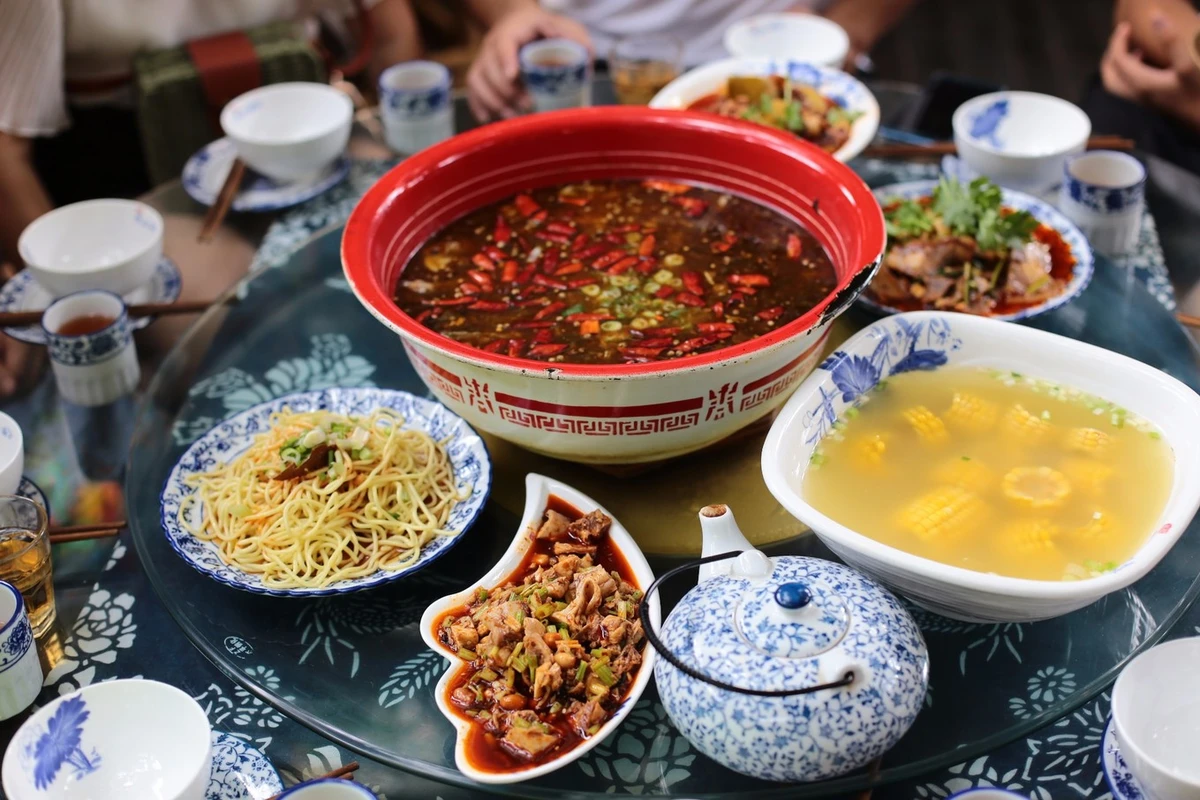
Some say that when you mention Chengdu, what comes to mind is not the city name but one food after another. Because Chengdu is a city filled with food. In every alley and every street of this city, you can encounter many delicious foods and interesting snacks at any time.
Yuan Gong – Let You Taste the Flavor of Home
Yuan Gong was recommended by a friend. It's authentic Yanbang cuisine (from Zigong), with very genuine flavors, allowing homesick locals to taste the flavor of home.
Address: No. 87 Xue Dao Street, Annex 1. South exit of Chunxi Road, cross the pedestrian bridge towards Xinhua Bookstore, about a ten-minute walk. It's also not far from Qingshiqiao Seafood Market, about a five-minute walk.
The Longmen Hanging Meat is really distinctive. When the waiter cuts it, they say: "First cut, good luck; second cut, step by step promotion; third cut, happiness and fulfillment." It tastes like crispy meat, very crunchy.
If I had to pick the most memorable dish, it would definitely be the Naked Shrimp. The Naked Shrimp is peeled shrimp meat, definitely fresh, and the veins are removed, giving diners peace of mind. The best part is that there is taro in the Naked Shrimp. The taro is delicious, soft and flavorful, offering an excellent texture.
Jumping Frog with Young Ginger – tender and pure in taste. This dish looks very spicy, but it's actually okay. The frog meat is tender, and it feels like the taste buds are dancing in your mouth. Good, good!
Eat Skewers in Red and Fire
Located just a few minutes' walk from Huazhaobi Station Exit A on the metro, Chengdu Gua Chuan Chuan has a very eye-catching sign. When I walked in, I felt the style was unique, very Chinese, and quite interesting.
They have not only skewers but also bowl dishes as their specialty. Many small bowl dishes taste quite good. Recommended must-order:冒火锅粉 (Spicy Hot Pot Noodles). The noodles are really tasty and well-seasoned. Every strand is coated with soup, and the flavor is absolutely amazing!
After eating skewers, have some ice jelly to cleanse the palate. Life is so enjoyable.
In Bieyuan (Another Courtyard), Savor Time
Chengdu Chike (Zhimin Road Branch)
Chengdu Chike is very popular in Chengdu. I experienced its charm last year.
When we arrived, there were still many diners waiting. The decor is simple yet stylish. The business is booming. Silver Fungus and Pear Soup, Old Chengdu Sugar Oil Fruit, Strange-Flavored Sweet and Sour Ribs, Baked Abalone on Paper, Naked Toto Shrimp... plus a few dishes I enjoyed last year, we ate until we were stuffed! The prices in Chengdu are so cheap, less than 100 yuan per person!
Naked Toto Shrimp – a dish full of ceremony. "Naked" means the shrimp is peeled, skewered on bamboo sticks, and then the waiter pours boiling oil over it at the table to cook it. The texture is tender and juicy, very oily and flavorful. My husband loved this dish and ate it non-stop until it was all gone.
Malubianbian Malatang (Zhimin Road Branch)
Malubianbian is also on Zhimin Road, with a unique dusty charm and distinctive style.
The retro decor makes you fall in love at first sight, as if you've returned to the streets of Chengdu in the 1980s. The old street-side stalls in Chengdu were just as interesting back then. Malubianbian even brought "street lamps" into the shop, painted retro scenes on the walls, and the enthusiastic service gives you the illusion of being back in the 80s. Small tables and small stools may not be comfortable, but this roadside atmosphere instantly takes us urban dwellers, busy day and night, back to childhood.
At Malubianbian, you can choose between traditional pot or classic pot depending on the spiciness level, along with dipping sauce. Hot dishes and cold dishes are ordered separately, while skewers are chosen from the cold cabinet according to personal preference. There is a dizzying variety of meat and vegetable ingredients; I want to put them all in my stomach! The dipping sauce can be dry or wet, and you can choose the flavor according to your preference.
Eating skewers is a unique experience. Although the price is very low, it allows you to taste the sweet, sour, bitter, and spicy flavors of the city, the street-level taste. "Eating skewers" not only satisfies cravings but also bridges the gap between Chengdu locals and diners.
Dejin Braised Kebabs
Location: No. 8, Base Shop, Xuefu Garden, Section 1, South Yihuan Road, Wuhou District (Metro Line 3, Moziqiao Station Exit A)
For foodies, Chengdu, known as the "Food Capital," holds a king-like status. In Chengdu's food ranking, skewers are indispensable for the night. We arrived at Dejin Braised Kebabs around 11 p.m. As soon as we entered, the staff warmly welcomed us and guided us to our seats, introducing their menu.
The overall environment of the shop is very comfortable, spacious and bright with a cozy and relaxed feel. After ordering, the staff brought us the dips. Among Dejin's special dips, I love the plum sauce and chili powder the most; they must be present when eating skewers. There is also soybean paste, which is best for lamb; seafood sauce for vegetables; and plum sauce for pork, beef, and other meats besides lamb.
The specialty of this shop is braised barbecue, mainly to preserve the original flavor of the ingredients. The lamb skewers with alternating fat and lean are perfectly flavored, with no gamey taste. Dipped in soybean paste, one bite is incredibly satisfying! The grilled chicken wings have a crispy, fragrant skin and tender meat inside. Paired with the sweet and sour plum sauce, it's the icing on the cake.
There are also grilled beef short ribs, grilled pork ribs, grilled duck tongues, beef skewers, etc., all satisfying your night cravings for meat. The braised skewers are juicy, with the meat neither dry nor tough, just right. Among the vegetables I ordered, I loved the grilled corn and potatoes the most. The corn was sweet and fragrant, the potatoes were soft and slightly charred, and the grilled eggplant was mouth-watering.
Additionally, the staff recommended the Douyin-famous Lemon Pickled Boneless Chicken Feet, and the taste did not disappoint. I felt I could eat an entire serving. At Dejin, all you need is your mouth; it will definitely satisfy you!
Location: 2nd Floor, No. 25, Section 4, Hongxing Road, Annex 23 (Metro Line 2/3, Chunxi Road Station Exit E2)
If you want to enjoy oysters freely in Chengdu, you must visit the internet-famous Hao Yingxiong (Oyster Hero) to strive to be an "oyster hero."
We went to Hao Yingxiong after watching a play by Mahua FunAge in the evening. It was nearly full even during late-night snack time. According to the staff, there had been a long queue before dinner. The self-service price is 118 yuan, or only 98 yuan for members, plus drinks at extra cost, unlocking an unlimited oyster feast.
Unlike Fuzhou, where oysters are counted by the piece, at Hao Yingxiong there are unlimited oysters, scallops, small chicken gizzards, pork belly, shrimp, and various vegetables. You can eat to your heart's content and wish you had a 128GB stomach. Freshly opened oysters are placed on the grill for about a minute, then topped with Hao Yingxiong's homemade garlic sauce and grilled for about 3 minutes, ready to enjoy the plump, tender, and juicy premium oysters. Steamed oysters are also a specialty. Complimentary snacks and fruits are available, with caramel bean curd and red bean pudding being highly recommended. The oysters are very fresh, juicy, and tender. You can also try grilled pig brain, which is also top-notch. The auntie serving us helped put the oysters on the grill and told us that their boss is very nice and generous; the self-service has no time limit, ensuring guests leave satisfied and full. So what are you waiting for? Come and experience the freedom of oysters, scallops, meat, and vegetables. Give yourself a chance to be an oyster hero! Only by personally walking into this shop can you feel its fiery popularity from head to toe. That's how I felt, and I believe you will too.
Chengdu Ximu Shanju Hotel (Shaanxi Street Branch)
Location: No. 130 Shaanxi Street, Qingyang District
Chengdu Ximu Shanju Hotel is located in the city center – No. 130 Shaanxi Street, southwest of Tianfu Square. It is about 930 meters from Metro Lines 1 and 2, about 327 meters from People's Park, about 350 meters from the popular Heming Old Teahouse (inside People's Park), about 290 meters from the trotter food street, about 1.3 km from Kuanzhai Alley, about 1.8 km from Wuhou Shrine and Jinli, about 1.6 km from Chunxi Road, and about 2.5 km from Taikoo Li. The location is excellent with convenient transportation. The hotel is surrounded by educational institutions, key schools, high-end commercial areas, office buildings, the Education Department, the Human Resources and Social Security Department, the Public Security Department, Shishi High School, City Center, Renhe Spring, etc., all within walking distance. The rustic wooden design style with warm purple-gray tones makes the rooms particularly comfortable. The Chengdu Ximu Shanju Hotel (Shaanxi Street Branch) has always been high value for money, so check-in was very easy. This time, I booked their Ginkgo Garden King Room.
Moreover, there is a mini cinema on the 2nd floor of the hotel, where you can watch blockbusters without leaving the hotel.


