Hidden Gems in Southern Sichuan: A Two-Day Self-Drive Trip to Renshou, Meishan
Tired birds return, the sunset lingers, warm breezes lift the branches—spring has returned to the earth once again. It's the perfect season for a spring outing. How could we not plan a spontaneous trip?
Located in the southern suburbs of Chengdu, Renshou County is a greatly underestimated小众 travel destination. Renshou is a "thousand-year-old ancient city" with a long history and splendid culture. It has been 1,400 years since Emperor Wen of Sui bestowed the county name in 598 AD. It boasts patriotic figures such as Yu Yunwen, a famous general of the Southern Song Dynasty who resisted the Jin, and Shi Lu, the "Oriental Van Gogh," as well as five national-level cultural heritage protection units and 39 intangible cultural heritage items. The long river of history has沉淀出 a profound cultural heritage. We plan to spend three days driving through all of Renshou, experiencing the unique beauty of southern Sichuan and discovering some lesser-known宝藏 destinations.
【Itinerary】
Chengdu — Renshou Kuixing Pavilion — Zhang San Sesame Cake in Urban Renshou — Lunch at Xiangshui Liufang Stone Mill — Casual Afternoon Tea at Bibeltu Campsite — Qixili Commercial Street — Light Show at Two Hills and One River Viewing Platform — InterContinental Resorts & Hotels (Indigo or InterContinental) in Heilongtan — Heilongtan Scenic Area — Renshou Urban Wetland Park — Lunch + Afternoon Tea at Hualing Villa Yinhuxi — Feng Jianwu & Shi Lu Art Museum — Chengdu
【Day 1】 Kuixing Pavilion
Our first stop was Kuixing Pavilion, the oldest and most historically cultural building in Renshou.
Kuixing Pavilion is located in Renshou County, Meishan City, Sichuan. It was first built in the first year of the Qianlong reign of the Qing Dynasty (1736) and rebuilt in the second year of the Tongzhi reign (1863). It is a provincial-level cultural heritage protection unit in Sichuan.
Kuixing Pavilion covers an area of 196 square meters at its base, with a base width of 14 meters. It consists of three parts: a sumeru pedestal, the pavilion body, and a decorative top. It stands 29 meters tall, a four-eave, octagonal, spire-roofed wooden structure. The roof was originally covered with gray-green simple tiles but was later replaced with glazed tiles during restoration. The eaves, brackets, and supporting arches are all finely carved. The pavilion has 80 pillars, with stairs on each floor allowing visitors to climb to the top for a panoramic view of the city.
The ground floor of Kuixing Pavilion uses eight eaves columns, eight corridor columns, and eight main golden columns to form the main structure. Among them, the eight golden columns run through the pavilion body. Each floor's framework retracts inward by one step until the fourth floor, where the bottom golden columns become eaves columns. Therefore, eight additional golden columns are added. These golden columns act as levers under the weight of the eaves, lifting them slightly off the ground, making it a "suspended-column" building similar to the Zhenwu Pavilion. This is one of the architectural features of Kuixing Pavilion. Another feature is that the eight sides of the pavilion are of unequal width.
Kuixing Pavilion was originally a building symbolizing literary style and civilization in feudal society. Today, it has become a major historical landmark in Renshou County and a rare ancient architectural gem. Climbing the pavilion and looking around, one can see both the old and new parts of Renshou, broadening the mind and spirit. It echoes the "Leisure Corridor" across from it, forming a unique scenic spot in the county.
After visiting Kuixing Pavilion, we went to try Renshou's local intangible cultural heritage snack—Zhang San Sesame Cake (Zhang San Zhima Gao), a must-eat local specialty in Renshou.
The technique of making Zhang's sesame cake is listed as a traditional skill item of Meishan's intangible cultural heritage.
Zhang's sesame cake originated in the Qing Dynasty and has a long history. In the late Qing and early Republic periods, Renshou sesame cake was once known as "Zilin Commercial Firm" and founded the "Zhang's Candy Factory." It was a tribute to the emperor during the Qing Dynasty and was praised by the people as the "King of Sesame Cakes."
It is said that during the Republic period, Renshou Zhang's sesame cake was exhibited in Nanjing and won a gold medal at the World Expo. Zhang's sesame cake is made from sesame, glutinous rice, walnuts, lard, and other ingredients. It is fine in texture, melts in the mouth, and is sweet but not greasy.
Now, there are more than 80 varieties, including black sesame cake, walnut sesame cake, and fig sesame cake. It has been well received by consumers and has been rated as a "National Geographic Indication Protection Product," known as "a unique天府 wonder" among local specialty foods.
According to the "Renshou County Annals," in the mid-Qing Dynasty, a wandering monk came to the "Kuaya Temple" in the ancient town of Lingzhou, Renshou. He chanted scriptures and made various Buddhist snacks of unique flavor and exquisite craftsmanship using local produce to offer before the Buddha statue. "Sesame cake" was one of them. The common people who came to worship at the temple spoke highly of it and learned the technique from the monk. Some residents of Wenlin Town, Dahua Town, and Wangyang Town began to sell it after making it themselves. "Renshou Sesame Cake" thus came into being and gradually became one of the most popular pastries in Renshou.
In the morning, we visited Kuixing Pavilion and tasted Zhang San Sesame Cake. It was time for lunch. We arranged lunch at the Stone Mill Farmhouse (Shimo Fang) of Xiangshui Liufang, a famous spot in Renshou. The environment is quiet and pleasant, and most importantly, the food is authentic—typical Sichuan cuisine.
Xiangshui Liufang is a national 3A-level tourist attraction. It is located in Mumeng Community, Puning Street, Renshou County, 1 km from the Chengdu-Chishui Expressway exit in Renshou. It features pristine ecological landscapes and rural pastoral scenery, integrating a farming culture experience area, an agricultural theme park, an eco-sports camp, a deep leisure resort, and high-end ecological living. It is a suburban leisure and vacation destination. There are more than 20 interconnected low hills, over 100,000 precious trees in lush greenery, a 25 km cycling loop winding around the hills, and over 4 km of waterfront running through it.
Covering an area of over 3,000 mu (about 200 hectares), Xiangshui Liufang is a suburban leisure and vacation paradise. Large-scale ecological farming and a concentrated display of long-standing farming culture allow urban dwellers to pick seasonal organic vegetables and fruits, evoking strong nostalgia. It also enables children who don't know what crops are to experience farming. Here, you can sightsee, experience, exercise, and vacation—a perfect suburban leisure tourist scenic area.
It returns to nature, blends into the landscape, and returns to simplicity. Six workshops (Liu Fang) include the Stone Mill, Waterwheel Mill, Oil Mill, Sauce Mill, Wine Mill, and Cake (Flour) Mill. The scenic area includes a large playground, a farming culture expo park, a farming culture performance area, an ancient tree expo park, a suspension bridge, hiking trails, and a 24 solar terms street.
Finally, the food arrived—ten-mile-fragrant wood-fired chicken!
Dinner was served—traditional Sichuan cuisine with complete color, aroma, and taste. The flavor was truly authentic!
After lunch, we rested at the Bibeltu Outdoor Campsite next to the Stone Mill, enjoying afternoon tea in great comfort.
The campsite is quite large. If you come from Chengdu, you can bring your own tent and camp here. Water, electricity, gourmet food, and barbecue are all available.
The campsite owner's motorcycle—cool and stylish, haha.
Enjoying desserts and afternoon tea.
In the evening, we arrived at Renshou's largest fashion commercial street—Qixili Street. We happened to catch the local Renshou National Tide Night Tour Lantern Festival. It was surprising that a county could host such a large-scale trendy market. What a lively scene!
There were so many tourists on Qixili Pedestrian Street, an endless stream. Countless snacks and a large-scale cultural performance—so lively! We planned to have a big feast here tonight.
Qixili Commercial Street is adjacent to Tianfu Avenue and Longtan Avenue, oriented toward food, entertainment, trendy play, and internet-famous gathering places. It creates a scenario-experience single-building commercial street similar to top-tier commercial areas like Taikoo Li, Xiangnan Li, and UPARK in Chengdu. It has become a destination for Renshou's tourism and leisure consumption and a window to showcase Renshou's cultural temperament.
Traditional snack—sugar painting.
Sun Wukong is selling "Indian flying pancake."
Traditional snack—Sichuan boboji.
Ten-mile-fragrant grilled oysters.
There was also a wonderful performance on the Qixili stage.
After eating various Renshou delicacies and specialties at Qixili, we drove to the outskirts of Renshou to see the light show at Two Hills and One River.
"Two Hills and One River" features Yisi Hill, Feiquan Hill, and Jinma River. Through Renli Road and Shouxiang Road, the two hills and one river are closely connected. In the evening, you can experience an ultimate light show, including the Feiquan Hill national flag mountain screen, a 270-degree panoramic viewing platform, the Yisi Hill Star Observation Deck glass walkway, and mountain lighting. Supporting facilities include roads, parking lots, sports facilities, tourist service facilities, and public restrooms. This creates a new "internet-famous" destination that combines Lingzhou culture, local characteristics, and modern technology.
Climbing to the glass walkway of the Star Observation Deck and looking across the viewing platform, the colorful lights covering the mountain gave us a strong visual sensory experience.
While watching the light show, you can also walk on the glass walkway. Personally, I think it's more exciting and interesting during the day.
Glass walkway opening hours:
Sunday-Thursday: 08:00-12:00, 14:00-18:00
Friday & Saturday: 08:30-11:30, 14:00-17:00, 19:30-21:30
Light show opening hours: Friday & Saturday: 19:30-21:30
Heilongtan Global Sunac Hotel Indigo
For our first night in Renshou, we chose the first Indigo Hotel in Sichuan—Heilongtan Global Sunac Hotel Indigo, located in the Heilongtan Scenic Area.
Heilongtan Global Sunac Hotel Indigo is a star-rated hotel with a Republic of China style. It is adjacent to the 4A-level Heilongtan Scenic Area, only 30 km from Meishan city center and about 1.5 hours' drive from Chengdu city center. It is very suitable for Chengdu friends to travel and is a great weekend spring outing and leisure destination.
When I first saw the lobby of Heilongtan Global Sunac Hotel Indigo, I was amazed. Everywhere I looked, there was the splendor of the last century. The hotel's interior design is inspired by the traditional courtyard architecture of the Sichuan-Chongqing region, influenced by Western architectural culture. It is solemn and elegant without losing artistic style, combining Chinese and Western architectural beauty while embodying historical depth, showcasing the hotel's distinctive artistic taste.
Heilongtan Global Sunac Hotel Indigo consists of eight independent buildings in the style of Western Sichuan mansions (gongguan), which can also be understood as separate villas. The hotel has 91 guest rooms, mainly decorated with a vintage green tone, making you feel as if you have returned to old Shanghai.
The rooms are equipped with oversized panoramic glass windows. Opening the window, you can enjoy the beautiful scenery of the hotel courtyard. Vintage cars, rickshaws, colorful cheongsams, retro gramophones—almost every corner of the hotel exudes a unique artistic atmosphere.
Almost every corner of the room is filled with a strong artistic atmosphere.
Even the bathroom has a unique style.
Staying at the Indigo Hotel, you can also change into elegant cheongsams and take photos, as if you were in old Shanghai of the last century.
The hotel's rickshaw is perfect for photo shoots!
The Blin Restaurant is located on the first floor of Zone 2 of the Indigo Hotel. The restaurant uses green train carriages as its design element, setting the space as train carriages. Through bright floor-to-ceiling windows, you can see a corridor resembling a train station. Stepping inside feels like boarding a train heading to spring—peaceful and full of travel atmosphere.
The old-fashioned telephone booth at the restaurant entrance is also great for photos.
Blin Restaurant has 108 seats, mainly serving Cantonese cuisine. It provides round-the-clock open-style Chinese and Western buffet breakfast and gourmet desserts, a paradise for food lovers.
The restaurant's style matches the hotel's decoration very well. You can enjoy food while taking photos.
Heilongtan Global Sunac InterContinental Hotel
If you don't like the style of the Indigo Hotel, you can choose to stay at the nearby InterContinental Hotel. The two hotels are very close but have entirely different styles.
Heilongtan Global Sunac InterContinental Hotel is located within the Heilongtan Scenic Area. Here, you have a view of the lake and mountains, both modern and tranquil. The hotel is surrounded by lush greenery, nestled against the mountain and facing the water. Walking into the hotel grounds, you feel as if you are in a paradise.
Stepping into the hotel lobby, the first thing that catches your eye is the majestic crystal chandelier. The Chinese-style indoor garden and leisure area are grand yet elegant, perfectly matching the tone of the Heilongtan Scenic Area.
The hotel has 401 luxury guest rooms and feature suites overlooking the panoramic view of Heilongtan. The interior design has a unique leisure and vacation concept, with a Chinese-style orientation that cleverly blends vacation with nature.
The hotel is also equipped with a spacious outdoor tent campsite, convenient for self-driving tourists and outdoor enthusiasts to camp. At night, the InterContinental Hotel is particularly charming.
After waking up in the morning, you can enjoy the hotel's buffet breakfast. It combines Chinese and Western varieties—bread, salad, dessert, fruit, fried rice, porridge, noodles, and more, all unlimited. The Longxuan Chinese restaurant serves Sichuan and Cantonese cuisine. The Shunxing Fresh Fish Restaurant specializes in fish hotpot, especially the fresh fish from the Heilongtan Reservoir, which is definitely worth a try.
Tianye Happy Farm is located by the lake within the hotel grounds, perfect for family fun. At the farm, you can experience the joy of sowing seeds and harvesting fruits, take children to learn about new plants and small animals, and take great photos. If you get tired, you can ride the hotel's shared electric vehicles for a tour around the lake, or gather friends for an outdoor party in the camping area.
The first day's itinerary was very relaxing but fulfilling. We rested well at the beautiful Heilongtan Scenic Area that night.
【Day 2】 Heilongtan Reservoir Monument
After breakfast at the hotel, we drove to the first stop of today's itinerary—Heilongtan Reservoir.
Heilongtan Scenic Area is located in Heilongtan Town, Renshou County, Sichuan, in the south-central part of the Sichuan Basin, at the western foot of the Er'e Mountains of the Longquan Mountain Range. It is 50 km north of Chengdu and 16 km northwest of Renshou County town. The total area of the scenic area is 115.3 square kilometers, with a core area of 30.9 square kilometers. Heilongtan Reservoir is the first large-scale water storage and irrigation project built in our province since the founding of the People's Republic of China. It mainly relies on water diversion from the Dujiangyan Irrigation System. Construction started in 1970 and was completed in 1972. In 1986, Heilongtan Scenic Area was established, later renamed Heilongtan Scenic Spot.
In 1986, Heilongtan Scenic Area was designated by the provincial government as one of the first batch of provincial-level scenic spots in Sichuan. In 2013, it was rated as a National Water Conservancy Scenic Area, in 2014 as a National AAAA-level Tourist Attraction, in 2014 as a Sichuan Provincial Forest Park, in 2016 as Sichuan Provincial Tourist Resort and Ecological Tourism Demonstration Zone, and in 2019 as a National Wetland Park. It can be said that a trip to Renshou is not complete without visiting Heilongtan.
An old archway by the lake.
Heilongtan Scenic Area is the largest and most beautiful artificial lake in western Sichuan, with extremely rich natural resources. It stores 360 million cubic meters of water. The scenic area's forest and green coverage is 5,062 hectares, with a forest coverage rate of 38.4% and a vegetation coverage rate of 98.4%. The area is home to hundreds of bird species, including wild ducks, egrets, gray cranes, and swans.
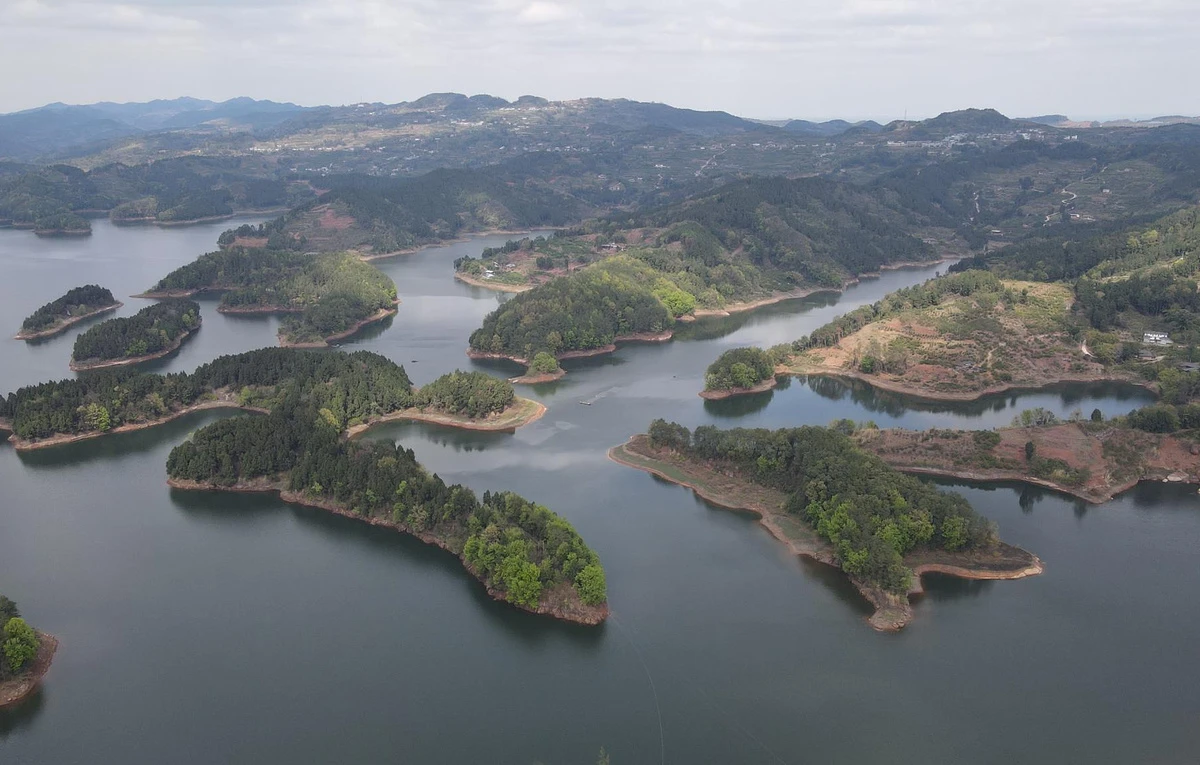
It really looks like Qiandao Lake!
Heilongtan Scenic Area combines beauty, wonder, seclusion, wildness, and lushness. It has more than 40 attractions, including the majestic dam, Longyan ancient relics, Panlong Green Island, Eight Immortals Islands, Three Bays of Accumulated Green, and Swallow Lake Light.
The 7 gorges, 7 dams, and 85 islands within the lake are scattered like bonsais on water. The vast expanse of blue water merges with the sky, creating a dreamy scene. The lake shoreline is 310 km long, and the water area is 23.6 square kilometers.
The scenery of Heilongtan Scenic Area truly lives up to its reputation: a vast expanse of blue water, water and sky of one color, countless small islands dotting the lake—a magnificent view.
Renshou Urban Wetland Park
Renshou Urban Wetland Park is a national AAAA-level tourist attraction. It is located in Puning Street, Renshou County, in the central area of the new northern city of Renshou. It officially opened in May 2016 and is a great place for urban leisure and recreation.
The design theme of Renshou Urban Wetland Park is "The wise enjoy mountains, the benevolent enjoy water." It features a wetland ecological landscape with elements of flower seas, wetlands, mountains, and rivers. The park has ten scenic spots: Gaotan Flower Valley, Zai Shui Yi Fang, Qingsha Green Bank, Puning Lake, Linshui Bay, Puning Moon Reflection, Water Dance City, Fantasy Wetland, Green Water Dam, Yunting Panoramic View, Mountain Forest Joy, and Music Fountain. It is a "city card" for Renshou's external image display and a city garden for Renshou people to return to simplicity and integrate with nature.
Flying the drone, we overlooked the entire park—the scenery was very tranquil.
Hualing Villa Yinhuxi
After visiting Renshou Urban Wetland Park, we drove to Hualing Villa Yinhuxi near Heilongtan Reservoir. We planned to have lunch here and ordered a full fish banquet (quan yu yan). We were looking forward to it.
When we arrived, we didn't have time to look around and went straight to the restaurant because everyone was hungry!
When visiting Heilongtan Scenic Area, you must taste the local fish. There are many ways to eat fish here, but the full fish banquet at Hualing Villa Yinhuxi takes fish cooking to the extreme. The same ingredient, after different cooking processes, yields different colors, aromas, and tastes—this reflects the local food culture.
The dishes included colorful fish lips, pumpkin fish puree, paper-wrapped fish, flavored fish (fengwei qiaokuo), golden fish head, qilin fish fruit, Longtan drunken fish, and fresh pepper fish stomach. Each dish showcased the authentic taste of Heilongtan fish, living up to its reputation. All dishes were full of color, aroma, and taste. After a hearty meal, we prepared to enjoy afternoon tea and rest at Hualing Villa.
[Add shooting location]
Hualing Villa Yinhuxi is located in the hilly valley of the Longquan Mountain range, backing onto Linghu Mountain Island, facing the 7 gorges and 785 islands of Heilongtan across the lake. The villa is built by the lake, enjoying tranquility amidst the hustle, perfectly integrated into nature, creating a serene and peaceful life aesthetics.
After tasting the full fish banquet of Heilongtan, we continued to enjoy afternoon tea here and experienced the fun of roasting tea.
If you don't want to leave at night, you can directly stay in the guesthouse suites of Hualing Villa Yinhuxi.
The door offers a view of the lake, and the window frames the mountain wildness. Hualing Villa Yinhuxi uses simple and natural styles as its base, skillfully incorporating vacation style, creating a warm and charming living space.
We had to return to Chengdu, so we didn't stay here.
Feng Jianwu & Shi Lu Art Museum
Feng Jianwu & Shi Lu Art Museum is located in Wengong Town, Renshou County. It was the last stop of our self-driving trip back to Chengdu. The museum is right on our way back. The whole building looks like a traditional Western Sichuan folk house (chuānxī mínjū). According to the museum's relevant person in charge, the museum is a perfect reproduction of the original Feng Family Courtyard, a county-level cultural heritage protection unit. In terms of architectural layout, it combines the architectural styles of the Jiangxi and Anhui (Gan and Hui) schools, the ancestral home of the Feng family.
Inside the museum, there are four functional areas: a basic exhibition hall, a special exhibition hall for Shi Lu's art, a creative products shop, and a temporary exhibition hall. It comprehensively presents the historical changes of the Feng family and the arduous artistic career and great artistic achievements of Feng Jianwu, a master of modern Chinese painting and calligraphy, and Shi Lu, the founder of the Chang'an School of Painting.
Shi Lu, originally named Feng Yaheng, was born in 1919 in Songlinwan, Wengong Town, Renshou County. Shi Lu loved art from an early age. At 15, he was admitted to the painting department of Chengdu Oriental Art College, systematically studying traditional painting, which laid the foundation for his later Chinese painting creations. In 1938, at the age of 19, Shi Lu devoted himself to the anti-Japanese national salvation movement and then went to Yan'an. Even after joining the revolution, he continued painting and used his brush to promote revolutionary ideas. Admiring the great Qing Dynasty painter Shi Tao and the modern revolutionary and writer Lu Xun, he changed his name to Shi Lu. His works include "Fighting in Northern Shaanxi," "The East is About to Dawn," "Crossing Eastward," and more.
Shi Lu expressed a revolutionary's cultural sentiment in the "grand historical narrative" with his unique artistic language. This had a considerable influence on the art world in the 1950s and 1960s, making him one of the most outstanding representatives of revolutionary artists during the Yan'an period. Looking back on Shi Lu's life, he was not only a gifted master but also a revolutionary artist full of patriotic feelings. He is known as the "Red Master" and "Oriental Van Gogh." This is also an important reason why the art museum has become a base for patriotic education and Party history education.
Thus ended our two-day self-drive trip from Chengdu to Renshou. We were very happy to discover many lesser-known宝藏 destinations in Renshou. As a place only an hour's drive from Chengdu, Renshou is truly the ceiling of宝藏 destinations for self-driving trips around Chengdu. This trip to Renshou left us wanting more, and we look forward to our next visit!
【Travel Tips】
【Transportation】
It is recommended to depart from Chengdu by self-driving for convenience, or take public transportation to Renshou and rent a car locally. The distances between attractions in Renshou are not far, and it takes about one and a half hours to drive from Chengdu to Renshou.
Check the weather forecast before traveling. For scenic areas like Heilongtan, the scenery may be greatly reduced on cloudy or rainy days.
Recommended local specialty snack: Zhang San Sesame Cake. Be sure to try it. It's also suitable to buy several boxes as gifts for friends.


