A 7-Day Semi-Independent Tour of Jiuzhaigou, Huanglong, Dujiangyan, Sanxingdui, Panda Base, and Chengdu City in Sichuan
Booked a small group tour of Jiuzhaigou, Huanglong, and Dujiangyan for 4 nights and 5 days via Ctrip (1450 yuan per person), with an additional 2 days added on my own to visit the Panda Base, Sanxingdui Museum, and within Chengdu city: Cultural Park, Kuanzhai Alley, Sichuan Museum, Du Fu Thatched Cottage, Wuhou Shrine Museum, and Jinli.
Day 1, March 21, 2023: Took D638 (Suzhou to Chengdu East); time 06:49 to 21:35. Upon arrival, a local guide picked us up.
Checked into Qiyashang International Hotel.
This is a hotel decorated in Tibetan style!
Lobby seating area!
Day 2: Headed to Jiuzhaigou Scenic Area. Since the route passed through Dujiangyan Scenic Area, the tour also arranged for us to visit Dujiangyan!
In 256 BC, for the strategic goal of enriching the state, strengthening the military, and supporting the plan of "conquering Shu means conquering Chu," Li Bing, then governor of Shu Commandery under the Qin state, oversaw the construction of Dujiangyan.
The photo above was taken by me at Dujiangyan in May 1988; 35 years have passed in the blink of an eye. This trip to Jiuzhaigou gave me the chance to revisit Dujiangyan, and with the guide's detailed explanation of the irrigation project, I gained even greater respect for this World Heritage irrigation project!
The wooden tripod on the left in the photo above is called a "bishui sanjiao," also known as a macha. It is often used for river closure, flood control, water regulation, and embankment reinforcement—highly effective water control facilities. The bamboo cage on the ground filled with pebbles is called a "zhulou" or bamboo cage. When Li Bing built Dujiangyan, he used this method of caged stones; it was simple, cost-effective, and highly efficient. This method has been passed down through the ages and is still widely used in flood control and emergency rescue today. The four iron rods in the middle are called "wotie" (lying iron), buried at "Fengqiwo" in the inner river as a standard for dredging depth, marking the depth for annual maintenance of the inner river. Legend has it that during Li Bing's time, a stone horse was buried under the inner riverbed as a depth standard, later evolving into the lying irons. The four existing irons were buried in the 4th year of the Wanli reign of the Ming Dynasty, the 3rd year of the Tongzhi reign of the Qing Dynasty, the 16th year of the Republic of China, and 1994, still functioning under the inner riverbed.
The ancient ginkgo tree in Dujiangyan Scenic Area—if it were autumn, the view would be a sea of gold.
Across from this building on the hill is the famous Erwang Temple complex, an important part of the World Heritage Dujiangyan.
The photo above was taken at Erwang Temple in May 1988; it was quite crowded then. Due to time constraints, we didn't visit the post-earthquake restored Erwang Temple this time.
Cross this Anlan Bridge to see the "Yuzui" (Fish Mouth).
Anlan Bridge shrouded in mountain rain and mist!
Li Bing's water control work created the world-renowned Dujiangyan. From the initial excavation of the Baopingkou (Precious Bottle Mouth) to divert water and construction of the Fish Mouth to split the flow, to the early Tang Dynasty when the Feishayan (Flying Sand Weir) was built, the main body of the Dujiangyan headwork took shape and has been passed down ever since.
The picture shows the Fish Mouth diversion dike, a water-dividing structure of Dujiangyan, named for its fish-mouth shape. It stands in the middle of the Min River, dividing it into inner and outer channels. The Fish Mouth skillfully uses terrain and topography to accomplish the task of diverting water, and also automatically regulates water volume under different water levels during flood and dry seasons.
At the Fish Mouth, the Min River outer river gate! It was around 9:00 AM, the sky was pouring rain, visibility was extremely low.
Took a scenic area shuttle from the Fish Mouth to Feishayan.
This is the Feishayan spillway, a lateral overflow weir at the end of the Fish Mouth diversion dike, anciently called "Shilangyan," named for its good sand-discharge effect. Feishayan plays the role of flood discharge and sand removal of the inner river dike, ensuring water supply for the Chengdu Plain while expelling most of the sand and gravel entering the inner river.
This is the Baopingkou opposite Feishayan!
Baopingkou water diversion inlet is cut into the ridge of Yulei Mountain extending into the Min River; it is the "throat" of the inner river irrigation area. Baopingkou restricts the inflow of water, limiting the amount entering the Chengdu Plain, and together with Lidui, it raises the water level to enhance the flood discharge effect of Feishayan.
Looking into the distance, through the mist, the Min River water rushes in, bending into Baopingkou—a naturally charming scene.
Dujiangyan still plays a major role today. Seeing a row of macha here, we understood the role they would play.
It is now March, and the water level on the riverbank has dropped to the point where the bank is exposed. Workers are stacking layers of bamboo cages in preparation for the upcoming flood season. This ancient method, widely used in flood control and emergency rescue, we were fortunate to witness today!
After leaving Dujiangyan Scenic Area, we saw this unique Nanqiao Bridge.
The ancient town of Guanxian in the rain is adjacent to Dujiangyan Scenic Area.
We spent a total of 1.5 hours at Dujiangyan (8:30-10:00). The pink bus we took had reclining seats, very comfortable. There were only 17 people on this tour, including the guide, a Tibetan post-80s.
Around 11:20, we entered Wenchuan County in Aba Prefecture!
At the Fish Mouth area of Dujiangyan, it was pouring rain. After leaving Dujiangyan and crossing the ancient Nanqiao and old town of Guanxian, the rain gradually eased. But as we passed through Wenchuan in Aba, the rain had stopped, and clouds were swirling around the mountains on both sides of the road, creating a pleasant scenery.
On the way to Jiuzhaigou, we passed through Wenchuan County, Mao County, Songpan County, and Jiuzhaigou County in Aba Tibetan and Qiang Autonomous Prefecture. We were now driving within Aba Prefecture!
Mao County, with an average altitude of over 1,600 meters, is a major settlement area for the Qiang people in China. The guide, Dawa, introduced the three treasures of the Qiang: Qiang embroidery, Qiang flute, and Qiang watchtower. Pointing to the distance outside the window, she told us that the watchtowers faintly visible in the mountains were the Qiang architectural treasures—Qiang watchtowers!
I caught a picture of a Qiang watchtower from the bus.
By the roadside, there were many cherry trees planted by farmers to get rich!
We had lunch here (11:51) (Qiang cuisine).
The streetlight design clearly had Qiang characteristics!
After the Wenchuan earthquake, all buildings of Mao County Middle School became dangerous. The Armed Police Force donated 80 million yuan to rebuild the school, named "Mao County Bayi Middle School."
The sky in the mountains changed like a child's face. When the bus reached here (14:11), the sky suddenly cleared, revealing blue sky and white clouds over the landscape!
A babbling brook flowed through the mountains!
In Mao County, the weather was okay, but the clouds here were thickening!
Around 14:40, we arrived at a simple bus rest stop before Songpan Ancient Town. A yak in front of us was waiting to earn money. The backdrop of mountains and a lake made for a nice view!
On the hillside by the road, simple huts and wildflowers—simple and beautiful!
Around 14:55, we reached Jin'an Town in Songpan County and visited the national key cultural relic protection site—Songpan City Wall and Songzhou Ancient Town!
Entering Songzhou Ancient Town!
Cars can drive inside Songzhou Ancient Town!
Around 17:00, inside Songzhou Ancient Town, it started to rain lightly again.
The scenic area is free. Outside, we had some yak skewers from Old Wang's shop (10 yuan for 7 skewers), which were salty and fragrant.
At 17:25, we were still in Songpan County, continuing toward Jiuzhaigou. Songpan County in northwestern Sichuan's Aba Prefecture has an average altitude of over 3,000 meters. While driving through this area, our guide Dawa kept telling us about local customs and natural scenery, reminding us not to sleep to prevent altitude sickness.
Around 17:40, looking out the window, heavy snow was falling. Starting from the overcast sky in Chengdu in the morning, heavy rain at Dujiangyan, misty rain in Guanxian ancient town, rain stopping in Wenchuan, clear skies in Mao County, and rain mixed with snow in Songpan, we experienced a rich variety of scenery along the way. For us from Jiangnan, it was a feast for the eyes, experiencing the various natural beauties of western Sichuan in a single day.
At 18:10, we entered Jiuzhaigou County in Aba Prefecture, with heavy snow outside.
At 18:42, nearing Jiuzhaigou, the weather showed mercy and the snow stopped!
This is the Jiuzhaigou Eternal Love Scenic Area (around 19:00 evening).
Around 19:20, we checked into Jiuzhaigou Jinlong International Holiday Hotel!
We had dinner at the hotel that evening. The dish that impressed me most was a plate of sauce-flavored yak meat (about 98 yuan per plate), which was fresh, tender, and delicious!
March 23, 2023: I opened the curtains early in the morning feeling joyful. There was no rain or snow outside, and the mountains were shrouded in mist—very beautiful!
Jiuzhaigou is located in Zhangza Town, Jiuzhaigou County, Aba Tibetan and Qiang Autonomous Prefecture, in the southern section of the Minshan Mountains in northwestern Sichuan. It is a national geopark primarily protecting geological relics such as calcified lakes, shoals, waterfall landscapes, karst water systems, and forest ecosystems. On December 14, 1992, Jiuzhaigou was inscribed on the UNESCO World Heritage List as a natural site at the 16th session of the World Heritage Committee.
At 8:48 AM, we arrived at the entrance of Jiuzhaigou Scenic Area. The picture above is a Y-shaped tour map of Jiuzhaigou. Our route using the scenic area bus (after buying tickets, no extra bus fare needed) was: From the entrance, take the bus to Nuorilang Transfer Station, then transfer to the right-line bus directly to Bamboo Sea (Jianzhuhai) and visit; then bus to Panda Sea (Xiongmahai) and visit; then bus to Five Flower Sea (Wuhuahai) and visit; then walk to Pearl Shoal (Zhenzhutan) and visit; then walk to Pearl Shoal Waterfall and visit; then pass by Mirror Sea (Jinghai) for lunch; then walk to Nuorilang Transfer Station, take left-line bus to Long Sea (Changhai) and visit; then walk to Five Color Pond (Wucaichi) and visit; then bus back to Nuorilang Transfer Station; visit Nuorilang Waterfall; then bus to Rhinoceros Sea (Xinuhai) and visit; walk to Tiger Sea (Laohuhai) and visit; walk to Shuzheng Waterfall and visit; walk to Shuzheng Cluster of Lakes (Shuzheng Qunhai) and visit; then bus to Spark Sea (Huohuohai) and visit; walk to Double Dragon Sea (Shuanglonghai) and Double Dragon Sea Waterfall and visit; then bus to Bonsai Shoal (Penjingtan) and visit; then bus back to the entrance.
Note: In winter, the right-line bus does not go to the Primeval Forest, Swan Sea, and Grass Sea attractions.
First lake—Bamboo Sea (Jianzhuhai)
At this time, the Bamboo Sea area was completely blanketed in heavy snow!
Visibility was very low!
The snow scene seen with the eyes was far more beautiful than what the camera captured!
Jiuzhaigou Scenic Area is well-developed, and the walking boardwalks are excellently built. So walking in the snow, we could enjoy the scenery at will while walking safely.
The opposite mountains were covered in snow, and the blue-green lakes reflected the snow on the mountains, with mist swirling, like a fairyland!
The Bamboo Sea, clad in silver, added an elegant touch to Jiuzhaigou.
Second lake—Panda Sea (Xiongmahai)
Cold and windless, making the lake exceptionally serene and thought-provoking.
Third lake—Five Flower Sea (Wuhuahai)
Five Flower Sea is at an altitude of 2,462 meters. Most people do not experience altitude sickness here.
Took a souvenir photo with the lake and snowy mountains in the background.
Look at the plants clearly visible in the water and the colors—absolutely stunning!
It is said that Five Flower Sea is the essence of Jiuzhaigou. Seeing it, indeed it lives up to its reputation.
When we arrived at Five Flower Sea, the weather favored us, and the snow stopped. Although the sky was still overcast, Five Flower Sea was breathtakingly beautiful!
Look at the reflection of the mountains in the lake, resembling a butterfly spreading its wings.
The people in the frame were messy, but it made the lake even more colorful and vibrant.
Look at the color of the lake—like the blue of a peacock feather!
No matter from which angle, you could see the clear water plants and mountain reflections.
The snow on the mountains paired with the sparse red leaves on the branches by the shore made it hard to tell the season.
In autumn, the colors on the opposite mountain would be even more splendid!
The colors in the water were rich and gradient.
Although there were no blue skies and white clouds today, the layered white snow on the green forest added charm to the lake!
Five Flower Sea is the most colorful lake in Jiuzhaigou, mainly because of the calcium carbonate deposits, algae, water plants, and dead trees at the bottom, which reflect and refract light differently, along with the reflections of blue sky, white clouds, green grass, and green forest in the lake, creating a mix of colors like earth yellow, emerald green, snow white, blue-green, navy blue, and dark green in the water. This was my favorite lake on this trip.
Fourth attraction—Pearl Shoal!
Walking to Pearl Shoal Waterfall, said to be a filming location for the TV series Journey to the West!
Fifth attraction—Pearl Shoal Waterfall!
Visiting during the dry season and off-peak, the waterfall was less spectacular, but the advantage was fewer people.
This part had some grandeur.
The characteristic of Pearl Shoal Waterfall: the average height is only 21 meters, but the width is 270 meters.
On the way walking to Nuorilang Transfer Station.
This huge rock is called the 8.8 "Earthquake" Rock. On August 8, 2017, a magnitude 7.0 earthquake struck Jiuzhaigou, causing a high-level collapse. This rock fell from an altitude of 2,654 meters to this valley, a vertical drop of 272 meters. The rock is 9.2 meters high and weighs about 522 tons. It is dolomitic limestone, formed in a marine environment 320 million years ago. This boulder witnessed the changes of Jiuzhaigou. The 8.8 earthquake dislodged it from the mountain, destroying vegetation along its path and creating a huge groove. This rock is inscribed to warn humans to respect nature.
Sixth attraction: Long Sea (Changhai)!
Long Sea is at an altitude of 3,101 meters. Here, I felt a slight headache, but it didn't affect my sightseeing.
Looking out, the entire lake was frozen, and snow was falling from the sky.
Where ice met water, it exhibited a unique beauty!
Walked from Long Sea to Five Color Pond.
The road within the scenic area.
The section from Long Sea to Nuorilang Visitor Center is called Zechawagou. We walked downhill from Long Sea to Five Color Pond.
Seventh attraction: Five Color Pond (Wucaichi)
Unfortunately, there was rain and snow today with no sunlight, so the pond did not display its colorful hues.
Five Color Pond is the smallest lake in Jiuzhaigou, known as the "Eye of Jiuzhaigou." Though it was freezing cold, this small pond did not freeze.
The section from Nuorilang Visitor Center to the entrance of Jiuzhaigou is called Shuzhenggou. It is the main tourist route of Jiuzhaigou.
Eighth attraction: Nuorilang Waterfall! In March during the dry season, the water flow was pitifully low.
Tenth attraction: Rhinoceros Sea (Xinuhai)!
Unfortunately, the sky lacked blue clouds.
Scenery along the road from Rhinoceros Sea to Tiger Sea.
Scenery along the road from Rhinoceros Sea to Tiger Sea.
Scenery along the road from Rhinoceros Sea to Tiger Sea.
Eleventh attraction: Tiger Sea (Laohuhai)!
Tiger Sea has many plants and flowers along its banks.
On the way from Tiger Sea to Shuzheng Waterfall.
Twelfth attraction: Shuzheng Waterfall!
The clear water from upstream flows gently here, showing the dynamic beauty of water in Jiuzhaigou.
This is a natural wonder of trees growing in the water and water flowing through the forest.
Shuzhenggou has many lakes of various sizes arranged in a chain. This is a nameless small lake.
This is a mountain peach blossom.
Further ahead is Shuzheng Mill House.
Thirteenth attraction: Shuzheng Mill House!
The water at Shuzheng Mill House was still very swift.
Fourteenth attraction: Shuzheng Village (Shuzhengzhai)!
Tibetan white pagoda in front of the village.
Fifteenth attraction: Shuzheng Cluster of Lakes (Shuzheng Qunhai)!
There are 19 lakes of various sizes in Shuzheng Cluster, like a string of green pearls.
Sixteenth attraction: Spark Sea (Huohuohai)!
During the 8.8 earthquake, the outlet dike of Spark Sea collapsed, and the lake landscape disappeared. The current landscape was restored after repair.
On the way from Spark Sea to Double Dragon Sea, the lake was rich with plants, full of wild charm.
Seventeenth attraction: Double Dragon Sea (Shuanglonghai)!
Here we also saw Double Dragon Sea Waterfall, but it was too ordinary, so I didn't take any photos.
Eighteenth attraction: Bonsai Shoal (Penjingtan)! In spring, it is especially vibrant.
Took a bus back to the entrance, ending our one-day tour of Jiuzhaigou.
March 24, 2023: Visited Huanglong, then returned to Chengdu. It was said that yesterday the road to Huanglong was heavily congested with heavy snow, so many tour groups canceled their Huanglong plans. Our guide was worried about traffic affecting our mood, so she suggested we leave early for Huanglong. We departed around 6:00 AM. By about 7:00 AM, the window showed a snow-covered landscape, but the snowy mountain peaks seemed to catch some morning light, making it seem like a good day.
The snow scenery on the road was really nice.
Passed by Chuanzhu Temple!
At 8:30, we arrived at Huanglong Scenic Area in Songpan County, Aba Tibetan and Qiang Autonomous Prefecture. We walked along the corridor to the lower cable car entrance.
At 8:32, we queued here to go up the mountain.
At 8:41, we reached the upper cable car station. If time permitted, we could walk from here into Huanglong. Look at the icicles hanging from the eaves and the vast snow-covered mountains; it was clear how cold Huanglong was today—truly freezing.
Huanglong Scenic Area covers over 700 square kilometers, about 100 kilometers from Jiuzhaigou, with altitudes ranging from 1,700 to 5,588 meters. The core area is dotted with more than 3,000 colored ponds. The main landscape features exquisitely structured and richly colored surface travertine deposits, consisting of Huanglong Gully, Danyun Gorge, Mounigou, Xuebaoding, and the Red Army Long March Monument Park. The main attractions are concentrated along Huanglong Gully, about 3.6 kilometers long, filled with carbonate deposits and rich flora and fauna. In 1992, Huanglong Scenic Area was inscribed on the World Natural Heritage List.
To reduce difficulty walking on ice and snow, we chose to take the scenic area sightseeing car (20 yuan per person) to the highlight of Huanglong: the Five Color Pond.
The road was indeed icy, and we were careful getting onto the vehicle.
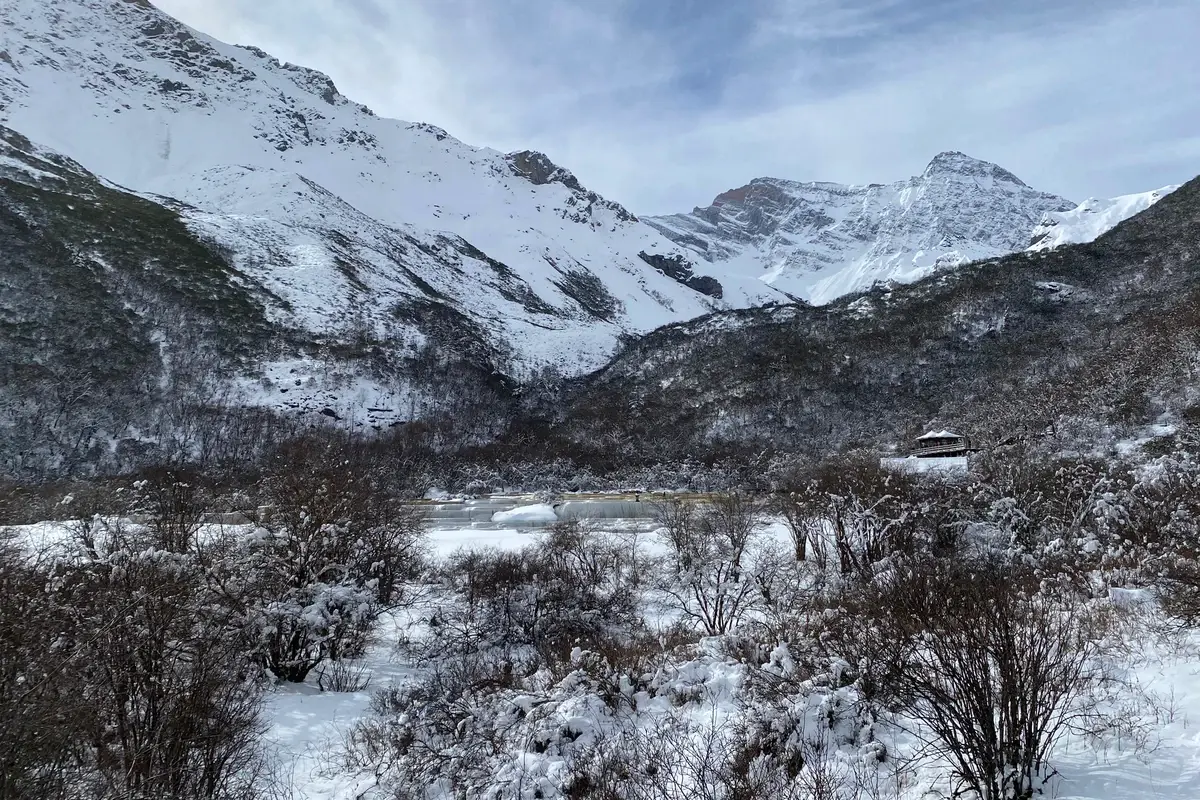
After about 10 minutes, we arrived at the stop near Five Color Pond. Looking around, it seemed that heavy snow had covered all the ponds in Huanglong Gully. I even wondered if we could see the beautiful "Jade Pool on Earth."
The Five Color Pond group covers 21,000 square meters with 693 ponds, the largest group in Huanglong Gully and the largest and highest-altitude open-air travertine pond group in the world today. We were destined not to see the grand pond groups today.
Finally, we caught a glimpse of the only part of the "Jade Pool" that was visible.
The pinkish-blue in the pond contrasted beautifully with the white snow!
Truly a pond of five colors!
Unfortunately, the sky was quite overcast.
This visit to Huanglong allowed more appreciation of the snow scenery in the mountain valleys.
Huanglong Middle Temple in Huanglong Gully was almost covered by yesterday's heavy snow.
March 25, 2023: Joined a one-day tour. In the morning, visited the Chengdu Research Base of Giant Panda Breeding; in the afternoon, visited the Sanxingdui Museum.
To see pandas playing outside, the tour group arranged an early departure at 6:30 AM. We arrived at the Panda Base around 7:50 AM, queued up, and there were quite a lot of people.
The small playground of giant pandas.
Giant pandas playing.
Energetic young people were the main force chasing the superstar "Hua Hua."
This was a lazy panda, sitting motionless while we photographed it.
This was a mischievous panda, its white fur stained soiled yellow from playing.
The Chengdu Research Base of Giant Panda Breeding creates a beautiful, comfortable, and livable environment for pandas—a paradise for them!
The park has colorful flowers, lush bamboo forests, and shady green trees.
At the Giant Panda Base, I saw red pandas for the first time. I learned that giant pandas, Asian black bears, brown bears, and polar bears all belong to the bear family, while red pandas belong to the red panda family. So red pandas are not baby giant pandas!
Red pandas are indeed not as cute as giant pandas.
After lunch, we arrived at the Sanxingdui Museum, whose foundation was laid in August 1992 and opened in October 1997. It is located at the northeastern corner of the Sanxingdui site, a national key cultural relic protection unit, by the Yazi River in Guanghan City, 40 kilometers south of Chengdu. It is a modern thematic site museum in China.
The bronze standing figure from the Shang dynasty in the comprehensive hall! The figure is 180 cm tall, with a total height of 260.8 cm and weighing about 180 kg. It wears a high crown and three layers of clothing, with complex, exquisite, and splendid decorations mainly featuring dragon patterns, supplemented by bird, insect, and eye patterns. The craftsmanship is unparalleled in Xia, Shang, and Zhou archaeology. The bronze standing figure (commonly called "Big Standing Figure") is also the tallest and most complete bronze standing figure, hailed as the "King of Bronze Statues in the World." The photo is not clear, but seeing it in person was extremely震撼!
The gold scepter from the Shang dynasty in the comprehensive hall! This is a Shang dynasty gold artifact. The scepter was made by hammering gold into a sheet and then wrapping it around a wooden rod. At one end of the gold scepter, there are three groups of patterns: the group near the end shows two symmetrical human heads facing each other, wearing five-tooth witch hats and triangular earrings. The other two groups are identical, with birds and fish facing back to back above and below.
The bronze sacred tree from the Shang dynasty in the comprehensive hall! Six bronze sacred trees were excavated at Sanxingdui. The most complete is "No. 1 Sacred Tree" unearthed from Pit No. 2 in 1986. It is 3.96 meters tall, the largest single bronze artifact in China. It represents the ancient Shu civilization and is a masterpiece of bronze casting, a mythological visualization of the communication between gods and humans in ancient Shu. In January 2002, it was included in the "First List of Cultural Relics Prohibited from Going Abroad for Exhibition" by the State Administration of Cultural Heritage.
The small bronze standing figure in the restoration hall looks like "Ultraman."
The small No. 3 bronze sacred tree from the Shang dynasty in the restoration hall!
The bronze human head with a gold mask from the Shang dynasty in the bronze hall!
The bronze mask with protruding eyes from the Shang dynasty in the bronze hall!
The bronze rooster from the Shang dynasty in the bronze hall! This rooster is plump, with a raised head, very vivid. Its realistic style contrasts sharply with many exaggerated artifacts from Sanxingdui, making it one of the most representative works of Sanxingdui.
The bitten mask-shaped ice cream (15 yuan each) even had the incomplete beauty of unearthed artifacts.
Around 4:20 PM, the one-day tour of Panda Base and Sanxingdui ended. The tour bus stopped in Qingyang District, Chengdu, near Chengdu Cultural Park. I heard that Cultural Park best reflects the locals' leisurely slow life, and there is a small theater for Sichuan opera face-changing performances, so we went in for a stroll.
The Cultural Park was full of blooming flowers, with a warm spring atmosphere!
Chengdu's Cultural Park is somewhat like Suzhou's large park, a leisure area for residents of the ancient city.
Locals often enjoy tea, read books, or get their ears cleaned in the park; outsiders are often directed to the theater here to watch Sichuan opera face-changing performances.
Leaving the Cultural Park to the Qintai Road archway, I checked Gaode Map and found that Kuanzhai Alley was nearby. So we had a CityWalk in Chengdu and walked to Kuanzhai Alley.
About ten minutes later, we saw this "Kuanzhai" landmark!
Entering this alley, many perpendicular old alley houses are very distinctive, the most famous being Narrow Alley (Zhaixiangzi) and Wide Alley (Kuanxiangzi), along with Well Alley (Jingxiangzi), collectively called Kuanzhai Alley.
This alley is called Persimmon Alley (Shizixiang); Narrow Alley and Wide Alley run parallel to it.
Entered Narrow Alley.
The entrance of a trendy shop inside Narrow Alley, selling nostalgic small items and snacks.
The historical and cultural background of Kuanzhai Alley created its unique style in planning and architecture: the combination of a complete city grid and military camps, northern hutongs with Sichuan courtyards, and Western-style buildings from the Republic of China period with Sichuan folk houses. These features give Kuanzhai Alley its architectural artistic characteristics, making it a rare urban cultural resource in the trend of homogenized cityscapes.
Intangible cultural heritage production—bronze ox!
A hitching post on the old wall at No. 32 Narrow Alley, about 1.2 meters above the ground, weathered and mottled. It is one of only three surviving hitching posts in Kuanzhai Alley. A hundred years ago, this area was home to the northern Manchu and Mongol Eight Banners and their families, who had the habit of riding horses. Therefore, this hitching post is also a symbolic representation of northern culture in western Sichuan.
A rare Chinese-Western architectural style in the historic street of Narrow Alley!
Look at the expression of this passerby—it somewhat resembles the face-changing masks of Sichuan opera.
Exited Narrow Alley and headed to the adjacent Wide Alley.
At the entrance of Wide Alley, tourists were weaving between Wide and Narrow Alleys.
What mythical beast is this?
Drinking tea and chatting in a small courtyard.
Ear cleaning (cai'er). It originated from barbers in folk culture and is a unique ear culture in Sichuan. It gives people a relaxing and enjoyable experience of tingling, tension, and excitement during ear cleaning. Look at this "little comfort"—how enjoyable!
By the time we reached the other end of Wide Alley, it was around 6:00 PM.
We took a taxi back to the hotel. Following a local's recommendation, we went to a skewer restaurant frequented by locals. We arrived at 7:45 PM, took a number, and waited until 9:00 PM to eat. Honestly, the meat and vegetables were indeed fresh, the seasoning was authentic and delicious, and the price was affordable. So it was worth the wait.
March 26, 2023: Free day. In the morning, we visited the Sichuan Museum (reserved in advance); in the afternoon, Du Fu Thatched Cottage, Wuhou Shrine, and Jinli. The Sichuan Museum is surrounded by green trees, close to Du Fu Thatched Cottage, quiet and elegant. Seeing birdcages hanging on tree branches gave us a sense of how leisurely the elderly in Chengdu are.
We spent over 3 hours at the Sichuan Museum.
After lunch, around 1:45 PM, we first went to Du Fu Thatched Cottage, a revisit after 35 years. It felt familiar and unfamiliar at the same time, as the place has clearly expanded in area.
"Yilan Pavilion" is a four-story brick pavilion from the Republic of China period, now located in the Plum Garden of Du Fu Thatched Cottage. Thirty-five years ago, it was not part of the cottage area.
Photos taken 35 years apart in front of the Thatched Cottage shadow wall!
Even a great leader once left footprints here at the shadow wall.
At 3:50 PM, we arrived at Wuhou Shrine Museum. Wuhou Shrine began with the construction of Huiling in 223 AD. It is the only temple in China dedicated to both a ruler and his ministers, and the most influential Three Kingdoms museum in the world. The cultural heritage protection area of Wuhou Shrine includes Han Zhaolie Temple, Wuhou Shrine, Huiling, and Sanyi Temple.
On March 4, 1961, Wuhou Shrine was listed by the State Council as one of the first batch of key national cultural relic protection units. The three characters "Wuhou Ci" were inscribed by Guo Moruo.
Sanyi Temple, originally on Tidu Street in Chengdu, was built during the Kangxi reign. In 1997, due to urban construction, it was relocated entirely to within Wuhou Shrine, using original building components and plaques.
Jinli is part of the Jinli folk culture area of Wuhou Shrine Museum.
Leaving Jinli, we walked to the street and tried the must-eat snack in Chengdu: Shuangliu rabbit head (13 yuan each). Then we had our last Sichuan dinner. The next day (March 27), we took the train back to Suzhou, ending our 7-day tour of western Sichuan.


