Sichuan Travel: Two Unforgettable Trips to Chengdu and Dujiangyan (Photos)
Chengdu, located in the Sichuan Basin of western Sichuan, is crisscrossed with rivers and rich in products, earning it the reputation of the 'Land of Abundance' since ancient times. As the birthplace of ancient Shu civilization, it is one of China's ten ancient capitals. On September 1, 1952, the Central People's Government of the People's Republic of China abolished various administrative offices, restored the Sichuan Province structure, and established the Sichuan Provincial People's Government in Chengdu, naturally making Chengdu the provincial capital of Sichuan.
Photo at Chengdu Renmin South Road Square (Photo by Li Ping)
The journalist has made multiple trips to Chengdu, but the most memorable are the two journeys to Dujiangyan in 1990 and 2021, 31 years apart. I remember first arriving in Chengdu in June 1990. At that time, to thank the Luzhou Laojiao Distillery in Sichuan for its strong support in recording a group of songs for the 11th Asian Games, including 'The Asian Winds,' we stopped in Chengdu on the way to Luzhou. On the morning of June 30, my colleague Li Ping and I boarded the No. 7 green express train, traveling for over 30 hours across two days and one night, finally arriving smoothly in Chengdu from Beijing.
Photo with Xiang Shijian (Photo by Li Ping)
When we exited Chengdu Railway Station and reached the exit, we immediately spotted a young man wearing a green T-shirt holding a white plexiglass sign with red characters reading 'Central People's Broadcasting Station, China Radio International.' He turned out to be Comrade Xiang Shijian of the Central Station's Sichuan Reporter Station.
Photo at Chengdu Railway Station (Photo by Li Ping)
Due to the train delay, Xiang Shijian had come to the station multiple times and finally picked us up specifically. Xiao Xiang's immense warmth made us instantly feel at home. Although we were new to this place, we seemed to shed the unfamiliar pressure of being in a new location and felt much more at ease.
Photo at Chengdu Shuangliu Airport (Photo by Xiang Shijian)
Xiao Xiang drove a Santana and quickly took us to the Chengdu Military Region Red Star Hotel, located diagonally opposite the Central Station Reporter Station, for check-in. Everything went smoothly. After settling into our accommodation, Xiao Xiang took us to the Sichuan Provincial Airlines to buy tickets for a flight from Chengdu to Luzhou at 9:30 AM on July 2. Unexpectedly, the ticket price was only 65 yuan at that time—really cheap.
In front of the Yun-7 aircraft bound for Luzhou (Photo by Li Ping)
Xiang Shijian was not only efficient but also familiar with the area. After handling the important task of the next itinerary's tickets, he drove the journalist team around within a single morning, taking us to three nationally protected cultural relic sites in Chengdu: Du Fu Thatched Cottage, Wuhou Shrine, and Wenshu Monastery.
Photo at Du Fu Thatched Cottage (Photo by Li Ping)
Du Fu Thatched Cottage is located on the banks of Huanhua Creek in the western suburbs of Chengdu. The environment is extremely elegant, featuring a garden-style courtyard with antique charm. The thatched pavilion truly leaves a legacy for later generations, and the poetic ambiance of the 'Sage of Poetry' is enchanting, making visitors reluctant to leave. Wuhou Shrine is a temple commemorating Zhuge Liang from the Three Kingdoms period, where there are lifelike statues of civil and military officials from that era. Liu Bei's tomb is also within the Wuhou Shrine. Although the tour of these three sites was brief and hurried, it left a deep impression.
Photo at Wuhou Shrine (Photo by Li Ping)
Around noon, we visited the Central Station Reporter Station and met with the then station director, Comrade Tan Dexiang, to brief him on our Sichuan trip. Director Tan arranged for Xiao Xiang to take us to lunch first. Afterward, we could head to the Guanxian Dujiangyan and Qingcheng Mountain tourist areas.
Photo at Chengdu Wenshu Monastery (Photo by Li Ping)
Leaving the reporter station, Xiao Xiang took us to a very famous Long Chao Shou restaurant, known for gathering Chengdu's renowned snacks, where we enjoyed a snack set meal that was enough to make us burst. I recall the snack set meal was only eight yuan per portion, with small plates and bowls, exquisite and delicate, including over ten items such as Long Chao Shou (dumplings), Dandan noodles, tangyuan (glutinous rice balls), silver ear soup, small steamed buns, siomai (open-faced dumplings), spicy tofu skin, spicy tofu cubes, spicy beef strips, and egg noodle pancakes.
Chengdu Long Chao Shou Restaurant (Archive Photo)
Although we tasted over ten kinds of snacks, Xiao Xiang said we hadn't tried them all, such as the famous 'Husband and Wife Lung Slices' (beef and offal in chili sauce) and fried quail. It truly lives up to the saying 'Eating in Sichuan is legendary.' Forcing ourselves to finish all the snacks, we eventually felt a bit uncomfortable— proving that even the best food should be consumed in moderation.
Photo at Dujiangyan (Photo by Li Ping)
After lunch, Xiao Xiang drove us to Dujiangyan, more than 50 kilometers from Chengdu. The car went all the way up the mountain. Looking down from the mountain, the majestic Dujiangyan water conservancy project was in full view. The fish-mouth-shaped diversion dam splits the surging torrent flowing from west to east into inner and outer rivers.
Photo at Erwang Temple (Photo by Li Ping)
Following Xiao Xiang's guidance, we crossed Erwang Temple, located midway up the mountain, and began descending. Erwang Temple was built to commemorate Li Bing, the famous ancient hydraulic engineer who constructed the Dujiangyan irrigation system. The temple complex is nestled among the trees on the hillside by the river, presenting a magnificent sight.
Photo by the Min River (Photo by Li Ping)
This temple, dedicated to the memory of Li Bing, the governor of Shu Commandery during the Qin Dynasty, and his son Erlang, who excavated the Dujiangyan in China, is located at the foot of Yulei Mountain on the eastern bank of the Min River in Dujiangyan. It was first built during the Northern and Southern Dynasties, and the existing structure was rebuilt in the Qing Dynasty. Originally named Chongde Temple, successive dynasties after the Song Dynasty conferred the title of 'King' on Li Bing and his son, and after the Qing Dynasty, the name was changed to its current one.
Photo at Lidui Park (Photo by Li Ping)
The stone walls inside the temple are engraved with the maxims of Li Bing and later generations on water control: 'Dredge the riverbed deep, build low weirs,' etc., known as the 'Three Character Classic of Water Control.' The temple houses statues of Li Bing and Erlang. The teahouse on the eastern side of the main hall is a stilt house suspended over a cliff, where visitors can rest and enjoy tea. The rear hall on the right side features stone inscriptions by artists such as Zhang Daqian and Xu Beihong. The garden is planted with various rare flowers and trees, with ancient trees reaching the sky and dense shade, making it a scenic spot in Sichuan.
Photo in front of Anlan Cable Bridge (Photo by Li Ping)
After descending from Erwang Temple, we came to the Dujiangyan water conservancy project for a close look. We saw the Anlan Cable Bridge, which spans the inner and outer rivers in two sections. Walking onto the bridge and looking down, the rushing torrents surged beneath like galloping wild horses, roaring and rumbling, stirring up white waves.
Photo on the Embankment (Photo by Li Ping)
Following Xiao Xiang's guidance, we walked along the inner river after the diversion towards Lidui Park to the east. There, we stepped onto a long river embankment made of large cobblestones wrapped in bamboo fences. We saw water seeping through the stone crevices, covering the embankment road with a thin layer of river water.
Photo at Baopingkou (Photo by Li Ping)
Walking on it, the water just covered our feet. It is said that this was because it had rained heavily a few days earlier, causing the water to overflow. If the water were higher, even this riverside path would be impassable. Reluctantly, we had to take off our shoes and socks and walk through the water. Fortunately, this stretch was short, and we soon reached the entrance of Lidui Park.
Photo at Qingcheng Mountain (Photo by Li Ping)
After passing through the park, Xiao Xiang's car had just arrived. He picked us up and took us to Qingcheng Mountain. Not long after entering the mountain gate, we saw a group of locals carrying sedan chairs (sliding poles) soliciting customers to go up the mountain. We climbed the stone steps and plank roads step by step. After going up a section, we found the mountain still densely forested, and the nearest scenic spot we wanted to visit was still far away. Due to time constraints, we had to turn back in a hurry. Thus, on June 30, 1990, thanks to the enthusiastic help of Comrade Xiang Shijian, we visited four famous scenic spots in Chengdu and Dujiangyan in one day. To this day, that first trip to Chengdu and Dujiangyan remains vivid in my memory.
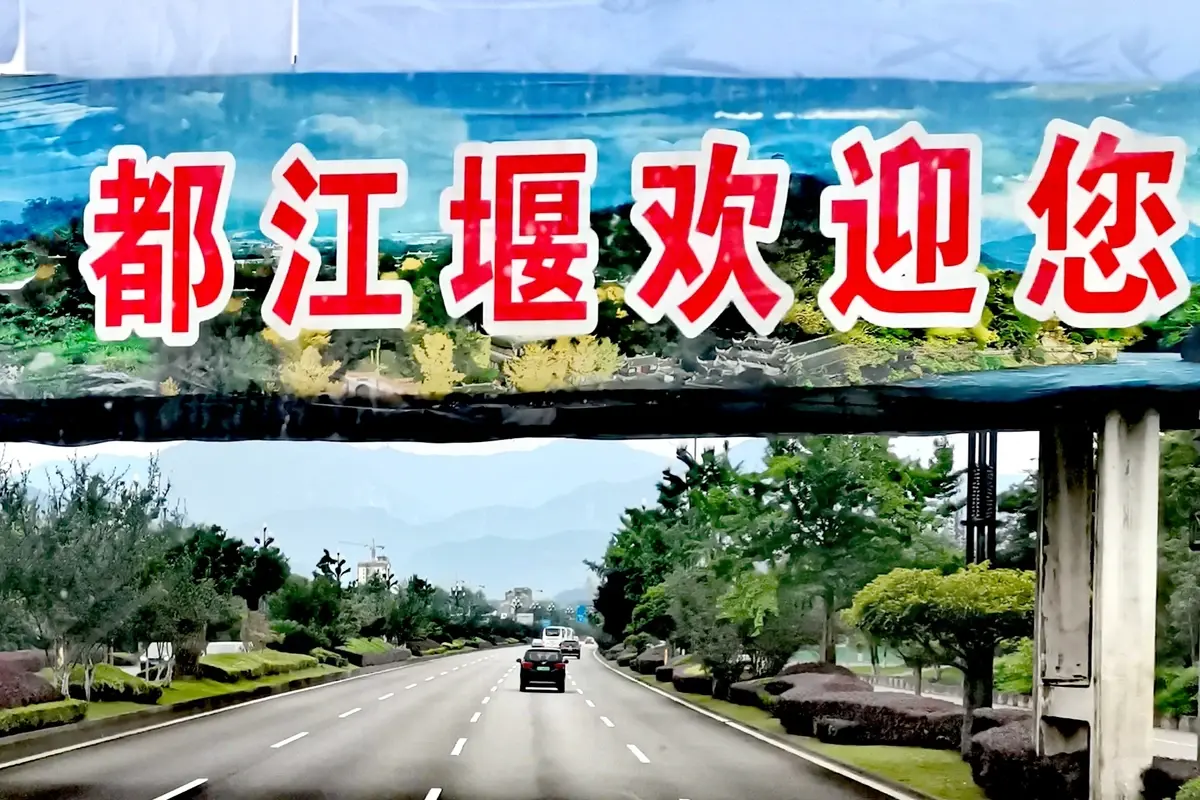
Welcome Banner on the Expressway (Photo by Feng Ganyong)
The journalist's second trip to Dujiangyan was on June 21, 2021, 31 years later. Due to participating in the 'Green China Tour into Beautiful Dujiangyan' event, I departed from Beijing and flew to Chengdu Shuangliu Airport, then drove onto the expressway towards Dujiangyan. Along the way, seeing the banner 'Welcome to Dujiangyan' felt especially warm. After more than an hour's drive, we arrived smoothly in beautiful Dujiangyan at 5:30 PM and checked into the Xinhao Holiday Hotel on the banks of the Min River.
Li Bing Memorial Hall (Photo by Feng Ganyong)
Since it was already evening upon arrival, the schedule allowed for free activities. Hearing that the beautiful Min River flowing through the city is a stunning scenery in Dujiangyan, after dinner I left the hotel for a stroll. Not far away was the Dujiangyan Water Culture Square, where the Li Bing Memorial Hall is located.
Lying Panda (Photo by Feng Ganyong)
Near the cultural square, there was a cute giant panda lying on its back on the lawn, with passersby taking photos with it. Standing there, looking into the distant continuous mountains, I saw a tower on one mountain, which was the Erwang Temple dedicated to Li Bing and his son, reminding me of my visit there 31 years ago.
Photo in the Square (Photo by Jia Jianxin)
Although this was my second visit to Dujiangyan, the impression from my first visit had completely disappeared. Dujiangyan is named after its world-famous ancient water conservancy project. During my first visit, I had visited sites like Erwang Temple, Lidui Park, and the Dujiangyan Irrigation System. Now, everything in Dujiangyan felt entirely new and unfamiliar.
A Corner of Dujiangyan (Photo by Feng Ganyong)
Strolling through Dujiangyan, I saw the scenic riverside along the tributaries of the Min River entering here, with many historical sites such as the Guanxian Ancient City Xuanhua Gate, Commandery Governor's Mansion, and Tianfu Source. Dujiangyan was formerly called Guanxian, and the Guanxian Ancient City, known as 'Mountains and rivers in embrace, a life of Dao,' attracts visitors from all directions with its rich cultural heritage, unique customs, and romantic lifestyle. Guanxian Ancient City is a city accompanied by a millennium-old weir, a city where scenery and city are integrated, a city of life’s savor, and a city directly accessible by express trains. Its main attractions include the South Bridge, West Street, Confucian Temple, Water Conservancy Mansion, and Yangliu River, among others.
Twilight View by the Min River (Photo by Feng Ganyong)
The overall development of Guanxian Ancient City began at the end of 2009. The facade buildings were all constructed in the Ming and Qing styles of western Sichuan, and water was diverted into the city, winding and meandering. Stepping into it, one feels as if traveling through history, dispelling modern worries and noise. At night, the ancient city, Yulei Pavilion, and mountain pavilions light up together, adding another scene to this beautiful post-disaster reconstruction city.
Xuanhua Gate of Guanxian Ancient City (Photo by Feng Ganyong)
Entering the ancient city, one can see the historically significant Xuanhua Gate. The east gate of Dujiangyan is called 'Xuanhua Gate.' Its original site was at the intersection of today's Xingfu Road and Jianshe Road, where the new gate now stands. The tower above the gate is called 'Shenggeng Tower.' The East Gate was the busiest city gate of Guanxian, and the East Street inside the gate is today's Xingfu Road, also the busiest street in the county. The term 'Xuanhua' means 'to disseminate the king's orders and educate the people.'
Streets of Guanxian Ancient City (Photo by Feng Ganyong)
Dujiangyan is not just about the Dujiangyan Irrigation System; Guanxian Ancient City also has many places worth visiting. On the way to the Dujiangyan Scenic Area, one can see the beautiful South Bridge, with various colorful paintings, carved beams, painted rafters, folk clay sculptures, calligraphy, and couplets integrated, known as the 'Waterborne Painting Tower,' 'First Bridge over the River Source,' and 'Scenery Viewing Platform.' Especially at night, touring the South Bridge and gazing at the ancient city's twinkling lights offers a unique charm.
Climbing Yangtianwo Covered Bridge (Photo by Feng Ganyong)
From under the ancient city wall, I climbed a beautifully carved and painted Yangtianwo Covered Bridge. This bridge is also known as the Yangtianwo Sluice Gate, the first important hydraulic structure for regulating the diversion on the inner river of Dujiangyan. The Yangtianwo Sluice Gate was built in the winter of 1963, with a total of six openings, three for the Pobo River main canal and three for the Zoujiang River main canal. Each opening is 9 meters wide, using a single-track electric travel motor for opening and closing. Yangtianwo Sluice Gate spans the main inner river canal, echoing the mountain-water city of Dujiangyan, controlling the inner river and benefiting the Tianfu region, known as the 'First Sluice in Western Sichuan.'
Photo on the Covered Bridge (Photo by Jia Jianxin)
Yangtianwo Covered Bridge is close to Yangtianwo Sluice Gate. The bridge adopts Ming and Qing architectural styles, with blue bricks, black tiles, carved window lattices, and upturned eaves on the bridge pavilions at both ends and in the middle, decorated in a classic and colorful manner. The bridge interior features calligraphy, poetry, and couplets by famous artists, giving the whole bridge a rich cultural atmosphere. The middle pavilion hangs a plaque with the inscription 'Tianfu Source' written by Mr. Guo Moruo.
Yangtianwo Fish Mouth Stone (Photo by Feng Ganyong)
Tourists and pedestrians can stroll leisurely on the covered bridge, take a short rest in the pavilion to view the scenery and enjoy the cool breeze, or go to the teahouse on the upper floor of the bridge to sip tea and chat. Below the covered bridge is the Yangtianwo Fish Mouth. There is a stone staircase in the middle of the bridge to go down. The fish mouth embankment is lined with white marble railings. To the left of the fish mouth is the Pobo River main canal, and to the right is the Zoujiang River main canal. The Pobo River main canal branches into the Puyang River and the Baitiao River through the Pobo Sluice, and the Zoujiang River main canal branches into the Zouma River and the Jiang'an River through the Zoujiang Sluice.
Best Tourism City Marker (Photo by Feng Ganyong)
Arriving at Yangtianwo Square, in the center of the square is a marker for 'China's Best Tourism City.' The square platform in the center holds a golden ball atop a torch-like shape. The whole shape is resplendent and magnificent. Not far away, by the roadside, is the Dujiangyan Commandery Governor's Mansion.
Commandery Governor's Mansion (Photo by Feng Ganyong)
Climbing the Commandery Governor's Mansion building, one can take in the mountain scenery and clouds, with the river flowing slowly, and the sound of a guqin playing 'High Mountains and Flowing Water' drifting gently, as if entering the realm of the Moon Goddess. Especially by the riverside with a gentle breeze, I practiced a set of 'Baduanjin' (Eight Brocades) and felt very relaxed.
A Corner of Yangtianwo Square (Photo by Feng Ganyong)
On the morning of June 22, 2021, the journalist set out from the hotel to participate in the 'Celebrating the 100th Anniversary of the Founding of the Communist Party of China--Green China Tour into Beautiful Dujiangyan Large-Scale Public Welfare Event.' After the grand opening ceremony, a large TV interview series 'Two Mountains on the Road: Ten People's Talk--Dujiangyan Chapter' was broadcast live jointly by People's Daily Online and China Green China Network. Afterwards, participants went to the foot of Qingcheng Mountain for a memorial forest planting activity.
Launch Ceremony of Entering Dujiangyan (Photo by Feng Ganyong)
For Qingcheng Mountain, this was the journalist's second visit. It is a global holy site of Taoism's Celestial Masters, one of the Ten Great Grotto-Heavens, one of China's four famous Taoist mountains, one of the five immortal mountains, and the birthplace of Chinese Taoism. Due to the lush, evergreen trees on the mountain, it has long been known as 'Qingcheng's quietness surpasses all.' The Taoist palace architecture is a concrete practice of the 'Unity of Heaven and Man' philosophy, starting from 'Tao follows nature.' The buildings on Qingcheng Mountain follow the mountain terrain, flexible in layout, emphasizing seclusion, concealment, quietness, and oddity, with human landscapes and natural landscapes complementing each other. The entire mountain is surrounded by peaks, shaped like a city wall, with thousands of stone steps and winding paths leading to quiet seclusion, excelling in quietness and cleanliness, rivaling the peril of Jianmen Pass, the beauty of Mount Emei, and the grandeur of Kuimen Gate.
Photo at the Foot of Qingcheng Mountain (Photo by Jia Jianxin)
It is quite regrettable that although the journalist did not thoroughly explore Qingcheng Mountain during the last visit, this time, participating in the 'Green China Tour into Dujiangyan' event, two entries into Qingcheng Mountain still did not allow for a visit due to time constraints. However, both activities took place in Dujiangyan Qingcheng Mountain. One was at the Qingcheng Mountain Homestay College at the foot of the mountain, interviewing President Xiao Hua about the Qingcheng Mountain Zuowang (Sitting in Forgetfulness) Taoist Experience Area culture.
Qingcheng Mountain Homestay College (Photo by Feng Ganyong)
The other activity was entering the Zuowang Forest Hotel within Qingcheng Mountain, a place like a fairyland for spiritual cultivation. There, I saw some people transcribing the 'Heart Sutra,' a process that took over forty minutes, leaving a profound and unforgettable impression.
Zuowang Forest Hotel (Photo by Feng Ganyong)
Additionally, the journalist also followed the Beautiful Dujiangyan Art Troupe to the Pigpen Coffee Garden in the Chuanxi Music Forest Patch in Dujiangyan. Listening to the creator, Mr. Song Jianming, a simple and unadorned farmer, recounting the creation and development process here, its unique and touching story was deeply enlightening.
Chuanxi Music Forest Patch (Photo by Feng Ganyong)
That evening, a spectacular 'Green China Tour into Beautiful Dujiangyan Large-Scale Public Welfare Performance' was held at the Dujiangyan Olympic Sports School Stadium. Six actors portraying the great leaders—Liu Jin, Lu Qi, Wang Wufu, Che Yuzheng, Zhang Zaixin, and Huang Hong—gathered in Dujiangyan to narrate the Long March stories and promote the Red spirit; Cheng Zhi, Liu Dongdong, Li Mi, Yun Duo, Gan Ping, Huang Yan, Jin Yu, Sheng Xi, Hai Lai Amu, Li Qiongyao, and the Mountain and Water Combo, among many other Green China cultural light cavalry, performed passionately, making the evening climax repeatedly, with an electrifying atmosphere.
Dujiangyan Public Performance Evening (Photo by Feng Ganyong)
On June 23, the journalist followed the Green China Tour into Dujiangyan Art Troupe for a second visit to Lidui Park in the Dujiangyan Scenic Area. During the visit, I carefully searched my memory from the first visit 31 years ago, but aside from Baopingkou and the Anlan Cable Bridge, I couldn't recall anything else...
Second Visit to Dujiangyan Photo (Photo by Jia Jianxin)
Arriving at Lidui Park again, I saw the park gate couplet: 'Completing the work of Yu the Great with divine axe and hammer, the land has no equal, the river channels attest to the grace of the Qin governor; Embracing all the beauty of Shu's mountains and waters, leading the rivers first, the famous garden adds color to Huayang's chapter.' The first line says that the land, known as 'Land of Abundance,' is unparalleled, thanks to Governor Li Bing, who inherited the divine axe and hammer from Yu the Great to complete the great Dujiangyan irrigation project; the second line says that among all the famous mountains and waters in Shu, Dujiangyan is the first, and Lidui Park is one of the places that enhances its beauty.
Entering Lidui Park (Photo by Feng Ganyong)
Inside the park, pavilions and terraces are arranged in a pleasing manner, with ancient tree stumps, exotic flowers, pond fountains, exquisite layout, and unique charm. The garden features a crape myrtle vase and a crape myrtle screen, cultivated over two to three hundred years, showing great ingenuity. This ancient ginkgo stump is said to have been planted by Zhang Song at the end of the Eastern Han Dynasty, still standing tall and lush, like a crane, blessed by the mountain and water spirit, and is said to have borne fruit. The crape myrtle vase, crape myrtle screen, and ginkgo stump are known as the 'Three Treasures of the Garden.'
Dujiangyan Fulong Temple (Photo by Feng Ganyong)
Coming to Fulong Temple (Temple of the Subdued Dragon), one can see a small hill with 42 steps, called Lidui, which is the solitary mound separated from Yulei Mountain when Li Bing and his son led the laboring people to excavate Baopingkou to divert the Min River water to irrigate the western Sichuan plain. The 'Lidui' stone tablet and 'Buddhist Sanskrit Inscription' tablets on both sides were erected by later generations, intending to use divine power to permanently suppress floods.
Guanlan Pavilion (Photo by Feng Ganyong)
Fulong Temple was originally named Fanxian Hall, built in the Jin Dynasty to commemorate the virtuous scholar Fan Changsheng from the Three Kingdoms period. Fan Changsheng, from Fuling, Sichuan, was said to have mastered the art of longevity, living to over 130 years. He was erudite and talented. Liu Bei and Zhuge Liang invited him to serve as an official, but he repeatedly refused, wanting to become an immortal, and was called 'Lord of Leisurely Freedom' by contemporaries. In the early Northern Song Dynasty, people commemorated Li Bing's achievements, expanded the temple, and, following the legend of Li Bing and his son 'subduing dragons to control water,' renamed it Fulong Temple. The viewing pavilion at Fulong Temple is the best spot to survey the entire layout of the Dujiangyan canal system.
View from the Fish Mouth Dividing Embankment (Photo by Feng Ganyong)
Standing at the Fish Mouth Dividing Embankment and looking into the distance, the water of the Min River seems to come from the sky. It originates from Gonggang Ridge in Songpan County, flows through Mao County, Wenchuan, Dujiangyan, Leshan, etc., and meets the Jinsha River in Yibin City, where it becomes the Yangtze River. It spans 735 kilometers in length, with an average annual flow of 496 cubic meters per second. It is precisely because of its abundant water source, rushing down from the high mountain gorges, surging violently, and facing the gradually lower terrain of the fan-shaped western Sichuan plain without restraint, that during flood seasons, it caused severe water damage. It was not until the engineering masterpiece of Li Bing and his son that the floods were controlled.
Baopingkou at the Foot of Lidui (Photo by Feng Ganyong)
Baopingkou is located at the foot of Lidui. It is the throat of the inner river diversion, a channel 20 meters wide, 40 meters high, and 80 meters long, excavated by Li Bing, shaped like a bottleneck, hence the name 'Baopingkou' (Bottle Mouth). The inner river water rushes here, is blocked by the lidui head-on, forming ponding and swirling currents, which clarify the water before it enters the mouth. During flood season, it forces the inner river not to surge too much into the narrow baopingkou, but instead to swirl back and discharge from the Feishayan (Flying Sand Weir) to the outer river, acting as a check gate to ensure the safety of the Chengdu Plain.
Second Visit to Baopingkou Photo (Photo by Jia Jianxin)
Baopingkou acts as a 'check gate,' automatically controlling the inflow of the inner river. It is an opening cut into the long ridge of Jianshan (now called Guankou Mountain or Yulei Mountain) that extends toward the Min River. It is the throat controlling the inflow of the inner river, artificially dug, shaped like a bottleneck, and unique in function, hence the name Baopingkou. Due to its magnificent natural scenery, Baopingkou is known as 'Lidui locks the gorge' and was one of the famous 'Ten Scenes of Guanyang' in history.
Anlan Cable Bridge (Photo by Feng Ganyong)
The Anlan Cable Bridge, also known as 'Anlan Bridge' or 'Couple's Bridge,' is located above the fish mouth of Dujiangyan, spanning the inner and outer rivers. It is renowned as one of the 'Five Great Ancient Bridges of China' and is the most iconic landscape of Dujiangyan. It was built before the Song Dynasty and was destroyed by war at the end of the Ming Dynasty (17th century). Its ancient name was 'Zhu Pu Bridge,' changed to 'Pingshi Bridge' in the first year of the Chunhua reign of the Song Dynasty, and during the Jiaqing reign of the Qing Dynasty, a new bridge was built and renamed 'Anlan Bridge.' The original cable bridge was supported by wooden raft stone piers, with thick bamboo cables spanning the river, planks laid as the deck, and bamboo cables as railings on both sides. It was about 500 meters long. The bridge now uses steel cables and concrete piles.
Dujiangyan South Bridge View (Photo by Feng Ganyong)
On the afternoon of June 23, 2021, the journalist successfully concluded the Dujiangyan itinerary and returned to Beijing from Chengdu Shuangliu Airport on China Southern Airlines flight CZ8812. While waiting at the airport, my thoughts wandered. Although the two visits to Dujiangyan were separated by as long as 31 years, both different experiences were unforgettable. Perhaps this is the charm of travel. (Text and Photos by Feng Ganyong)


