Days at Cishan
On August 16, 1976, it was an extremely ordinary day, yet in my memory, it is unforgettable. On this day, I left home, stepped into society, became a railway worker, and had a formal job.
For two and a half years after graduating from high school, I had no job. The bitterness and hardship during that period were beyond words. At that time, the national policy was that high school graduates could not further their studies, join the military, or find employment; they had to go to the countryside to receive re-education from the poor and lower-middle peasants. At school, the school would directly transfer the students' household registrations collectively to the designated communes and production brigades for the Down to the Countryside Movement.
Finally, having a formal job was very exciting. The day before, my father told me that a car would take us to report to our new work unit early the next morning, and he informed me of the meeting point and departure time. My workplace was in Cishan, Hebei, far from home. I packed my clothes and luggage early, putting clothes in a tin box, tying my quilt and mattress into a bundle, and prepared for the next day's departure.
The next morning, just at daybreak, I arrived at the agreed location. A Jiefang flatbed truck was already parked there. Our group of nine—three men and six women—gradually gathered. Everyone was light and quick, swiftly loading luggage onto the truck, then climbing aboard one by one. After seating ourselves, the truck started. A personnel officer was responsible for escorting us; he sat in the cab and told us it would take eight hours to reach Cishan. Not long after we set off, we stopped at Yuci long-distance bus station, where a female student got on. It seemed her home wasn’t in Yuci. On board, there were now ten of us—three men and seven women—heading straight for Cishan.
Cishan was a small town in Wu'an County, Hebei Province. The Handan–Changzhi Railway was to connect with the existing line at Cishan Station. At that time, the Hanchang line was not yet fully operational, but the section from Cishan to Shexian had been completed. To transport iron ore out and coal in, this section was connected to the existing line at Cishan Station ahead of schedule, under the temporary management of the Cishan Transportation Section. They ran one pair of passenger trains and several freight trains daily. Our group of ten would join the temporary operation of the Cishan–Shexian railway.
The truck wound through the rugged mountains of the Taihang range, passing through Yushe, Changzhi North, Lucheng, Licheng, Shexian, and other places. Mid-August was the hottest time of the year. The truck sped along the highway, with trees and scenery slowly receding on both sides. The asphalt road, scorched by the sun, gave off a blazing light. From a distance on the truck, it looked like pools of clear water reflecting the sunlight. Neat rows of poplars lined both sides of the road, and cicadas on the trees chirped impatiently in the sun, their sounds joining into a continuous chorus, as if playing beautiful music for us, cheering and blessing us.
The truck jolted from time to time. Everyone sat on their luggage, silent, lost in thought and dreaming about their future. After a long journey, we arrived at Cishan at four in the afternoon. The truck stopped in the unit's yard, and we unloaded our luggage one by one. At that moment, we looked at each other. The wind and sun had weathered everyone during the trip, leaving our faces and arms flushed red.
This place had originally been open wilderness. The Cishan Transportation Section had built administrative, living, and residential areas here. The administrative area housed the offices of administration, political work, public security, telephone exchange, communication maintenance area, and leadership. The living area included a clinic, guesthouse, canteen, and dormitories. The two areas were separated by a narrow dirt road. Perpendicular to this dirt road was a wider dirt road, probably a township road, leading on one side to Cishan Railway Station and on the other into the distance. The residential area was located on the other side of this wider road, with six or seven houses, surrounded by farmland.
The personnel officer who escorted us handed us over to the local personnel department, which arranged for us to rest in the guesthouse. The guesthouse was a third-class building: brick pillars, adobe walls, plastered inside and out, tar-paper roof, and dirt floor. Such buildings were cheap to construct, but they were not insulated, not heat-resistant, and definitely not earthquake-proof.
Living in the guesthouse were two Ningbo cotton fluffers who made quilt covers for the staff and their families. We three male students shared a large room with them. Back then, Ningbo people already knew how to go out to earn money; they had a strong business sense. At that time, the unit had a cultural propaganda team. The person in charge came to the guesthouse several times to try to persuade me to join their team. In fact, I had no artistic talent at all; I knew nothing about singing, playing instruments, or acting, and had no interest. I didn't like performing arts, so I never agreed.
It had been less than twenty days since the Tangshan earthquake. Since Cishan was relatively close to Tangshan, the aftershocks were definitely strong. People were still in shock from the earthquake. The staff residential houses were also third-class buildings, not earthquake-resistant. Next to them, workers had set up makeshift earthquake shelters everywhere. These so-called shelters were very simple: low wooden frames covered with colorful plastic sheets on all sides and the top, providing shelter from wind, rain, and sun. At night, sleeping inside, there was no fear of earthquakes. The residential area was a chaotic mess, with these shelters interspersed among the third-class houses.
At the time, I had no time to think about the safety of the buildings. Having a formal job was already good enough. After two days in the guesthouse, I was assigned to the communication maintenance area. The other two male students were assigned to the signal maintenance area and the carrier room respectively, while all seven female students were assigned to the train crew as attendants. We moved into our respective dormitories.
The dormitory was infested with rats. There wasn't much food in the men's dorm, yet rats still scurried around. Sometimes several of us would try to block them, but the rats would quickly climb along the interior wall corners up to the roof beams and escape. Back when my family rented a house, the landlord used to put food in baskets and hang them from the beams to avoid rats. Such methods would have been useless here.
There was a small gate behind the living area. Through the gate, a path led to Cishan Station, less than a kilometer away. The train crew from the train crew office would take this path every day to go on duty, traveling between Cishan and Shexian. Because of the harsh conditions, some of the people who came with me felt homesick, but I was an exception. At that time, I was like a bird that had just flown out of a cage, breathing fresh air and soaring freely.
The canteen was right across from the dormitory, very close. At that time, you needed grain coupons to eat; having money alone wouldn't get you food. My household registration was in Shanxi, but my work unit was in Hebei. Shanxi grain coupons couldn't be used in Hebei, and it was very difficult to get national grain coupons. So I had to transfer my household registration to the local area, onto the unit's collective registration, which solved the food problem. The canteen food was as expected: coarse grains were abundant, fine grains were scarce. Sometimes the canteen would make dumplings. They would prepare the dough and filling, and anyone who wanted dumplings could buy the dough and filling, make the dumplings themselves, and find a place to cook them. At that time, I didn't know how to make dumplings and couldn't find a place to cook them. Every time this happened, I could only sigh in frustration and buy something else instead of dumplings.
Less than a month after arriving in Cishan, Chairman Mao passed away. On September 9, at 4:00 p.m., the Central People's Broadcasting Station broadcast "A Letter to the People of All Ethnic Groups in the Country," announcing the news of Chairman Mao's death. I was in the dormitory when I suddenly heard a female worker in the yard scream, saying Chairman Mao had died, and then she burst into loud sobs. I quickly ran to the yard. The unit's loudspeakers were broadcasting the Central People's Broadcasting Station's letter, and I knew Chairman Mao had passed away.
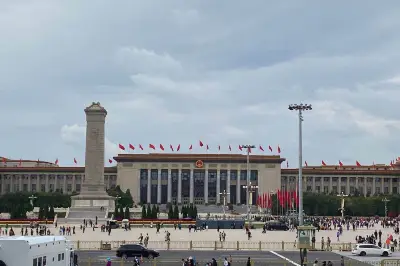
At that time, people had deep feelings for Chairman Mao. He represented the interests of the vast majority of working people, unlike some later leaders who represented the interests of a tiny bureaucratic-comprador class and failed to win people's hearts. Chairman Mao was gone, and everyone felt sorrow. His memorial meeting was held on the 18th at Tiananmen Square. Various localities and units organized listening and watching of the live broadcast. I watched the television broadcast at the unit. It was raining heavily that day, and the organizer at the unit was sobbing at the venue.
Not long after, the Gang of Four was smashed. When everyone heard the news, they were overjoyed and rushed to tell each other. In particular, Jiang Qing and Zhang Chunqiao were unpopular. Zhang Chunqiao's so-called "prefer socialist weeds to capitalist seedlings" was simply absurd logic. The Chinese economy had been pushed to the brink of collapse by them. The unit organized a parade to support the Central Committee's decision, and I was in the parade. Cishan had few people, and no one watched our parade, but we walked on the country paths, beating drums, clashing cymbals, and shouting slogans passionately, just like the student parades in 1930s movies. Smashing the Gang of Four fully reflected the people's will.
The unit held a criticism meeting. I spoke on behalf of the communication maintenance area. Writing articles was not difficult for me; I prepared the draft in advance and read it at the meeting. I said the Gang of Four were like a golden lid covering a jar of human flesh sauce, like face cream smeared on a ghost's face. My speech was praised by the comrades present, who said my metaphors were vivid and apt. I also wrote a poem and recorded it in my diary. More than forty years later, when I opened that diary, it read: "The leader passed away; sorrow overwhelms, the grief is extreme..."
Later, the Youth League branch put me in charge of the blackboard bulletin board for propaganda. I was always conscientious, publishing the blackboard on time, promoting the Party's policies, and commending good deeds among the staff. Near our station, there was a mass grave at Hecun, a stark evidence of the heinous crimes committed by the Japanese when they massacred Chinese miners at the Fengfeng Coal Mine. The mass grave was filled with white bones, recording a history of blood and tears of Chinese miners. The Youth League organization took young members to visit it for patriotic education, deepening our hatred for the Japanese invaders.
In the communication maintenance area, I was responsible for maintaining telephones and communication lines, directly serving railway operations—a heavy responsibility. At that time, telephones were magneto type. Normal line and telephone maintenance were relatively easy; the most feared situations were emergencies. Sometimes there would be line breaks, cross connections, or grounding faults. Regardless of day or night, wind or rain, these situations required immediate on-site handling. Once, a pole crossing the railway line had a broken insulator, causing a grounding fault that needed replacement. That pole was very tall—an asphalt-impregnated wooden pole with two stages of climbers, about twenty meters high. I wore climbing spurs, carried the insulator, and climbed up. The wind was blowing, the foreman directed from the ground, and I stood on the crossarm. Looking down at the foreman from such a height, my legs trembled, and sweat soaked my clothes. After replacing the insulator, I slowly climbed down, step by step, with great difficulty. Actually, I had acrophobia, but I didn't know it then. I was afraid of heights and dared not look down from high places. If I stood at a height and looked down, blood would rush to my head and my legs would go weak.
In late December, it was the depth of winter; the weather was extremely cold. One afternoon, the unit suddenly called all the young people together and told us to go to Cishan Station to take a railcar to the Shexian No. 150 Power Plant for rescue and emergency repair. It turned out that a train loaded with coal had collided with an empty train car on the No. 150 Power Plant's dedicated line. The scene was tragic; one person died, the track was destroyed, and coal could not be transported into the plant, which faced a shutdown. Our task was to haul ballast, carry sleepers, and restore the track. The bitter wind was biting; our hands were too cold to stretch out, and our feet were numb. Working outdoors under such conditions was extremely difficult. Moreover, there was no place to rest at night, so many people huddled around a stove in a room, dozing off. After being rotated back, I slept soundly in the dorm to recover my strength.
Later, I was transferred to Xinguzhen Station, where conditions were even worse than at Cishan. There was no canteen. At the station, some staff brought their families to cook, while others cooked for themselves. I could neither cook nor find a canteen, so eating became a problem. Fortunately, there was an engineering team responsible for maintaining the railway line in our section, and they lived nearby. Over time, I got to know them and bought meals from their canteen. Their cook was from Sichuan, and his twice-cooked pork was very tasty. That solved my food problem.
Once, I went to the market in Yetao Town but didn't buy anything. On the way back, I passed through Gucun Village and bought a jin (half a kilogram) of eggs from a peasant woman. I tied the corners of a handkerchief to make a bag and carried the eggs. Just as I was about to leave the village, a village cadre stopped me and asked where I bought the eggs. I said I bought them at the market. He didn't believe me and insisted I tell him which household. Actually, he had been watching me. In the end, he dragged me to the peasant woman's house and made her return my money, leaving the eggs behind. Although the Gang of Four had already been smashed, the countryside still enforced the policy of "cutting off the tails of capitalism." That peasant woman selling eggs privately was considered engaging in capitalism. Peasants were limited in how many pigs, chickens, and trees they could raise or plant; exceeding the limit was regarded as capitalist restoration. How absurd! Many years later, I told this story to my child, who simply couldn't believe such things happened.
At that time, a master worker wanted to fix me up with a girlfriend. I felt I was too young and not ready for such matters, so I politely declined.
Sometimes I went to Cishan on business. I would take the train in the morning and return in the afternoon. I didn't need to buy a ticket for the round trip, nor did I have a commuter pass, because it was our unit's own train and I knew the train attendants. But staff from other units, who didn't belong to our Cishan Transportation Section, had to buy tickets or hold railway passes. Once, a worker from a line maintenance unit rode without a ticket. When the train attendant checked tickets, an argument broke out. The duty police officer came to mediate, but the worker didn't back down. Seeing he couldn't persuade the worker, the officer drew his gun to intimidate him. Unexpectedly, the worker wasn't afraid at all; he stood up and wrestled with the officer for the gun. The gun accidentally went off, and the bullet shot through the ceiling, fortunately hurting no one. Afterward, the officer was removed from the public security team.
At that time, the public security team wasn't composed of police academy graduates like today. The personnel quality was uneven, leading to unexpected incidents. At Dongshu Station, local villagers often stole coal from the trains. The leadership arranged for police to ambush and catch the coal thieves. One night, a few thieves came. The ambushing officer shouted loudly; the thieves dropped their tools and ran. The officer chased them. After a while, unable to catch up, he fired a warning shot into the air, which startled the thieves and made them stop. The officer, seeing it was pitch dark around and the other side had three or four people, felt outnumbered and frightened, so he turned and ran back. The thieves, after regaining their composure, started chasing him. In the end, the officer was knocked unconscious and his gun was taken. Losing a gun was a serious matter. The police later investigated and recovered the gun.
Later, I was transferred to the Shexian communication maintenance area. Shexian is rich in walnuts, persimmons, and Sichuan pepper. In front of my dormitory, there was a pepper tree; behind it, a walnut tree. The pepper tree in front bore abundant peppers in autumn. Sometimes when I cooked, I would pick a few peppers directly from the tree. The walnut tree behind was full of walnuts. Several branches grew onto our roof, so we could climb onto the roof and pick walnuts freely. When the tree's owner came to pick walnuts, he found that the walnuts on the roof-side branches were all gone. He came to confront us. We all pleaded ignorance, but the owner stared at our hands and knew we were the culprits. Each of our hands had dark brown stains from peeling the green husks of walnuts, which wouldn't disappear for half a month. The owner was very angry and took our washbasins as compensation.
The amateur cultural life at our station was monotonous; there was nothing to do in the evenings. Calling home took a long time to connect, and sometimes when it finally got through, the voice was faint and hard to hear, because the call had to go through several exchanges. Down the hill, there was a motor transport unit also involved in constructing the Handan–Changzhi Railway. They often showed outdoor movies. Whenever there was a movie, we would go watch it; it was only a ten-minute walk. It was there we watched films like "Five Golden Flowers," "Ashima," and "The Fairy Couple."
At our station, a worker in his forties had committed a mistake and was placed under isolated investigation, requiring militia guards at night. The leadership assigned two people from the communication maintenance area to guard him. The other person was older and more experienced. He suggested we didn't need to guard simultaneously; he would take the first half of the night, and I would take the second half. In fact, the first half wasn't disturbing sleep, but the second half was very hard to endure. The worker under investigation noticed I was extremely sleepy and told me to go back to sleep, saying he wouldn't escape or commit suicide. Hearing that, I became more vigilant. I slung the gun over my shoulder, and my drowsiness vanished. I stuck it out for a whole week. In fact, the guns issued by the station police were only for deterrence; they had no bullets.
After the smashing of the Gang of Four and the end of the Cultural Revolution, the Central Committee decided to raise the wages of 30% of the staff. Many people around me had worked for over ten years as Grade 2 workers without a pay raise, earning only 40 yuan a month, plus a mobility allowance of no more than 50 yuan, to support their wives and children. Those of us who had just started working didn't make much less, yet these people were the backbone and key members of the workforce. They truly deserved a pay raise. But only 30% could get it. How to draw the line? It was very difficult. The factionalism from the Cultural Revolution hadn't disappeared, and new conflicts emerged. People began to fight and hurt each other again.
The communication lines under our responsibility required regular patrols. Each section was seven kilometers long, which meant carrying climbing spurs and insulators and walking at least seven kilometers. Sometimes when it was time for a meal and I was in the middle of a section, I would bring some dry food, sit down when hungry, eat, and then continue. One morning, I went out on patrol and found a broken insulator on a pole that needed replacing. It was an eight-meter-high concrete pole. Since there was frost on the pole in the morning, I didn't notice. As I climbed with spurs and the insulator, I slipped and slid down. All the buttons on my clothes were torn off. Fortunately, I wasn't injured, but my legs were shaking badly. After a while, when the frost on the pole melted, I climbed up again and replaced the insulator.
Shexian Station had a dormitory canteen. Generally, before meals, I would cook some rice myself and buy a stir-fry from the canteen. Rice had to be bought from Xinxiang, Henan. Sometimes a few of us would go together to carry rice back. At that time, the state exercised strict control over grain; grain could not be taken out of the province, otherwise it would be confiscated and auctioned. In Xinxiang, transactions usually took place at night because the grain market was not open. During the day, no one dared to trade. At night, we would get off the train and go straight to the place where rice was sold, buying quickly and leaving quickly to avoid being discovered by the management and causing trouble. The rice sellers knew the buyers' psychology; they would take advantage of the darkness and poor light to mix white sand into the rice, and they would use a combination of large and small weight scales to shortchange us. When we weighed the rice we bought back, it was always several catties short.
A friend of mine had a wife who worked as a train attendant. She wanted to introduce a girl to me. The person who had tried to fix me up before and this person didn't know each other, yet they were introducing the same person. What a coincidence! Although the girl's personal conditions were good, I felt I was too young for romantic matters, so I politely declined.
In April 1978, I was transferred away from the Cishan Transportation Section. Those days have become forever memories.