Handan, Unchanged for Three Thousand Years
I first noticed Handan while filtering travel destinations in Hebei Province. To the north is Zhangjiakou, and to the south is Handan—these are the places in Hebei where I have yet to leave my footprints. While searching online, I discovered that this little-known city actually has a profound historical heritage. So a travel plan for Handan quietly took shape in my mind...
A place that hasn't changed in over three thousand years;
A name that hasn't changed in over three thousand years;
A sound that hasn't changed in over three thousand years;
A city where, when you stand there, you travel back three thousand years—Handan.
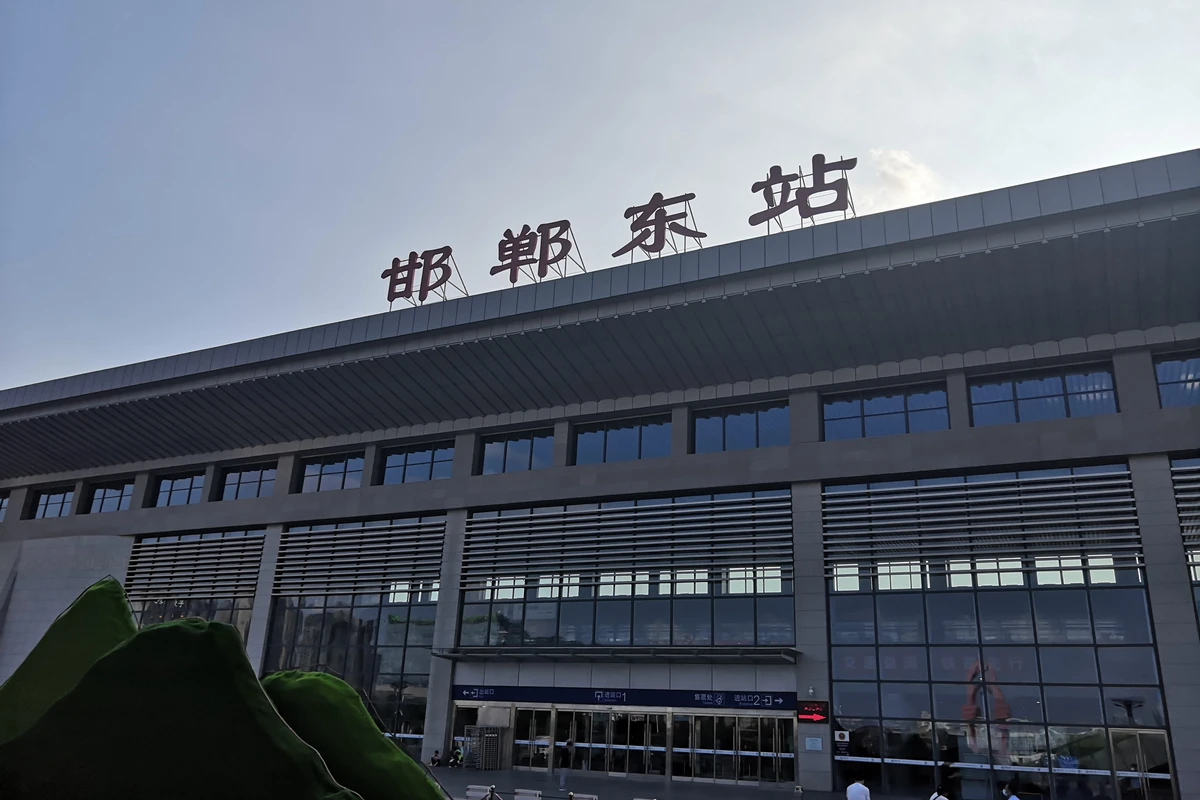
At 7:46 AM on July 19, we arrived at Handan East Station on time aboard G6753. I had previously booked a Haval M5 on Ctrip, and the delivery driver brought the car to the underground parking lot right on schedule. After quickly completing the paperwork, we set off for our first destination: Guangfu Ancient City.
Guangfu Ancient City is located northeast of Handan, about a 30-minute drive. Outside the south gate of Guangfu Ancient City is the “Former Residence of Yang Luchan.” We bought electric cart tickets here (20 yuan/person), and from the driver we also purchased the combo ticket for Guangfu Ancient City’s attractions (adults 90 yuan/person, children 45 yuan/person). Then we parked the car next to Yang Luchan’s former residence (parking fee 5 yuan/day).
Our first stop by electric cart was Hongji Bridge, known as the “sibling bridge of Zhaozhou Bridge.” Hongji Bridge shares the same construction techniques as Zhaozhou Bridge but is slightly smaller. Because it is far less famous than Zhaozhou Bridge, it is well-preserved with almost no traces of modern artificial work. In the old days, Hongji Bridge was the only route from the Handan area to Shandong. The Japanese set up checkpoints and built water dungeons here. The Fuyang River beneath the bridge flows from Fengfeng’s Black Dragon Cave northward all the way into Tianjin’s Haihe River.
At the entrance to the Hongji Bridge scenic area, we hired a tour guide (explanation fee 100 yuan, covering 5 attractions: Hongji Bridge, Yang Luchan’s Former Residence, Guangfu Ancient City Wall, Wu Yuxiang’s Former Residence, and the Wu Family Compound). With the guide’s explanations, we gained a deeper understanding of Hongji Bridge. Without a guide, most people might simply see it as a stone bridge.
Leaving Hongji Bridge, we returned to “Yang Luchan’s Former Residence.” The courtyard is small and rebuilt, filled with old photos, mainly telling stories about Yang Luchan. The only noteworthy item is the plaque in the main hall reading “Tai Chi is Good,” which was Deng Xiaoping’s inscription for Chinese Tai Chi.
From Yang Luchan’s Former Residence, we headed to the east gate of Guangfu Ancient City. Back and forth, we had already passed through the road between the southeastern corner of Guangfu Ancient City and Yongnian Wa Wetland three times... As an ancient city, it retains quite a number of historical relics. In particular, the two rusty iron-clad city gates, with iron sheets peeling off to reveal the wood underneath, allowed me to truly see the city gates’ unadorned appearance after a thousand years of wind and rain.
Descending from the city wall, we visited Wu Yuxiang’s Former Residence and the Wu Family Compound. The Wu Family Compound is actually the former residence of Wu Ruqing, Wu Yuxiang’s second elder brother, who was a metropolitan graduate and served as a second-rank official at the Ministry of Punishment with a peacock feather. Their eldest brother, Wu Chengqing, was a provincial graduate and served as the magistrate of Wuyang County in Henan. The Wu Family Compound displays the Wu family’s prominent status and wealth. The third brother Wu Yuxiang’s former residence, similar to Yang Luchan’s, mainly introduces Wu-style Tai Chi. Of course, its luxury level is inferior to the Wu Family Compound but far surpasses Yang Luchan’s residence.
After finishing the Wu Family Compound visit, we did not go to the Guangping Prefectural Office to the north, partly because it was under renovation and partly because after visiting the Governor’s Office in Baoding, we had no expectations for this newly built prefectural office. Following a recommendation on Dianping, we went to “Yan’s Restaurant.” It was empty, and an elderly lady was sitting at the door picking vegetables. We hesitated but went in anyway. We had mentally prepared for being overcharged at a scenic area restaurant, but unexpectedly the food was tasty and the prices low. The three of us spent a total of 101 yuan and ate our fill. The old lady waived the odd change, making it exactly 100 yuan.
Leaving Guangfu Ancient City, we drove to Xiangtangshan Grottoes in the Fengfeng Mining Area as per navigation. It is also marked on the map as Xiangtangshan Scenic Area, also known as North Xiangtangshan. The tickets for our family of three cost 229.8 yuan—I’m not sure why there was a “.8,” maybe some discount. Parking was 10 yuan. The guide here also cost 100 yuan, explaining all the way to the top, climbing while speaking—truly a hard-earned wage.
The white pagoda at the foot of Changle Temple, though dilapidated, was still impressive. The stone Buddha heads at the Changle Temple site were missing, and the Grand Hall remained only its stone foundation, yet it still exuded solemnity.
Walking up the mountain path, the road was not long, and there was not much scenery along the way. Halfway up the mountain were the grottoes. Being also a Northern Wei period grotto, compared to the Yungang Grottoes in Datong that I had visited before, the scale here was significantly smaller. However, the fact that photography was allowed inside the grottoes was absolutely wonderful. Without further ado, just look at the pictures!
Since Wahuang Palace was in She County, over 50 kilometers away from Xiangtangshan, we planned to stay overnight in She County and head to Wahuang Palace early the next morning.
The next morning after breakfast, we set off from She County to the nearby Wahuang Palace. Wahuang Palace is located on Zhonghuang Mountain, first built in the Northern Qi period as a detached palace by Emperor Wenxuan (Gao Yang). It is the mythical place where Nüwa “molded humans from clay and repaired the sky with melted stones.” It is the largest and earliest architectural complex dedicated to the ancestor goddess Nüwa in China. On the cliff outside the Wahuang Pavilion at the top, there are six sections of cliff-face sutras carved during the Northern Qi period, totaling 130,000 characters, known as “the world’s first cliff scripture group,” the earliest and most numerous existing cliff-carved sutras in China.
After buying tickets (adults 70 yuan/person, children 35 yuan/person), we did not hire a guide because we deviated from the normal route. Upon entering the scenic area, we first took an electric cart (round trip 20 yuan/person) through a large artificial garden—this was really necessary. After getting off, we took a cable car (one way 40 yuan/person) to near Butian Peak, a ride of about 25 minutes. Then we walked along Butian Road, enjoying the scenery all the way to Wahuang Pavilion. Along the road, we passed a slide car (one way 30 yuan/person). To experience the slide, we returned to this point after visiting Wahuang Pavilion and took the slide down the mountain (it can also be taken up).
Wahuang Pavilion is built against the cliff, with four stories. The first floor is the Worship Hall, above which three more stories are constructed. The pavilion leans against the cliff, secured by eight iron chains, earning it the names “hanging temple” and “movable building.” Inside, many visitors came to worship and fulfill vows. It is said that each floor offers different blessings. On the second floor, we encountered an old lady standing before a deity statue singing; with her heavy accent, I could only pick out words suggesting she was praising Goddess Nüwa.
Going around to the back of Wahuang Pavilion, we saw the eight iron chains—truly awe-inspiring, making one marvel at the wisdom and creativity of the ancients.
Next to Wahuang Pavilion is the so-called “world’s first cliff scripture group.” Looking at the carved scriptures, one couldn’t help but think of the phrase “iron strokes and silver hooks.”
In our initial plan, we had not arranged a visit to the 129th Division Memorial; originally we planned to return to downtown Handan from Wahuang Palace to visit the Handan Museum. However, the highly popular Handan Museum did not allow me to make a reservation, so we changed the itinerary to visit the 129th Division Memorial and Headquarters, which were not far from Wahuang Palace.
At the 129th Division Memorial, we hired a guide (100 yuan) to explain the 129th Division Memorial, the General Ridge Monument, and the 129th Division Headquarters Site. During the explanation, we learned that Marshals Liu Bocheng and Xu Xiangqian are buried here, and in 1990 Deng Xiaoping personally wrote the inscription “General Ridge.”
At the 129th Division Headquarters Site, we saw the Communists who lived a hard life yet won the people’s hearts.
After visiting the 129th Division Headquarters Site, we had lunch at a nearby “Old District Canteen.” As someone who never picky about food and doesn’t avoid any ingredients, a dish called “min jie” (a kind of noodles) was a bit hard for me to get used to.
Travelogue Directory
1. Preface: How Handan Came into My View
2. First Stop: Guangfu Ancient City
3. Second Stop: Xiangtangshan Grottoes
4. Third Stop: Wahuang Palace
5. Fourth Stop: 129th Division Memorial and Headquarters
6. Conclusion
Travel Information
Hotel Index
Guide Index
Airfare Index
Website Navigation
Travel Index
Cruise Index
Corporate Travel Index
Franchise Cooperation
Distribution Alliance
Friendship Links
Corporate Gift Card Procurement
Insurance Agency
Agent Cooperation
Hotel Franchise
Destination and Scenic Area Cooperation
More Franchise Cooperation
About Ctrip
About Ctrip
Ctrip Highlights
Contact Us
Careers
User Agreement
Privacy Policy
Business License
Safety Center
Ctrip Content Center
Intellectual Property
Trip.com Group
Algorithm Disclosure