Visiting the Palace of Nüwa
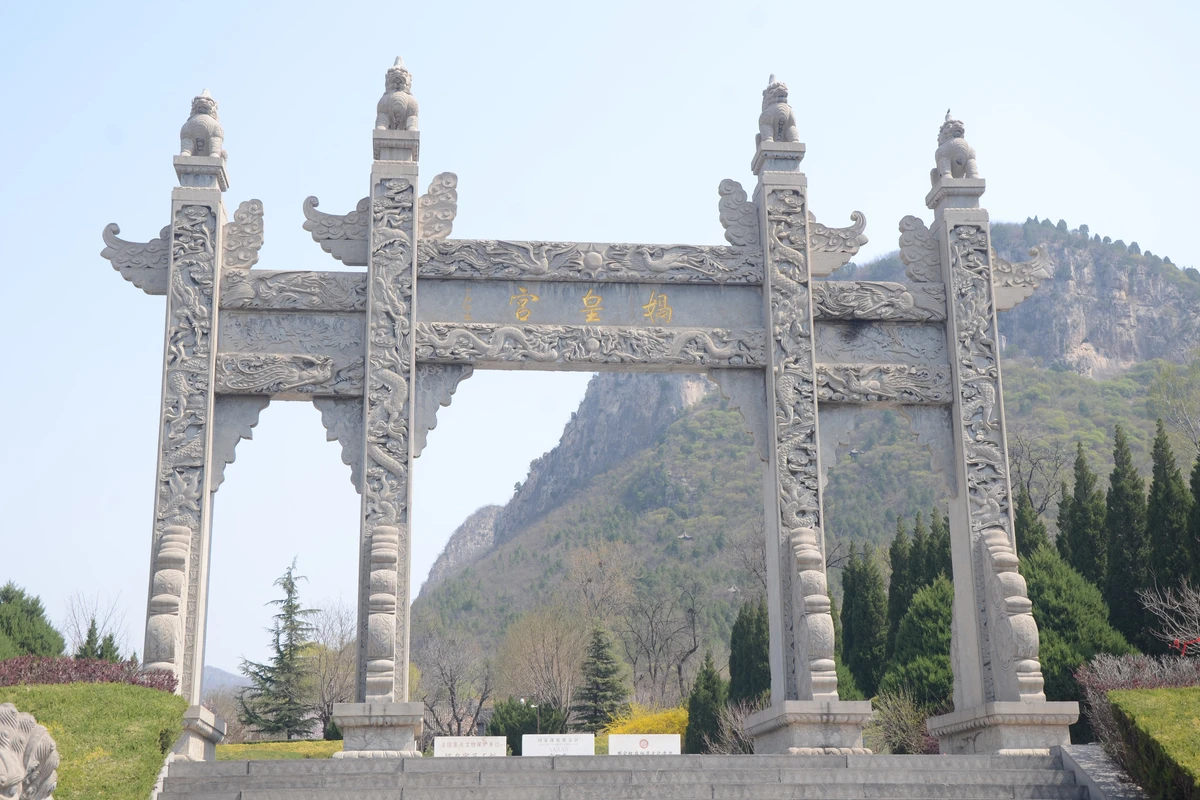
The Palace of Nüwa, situated on Zhonghuang Mountain in She County, Hebei Province, was first built during the Northern Qi dynasty and has a history of over 1,400 years. It is an ancient architectural complex dedicated to Nüwa, the goddess who, according to myth, 'molded clay to create humans and smelted stones to patch the sky.'
More than forty years ago, I worked in She County, only eight kilometers from the Palace of Nüwa, but transportation was inconvenient at that time. Although I knew there was a Palace of Nüwa on Zhonghuang Mountain, I never had the chance to visit.
On March 29, 2023, my wife and I drove to the Palace of Nüwa. The site consists of four groups of buildings: three at the foot of the mountain—Chaoyuan Palace, Tingshen Palace, and Guangsheng Palace—and one on the cliff face, the Nüwa Pavilion. Most of these structures were built during the Ming and Qing dynasties. After parking the car, we entered the scenic area and first arrived at Butian Lake, where Nüwa is said to have molded clay to create humans. By the lakeside, we quietly recalled the myth of Nüwa creating humanity.
Legend has it that in the ancient era after Pangu separated heaven and earth, humans did not yet exist. One day, Nüwa sat despondently by the lake, staring blankly at her reflection. She scooped up a handful of wet mud from the shore, kneaded it into a ball, and shaped it in her own image. When she set it on the ground, it came to life—and this was the first human.
So Nüwa continued to mold more figures. She then broke off a vine, dipped it into the lake, and flicked mud droplets onto the ground, each droplet turning into a person. Over time, these people aged and died. Following the way all creatures passed on life, Nüwa taught humans to pair male and female, establishing the institution of marriage so that humanity could reproduce and survive to this day.
After walking back from the lake, we visited Chaoyuan Palace, Tingshen Palace, and Guangsheng Palace. Chaoyuan Palace is a two-courtyard temple combining Buddhism and Taoism; the Mahayana Hall enshrines Guanyin, Samantabhadra, Manjushri, Ksitigarbha, and other bodhisattvas. Tingshen Palace is an independent courtyard where aristocrats and officials would dismount to rest during visits or worship in old times. Guangsheng Palace is a temple for seeking children, according to myth; the Hall of Offspring houses statues of the Child-Giving God and the Hastening Birth Goddess. We walked into each of these temples to explore.
Then we arrived at Butian Square, where there is a statue of Nüwa and stone inscriptions recounting how she molded clay to create humans and smelted stones to patch the sky. We stood before the statue, paying homage to this creator goddess and mother deity.
Next, we visited the Northern Qi Stone Inscription Exhibition Hall. The exhibits are arranged chronologically across three halls, showcasing carving styles from nine periods: Northern Qi, Sui, Tang, Song, Jin, Yuan, Ming, Qing, and the Republic of China. These stone figures are plump in form, smooth in line, and highly artistic. Despite being over a thousand years old, they still radiate a moving luster and dazzling colors.
After touring these sites, we began climbing to the Nüwa Pavilion. Slowly walking up the winding Eighteen Bends, we reached the gate of the Nüwa Pavilion. There, we found cliff-carved scriptures covering an area of 54.18 square meters with over 41,000 characters. We stood there appreciating this ancient cultural heritage from more than 1,400 years ago. The Northern Qi cliff inscriptions are divided into five sections, totaling 165 square meters and containing over 137,000 characters.
The Nüwa Pavilion is built on a steep mountainside and is the main structure of the entire complex. It has four levels: the first is a worship hall, above which rise three more pavilions—Qingxu Pavilion, Zhaohua Pavilion, and Butian Pavilion. We climbed all the way to Butian Pavilion. The Nüwa Pavilion clings to the cliff, secured by nine iron chains fastened to eight 'hitching posts' on the rock face. When we ascended, the building swayed noticeably due to the number of visitors. The ground floor of the Nüwa Pavilion is a grotto, originally built during the Tianbao era of the Northern Qi dynasty, making it the earliest structure in the complex.
Descending from the Nüwa Pavilion, we saw across from Zhonghuang Mountain a valley called Butian Valley, where Nüwa is said to have smelted stones to patch the sky. Legend says that one day the western sky suddenly collapsed, and water from the Heavenly River poured down through the gap, drowning many people. Nüwa came here, gathered many colorful stones, piled them up, and smelted them with divine fire into molten rock, which she used to seal the sky's breach. To make the sky more stable, she also cut off the four legs of a giant sea turtle to serve as pillars propping up the heavens. From then on, heaven and earth were fixed, and the four seas were at peace.
Every year from the first to the eighteenth day of the third lunar month, people celebrate Nüwa's birthday. Many worshippers from all over China and overseas Chinese come to pay homage, making the festival a grand event and a major attraction.
After finishing our tour of the Palace of Nüwa, we returned to the parking lot, drove to She County Railway Station, and set out to recall memories of the past.