Spring Trip to Dali, Yunnan: Erhai Lake, Cangshan Mountain, and Ancient Towns Full of Spring Charm, Slow Travel Time Intoxicates
Dali: The poetry and distant places in the mouths of literary youth
Some always say: Life is a journey, and travel is a microcosm of life. The people, events, and objects encountered on the journey are but a fleeting glance on the road of life.
Thus, people love to travel, changing destinations again and again to see different people and things and experience different cultures.
Dali, a city that calms the heart and removes restlessness. Stepping onto this city, it feels as if you instantly forget everything...
Many people, after a quick visit, store the bits they saw deep in their hearts, hoping to return to Dali in their dreams.
To many, Dali is Cangshan Mountain embracing Erhai Lake, with intersecting roads linking every piece of land and every village.
In the basin, birds sing and flowers fragrance; vast seas of flowers bloom in a riot of color; the Cangshan Mountain stretches for dozens of kilometers, vast and green; under the azure sky, clouds drift lazily; the gentle sunlight caresses every corner.
The pace of life and urban style of Dali give a strong sense of "seclusion"; it is the home where "wanderers" want to stop.
Dali's lazy, cozy, and slow life is the dream of those tired of the bustling city. I used to not understand why so many people would give up everything in the big city, move their whole families to Dali, and start anew.
Now, perhaps I understand a bit: only after experiencing the noise of the world and the extreme busyness of life can one appreciate the rare tranquility and freely chosen life that Dali offers.
The days here are quiet and plain, unchanged from some unknown time until now. Here, you can hold on to the thin years and persist in your hobbies.
The breeze from Erhai Lake, the rain falling from the top of Cangshan, the birds flying across the sky, the sun that rises and sets, and the flowers that wither and bloom through the seasons all exude the flavor of happiness.
After a spring rain, Dali warms up and flowers bloom. The spring breeze brushes the face, and a riot of color covers the fields. The spring trip to Dali officially begins!
7 days and 6 nights to dream of Dali and start the slow travel time.
Four cableways, two mountains, two roads, one sea, one island, one ancient city, one film studio, one temple, one spring, one West Lake—7 days to see all the mountains and waters of Dali and experience a life different from the ordinary!
Tips: The four cableways are Gantong Cableway, Cangshan Ximatan Grand Cableway, Zhonghe Cableway, and Jizushan Cableway; the two mountains are Cangshan and Binchuan Jizushan; the two roads are Cangshan Jade Belt Cloud Tour Road and Erhai Lake Ring Road; the one sea is Erhai Lake; the one island is Nanzhao Customs Island; the film studio is Tianlongbabu Film Studio; the one ancient town is Xizhou; the one temple is Chongsheng Temple Three Pagodas Cultural Tourist Area; the one spring is Butterfly Spring; the one West Lake is Eryuan West Lake.
Cangshan, a gene bank of flora and fauna, and one of the water sources of Erhai Lake—these aspects are enough to show its lofty status in Dali.
Cangshan is located in the most complex terrain of the Hengduan Mountain Range in China. Its formation is inseparable from plate movements. As we all know, the roof of the world, the Himalayas, was formed by intense collision between the Indian Ocean plate and the Asian continent, causing large-scale orogeny and crustal uplift. Dali's Cangshan is one of them.
After the mountains formed, they blocked a large amount of water vapor. Combined with suitable temperatures, a large number of plants and animals reproduced here. From then on, Cangshan gradually took on its present form.
Towering, steep, rugged, and mysterious—standing at the foot of the mountain and looking up at its majestic body, it feels like it is the guardian deity of this land, where gods dwell.
Cangshan changes endlessly throughout the year: when clouds churn and mist wraps the top, it is mysterious; when the sky is clear and cloudless, its outline is clearly visible; when covered in white snow, it is cold and profound.
A cloud, a pool of water is a legend; a snow, a sea of flowers is an addiction that makes one unable to extricate themselves!
Jizushan is located in Binchuan County, Dali. In Yunnan, each mountain has its own distinctive features, and Jizushan is the mountain with the strongest Buddhist culture in the province.
From the foot to the top, you can see traces of centuries-old temples and rebuilt monasteries on the original sites. The strong Buddhist culture and tranquil environment attract a continuous stream of hikers from weekends to holidays.
Jizushan may seem unremarkable, but it has a hidden world. Temples abound, large groups of wild monkeys roam freely, and the Lengyan Pagoda at the top is a natural landmark for the Hump Route.
The biggest feeling when entering Jizushan is "stillness". Even in crowded temples, you feel that tranquility is the norm here; noise and clamor do not belong.
The ancient trees, ancient temples, and the people who live there year after year, under this atmosphere, have a kind of "lightness and indifference to honor and disgrace."
Once you enter Jizushan, for no reason, your heart can calm down, allowing you to focus on and discover things you never noticed before.
Gantong Cableway is one of the cableways on Cangshan. It is the first cableway from south to north on Cangshan, named after the nearby famous thousand-year-old temple—Gantong Temple.
Gantong Cableway has a one-way length of over 2500 meters, with a small elevation difference, and it goes straight into the hinterland of Cangshan.
The main sights along the Gantong Cableway line are Qingbi Stream, Zhenlong Chess Game, and Cangshan Grand Canyon. The most special is Qingbi Stream.
Qingbi Stream is recognized as the most beautiful among the eighteen streams of Cangshan. The stream's style is very unique, with both a strong side and a gentle side.
The three pools of Qingbi Stream are independent yet connected. The upper pool is the most mysterious, rarely seen in its entirety.
The middle pool is the most eye-catching. During periods of abundant rainfall, water from the upper pool rushes out from the mountains, forming a white ribbon on the cliff, falling into the second pool. The minerals in the pool water, after long sedimentation, give the water a rich blue-green color.
The lower pool has a gentler terrain, located between two mountains, with the largest area. The water is not deep, but crystal clear. In the middle of the pool stands a Guanyin statue. In front of the pool, a row of large stepping stones is placed for tourists to play.
Cangshan Ximatan Grand Cableway is the highest altitude, largest elevation difference, and longest cableway among the three cableways on Cangshan. It is also the only cableway on Cangshan that requires a transfer to reach the Ximatan Scenic Area at the top.
The Ximatan Grand Cableway is also the cableway with the greatest elevation difference in China!
There are three scenic spots along the Ximatan Grand Cableway route: the first is Ximatan Scenic Area, the second is Qilongnü Pool, and the third is Tianlongbabu Film Studio.
The features and highlights of the three scenic spots are different. Ximatan and Qilongnü Pool are mainly natural scenery, while Tianlongbabu Film Studio focuses on cultural customs.
Ximatan is a lake on Cangshan. It is said to be named because the army led by Kublai Khan camped here and washed horses.
The scenery of Ximatan is highly seasonal. In summer and autumn, the water volume is the most abundant. In summer, during the rhododendron season, the surroundings are covered with rhododendrons and other wildflowers. The fir trees are a deep green, and the mist spreads like a fairyland.
In winter and spring, there is not much water vapor in the air. Ximatan loses its misty feeling but gains a sense of coldness and detachment due to the white snow. Without the obstruction of fog, all the scenery of Ximatan is fully visible, and a corner of Erhai Lake is also clearly seen, but the main color of Ximatan turns white.
Qilongnü Pool is seven spring pools in the mountains. Each pool has a different shape and scenery. Streams, pools, and waterfalls appear in combination or alone in Qilongnü Pool.
The scenery of Qilongnü Pool is also highly seasonal, like Ximatan. During the dry season, the water volume of the entire Cangshan decreases, and the water volume of Qilongnü Pool also decreases, affecting the waterfall landscape; waterfalls may disappear or reduce in volume.
As a habitat for flora and fauna, Cangshan not only has lush vegetation but also many animal species. Near Qilongnü Pool, red pandas may appear.
Zhonghe Cableway is the northernmost of the three cableways on Cangshan. It is an open-air cableway. Sitting on it, you can feel the coolness and fresh air of Cangshan.
The attractions near Zhonghe Cableway are slightly inferior to the other two cableways, with only one Zhonghe Temple. However, as the northern terminus of the Jade Belt Cloud Tour Road, the scenery along the hiking section from Qilongnü Pool to Zhonghe Cableway is unique.
Jade Belt Cloud Tour Road is a 11.5 km long, 2-meter-wide blue stone hiking trail on the mid-slope of Cangshan.
Gantong Cableway, Ximatan Grand Cableway (Qilongnü Pool Station), and Zhonghe Cableway all connect to the Jade Belt Cloud Tour Road. No matter which cableway you take, you can reach it. The only difference is that the hiking distances and scenery vary depending on the combination of two cableways.
Taking Gantong Cableway takes you to the starting point of the Jade Belt Cloud Tour Road. From the starting point to Qilongnü Pool Station is the first half of the road, and from Qilongnü Pool to Zhonghe Cableway is the second half.
The first half mainly features mountain scenery and water appreciation. During the rainy season, you will see the mountains and peaks shrouded in mist, while pure white streams wind through the green forest in the valleys.
The second half mainly features strange rocks and the Erhai Basin landscape, with a broader viewpoint. Along the way, bizarre rocks stand in various shapes, as if you have wandered into the Third Pole of the Earth.
The strange rocks look as if they have been chiseled by someone, with a variety of shapes that are truly astonishing!
Dali has many famous tourist roads, such as Dali-Lijiang Line, Xijing Line, etc. These roads connect the beauty of Dali. The Dali-Lijiang Line features picturesque pastoral scenery and seas of flowers in all seasons. Among these tourist roads, the most famous, popular, and scenic is the Ring Road.
The Ring Road is divided into West Ring Road and East Ring Road. The West Ring Road is close to Xizhou Ancient Town, Dali Ancient City, Longkan Pier, and fishing villages by Erhai Lake.
The East Ring Road starts from Haidong Town, passing through Luoquan Peninsula, Xiaoputuo, Shuanglang, and Nanzhao Customs Island.
Besides scenic spots, the Ring Road is also a popular route for young people to take photos and self-drive tours. The gentle wind ruffles the lake, sunlight spills generously, and leisurely people drive or ride bicycles, stopping and going.
Erhai Lake, a pearl on the plateau, a unique dreamlike wonderland formed by absorbing the essence of heaven and earth.
Erhai Lake stretches a hundred miles from north to south and spans dozens of miles from east to west. Relying on this lake, the civilization of Dali has multiplied and passed down, and the people of Dali live and work in peace.
A long time ago, it seems that humans and the lake signed a contract: generation after generation of Dali people protect it, and it gives the Dali people the survival resources they most need.
Today, besides survival resources, the lake provides the Dali people with inexhaustible beautiful scenery, allowing everyone to roam in this fairyland.
Erhai Lake cruise ships are tools for roaming the fairyland. A cruise ship crosses from north to south, allowing passengers to travel in the fairyland, gaze at Cangshan from afar, view Erhai up close, and watch migratory birds flying low and circling over the water.
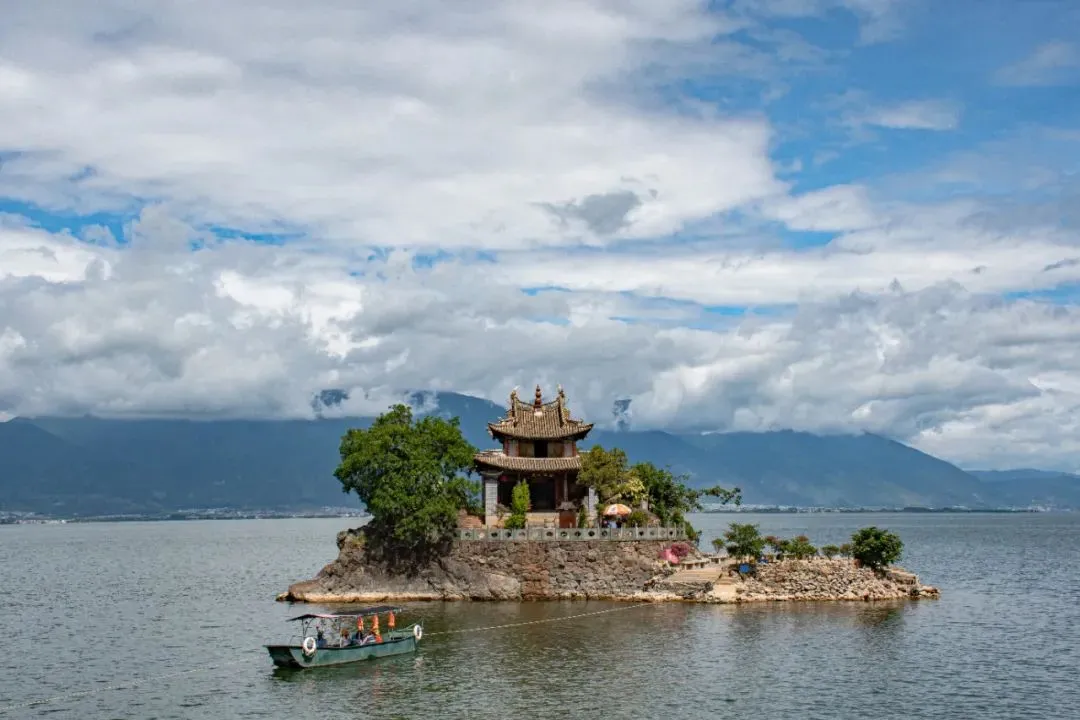
Nanzhao Customs Island is located in the golden area where the sky and sea merge in Dali. It is the only island in Erhai Lake that is not connected to the shore.
It is said that Nanzhao Customs Island was once the summer palace of the Nanzhao Kingdom.
Nanzhao Customs Island is the most representative island of Shuanglang. The rippling Erhai Lake and the towering nineteen peaks of Cangshan all serve as its backdrop.
Natural wonders such as sunset, sunrise, rain, mist, and clouds often appear, highlighting the exquisiteness and transcendence of Nanzhao Customs Island.
Away from the shore, time on Nanzhao Customs Island slows down and becomes quiet, forming a sharp contrast with the lively Shuanglang town on the shore.
Ancient towns are the history of a city and living folklore museums!
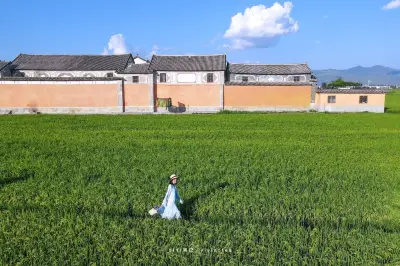
Xizhou, one of the many ancient towns in Dali, is the closest to Dali Ancient City. It gathers Bai architecture from the Ming, Qing, and Republic of China periods.
From afar, the white walls and black tiles look like an ancient and elegant city. The unique shapes and almost perfect structures give a sense of elegance without losing freedom, solemn and majestic without losing lightness and agility.
Entering the ancient town, the ink-painting-colored Bai folk houses, the leisurely locals walking in the alleys, and the tie-dye cloth fluttering in the wind all give the feeling that "time has frozen here!"
Tianlongbabu Film Studio exists because of the classic 2003 TV series "Demi-Gods and Semi-Devils" (Tianlong Babu). It also made more people know that there is a "martial arts world" at the foot of Cangshan.
Tianlongbabu Film Studio has clear boundaries with the surrounding buildings, with a distinctive style. Several city walls and two gates enclose this place into a unique area.
The layout of Tianlongbabu Film Studio is not complicated. It centers on the Dali Imperial Palace complex, with Dali Street and Daliao Street connecting all important buildings.
Entering through the main gate is Dali Street, which is also the main road to the Dali Imperial Palace. On both sides of the main road are imitation ancient buildings, mostly used as merchandise display areas, folk culture exhibition areas, and leisure areas.
At the end of the street is the entrance to the palace. Three circular arched gates with strong ethnic minority characteristics are the main gate of the palace. Climbing up the steps, you reach the palace. The buildings are tall and upright, with pavilions and corridors showing an ancient charm, exuding a magnificent aura different from ordinary structures.
On Daliao Street, various shops are lined up one after another. Every day, exciting performances take place here, with people coming and going, truly recreating the lively street scene of Dali a hundred years ago.
The entire Tianlongbabu Film Studio has everything for eating, playing, shopping, and watching, as if it is a miniature landscape of the Dali Kingdom period.
Chongsheng Temple Three Pagodas Cultural Tourist Area is the only AAAAA-level scenic spot in Dali. The landmark buildings in the area—the three brick pagodas—are also among the few thousand-year-old cultural relics in Dali.
Chongsheng Temple Three Pagodas Cultural Tourist Area is no longer just a simple tourist attraction; it is a fusion of Dali culture.
Cultures from the Nanzhao period to the Dali Kingdom period converge here. Painting, architecture, and folk customs are all displayed in the Chongsheng Temple Three Pagodas Cultural Tourist Area.
From its initial construction to destruction and then reconstruction, the Three Pagodas of Chongsheng Temple have a history of over a thousand years. The ups and downs of Dali's development are reflected in them. Therefore, it is no exaggeration to say that the Three Pagodas of Chongsheng Temple are the spiritual treasure house of the Dali people.
The Chongsheng Temple Three Pagodas Cultural Tourist Area covers a very wide area. The front part is the Three Pagodas area, mainly consisting of the three pagodas and some natural landscapes, relatively open. The back part is Chongsheng Temple, with dense buildings and relatively narrow space, but the buildings are arranged in a staggered manner, not crowded.
The origin and construction of each pagoda, pool, temple, and hall in the Chongsheng Temple Three Pagodas have their own allusions. Listening to the guide's explanation, you will feel as if you are in the "Dali Culture Expo Park."
The thousand-year-old, hundred-year-old Butterfly Spring is the love holy land of Dali. The clear spring in Butterfly Spring Park has never dried up since its discovery. The century-old acacia tree by the spring is still lush and green.
A hundred years ago, Butterfly Spring was only the Butterfly Spring of the Dali people; its stories were only told locally. But in the past 60 years, with the popularity of the film "Five Golden Flowers," which tells the story of the Bai ethnic festival "March Fair," Butterfly Spring has become the Butterfly Spring of the whole nation.
After a hundred years, the image represented by Butterfly Spring has never changed, still symbolizing sincere feelings.
Today, around Butterfly Spring, ancient trees have grown tall, streams flow everywhere, and a butterfly breeding museum—Butterfly World, the largest butterfly museum in the country—has been built. Only Butterfly Spring and Lovers' Lake remain unchanged.
Now, Butterfly Spring has an added sense of ease and leisure. No matter when you go to Butterfly Spring, the spring water is clear and bright. In Lovers' Lake, groups of carp swim slowly, and white geese play on the water.
Eryuan West Lake is one of the many plateau lakes in Dali.
If it is your first time stepping into Eryuan West Lake, you would never imagine that there is such a large lake wetland in the flat basin.
Eryuan West Lake is hidden and mysterious, beautiful and quiet, truly a pearl of the plateau.
Eryuan West Lake is smaller than Erhai Lake, with a maximum depth of only 3.3 meters. There are reed beds and Bai folk houses in the water, but being small has its advantages.
The environment here is excellent, with a tranquility that Erhai Lake cannot match. There is almost no sound except for the melodious Bai folk songs. Looking around, there are no tall buildings, only deep distant mountains.
The tour of Eryuan West Lake uses the most traditional method of human-powered wooden boat rowing. A slender wooden boat sails on the lake, allowing you to see gently swaying water plants, wild lake ducks and water birds foraging in the reed marshes.
With the simplest means of transportation—a boat, an oar, and two people rowing on the lake—you can experience the charm of Eryuan West Lake to the fullest. Most people even feel reluctant to leave when the tour ends.
Over the past 7 days and 6 nights, we climbed the mountains of Dali, saw the waters of Dali, admired the flowers of Dali, visited the ancient towns of Dali, waited for the sunset of Dali, and strolled through the ancient temples of Dali.
In the end, you will find that the beauty of Dali's scenery lies in its spotlessness and uniqueness; the beauty of Dali's culture lies in its long history and inclusiveness; the beauty of Dali's life lies in its detachment from the world and transcendence.
[Editor] Yunnan Read, Yijing
[Note] Please indicate the source for reprinting. If there is any infringement, please contact for deletion.