Heading North – Departing from Beijing in July 2012 to Hailar (Hulunbuir Grassland)
One day, my mother told me that my father had mentioned wanting to see the grasslands. This year is my father's 60th birthday, and it also coincides with Dabao's graduation from kindergarten and his upcoming entry into primary school. With such a memorable occasion and this wish, we naturally had to fulfill it. Since we were going, we might as well see China's largest and finest grassland! After doing some research, I realized that the most beautiful grassland is actually over 1,700 kilometers away from us. More importantly, transportation is not as convenient as going to the coast or Jiangsu/Zhejiang. Departing from Beijing, one-way flight tickets for four people would cost about 5,000 RMB. Even more troublesome is that we would have to take bumpy small planes. Later, we decided to take the train there and fly back. Then we added Harbin as a destination, so we ended up taking the train the entire way. Here, the first person I must thank is 12306. Although the Ministry of Railways received a lot of criticism when they launched this website, I have to say it has brought great convenience to our lives. For this trip, except for the soft sleeper outbound which we couldn't get and had to settle for hard sleeper (it wasn't departing from Beijing, and I only saw one soft sleeper ticket released), the other two legs were smoothly booked as soft sleepers from Beijing, and all tickets were collected before departure. Everything was ready except for the east wind. Additionally, because the local scenery is beautiful, taking a shuttle bus would certainly not satisfy the elderly and child when they want to get off anytime they feel uncomfortable. So like most travelers, we chose to charter a car. Fortunately, on the night before departure, I found the contact information of Sister Sun, a Hailar driver, in a travel blog by a random netizen. Luckily, her schedule worked out. Fate is a wonderful thing. Our group of four, including two elderly and one child, all suffer from motion sickness. Family members who couldn't come were very worried. But during the four days Sister Sun drove, everyone was full of energy. This is partly due to my itinerary arrangement, and partly due to Sister Sun's driving skills and her considerate service. No wonder everyone says she is great with elderly and children! So on my last day of work, I pushed all the troubles onto Z and my boss and bravely left. Hailar, here we come. The Hulunbuir Grassland is calling us! Let all those projects and equipment go to hell for now!
From Beijing to Hailar, thirty hours on the sleeper train.
This is probably the longest train ride we have ever taken. Fortunately, the people we met, both young and old, were very friendly. They tolerated Dabao climbing up and down and even enthusiastically taught him to look at the scenery outside the window. As the train got closer to Hailar, the weather became gloomier. Although we knew it had rained the day before, seeing this weather made us a bit depressed. Fortunately, the train arrived at Hailar station at 12:41 PM. As soon as we exited, we saw Sister Sun holding a sign with our names. I didn't expect Sister Sun to be in her fifties. Her voice sounded like she was around forty. Sister Sun appeared to be a very efficient person. Seeing that we had been on the train for so long, she immediately arranged for us to have lunch. While we were eating, she even went out to buy cheese for Dabao. After lunch, we went to see the Winding River.
The so-called "Number One Winding River Under Heaven" is the Morgole River. It winds briefly across three hundred kilometers of grassland, but its channel stretches over 1,500 kilometers. The Morgole River (meaning "bumping river" in Mongolian) flows along, constantly bumping and turning, pouring its lingering poetic sentiment onto the grassland. The ninety-nine bends of the Yellow River stretch over more than 5,000 kilometers of land, while the countless bends of the Morgole River are concentrated within three hundred li. The title "Number One Winding River Under Heaven" is well deserved!
The Morgole River originates from the Hada Ridge in the central Greater Khingan Range, passes through the Hulunbuir grassland, flows past the shore of Hulun Nur Lake, and finally merges into the Hailar River. Legend has it that Morgole was the name of a girl. Long ago, this area was a water-deficient grassland where grass didn't thrive and livestock didn't prosper. That year there was a severe drought. Morgole was extremely anxious and vowed to find a sacred spring in the Khingan Mountains and bring it back to relieve her hometown's suffering. But after enduring great hardships and traversing the mountains and ridges of the Khingan, she could not find the sacred spring. Finally, exhausted and hopeless, she collapsed on a hillside. The next spring, when the snow and ice melted, a clear mountain spring gushed out from the spot where the girl fell, gathering snowmelt and springs along the way, flowing straight towards her hometown. The people in her hometown did not see the girl return, but they saw the winding mountain spring flowing in. They believed it was the girl's transformation, so they called it the Morgole River.
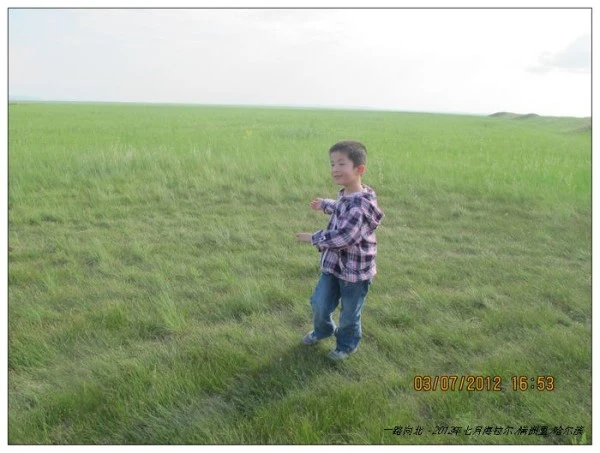
At the Winding River, we met a group of aunties and uncles from Northeast China. They came well-prepared: a Jeep and a minibus. Inside the minibus, there was even a table for playing mahjong. Seeing us taking photos, one auntie warmly handed us a flag to pose with, making Grandpa and Grandma laugh from ear to ear. Amidst the beautiful scenery, Dabao actually fell asleep. Grandpa had to wake him up for this photo. Hey, isn't this the scene from that CCTV segment? You're right! We continued to Ergun. Tonight we rest here. Tomorrow we'll go see the Genhe Wetland. We stayed at a hotel recommended by Sister Sun. It was new, clean, and reasonably priced. They also had a dog that loved running after Dabao. Dabao was thrilled, shouting "PUPPY"!
Let me interject a bit of Ergun introduction to educate Dabao.
Ergun, a witness to history
Visitors to Hulunbuir all want to learn about its history, and the most authoritative witness to Hulunbuir's history is the land of Ergun. Starting from Hailar, driving 100 kilometers north brings you into Ergun City. On this land flows the Ergun River, which holds special significance for the Mongol nation. The Mongol people were born, developed, and gradually grew strong along this river. The upper reaches of the Ergun River, the Hailar River, enter the Hulunbuir Plateau from Yakeshi and flows to near the Abagaitu Mountains, where it is called the Ergun River. After flowing to Luogu River, it becomes the Heilongjiang River. Excluding its source, the Hailar River, the Ergun River is 900 kilometers long with a drainage area of 61,700 square kilometers.
"Ergun" means "to present" or "to offer" in Mongolian. Later, it was embellished to mean "dedication," which is quite fitting. The Ergun River, as a cradle and mother, not only nurtured the Mongol nation but also nourished the land on both banks. Ergun City has dense forests, fertile farmland, and excellent pastures, making it a blessed land throughout history. As early as the Sui and Tang dynasties, Shiwei was the campsite of some tribes in Hulunbuir. The Tang Dynasty set up the Shiwei Governor's Office to govern. After Genghis Khan unified the Mongolian grassland, he implemented the "household enfiefment system." The Ergun River, Genhe River basin, and Hulun Lake were the fiefdom of Genghis Khan's second brother, Khasar. The fortress on Black Mountain was their main residence. In 1727 (the fifth year of Yongzheng), the Qing government set up outposts along the Ergun River to manage border affairs and internal affairs until the Republic of China. In 1920, Shiwei County and Qiqian Administrative Bureau were established; in 1921, Qiqian Administrative Bureau became Qiqian County. In 1933, the puppet Manchukuo changed Shiwei County and Qiqian County to Ergun Left Banner and Ergun Right Banner. In 1948, they merged into Ergun Banner, with the government in Sanhe Town. In January 1966, with State Council approval, Ergun Banner was abolished and divided into Left and Right Banners, and Sanhe, Shangkuli, and Labudalin (which had been transferred to Chen Banner in 1961) were returned to Ergun Right Banner. In 1975, the banner government moved to Labudalin.
For dinner, we tried the local hand-grabbed lamb. Before the meal, Dabao finally got to taste the Hailar popsicle. It was indeed delicious, rich with milk flavor. We chose the restaurant "Mongolian Fate" on Yunshan Road, recommended by netizens. 38 yuan per jin. Our group of four adults and one child couldn't even finish a little over two jin of meat—not much of an appetite. Later, when we checked other menus, this place was indeed the most affordable. It's worth mentioning that the lamb was less gamey than what we get in Beijing; it even had a pleasantly sweet taste. Paired with milk tea, it's a must-try for all tourists visiting the grassland.
A quiet night. Waiting for tomorrow to go to Genhe Wetland.
Only after arriving in Inner Mongolia did we realize that sunrise here is as early as around 3 AM. And sunset is as late as 9 PM! Grandma was deeply moved. When she was in school, she learned that Mongolian people had to get up at 3 AM to milk cows. She felt sympathetic. But after coming here, she found that the sun rises so early, and in winter, people can't work outdoors for months. Nature is indeed fair. According to Sister Sun, if we got up early, we could skip the 50 yuan entrance fee for the wetland. So we set out at 7 AM. But someone else came even earlier, waving a batch of tickets for people to buy. Since the previous group didn't pay, we also paid 50 and went in. Future travelers who want to sneak in will need to get up even earlier.
Genhe Wetland is the "No. 1 Wetland in Asia," the largest and most pristine wetland still in its original state in China. Genhe Wetland Reserve covers 126,000 hectares, located at the confluence of the Genhe, Ergun, Deerbugan, and Hawu'er rivers, forming a large floodplain and a delta. It includes the Genhe, Deerbugan, and Hawu'er rivers with their floodplains, willow thickets, saline-alkali meadows, ponds, and tributaries. It is the most intact and largest wetland in China, known as the "No. 1 Wetland in Asia."
It was a place worth visiting, not in vain for our arduous climb. It started raining as we went downhill. The electric car drivers were really overcharging: round trip 15 yuan, one-way also 15. Seeing the pouring rain, would you get on or not? Back in Ergun city, we found a random breakfast shop. We had congee. Dabao continued with milk tea and kept this habit throughout the trip. After breakfast, we set off in the heavy rain towards our second stop of the day—Birch Forest Scenic Area. Here, Dabao continued to adapt to local customs by having a cup of birch sap. This is a free attraction, great for photos. The only cost was a 5 yuan parking fee. But if you, like Dabao, also eat, drink, and buy a small yurt, that's another story. Leaving Birch Forest, we headed straight for the highlight of our trip—Enhe. So for the half day we spent in Enhe, I'll start a new chapter to write about this small place that deeply moved us.
It is said that the two things one should do when young are: have a carefree romance—love for love's sake, regardless of money or status; and take a spontaneous trip—pack your bags and let promotions and raises go to hell. For the former, I'm impatient with wasting time; if it's not right, I'd rather not start. For the latter, when I was young, I wanted to save money to improve the family's conditions and ease my parents' burden. After marriage and having a child, we suddenly went from a two-person world to a three-person world, and every trip was surrounded by a large group. There is no regret. Choosing to go to Enhe, the only Russian ethnic township in China, was because its name happens to be the same as Grandpa's given name. On the eve of Grandpa's birthday, visiting a place with the same name as his was certainly meaningful.
Before the trip, I read about Enhe Township and found that it had won the title of "Top 10 Charming Towns in China" in 2005. Currently, there are over 300 households with a population of over 2,000, of which about 48% are of Russian descent, a ratio 2-3 times higher than the neighboring Shiwei Town. Currently, over 1,700 ethnic Russians, known as descendants of Chinese and Russian intermarriage, live here. It has a mysterious exotic atmosphere and is the place with the strongest Russian ethnic flavor and the most concentrated settlement. According to historical records, after the October Revolution in Russia, many White Russian aristocrats fled across Siberia to the banks of the Ergun River, and some crossed into Ergun City to settle. At that time, the provinces of Hebei and Shandong suffered from successive floods and droughts, and a considerable number of young and middle-aged farmers "fled to the Northeast" and came to the Ergun region. Most of them were small traders or gold panners, exchanging cigarettes, alcohol, sugar, tea, and other small goods for wheat, cattle, horses, sheep, and sand. Many of these "Northeast fiedlers" married Russian girls and started families.
In terms of diet, the Chinese-Russian descendants maintain traditional eating habits, with the main food being "big lieba." "Lieba" is the Russian transliteration of bread. "Big lieba" is very large, the smallest being half the size of a basketball, with a very hard crust. These descendants inherited the Chinese ingenuity. They skillfully incorporate various ingredients into Russian dishes, creating many delicacies. For example, when blueberries, strawberries, wild grapes, and other wild fruits ripen, people make them into various jams. When fish is fat, they make fish roe paste and cold sour fish. Here you can also taste fresh milk, simidan (a kind of cream), cream, cheese, and other dairy products. No matter what ingredients, they become delicious dishes here.
Leaving Birch Forest, we noticed that the landscape was significantly different from the grassland. Sister Sun said this area already belongs to the Greater Khingan Range. Grandpa and Grandma spent their whole lives in the forestry system and were very interested in the roadside trees. It had just cleared up after the rain, and the peony flowers along the road were blooming, making us get out for a stroll. This flower is called golden lotus. Sister Sun said it's effective for treating pharyngitis. Many southerners living in the north have throat problems, so we also picked a bag. Later, we dried it on the front seat of the car and eventually brought it back to Beijing. In Enhe, we saw this for sale; a bag our size would cost 15 yuan. So we not only toured but also made some money. Hehe.
Let me interject some info about golden lotus.
Flower name: Golden Lotus (Trollius chinensis)
Latin name: Trollius chinensis
English name: globeflower, globe flower
Family: Ranunculaceae
Part used: flower
Origin: Inner Mongolia, Hebei, Shanxi, etc.
Golden lotus has a long history in China. Every summer, on the Hulunbuir grassland and in the primeval forests of the Greater Khingan Range along the China-Russia border, golden yellow golden lotuses shine like summer stars in the grassland and forest. Because golden lotus grows at high altitudes in China, its flowers and leaves are small, but its ornamental and medicinal value is no less than that of Europe.
Effects: Golden lotus is rich in alkaloids and flavonoids. Based on imperial formulas, scientifically processed golden lotus tea has anti-inflammatory, thirst-quenching, throat-soothing, detoxifying, and beauty-enhancing effects. It prevents and treats chronic pharyngitis, throat inflammation, and tonsillitis. It also has a certain effect on elderly constipation. Regular consumption can expand lung capacity, enhance oxygen uptake, and fight fatigue. The vitamins, carotene, and other trace elements in golden lotus can supplement cell nutrition, promoting blood circulation and beauty as well as refreshing the mind.
"Shan Hai Cao Han": Treats boils and various wind diseases.
"Gang Mu Shi Yi": Treats mouth sores, throat swelling, gum inflammation, ear pain, eye pain, improves vision, and dispels miasma.
"Hebei Zhong Yao Shou Ce": Clears heat and detoxifies.
Brewing method: One teaspoon of golden lotus petals, steep in a cup of boiling water for about ten minutes; can add brown sugar or honey to taste.
Suitable people: Generally suitable; especially good for those with coughs.
Golden lotus is known as "Saiwai Longjing." After brewing, the tea is clear and bright with a faint fragrance. However, since golden lotus belongs to the Ranunculaceae family, it has some toxicity.
From the perspective of traditional Chinese medicine, golden lotus is bitter and cold in nature, with heat-clearing and detoxifying effects. When consuming it, one should be cautious and not drink too much; even medicine has side effects.
Especially for those with spleen and stomach deficiency-cold (e.g., feeling stomach discomfort after eating cold food, poor digestion), they should be very careful and avoid drinking it.
But it does have the effects of clearing heat, detoxifying, nourishing the liver, improving eyesight, and refreshing the mind. It is suitable for people with excess heat syndrome in TCM—those who easily get feverish and have sore throats. Drinking golden lotus tea is helpful for respiratory inflammations like stomatitis, pharyngitis, and tonsillitis.
Precautions: Do not drink excessively over a long period; long-term use may harm the kidneys. Pregnant women should avoid. Store in a cool, dry place out of children's reach.
Tea saying: Golden lotus symbolizes lonely beauty.
We drove on and saw passengers getting off the bus at the intersection. Then, Enhe finally appeared before us.
Sister Sun, familiar with the place, took us to the well-known Aunt Sun Jinhua's house. We had called over a week earlier to book, so we were the first guests to arrive that day. Look at her small yard. Every household has such a flower stand.
We stayed in a wooden house (Mukele house). One house had two beds, costing 80 yuan per room. In the evening, we took a mud sauna, 10 yuan per person. A standard double room with two beds was 220 yuan per night. Aunt Sun Jinhua's eldest daughter said that since no one eats lunch at their place, we could eat at another restaurant, or we could eat with their family. Since we had dinner and breakfast booked here, we thought we'd go out for lunch. Leaving Sun Jinhua's house and turning left, we passed the post office and saw the bread shop. We went in just as the bread was coming out of the oven, so I bought two of each kind. Perhaps netizens' praise was too high, or we just love pastries, but it was lower than expected. Except for a soft pancake-like waffle that was good, everything else was mediocre. Sweet ones were better than savory. The price was about over 20 yuan per jin, okay. But the round, grid-patterned waffle-like ones are worth trying. Good! Carrying our bread, we walked to the small bridge. It was fun there. A large tour group stopped briefly, and a group of beauties were posing on it.
After a stroll, we had lunch at a small restaurant that Sister Sun knew. After lunch, it started to rain, so we went back to Sun Jinhua's to rest. Look at our wooden house. Dabao chose Room No. 1.
We hadn't been lying down for thirty minutes when the sky suddenly cleared. The weather on the grassland is so capricious. Don't be scared by the weather forecast when you travel here. Even if it predicts rain, even heavy rain, there will be sunny periods during the day. It always comes in waves. In the Sun family's small yard, Grandma and everyone were selecting fresh daylily buds for dinner. They were freshly picked from the mountains. The thing that attracted Dabao the most was the swing in the yard. The Sun family's little grandson called it "playing u-u." See how happy Dabao was! When it cleared up, we went out for a walk. Looking left from Sun Jinhua's house, you see a small white hut selling blueberry ice cream. The cone one for 3 yuan has no blueberry sauce, so we bought the cup one for 6 yuan. It was really delicious! The blueberry sauce was not too sweet, and the ice cream itself was rich in milk. Then Dabao happily went horseback riding. He changed horses twice and rode for two hours until sunset, around 9 PM, before reluctantly leaving. He even wanted to ride again in the morning. It was 50 yuan per hour at that time; during peak season, it's 60.
In the evening, we took a mud sauna. It's a tin barrel in the corner of the room, burning a big fire with a pot of water on top. Then we mix with cold water to wash. The water drains directly through the floor drain. It was a very interesting experience. The night was very peaceful, so Dabao quickly fell asleep on his own little bed. Tomorrow we leave here for Black Mountain.
The time spent in Enhe was the most leisurely.
Sometimes I think, why do we work hard to earn money? To leave it for the children?
The morning we left Enhe Township, Grandpa and Grandma got up at around 3 AM to watch the sunrise. Unfortunately, it was foggy, so they didn't see it. Everyone else was fast asleep. We left Sun Jinhua's house at 8 AM. Although we only stayed one night, this family was very warm. Sun Jinhua even invited Dabao to come back after he gets married. Everyone laughed heartily, which eased the parting mood. Our car headed to today's second destination. Because it had rained in previous days, we gave up going through Qika and returned directly to Ergun, then to Black Mountain. Since we specifically asked for a pot of freshly squeezed milk for breakfast, Grandma told Dabao it was the purest milk and would help him grow tall. The kid got excited and drank too much, nearly getting dizzy in the car. Luckily, we soon arrived at Birch Forest. He had another cup of birch sap and quickly perked up again. I heard that birch sap is collected in May from trees over 50 years old, frozen in freezers, and once it's gone, it's gone. Unfortunately, 10 yuan for a small cup is too expensive. At Black Mountain Town, we asked Sister Sun to recommend a hotel. This place, which looked like a small inn along a highway in an inland city, was called Old Six Restaurant or something. I don't remember clearly. On the left was their restaurant. There was a door on the right. The owner opened it, and we saw the standard rooms, very new and clean, 140 yuan per night. Pretty good. More importantly, they had a computer. But the owner said that during milking time, the voltage drops and the computer won't turn on. Sure enough, I saw something new on Taobao from the store I often buy from, but I couldn't grab it—very frustrating. As usual, we had lunch there and rested. We went out again around 3-4 PM to head directly to the Black Mountain Ancient City. The price of vegetable and mushroom dishes here rivaled meat. But no choice—we couldn't do without vegetables every meal. Not cost-effective but we had to eat.
Let me interject some info about Black Mountain.
Black Mountain Ancient City
The city gets its name from its location near Black Mountain in Ergun City. It is about 10 kilometers northwest of Black Mountain. The city has an inner and outer city, both with earth walls. The outer city is square, with a perimeter of 2.35 kilometers and an area of 346,290 square meters. The remaining walls are 1-2 meters high, with the highest over 4 meters; the top width is 2 meters, base width 6 meters. Outside the walls is a moat, 5-9 meters wide at the bottom, 1-2 meters deep. There are gates on all four sides, 9-12 meters wide. Outside the gates are barbicans. About every 100 meters along the wall are watchtowers, and at the corners are large corner towers projecting beyond the walls. The inner city is located in the middle-west-north part of the outer city, rectangular, with a perimeter of 560 meters and an area of 18,871 square meters. There are two small gates, east and west, and a moat outside. The entire building is arranged in a "干" shape. Inside, granite column bases are regularly arranged with 4-meter spacing. Glazed tiles, green bricks, dragon-patterned eaves tiles, and green-glazed basin fragments are everywhere. In the northwest part of the outer city, there is a square-inside-round-outside structure. The outer wall top width is 2 meters, with a 5-meter-wide south gate. In the northeast corner of the outer city is a small city with a well, now collapsed; inside the north wall of the outer city is a series of small dwelling remains. This ancient city is a Liao Dynasty site. According to "Annotations on the Genealogy of the Yuan Emperors" and Rashid al-Din's "Jami' al-tawarikh" and expert research, during the Mongol Empire, the Ergun River basin was the fiefdom of Genghis Khan's eldest brother, Jochi Khasar. The Black Mountain port faces Russia across the border. The port's annual cargo throughput is 1.5 million tons and is a national first-class port. Taking a cruise on the border river, you can see the different styles on both sides.
It was a desolate scenic spot. On the road, we only saw our car speeding on the only road. We crossed an iron bridge, passed a herder settlement, and then saw an area with lush grass, fenced off. That was the city wall site. Nobody was there. We stopped the car, pushed open the iron gate, and drove down. We saw a monument for the site.
Khasar (1164–1226), the second son of Yesugei Bagatur and younger brother of Genghis Khan. In "The Secret History of the Mongols," Khasar is called Jochi Khasar. "Jochi" is his name; "Khasar" (or "Has'er") is a Sanskrit word meaning lion's mane or lion. "Habutu" is an ancient Khitan word meaning archer. Jochi Khasar was a skilled archer from childhood, with superb archery, so he was called Habutu Khasar. He followed Genghis Khan from a young age and made immortal contributions to the prosperity of the Mongol nation and the establishment of the Mongol Empire. He was an outstanding military commander in Mongol history. In 1189, to strengthen the Great Khan's power and defend against external attacks, Temujin established a "keshig" (guard) army. Khasar was appointed as its commander, responsible for guarding the Great Khan's camp. He became Genghis Khan's sword-bearer, fierce attendant, and capable assistant. This army's title was "Khorchin," which later became the name of Khasar's descendants' tribe. In 1206, after Genghis Khan established the Great Mongol State, he organized the subjects into thousands and granted them to his family members. Khasar received 4,000 households and the area around Hulun Lake and the Ergun River and Hailar River basins as his fiefdom. Today, the ten banners such as Khorchin, Alxa Khorchin, Jalaid, Dorbet, Gorlos, and parts of the former Ulanqab League like Siziwang, Mao Ming'an, Urad, and Qinghai Koshut are descendants of Khasar, comprising about two-thirds of the Mongol population. Standing on this grassland, you can imagine the prosperity of this land back then. But now, under the sun, this scenic spot with no one else but us was a first in our many years of travel. Travelers like us probably only come here briefly; look at this patch of grass, only a few meters around has been trampled flat. Accustomed to bustling crowds, suddenly being in such a scenic spot, under such a blue sky, accompanied by this wild grass, if not for the swarms of mosquitoes, we would have been willing to walk further into the depths of the grassland to see if this ancient city really had walls and moats as described. In the evening, we ate smoked lamb leg at Ziyu Restaurant recommended by netizens. 48 yuan per jin. It had a tea fragrance, said to be the owner's original creation. Our group doesn't eat much meat, so we just went to the recommended places, no comparison. Not bad! After dinner, we returned to the hotel. True to form, the power went out within a few minutes. I finally had to use my phone to go online. Grandpa and Grandma planned to walk on the grassland, but were driven back by mosquitoes soon after. The sunset at Black Mountain did not disappoint us. Reminder: power outages are frequent here. So the first thing when you get back to the room is to take a quick shower. Those of us who returned late were lamenting, since due to the power outage, we couldn't shower. If you don't need a shower, why stay in a standard room? This was our last night on the grassland, so we slept early. Unfortunately, the quilt felt a bit damp and never got warm. Eventually, Dabao and I slept on the same bed. Sunrise at Black Mountain. Getting up at 4 AM was already late. If we had gotten up at around 3 AM, we would have seen the egg-yolk sun. After so many years, I woke up this early to see the sunrise for the first time, but still too late. Some things are just meant to be encountered by chance; let it be!
Today's itinerary: from Black Mountain to Manzhouli. Then at 6 PM, we take the train from Manzhouli to Harbin. This is the last day of our grassland trip. Compared to others' 5-6 day itineraries, our 3.5-day trip seems a bit short. But Sister Sun said this is the essence of the northern grassland route. Since we grew up in forest areas, we are not particularly interested in forest parks. The grassland we saw from Black Mountain to Manzhouli should be the best grassland. Riding in the car, it felt like the car was driving along the only road on the grassland, heading straight into the clouds. And we could forget and abandon all worldly cares. Just like that, without purpose, accompanied by blue sky, white clouds, and endless green grass, moving forward, forward. Let us run on the grassland one last time, capture this time and beautiful scenery in our lenses!
Around 11 AM, we finally arrived at the Manzhouli Guomen Scenic Area. This was the most expensive attraction on this trip: 80 yuan per person for entrance. China's national gate, said to be the fifth one now. Compared to China's, Russia's national gate looks very ordinary, reportedly always like this, unchanged. Dabao finally saw a Russian steam locomotive loaded with logs entering China's gate. Compared to the entrance fee, the Russian ice cream was also pricey. Dabao tried three kinds, costing 60 yuan. After the Guomen, we went directly to the Matryoshka Square. Unfortunately, the camera battery died. We forgot to bring the plug adapter. Thank goodness we made it to Manzhouli. The matryoshka dolls at the square had high initial prices; the final price was about one-third. There was a set of six, originally 260 yuan. Grandma actually bargained to 200 yuan, which was ridiculous. We didn't take it, and the seller chased us out asking if 100 yuan was okay. That kind of selling approach is really scary. Lunch was at the recommended Haima Western Restaurant. The dishes were cheap and portions large. Address: No. 4-5, Building 3, Fuhao City Commercial Street, Fourth Street, Manzhouli City. We ordered all the recommended dishes: chef salad, curd cake, borscht, Haima special, mashed potatoes, mahaha fish, pineapple meat, fries, and others—a big table. But we forgot to take photos. Honestly, it wasn't as good as expected, maybe due to regional taste differences. There were indeed many Russians here. After lunch, we found a nearby Mongolian specialty store to buy some items, then asked Sister Sun to take us to the train station. Since it was not yet 3 PM and our train was at 6 PM, Sister Sun warmly offered to take us around for a sightseeing drive. But knowing she still had to drive over 200 kilometers back to Hailar, we politely declined. Before leaving, I wanted to give her an extra 100 yuan for gas, but she refused, making us feel very embarrassed. Even after we drove away, Dabao kept waving to her. Even on the first day in Harbin, when we went to a restaurant and the waiter asked how many people, Dabao said "five." Where are the five? Then he realized that Grandma (Sister Sun) was no longer with us; she had returned to her home in Hailar. Hailar driver Sister Sun's phone: 13145280653. The journey continued, but we were very grateful to have met Sister Sun, such an understanding and considerate person. She brought us joy on the trip. Thank you very much!
The train crossed the Songhua River.
After many years, I came to Harbin again. Unlike the previous honeymoon trip, this time I brought my parents and child to revisit old places. I had a myriad of emotions. Over the phone, you asked me if I remember this place and that place. How could I forget? One of the most unforgettable times of my life. Unfortunately, many places can't be found anymore, and you are not by my side. I remember we took a boat from Sun Island to Central Street. I tried several kinds of Madiel popsicles. We had lunch at some food stall. We foolishly went to buy leather jackets. You got an upset stomach but still accompanied me to the Churin department store on Gogol Street to shop. This time, there's no need to go that far; Churin and Harbin Meat United are both on Central Street. We chose the Hanting Hotel on Central Street. Turn right, and within 500 meters is Central Street. Turn left, and you reach St. Sophia Cathedral. Cross the road and walk straight, within 30 minutes past the train station, you reach Heilongjiang Museum. After arriving at Hanting, we put down our luggage and took a comfortable shower. While doing that, I borrowed a charger from the front desk to revive the camera. Let's head to Central Street first!
Harbin Central Street Pedestrian Street is... The street starts from the Flood Control Monument on the Songhua River in the north and ends at Jingwei Street in the south, with a total length of 1,450 meters and a width of 21.34 meters, including a 10.8-meter-wide pedestrian stone path. Known as "Harbin's First Street," Central Street, with its unique European architecture, dense high-end shopping malls, flowery leisure areas, and colorful cultural life, has become a bright spot in Harbin. The most peculiar thing is the stones paved on Central Street. They are rectangular stone bars laid longitudinally, completed in 1924 under the supervision of Russian engineer Komtrashok Company. Once the longest pedestrian street in Asia, it was built in 1898, originally called "China Street." In 1925, it was renamed to the current "Central Street." It has now developed into Harbin's most prosperous commercial street. Although not the longest street in Harbin, it encompasses the four most influential architectural schools in Western architectural history: Renaissance (15th-16th centuries), Baroque (early 17th century), Eclecticism, and Art Nouveau (late 19th-early 20th centuries). The street has 71 European-style or European-imitation buildings, including 13 municipal protected buildings in Renaissance, Baroque, Eclecticism, and modern styles. These buildings embody the essence of Western architectural art, making Central Street an architectural art gallery. European style permeates Central Street's European architecture, with a classic every five steps and a sight every ten. The architectural styles that took centuries to form in Western history make Central Street the most famous street in the Far East. The most charming 300-year cultural development history of Europe is fully displayed on Central Street, with its profound historical span and extensive architectural art rarely seen in the world.
For Dabao, everything else is fleeting; food is king. Stepping onto the cobblestones of Central Street, the little guy scurried along, his eyes scanning everywhere, of course looking for the Madiel ice cream he had seen in the guide. I'm ashamed to say that although Madiel was still in its old spot, I had to ask someone to find it. But if you see almost everyone walking toward you holding a yellow ice cream, you're close. The aunties selling ice cream in front of the store also have distinctive uniforms! When he went inside, he knew to buy the cheapest one. But Mom told him to buy what he really wanted because it's rare to come here. Walking all the way to the end, we reached the ticket booth for the boat. Spending summer in Harbin, how could you not visit Sun Island? This reminds me of the song my mother used to sing when I was little: "On Sun Island" – In the bright summer days, the sky is so clear, the beautiful Sun Island is so enchanting. With fishing rods and camping tents, we come to Sun Island. Dabao waved his hand: "Cross the river!" There were many elderly ladies selling boat tickets; I was afraid they were scammers, but the ticket seller said they were the same, so we bought round-trip tickets from an elderly lady. 10 yuan per person. It's hot, and the elderly don't have an easy time. On the ferry, looking across, blue sky and white clouds, I couldn't believe this was Harbin. It felt like the south. Sun Island is shaded by green trees, with families picnicking everywhere. Unfortunately, we weren't well-prepared and didn't bring a picnic blanket. Most of the provided seats were in the sun. So we didn't last long before getting dizzy from the sun, so we returned to the hotel. It's a pity for that stretch of green shade; without any editing, it was a beautiful deep and light green. And so we said goodbye to the Songhua River, inevitably with a bit of indescribable regret. I originally wanted to visit Xiao Hong's former residence, but found it was far away. So I consoled myself that Xiao Hong at least left behind a few works, and people like us who've read her books want to see where she lived. But other women who endured hardships like her, perhaps only the surging Songhua River remembers their helplessness. Everything is fleeting. Status, honor, those who loved you or hated you, those you loved or hated – in the long river of time, all will be forgotten. Since all roads lead to the same end, what's the point of fighting and comparing in this limited time? Just a waste of time. So, we turned our lens to the child. You can call us shortsighted or unambitious, but as the saying goes, only the drinker knows the taste of water.
At noon, we returned to the hotel to rest. Around 4 PM, when the sun was less strong, we went out again to St. Sophia Cathedral.
In 1903, with the completion of the Chinese Eastern Railway, the Russians transferred a division of troops to guard the railway, and in 1907 built a wooden military church in Harbin – St. Sophia Church. In 1923, next to the wooden church, they began building the new church we see in the picture, completing it nine years later. Nine years to build a church – neither the towering Gothic nor the complex Baroque – shows the Russians' inefficiency. This reminded me of something: last summer, while visiting Vladivostok, I saw several newly built 4-5 story residential buildings. Someone told me they were built by Chinese workers in one year. If it were Russians, it would take at least three to four years to complete. That's why Russians didn't trust the quality and safety of a building built in one year; they didn't dare move in even after two or three years. Although Russians believe in Eastern Orthodoxy, the Russian-style Eastern Orthodox church architecture differs greatly from traditional Byzantine style. Instead of the traditional Byzantine large dome, there are Russian-style onion domes, and around the onion dome are several small tent roofs. St. Sophia Church is grand and exquisite, a typical example of Byzantine architecture. It is the largest Eastern Orthodox church in the Far East, a historical testimony to the Russian invasion of Northeast China and an important relic for studying Harbin's history. In June 1997, it was restored and renamed Harbin Architectural Art Museum. The church's walls are all made of red bricks, with a huge dome on top, and tent roofs of different sizes on four sides, forming a main-sub layout. The pointed building at the front gate is the bell tower, with seven bronze bells corresponding to seven notes, played by a trained bell ringer using hands and feet to produce melodious chimes.
Unexpectedly, St. Sophia Cathedral became one of Dabao's most cherished places because he could feed pigeons and watch the musical fountain. Be sure to check the sign on the left side of the church for the fountain schedule and when it's time to play in the water. I don't remember clearly; maybe 7 PM? The fountain rose and fell with the music, and all the children were delighted. Those with raincoats stood close. We didn't expect this, so we didn't bring raincoats. But Dabao couldn't resist, jumping and shouting with the other children. When the musical fountain ended, everyone ran into the venue, stepping on a red light ring. Haha, it was very interesting; you'll understand what happened when you go. Later, water splashed everywhere. Dabao was running in the middle, and I thought we'd have to go back to change clothes before dinner. But when he came out, haha, he wasn't wet at all. We planned to eat at Laochang Chunbing across the street, but Dabao didn't want to leave; he wanted to play more. We promised him to come again before the train tomorrow night. Laochang Chunbing was indeed delicious. We also ordered Harbin beer. By the way, across the street is Daoli Market, where dried sausages etc. are said to be cheaper than on Central Street. But for convenience, we bought on Central Street.
On our last day in Harbin, we chose to visit Heilongjiang Provincial Museum.
Heilongjiang Provincial Museum is a large comprehensive provincial museum located at No. 46 Hongjun Street, Harbin. It is a scientific center for preserving, researching, and exhibiting Heilongjiang's history, culture, art, and flora and fauna. It is a Class I protected building in Harbin and a provincial cultural relic protection unit. In 1962, Mr. Guo Moruo inscribed the museum name. Originally built in 1904 as the Moscow Shopping Mall by Russians, in 1922, Russians established the Eastern Province Cultural Relics Research Association and set up a museum here. It was managed by Russians and Japanese successively. In 1951, the people's government took over and renamed it Songjiang Provincial Science Museum. In 1954, Songjiang Province merged with Heilongjiang Province, and it became Heilongjiang Provincial Museum. What interested Dabao most was the Paleontology Exhibition Hall. According to data, the exhibition area is 480 square meters. Key exhibits include the large skeletons of the Heilongjiang flat-headed hadrosaur, woolly rhinoceros, and Songhua River mammoth, all excavated by the museum after the founding of the People's Republic of China. The woolly rhinoceros unearthed in Fulaerji is 1.82 meters tall and 3.67 meters long, extremely complete, with all small toe bones preserved. It is one of the largest and most complete specimens of its kind in China and is rated as a first-grade specimen. The mammoth skeleton unearthed in Zhaoyuan County along the Songhua River is 5.45 meters long and 3.33 meters tall, the first relatively complete mammoth fossil in China. To be honest, I don't understand what's so interesting about dinosaurs. In the adult world, even if these things once existed, most of us are busy chasing money and don't want to spare a minute for this. But child, when you are little, do whatever you like! At least before you learn the law of survival of the fittest in this society, you once worked hard for your interests. Many times, we focus too much on results and neglect the process. When we fail and look back, we find we gained nothing from it – just a waste of time.
When we visited, there were many exhibitions. This blue-and-white porcelain plate was really beautiful. I just couldn't move my eyes away. I took a picture to look at at home. This is a French colored plate. I remember Sanmao collected many plates. If it weren't for boys bumping into things, I would also like to collect many beautiful plates at home. At least bring one back from each travel destination. Usually, I agree with the idea that being a mother isn't easy – earning money for the family and managing the household. What do men do? Most don't take initiative unless you tell them. If you get angry and do everything yourself, and one day you go on strike, they think something's wrong. "You usually do it, why didn't you say anything?" Problems need to be solved one by one. Bottling things up leads to serious consequences. I digress. At least nowadays men don't enjoy the embroidered pouches we give them. Look at what pouches used to look like.
Exiting the museum, cross the street and you reach another famous street in Harbin.
Gogol Street was built in 1901, with a history of over a hundred years. As early as the early 18th century, with the construction of the Chinese Eastern Railway and the implementation of the "new city plan," streets were laid around the central Lama Square, and Gogol Street began to take shape. In 1902, to expand its business, the Churin Company moved its branch from Xiangfang to the intersection of Nangang Big Street and Gogol Street, building a building there. Since then, many Russian shops, pharmacies, etc., appeared around Churin, and Gogol Street gradually developed. Originally called New Business Street or Gogol Street, it was renamed Yizhou Street in 1925. It is located in the middle of Nangang District, from Wenchang Street in the south to Yiman Street in the north, with a total length of 2,642 meters. Originally paved with square stones, it was repaved with asphalt in 1987, with a road width of 12-21 meters and sidewalks of 2-4 meters on each side. It is a first-class urban street. In 1958, to commemorate Chairman Mao's visit to Harbin and his inscription "Struggle," it was renamed Fendou Road. On September 28, 2003, it was renamed Gogol Street. Tourist review: The buildings on Gogol Street combine Chinese and Western styles, blending various Chinese, Russian, and European styles harmoniously through various details. Walking into this street, you enter a multicultural and simple elegance, and your body and mind rise slowly in tranquility. Main attractions on Gogol Street include: Alexeyev Catholic Church, Russian River Garden, Children's Park, etc. We just strolled around the street, then went into Churin to buy some food and drinks. With this travel combination, we couldn't go shopping for clothes – saved money! Bought a pig head stick for the kid. Took a taxi back to the hotel; it was only 9 yuan? Highly recommend this Hanting. Great location! Originally, check-out time was 2 PM, but the sun was still strong at that time. So we extended it by 4 hours as a hourly room for 80 yuan. We stored our luggage and went out at 6 PM. Before boarding the train, we let the kid equip himself fully to play in the fountain again. The raincoat was originally prepared for the grassland in case of rain, but it ended up being used in Harbin – unexpected but pleasant! We went to Dongfang Dumpling King across from St. Sophia Cathedral for dinner. The dumplings were really delicious, not greasy, with many varieties. Must try. After dinner, we fed pigeons and played in the fountain. This time fully armed. The kid was overjoyed. Seeing the child's smile, I suddenly felt that all the hardships in this life were worth it. He is still so young, full of desire for everything, and he is the future hope of the family. As parents, what reason do we have not to work hard and strive? Evening train back to Beijing. The day after we got home, we realized we had left a travel bag on the train. With a faint hope, we called the West Station, but no one turned it in. From joy to sorrow. But the funny thing is, we all thought hard and couldn't remember what valuables were in the bag. It was just a big bag of snacks. Forget it. If there had to be some bitterness to balance our excessive joy, then we accept it. A family with elderly and children traveling so far – this is already a perfect ending, isn't it? This cannot be edited. Apologies for the formatting.
Finally finished. Thank you all.
Sending you a golden marigold mentioned in the article. See you next year!


